Agriculture accounts for roughly 35 per cent of the Indian drone market by application share (Ministry of Civil Aviation press briefings, 2024 to 2025). More than five million hectares of Indian farmland sit under drone-spraying coverage. The Ministry of Agriculture funds purchases up to 75 per cent or ₹7.5 lakh under the Sub-Mission on Agricultural Mechanisation. The Namo Drone Didi programme has allocated ₹1,261 crore for 14,500 women-led self-help groups (Press Information Bureau, 30 November 2023). This guide maps the regulation, subsidy mechanics and field economics.
How drones in agriculture became India's largest UAS application segment
The Indian agricultural drone market was a demonstration economy until 2022. Four policy moves changed that. The Sub-Mission on Agricultural Mechanisation (SMAM) was rewritten in January 2022 to include drones as a fundable category. The Central Insecticides Board and Registration Committee began issuing provisional approvals for fertiliser and pesticide spraying through drones in the same window. The DGCA Type Certification framework operationalised through 2022 to 2024 under the Quality Council of India (Ministry of Civil Aviation, 25 August 2021). The Namo Drone Didi programme was notified in December 2023 (Press Information Bureau, 30 November 2023).
The market response was direct. Agriculture moved from a sub-10 per cent share of unmanned aircraft applications to roughly 35 per cent inside four financial years. The Indian drone market is projected to reach ₹4.87 billion by 2030 from ₹1.58 billion in 2024 at a 22.15 per cent CAGR. The agricultural segment carries the largest single slice of that projection.
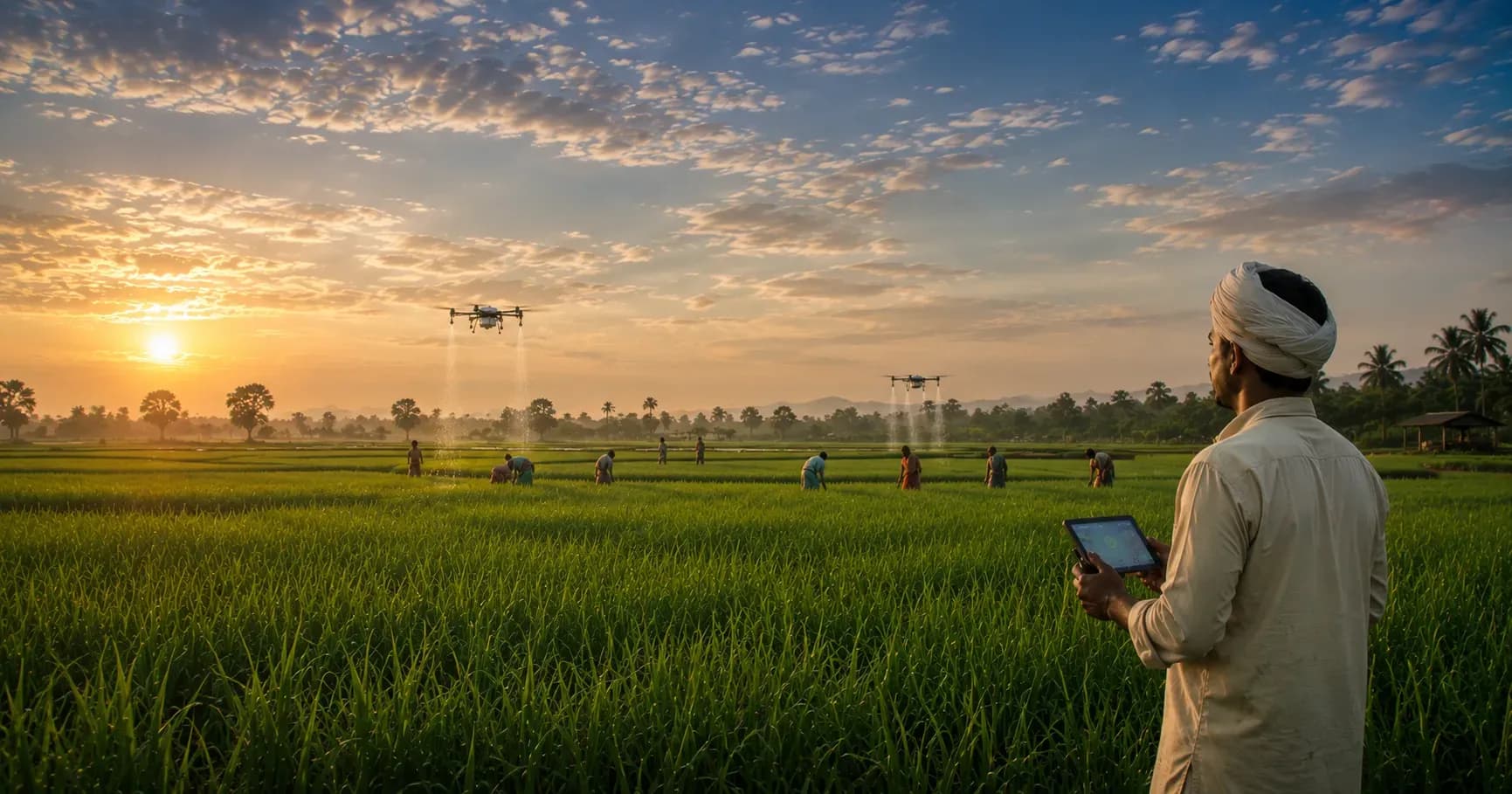
The throughput case explains the demand. An agricultural spraying drone covers one acre in approximately five minutes. A manual knapsack sprayer covers the same acre in 30 to 40 minutes with higher chemical use and direct operator exposure. Agriculture is the only Indian drone segment where Government of India subsidies and DGCA compliance move in lockstep, and that alignment is what built the segment lead.
The regulatory frame: Drone Rules 2021 and agricultural drone weight classes
Rule 5 of the Drone Rules 2021 sets the five-class weight taxonomy that every agricultural drone in India is classified under (Ministry of Civil Aviation, 25 August 2021). Two classes hold the agricultural market. The Small class covers unmanned aircraft above 2 kilograms and up to 25 kilograms maximum all-up weight, and holds scouting and light-spraying micro-platforms. The Medium class covers above 25 kilograms and up to 150 kilograms maximum all-up weight, and is the working tier for 10 to 40 litre tank sprayers.
The operational weight is where compliance fails. A medium-category sprayer typically weighs 35 to 40 kilograms empty and reaches 60 to 92 kilograms loaded MAUW during a spraying run. Regulators classify the platform on loaded operational MAUW, not on transport weight.
Platform tier | Empty weight | Loaded MAUW range | Drone Rules 2021 class |
|---|---|---|---|
10-litre spraying drone | 18 to 25 kg | 28 to 38 kg | Medium |
16 to 20-litre spraying drone | 28 to 35 kg | 48 to 60 kg | Medium |
30 to 40-litre spraying drone | 38 to 45 kg | 70 to 92 kg | Medium |
Scouting and light-imaging drone | 1.5 to 6 kg | 1.5 to 6 kg | Nano, Micro or Small |
A mismatch between declared MAUW and operational MAUW is the leading cause of voided third-party insurance after a field incident. Operators registering an agricultural drone on eGCA must declare the heaviest approved operational configuration. The full Drone Rules 2021 weight classes are explained in the Drone Categories by Weight cluster.
Type Certification and the SOP for agricultural drone spraying in India
The Standard Operating Procedure for Use of Drones in Indian Agriculture is the founding regulatory document for the segment (Ministry of Agriculture and Farmers' Welfare, December 2021). It defines operator competence, spray height, swath width, buffer distances, and pesticide-label compliance for drone-based spraying operations. The subsequent provisional approvals issued by the Central Insecticides Board and Registration Committee cover specific fertiliser and pesticide formulations for aerial application through drones.
Every agricultural drone sold in India must hold a DGCA Type Certificate. The certification framework is operationalised through the Quality Council of India under the Drone Rules 2021 (Ministry of Civil Aviation, 25 August 2021). The first DGCA Type-Certified medium-category agricultural spraying drone was approved in October 2024, anchoring an indigenous manufacturing base inside the medium class.
The operational SOP is tight. Spraying operations run under Visual Line of Sight only. Spray height typically stays at 1 to 3 metres above the crop canopy. The pilot must hold a valid Remote Pilot Certificate issued through a DGCA-approved Remote Pilot Training Organisation. Pesticide-label compliance is enforced under the Insecticides Act 1968 and the CIBRC approvals. Buffer distances apply to water sources, habitation and schools, and these vary by state pesticide policy. The DGCA Type Certification framework is mapped in the Type Certification Process cluster.
Kisan Drone subsidy: how the SMAM ladder funds agricultural drones in India
The Kisan Drone subsidy is the single largest demand driver in the segment. The Ministry of Agriculture and Farmers' Welfare announced the policy on 22 January 2022 under the Sub-Mission on Agricultural Mechanisation. The SMAM operational guidelines have been refreshed since to clarify eligibility tiers (Ministry of Agriculture and Farmers' Welfare, 22 January 2022 and subsequent SMAM guideline revisions).
The subsidy ladder runs across four eligibility tiers. Farmer Producer Organisations qualify for the top of the ladder. Custom-hiring centres set up by Cooperative Societies, FPOs and Rural Entrepreneurs sit one rung lower. Reserved-category individuals, women farmers and farmers in the North-Eastern states qualify for the middle tier. Other individual farmers qualify at the base rate.
Eligibility tier | Subsidy share | Subsidy cap |
|---|---|---|
Farmer Producer Organisations (FPOs) | Up to 75 per cent | ₹7.5 lakh per drone |
SC, ST, small and marginal farmers, women farmers, North-Eastern states | Up to 50 per cent | ₹5 lakh per drone |
Custom-hiring centres by Cooperative Societies, FPOs, Rural Entrepreneurs | Up to 40 per cent | ₹4 lakh per drone |
Other individual farmers | Up to 40 per cent | ₹4 lakh per drone |
The Namo Drone Didi programme runs as a separate funding line and is restricted to women-led self-help groups. The Union Cabinet allocated ₹1,261 crore for 14,500 SHGs over financial years 2024-25 to 2025-26 (Press Information Bureau, 30 November 2023). The programme covers up to 80 per cent of drone-package cost or ₹8 lakh, whichever is lower, and is administered through the Department of Agriculture and Farmers' Welfare.
The bottleneck is disbursement. State governments administer the subsidy through Direct Benefit Transfer with a lead time of 60 to 120 days after purchase and post-installation verification. Operators planning purchases against the subsidy should size working capital for that window. The full subsidy mechanics, eligibility documents and state-wise disbursement variation will be detailed in the dedicated Kisan Drone subsidy cluster.
Drones for crop spraying: tank sizes, throughput and chemical-use reduction
Drones for crop spraying are sized by tank capacity, and tank capacity drives every downstream economic decision. The 10-litre class is the entry tier for paddy, vegetables and pulses. The 16 to 20 litre class is the working tier for wheat, cotton, sugarcane and oilseeds. The 30 to 40 litre class is the heavy tier for plantation crops and large-acreage estates.
Tank size sets swath width, battery cycle per acre, and refill-and-recharge cadence. Field throughput ranges from 25 to 40 acres per drone per day. Two-battery operations with a hot-swap protocol add 20 to 30 per cent to daily throughput, at the cost of higher pilot fatigue and tighter battery temperature management.
Chemical-use reduction versus knapsack spraying ranges from 20 to 40 per cent. The reduction is driven by droplet-size control through pressure nozzles, swath uniformity across the boom, and drift minimisation through low-altitude flight lines. The water-volume requirement also drops from 200 to 400 litres per acre under knapsack spraying to 10 to 25 litres per acre under drone spraying for CIBRC-approved formulations.
Three operational guardrails decide whether the throughput numbers hold in the field. Wind speed should stay below 4 to 5 metres per second to control drift. Spray pressure must be calibrated against the label-specified flow rate for the formulation in use. Battery swap-out discipline matters because a mid-pass interruption breaks swath geometry and forces a re-spray on the missed strip.
Precision agriculture drones in India: multispectral, thermal and NDVI workflows
Precision agriculture drones in India split into two payload families that sit alongside the spraying tier. Multispectral cameras carry red, green, blue, red-edge and near-infrared bands. They generate the Normalized Difference Vegetation Index, the chlorophyll-content proxy that field-maps crop stress, irrigation deficit and pest pressure. Thermal payloads detect canopy-temperature variation that flags water stress and disease onset days before visible symptoms appear.
The full precision-agriculture workflow runs end to end. The drone flies an RTK or PPK corrected flight line at 80 to 120 metres above ground level. The captured imagery is stitched into an orthomosaic in photogrammetry software. The orthomosaic feeds into NDVI, NDRE and thermal-anomaly map layers that mark zones of crop stress at sub-metre resolution. The zone-prescription maps then feed back into variable-rate application by the spraying drone, closing the precision-agriculture loop.
Cost compression in indigenous multispectral sensor manufacturing is projected at 30 to 50 per cent over the next 24 months. The pricing shift is anchored on the Production-Linked Incentive scheme allocation for drone components (Ministry of Civil Aviation notification, 15 September 2021). The compression matters because the multispectral payload has been the single biggest barrier to multispectral drone for crop monitoring deployments at the small-farm scale.
Agriculture drone price in India: acquisition cost, per-acre economics and breakeven
The agriculture drone price in India is the question every CHC operator asks first, and it has a clean answer. Acquisition cost for a 10-litre DGCA Type-Certified medium-category spraying drone runs from ₹6 lakh to ₹10 lakh pre-subsidy. Post-subsidy cost compresses to ₹1.5 lakh to ₹4 lakh depending on the eligibility tier under SMAM or the Namo Drone Didi programme. The 16 to 20 litre class runs ₹9 lakh to ₹14 lakh pre-subsidy. The 30 to 40 litre class runs ₹14 lakh to ₹22 lakh pre-subsidy.
The drone spraying cost per acre in India is what the farmer ultimately pays. Service rates charged by custom-hiring operators range from ₹350 to ₹600 per acre. Paddy and wheat sit at the lower end of the band. Sugarcane, cotton and orchard crops sit at the upper end. Per-acre rates also vary by state agricultural input policy, contract scale and crop calendar density.
Economic line | Range | Notes |
|---|---|---|
Acquisition cost, 10-litre Type-Certified | ₹6 lakh to ₹10 lakh | Pre-subsidy list price |
Post-subsidy effective cost (FPO tier) | ₹1.5 lakh to ₹2.5 lakh | After 75 per cent SMAM cap |
Service rate to farmer | ₹350 to ₹600 per acre | Crop-dependent |
Daily throughput | 25 to 40 acres | Single-drone, single-shift |
Annual operational acreage | 5,000 to 8,000 acres | 200-day spraying season |
Single-drone annual breakeven | 2,000 to 3,500 acres | Includes battery, insurance, pilot wages |
Single-drone breakeven sits between 2,000 and 3,500 acres annually. The number accounts for battery replacement cycles of 200 to 400 cycles and IRDAI-approved drone insurance premiums of 1.5 to 3 per cent of insured value annually. It also factors pilot wages, inter-field transport, and routine maintenance. CHC operators running disciplined route density typically clear breakeven inside the first 12 months of operation. The full insurance mechanics are detailed in the Drone Insurance cluster.
Drone in farming compliance: Rule 44 insurance and operational MAUW discipline
Rule 44 of the Drone Rules 2021 makes third-party insurance mandatory for every drone in farming operations (Ministry of Civil Aviation, 25 August 2021). The rule is non-negotiable and applies regardless of weight class once the drone is registered on eGCA. Operating an uninsured agricultural drone carries direct exposure to civil liability and a registration-suspension risk.
Spray-drift liability is the largest civil-exposure category in agricultural drone operations. Three drift-related claim heads recur. Pesticide-label compliance failure under the Insecticides Act 1968 attracts both criminal and civil exposure. Downwind buffer breach into water sources, habitation or schools attracts public-nuisance and pollution-law exposure. Chemical-trespass into adjacent farmland attracts tort claims for crop damage from the neighbouring landholder.
The leading insurance-void cause in the medium-category agri segment is operational MAUW versus declared MAUW divergence. A 38 kilogram empty-weight sprayer operating at 90 kilograms loaded MAUW must be declared and insured at the loaded figure, not the transport weight. The Insurance Regulatory and Development Authority of India has approved drone-specific liability products through multiple general insurers since 2022 (IRDAI product circulars, 2022 onward). The Rule 44 third-party drone insurance framework is mapped in detail in the Drone Insurance cluster.
Agricultural drones in India: indigenous manufacturing and the PLI tailwind
The indigenous manufacturing case for agricultural drones in India runs on the Production-Linked Incentive scheme. The Ministry of Civil Aviation notified a ₹120 crore sector-specific PLI allocation for drones and drone components on 15 September 2021. The allocation sits inside the broader ₹48,000 crore PLI envelope across 14 sectors. The policy intent is direct: build a domestic agricultural drone manufacturing base and compress import dependence on foreign multi-rotor platforms.
The market shift has been visible since 2024. The medium-category agri-drone segment now carries indigenous DGCA Type-Certified platforms alongside imported alternatives. Several state SMAM administrations now treat domestic manufacturing as a subsidy-eligibility advantage, and the procurement preference is hardening into formal policy in agricultural-machinery tenders.
The training and demonstration backbone is also indigenous. The Indian Council of Agricultural Research operates 25-plus Krishi Vigyan Kendra demonstration sites for agricultural drone training under the SMAM extension framework. The pilot pool feeding into agricultural service operations also draws from the SVAMITVA rural-mapping scheme. SVAMITVA has built a trained surveying-grade drone operator base across more than 310,000 villages by end-2024 (Press Information Bureau, ongoing scheme updates). The PLI scheme for agricultural drones, the KVK demonstration network and the SVAMITVA-trained pilot pool together form the supply-side spine that the demand-side subsidy ladder is now meeting.
What the next 24 months change for drones in agriculture in India
Four shifts will reshape drones in agriculture in India between 2026 and 2028. The first is BVLOS corridor expansion. Six of the targeted 100 corridors are currently operational under the Drone Rules 2021 framework. The phased rollout will open contract spraying across larger contiguous estates and plantation crops where Visual Line of Sight operations are throughput-limited. BVLOS agricultural drone operations India will move from pilot deployments to commercial contracts inside this window.
The second is the Civil Drone Bill. When notified, the regulatory consolidation will reframe operator classes, third-party insurance minimums, pilot certification pathways, and the operational SOPs that currently sit across multiple ministerial notifications. Operators should track the consultation drafts through the Ministry of Civil Aviation and the Bureau of Civil Aviation Security.
The third is payload cost compression. Multispectral and thermal payload costs are projected to compress 30 to 50 per cent as indigenous sensor manufacturing scales under PLI. The compression will open precision-agriculture deployments at the small-farm scale that have so far been priced out.
The fourth is platform diversification. Hydrogen and tethered long-endurance platforms are entering pilot deployments for plantation and orchard monitoring where multi-rotor endurance ceilings cap operational utility. Direct Benefit Transfer disbursement digitalisation under PM-KISAN linkage is also targeting reduction of the 60 to 120 day subsidy lag. A shorter disbursement window would meaningfully change working-capital math for new entrants.
Drones in agriculture have stopped being a demonstration story. The single largest segment of the Indian unmanned aircraft market now runs on three pillars. Subsidy mechanics reach FPOs, women-led self-help groups and rural entrepreneurs. A Type Certification framework has produced its first indigenous medium-category platform. And the field economics breaks even inside 12 months for a disciplined custom-hiring operator. The operators who treat agricultural drones as a regulated aviation operation, not a farm implement, will be the ones who scale across the next 24 months.