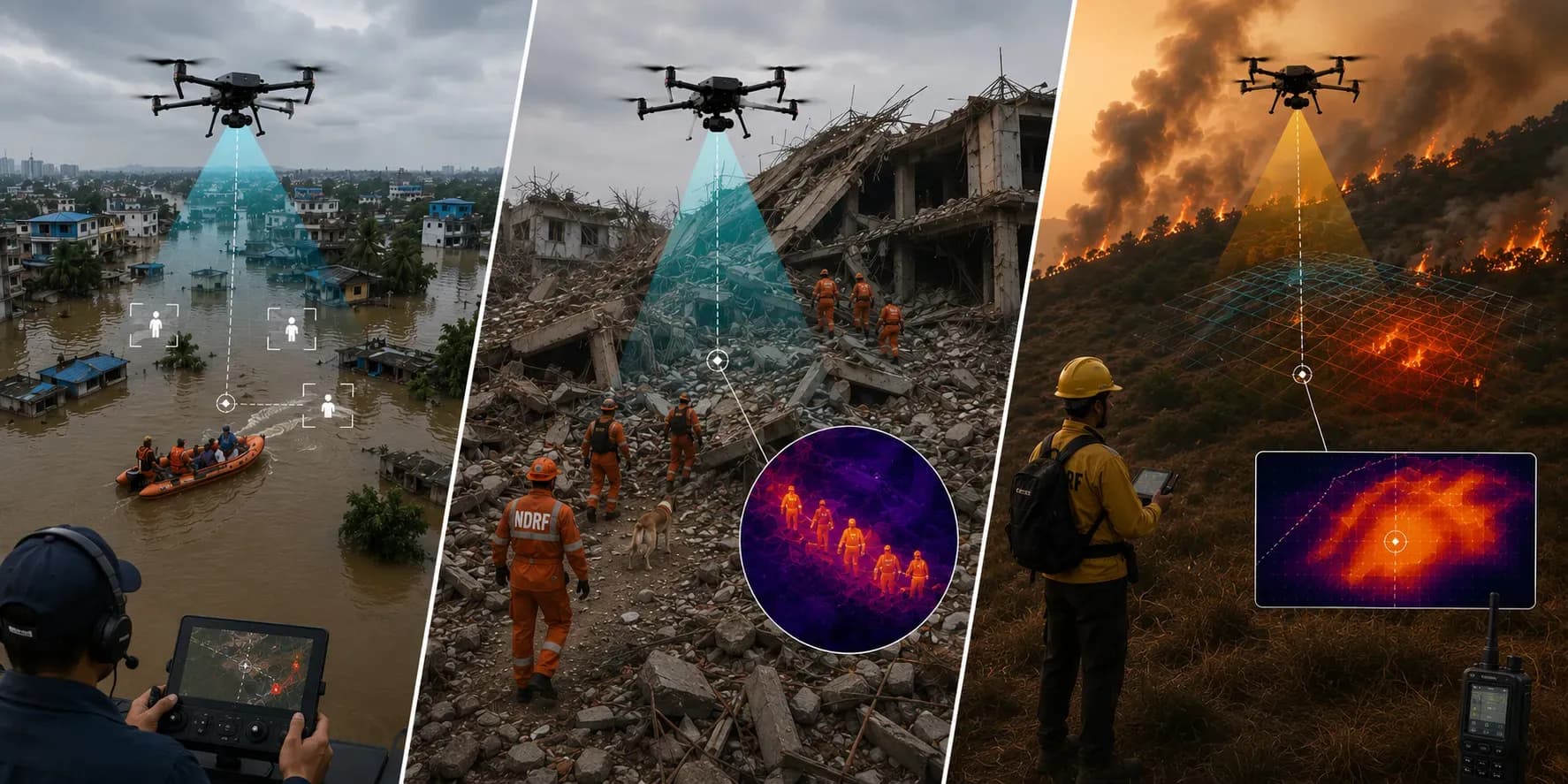
Drones in construction now operate inside a three-layer framework that procurement teams cannot avoid. The mandate layer is anchored by the NHAI monthly drone-survey rule (Press Information Bureau, 16 June 2021) and the SVAMITVA scheme under the Ministry of Panchayati Raj. The platform layer is DGCA compliance under the Drone Rules, 2021, and the evidentiary layer is the artefact accepted by the contracting authority. An AI-assisted analytics layer now sits on top of all three, turning aerial captures into searchable, anomaly-flagged, time-series evidence.
Defining drone inspection in India's construction stack
Drones in construction now sit inside a statutory infrastructure workflow rather than a standalone surveying activity. Construction firms use unmanned aircraft systems to generate inspection footage, volumetric analysis, terrain models, corridor mapping, and progress documentation. The asset classes covered include highways, bridges, rail corridors, transmission assets, and rural land records. The shift matters because central agencies now require drone-captured evidence at multiple stages of project execution (Ministry of Civil Aviation, 25 August 2021).
How drones are used in construction in India depends on the asset class and the reporting authority. Highway contractors use drone survey construction site workflows to capture monthly progress evidence for upload into the National Highways Authority of India Data Lake. Rural land-record teams use orthomosaic mapping and geo-referenced imagery to generate property cards under the SVAMITVA scheme. Power utilities use thermal and visual inspection payloads to identify conductor sag, vegetation encroachment, and tower integrity anomalies during corridor inspections (Survey of India, 24 April 2020).
The operational distinction between drone inspection and conventional surveying is now contractual. Traditional surveys generated reports for internal engineering teams. Drone inspection in India generates evidentiary records tied to arbitration exposure, milestone certification, billing validation, and state audit pipelines. That difference changes procurement language, data-retention requirements, and platform selection criteria.
The technology stack has also changed. Inspection workflows pair high-resolution electro-optical payloads with computer vision models that classify cracks, material displacement, slope instability, and heat signatures directly at the edge. Infrastructure inspection drones now operate as sensor platforms connected to cloud-based project-monitoring systems rather than isolated aircraft performing manual capture tasks.
Mapping the NHAI monthly drone survey mandate
The NHAI drone survey mandate transformed drones from optional construction tools into compulsory monitoring infrastructure across the national highway ecosystem. The National Highways Authority of India directed contractors and concessionaires to conduct monthly drone surveys at every stage of highway development (Press Information Bureau, 16 June 2021).
The rule applies across greenfield corridors, brownfield expansion projects, and operational highway assets. Contractors must generate comparative visual evidence showing earthwork progress, pavement status, structure completion, traffic diversions, and utility relocation stages. The drone monthly survey highway India workflow feeds directly into NHAI's Data Lake portal. Supervising consultants and authority engineers then review project execution against milestone schedules (Press Information Bureau, 16 June 2021).
Layer | Requirement | Output artefact | Issuing authority |
|---|---|---|---|
Project monitoring | Monthly drone survey | Comparative progress footage | NHAI |
Corridor documentation | Geo-tagged imagery | Site audit record | MoRTH |
Dispute review | Historical aerial evidence | Arbitration support file | NHAI |
Milestone verification | Time-series mapping | Contractor compliance evidence | Authority engineer |
The mandate altered commercial exposure inside EPC and HAM contracts. A contractor that fails to maintain auditable drone evidence can face disputes around delay attribution, payment certification, and variation claims. Drone survey NHAI Data Lake uploads now operate as evidentiary infrastructure rather than marketing collateral.
The Ministry of Road Transport and Highways also aligned drone capture with the Network Survey Vehicle framework used for road-condition assessment and asset documentation. That pairing matters because aerial inspection data complements ground-based pavement and corridor analytics inside unified monitoring systems (Ministry of Road Transport and Highways, operational protocol documentation).
The procurement effect is visible across the market. Infrastructure firms no longer procure only aircraft. They procure compliant data pipelines, retention workflows, certified pilots, and repeatable audit chains.
Tracing the SVAMITVA drone survey programme
The SVAMITVA drone survey programme established drone mapping as a state-backed land-record infrastructure layer across rural India. The Ministry of Panchayati Raj launched the programme on 24 April 2020 with Survey of India as the technology partner (Survey of India, 24 April 2020).
The programme uses drone survey rural property India workflows to generate high-resolution maps tied to property-card issuance. Survey teams capture aerial imagery over inhabited rural areas, process orthomosaic outputs, reconcile parcel boundaries with village-level verification, and issue legal property documentation through state revenue systems. The infrastructure outcome is administrative, fiscal, and legal at the same time.
The technical stack behind SVAMITVA differs from conventional commercial inspection deployments because the workflow depends on Continuously Operating Reference Station networks and geo-referenced accuracy standards. Survey-grade outputs require positional precision suitable for legal boundary creation rather than visual inspection alone (Survey of India, 24 April 2020).
The programme expanded into a nationwide operational pipeline through 2024 and 2025. Parliamentary and PIB records show continuing rollout activity across multiple states. Recent disclosures include state requests for operational clearance inside restricted airspace zones (Press Information Bureau, 2024; Rajya Sabha proceedings, August 2025).
SVAMITVA also demonstrated how AI-assisted image processing entered state mapping workflows. Computer vision models help classify structures, align imagery sets, and reduce manual reconciliation time during parcel processing. The system does not autonomously issue land records. It identifies structures and supports verification workflows handled by authorised officials.
The programme created a second-order effect for commercial operators. Survey companies that once sold standalone mapping services now compete inside state procurement frameworks tied to accuracy compliance, data governance, and archival standards.
Inspecting power lines, bridges, and linear assets
Infrastructure inspection drones operate across long-linear public assets where manual inspection creates time, safety, and access constraints. The operational model differs from construction monitoring because inspection teams prioritise anomaly detection, thermal analysis, and repeatability over visual progress tracking. The propulsion, control, and sensor stack inside an inspection drone determines what data the workflow can capture in a single sortie. Our deep-dive on how the propulsion, control, and sensor stack inside an inspection drone actually works covers the engineering layer in detail.
Drone power line inspection India workflows focus on transmission corridors, substations, tower structures, and vegetation intrusion zones. Utilities use electro-optical and thermal payloads to identify overheating joints, damaged insulators, and conductor deformation without shutting down the line. The inspection cycle produces geo-tagged maintenance evidence suitable for asset-management systems and contractor review pipelines.
Drone bridge inspection India deployments follow a similar pattern. Inspection teams capture imagery around pylons, undersides, expansion joints, cable systems, and inaccessible structural elements. Computer vision models help classify crack propagation, corrosion signatures, and concrete deterioration patterns before engineers validate findings through structural review workflows.
Railway inspection operations extend the same logic into track corridors, signalling infrastructure, embankments, and overhead electrification systems. The advantage is persistence across long distances rather than isolated spot checks. BVLOS-enabled inspection routes increase corridor coverage while reducing repeated manual deployment cycles (Directorate General of Civil Aviation, operational exemption framework).
These operations also reshape how infrastructure agencies structure maintenance evidence. Historical aerial imagery creates time-series records that support preventive maintenance and contractor accountability. A bridge inspection no longer exists only as a static engineering note. It exists as a searchable aerial record tied to dates, coordinates, and inspection metadata.
Reading Drone Rules 2021 against commercial inspection
Drone Rules 2021 commercial inspection operations sit inside a layered compliance framework. The framework covers aircraft category, pilot authorisation, airspace access, insurance, and platform registration. The Ministry of Civil Aviation notified the Drone Rules 2021 under GSR 589(E) on 25 August 2021 (Ministry of Civil Aviation, 25 August 2021). The points below name the layers that bind commercial inspection; the full stack sits inside India's drone regulatory framework.
Commercial drone inspection compliance India workflows depend first on aircraft classification. The drone categories by weight under DGCA define operational limits based on weight and use case. Construction and infrastructure inspection platforms generally operate inside the Micro and Small categories, though heavier mapping payloads can move into Medium-category compliance requirements. The Drone Amendment Rules 2022 changes to inspection permissions also reshaped Remote Pilot Certificate eligibility for operators working in this band.
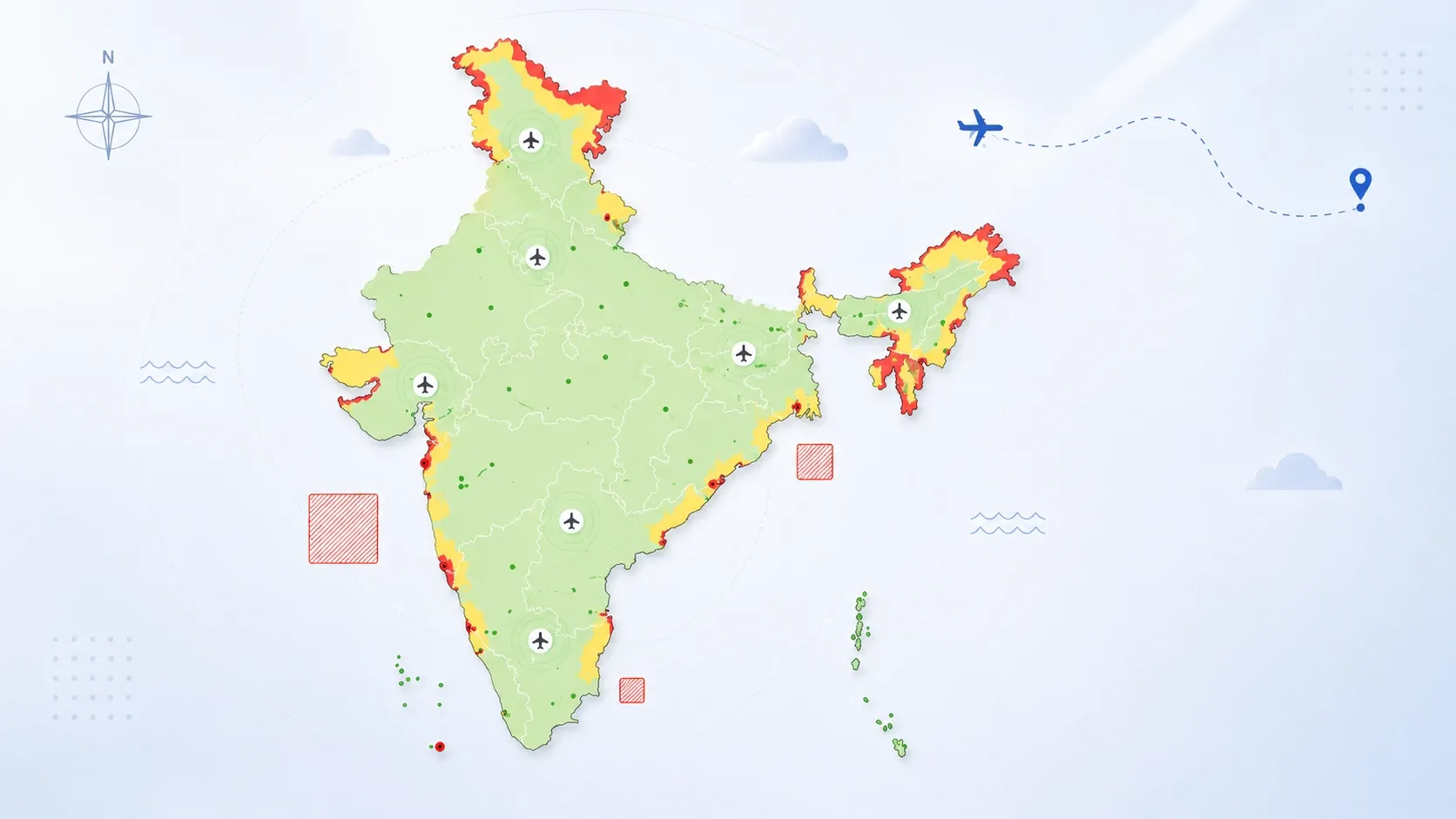
The second layer is airspace authorisation. Construction sites inside yellow zones on India's drone airspace zone map require permission workflows through DigitalSky before flight operations begin. Operators conducting DGCA drone permission construction workflows must reconcile project timelines with approval windows, local airspace restrictions, and NOTAM-linked operational conditions. The current yellow zone permissions on DigitalSky workflow runs through an automated approval flow with typical turnaround inside the same working day for routine sites.
The third layer is platform traceability. NPNT, short for No Permission No Takeoff, remains mandatory for compliant operations inside DigitalSky-authorised airspace. The July 2025 eGCA-DigitalSky platform split moved aircraft registration and licensing functions into eGCA while maintaining airspace and NPNT workflows inside DigitalSky (DGCA eGCA documentation, 3 July 2025).
Compliance layer | Operational requirement | Authority |
|---|---|---|
Aircraft category | Weight-based certification | DGCA |
Pilot authorisation | Remote pilot credentials | DGCA |
Airspace access | Zone approval workflow | DigitalSky |
Insurance | Third-party liability cover | Rule 44 |
Platform traceability | NPNT compliance | DigitalSky |
Rule 44 also requires third-party drone insurance obligations for every commercial inspection platform above the Nano threshold. That captures almost every drone deployed across construction and infrastructure work in India today.
The Bharatiya Vayuyan Adhiniyam 2024 replaced the Aircraft Act, 1934 from January 2025 onward. The change reshaped the statutory foundation for civil aviation regulation in India (Ministry of Civil Aviation, January 2025). Construction operators now sit inside a compliance environment where aviation regulation and infrastructure procurement intersect at procurement level.
Operating BVLOS corridors for long-asset inspection
BVLOS drone inspection India operations matter because linear infrastructure exceeds the practical range of visual-line inspection models. Beyond Visual Line of Sight corridors allow approved operators to inspect highways, transmission lines, coastal assets, and remote terrain without maintaining continuous visual observation of the aircraft.
The Directorate General of Civil Aviation authorised multiple BVLOS operational corridors covering mineral surveying, coastal monitoring, and logistics experimentation (Directorate General of Civil Aviation, 2024 to 2026). These exemptions established operational precedent for infrastructure inspection workflows tied to long-distance assets.
BVLOS corridor infrastructure inspection operations depend on more than aircraft endurance. Operators must integrate command-and-control redundancy, telemetry continuity, detect-and-avoid procedures, geo-fencing, and route-level risk assessment. The compliance burden grows because corridor inspections cross multiple airspace segments rather than isolated project sites.
AI-assisted route planning sits at the centre of the BVLOS workflow, adjusting flight paths around terrain constraints, restricted zones, and communication dead spots. The model is becoming the difference between a corridor that scales and one that does not. Human flight planners cannot replan in real time across multi-hour sorties at the cadence asset owners now expect.
The policy signal matters more than the present scale. DGCA's exemption history indicates a transition path toward formalised BVLOS inspection regulation for commercial infrastructure workflows.
Uploading drone evidence into the NHAI Data Lake workflow
Drone construction monitoring India workflows now terminate inside government-controlled evidence systems rather than contractor archives. The NHAI Data Lake model established the clearest example of this transition after the 2021 mandatory survey directive (Press Information Bureau, 16 June 2021).
The drone survey NHAI Data Lake workflow follows a repeatable structure. Survey teams capture geo-tagged monthly footage, process imagery against approved project coordinates, generate comparative progress outputs, and upload the resulting files into authority-linked systems for review and retention. The output becomes part of the contractual record.
That evidentiary structure changes dispute resolution dynamics. Historical aerial records support milestone verification, delay attribution analysis, land-access review, and arbitration proceedings. Aerial inspection data no longer functions only as operational visibility for engineering teams. It functions as legally reviewable infrastructure evidence.
The same logic now appears across adjacent sectors, including state urban bodies running encroachment-monitoring archives and utility operators maintaining maintenance-verification records.
The architecture also supports AI-enabled inspection analytics. Time-series imagery allows anomaly-detection systems to identify surface deformation, structural changes, and material displacement patterns across repeated survey cycles. Human operators still validate outputs, but the review workflow becomes faster and more scalable.
Reconciling procurement with the mandate-platform-evidence triad
The mandate-platform-evidence triad reframes how procurement teams should evaluate drone inspection vendors. The first layer is the government mandate that creates the operational requirement. The second layer is the DGCA compliance framework that permits lawful execution. The third layer is the evidentiary output accepted by the contracting authority.
A vendor that satisfies only one layer creates downstream exposure. A contractor may possess compliant aircraft but fail to maintain audit-grade archival workflows. Another operator may capture accurate imagery but lack lawful DigitalSky authorisation. Procurement teams must evaluate all three layers together because infrastructure agencies audit the entire operational chain.
This also changes how survey companies position their services. Drone survey construction site operations are no longer differentiated only by flight capability or image quality. Differentiation now depends on data integrity, compliance documentation, geo-referencing accuracy, and evidentiary retention standards tied to government workflows.
The contrast with legacy surveying is clear. Traditional surveys generated static deliverables at isolated milestones. Drone inspection systems generate continuous operational evidence across the life cycle of an asset. That evidence now feeds directly into government review systems, arbitration pipelines, and AI-assisted monitoring platforms.
The procurement implication is structural. Infrastructure inspection procurement resembles regulated aviation procurement rather than outsourced photography services.
Tracking the next twelve months of inspection policy
India's inspection-drone framework now points toward a fourth layer. An AI-assisted audit layer is forming on top of the mandate, platform, and evidence stack, formalised through DigitalSky-eGCA interoperability and corridor-level BVLOS approvals. The next inflection point sits around formal BVLOS inspection frameworks under the Civil Drone regulatory pipeline signalled after the Bharatiya Vayuyan Adhiniyam transition.
Procurement officers should track how ministries standardise aerial evidence retention, audit admissibility, and corridor-level BVLOS approvals across infrastructure sectors. Survey operators should track how DGCA formalises long-range inspection permissions, AI-assisted review workflows, and platform interoperability requirements between eGCA and DigitalSky.
Every major public asset project will soon carry a persistent aerial evidence layer from land acquisition through lifecycle maintenance. Procurement officers who build that layer into their tender language now will avoid the retrofit cost when ministries formalise it.