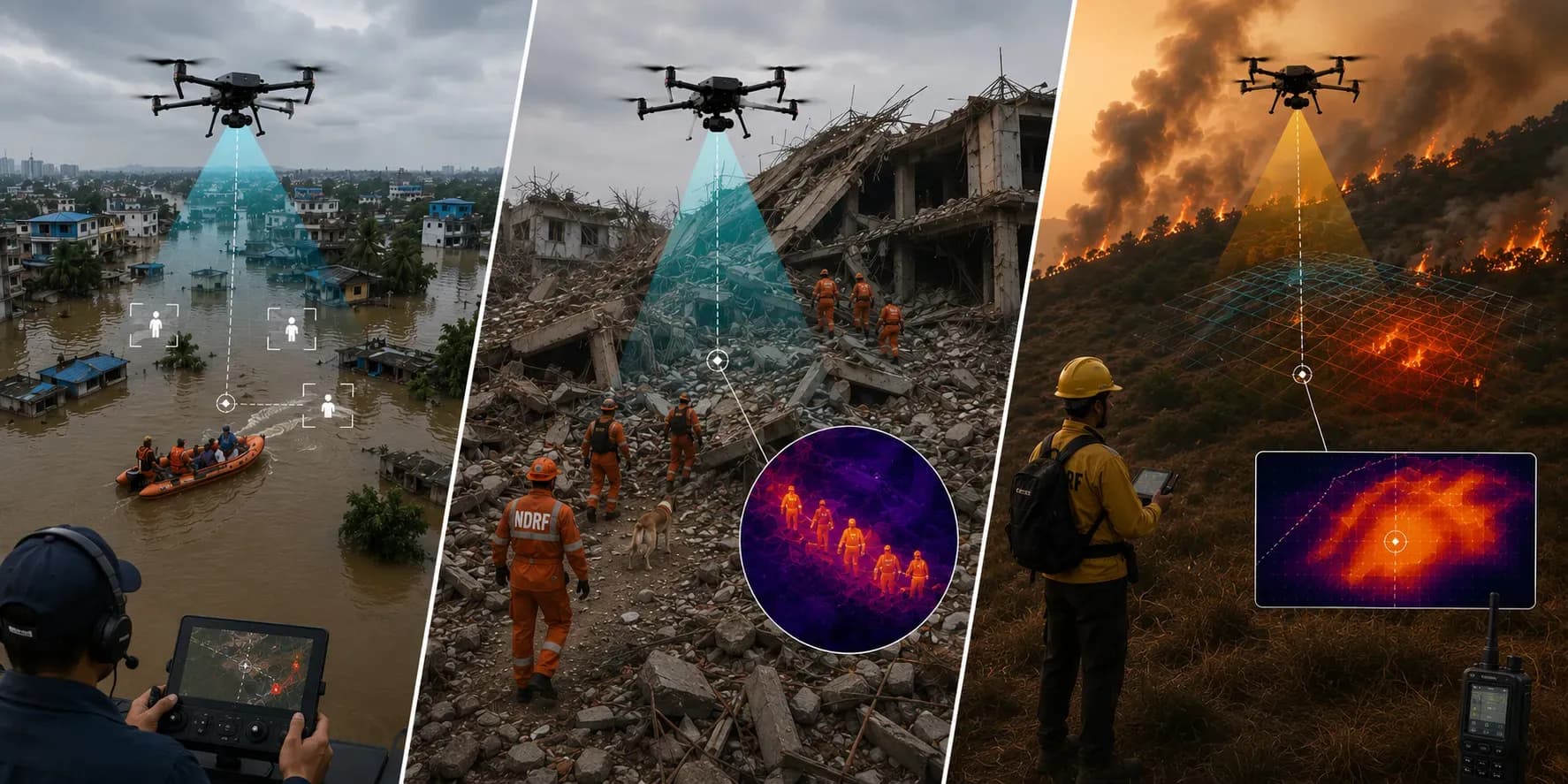
The August 2025 floods across Uttarakhand and Himachal Pradesh changed the picture for drones in disaster management in India. NDRF rescued more than 3,700 people in 48 hours across Kangra and Chamba (Akashvani News, 28 August 2025). SDRF cargo drones delivered medicines and ration into Mandi's Janjehli valley after roads were lost. The agency-platform-statute triad below maps the response chain, anchored to the TEC study paper on disaster-drone use cases (Telecommunications Engineering Centre, 1 April 2024).
Defining the disaster taxonomy India actually plans for
Drones in disaster management operate against a hazard map defined by the National Disaster Management Authority and the Disaster Management Act 2005. The NDMA records 58% of India's landmass as prone to earthquakes of moderate to high intensity. Over 5,700 kilometres of coastline remain cyclone- and tsunami-prone (National Disaster Management Authority, accessed 23 May 2026).
The TEC study paper divides drone operations into flood response, landslide mapping, wildfire monitoring, earthquake search and rescue, and logistics support (Telecommunications Engineering Centre, 1 April 2024). Each category drives a different drone architecture. Flood rescue needs endurance, payload, and route planning over disrupted terrain.
Earthquake response needs thermal payloads, computer vision, and edge inference for debris analysis. Wildfire operations depend on satellite-linked thermal mapping and perimeter tracking. The Indian response chain itself differs from a purely civil drone model.
The Disaster Management Act 2005 set the institutional response hierarchy (Ministry of Home Affairs, 23 December 2005). It established NDMA, State Disaster Management Authorities, District Disaster Management Authorities, and the National Disaster Response Force as a layered structure under MHA. Army Aviation enters when terrain isolation or payload requirements exceed civilian lift capacity.
The result is not one drone ecosystem. It is three parallel operating environments sharing the same emergency space. NDRF and SDRF units handle tactical reconnaissance and last-mile delivery.
The Forest Survey of India runs satellite-fed forest-fire detection. Army Aviation provides heavy lift into cut-off sectors. The drone disaster management policy India operates today reflects this triad. Disaster relief flights under the wider Drone Rules 2021 stack operators answer to follow a different exemption path. They run on terms set apart from military aviation or satellite-fed wildfire operations (Ministry of Civil Aviation, 25 August 2021).
Surveying floods, the frequent operational test for ISR drones
Floods are the dominant operational test for drones for flood rescue in India. The August 2025 Dharali-Harsil cloudburst response in Uttarakhand showed how ISR drones, cargo drones, helicopters, and ground rescue teams now operate together inside a single disaster theatre.
Akashvani News reported the 7 August 2025 deployment after the cloudburst (Akashvani News, 7 August 2025). A total of 518 personnel from the Indian Army, NDRF, SDRF, ITBP, and civil administration moved into the Bhagirathi valley. Helicopters inserted rescue teams into Dharali. Drone sorties mapped damaged terrain and identified isolated civilian clusters.
Drone search and rescue Uttarakhand operations depend on terrain mapping and thermal overlays. Survey drones generate orthomosaic maps that SDRF command teams route through mission-planning software. Computer-vision workflows classify road washouts, blocked bridges, and temporary landing zones. That compresses the time between aerial survey and ground movement.
The Indian Army drone flood relief operations later that month expanded the logistics role of unmanned systems. SDRF cargo drones delivered medicines, drinking water, and ration into Janjehli valley after landslides cut road access (Akashvani News, 28 August 2025). Cargo operations differ from reconnaissance sorties.
They require route stability, payload balancing, and conditional Beyond Visual Line of Sight clearance under the DGCA framework. That clearance touches the airspace zone map operators read before any disaster sortie. The drone disaster relief Drone Rules 2021 pathway permits these flights through MoCA-DGCA conditional exemptions, the same mechanism that earlier cleared ICMR's BVLOS vaccine corridor.
Locating survivors in earthquake debris with thermal payloads
Drones for earthquake search and rescue operate as aerial ISR systems for debris analysis, survivor detection, and route clearance. The target environment is dense rubble, unstable structures, and blocked urban corridors.
Drone thermal imaging earthquake survivors depend on infrared payloads, edge inference, and low-altitude mapping passes. The drone does not confirm survivor identity. It identifies thermal anomalies that rescue teams validate on the ground. Heat signatures inside debris fields generate false positives from machinery, fires, and exposed surfaces.
The TEC study paper identifies earthquake response as a high-value deployment category because drones reduce responder exposure inside unstable structures (Telecommunications Engineering Centre, 1 April 2024). Drone sorties map structural collapse patterns before rescue personnel enter damaged zones. India's earthquake risk profile makes this operationally relevant, with the NDMA recording 58% of Indian landmass at moderate to severe seismic exposure.
Indian disaster agencies are moving toward integrated mission feeds. Drone telemetry, thermal overlays, and mapping data route into command dashboards used by SDRF control rooms and district administrations. That turns the drone from a standalone camera platform into a node inside a wider operational network.
Tracking wildfires through the Forest Survey alert system
Forest fire detection drones operate inside a different institutional pathway than flood and earthquake systems. The Forest Survey of India manages wildfire alerts through satellite-fed monitoring rather than tactical disaster battalions.
The Forest Survey of India forest fire alert system uses MODIS and SNPP-VIIRS satellite data. The feed routes through the National Remote Sensing Centre to generate near-real-time alerts for state agencies (Forest Survey of India, accessed 23 May 2026). The system processes six satellite passes every 24 hours. Large-fire alerts then escalate to State Disaster Management Authorities, district administrations, and armed forces where required.
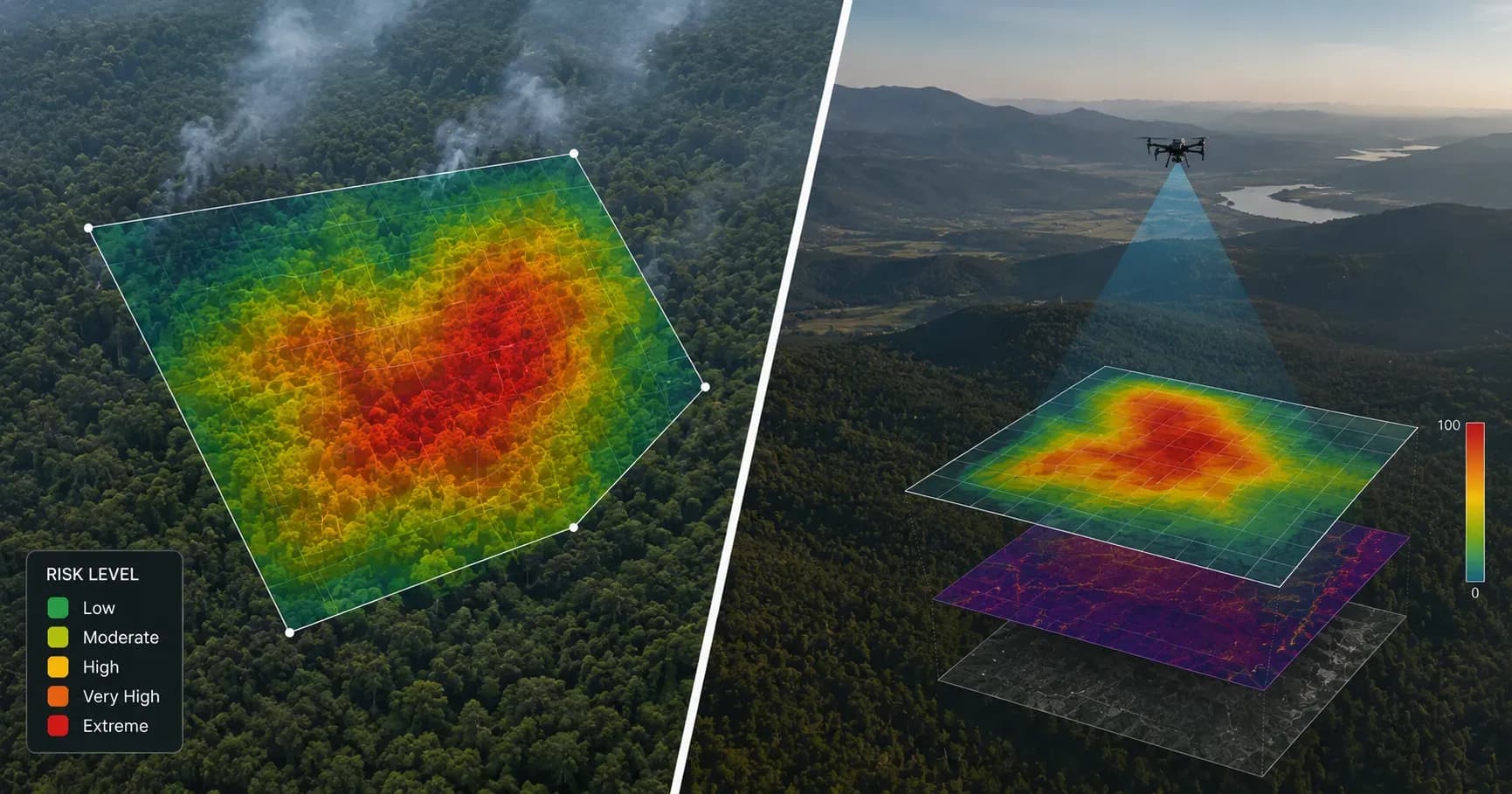
This operating model matters because wildfire drones rarely initiate the response cycle. Satellites detect thermal signatures first. Ground drone teams then validate hotspots, map perimeter spread, and assess terrain access. Wildfire drones are tactical verification systems inside a satellite-first architecture.
The India State of Forest Report 2019 estimated that around 4% of Indian forest cover is extremely fire-prone (Forest Survey of India, 2019). It also recorded 54.4% of forests as exposed to occasional fires. At that scale, manual perimeter assessment fails during peak fire conditions. Thermal drones help state forest departments classify fire intensity, identify spread corridors, and map containment lines.
AI-assisted image segmentation distinguishes active burn zones from smoke shadows and heat reflections. That reduces unnecessary deployment into low-risk sectors and keeps state forest crews focused on the perimeter that actually matters.
Operating the NDRF and SDRF drone fleet across states
NDRF drone operations sit inside a hybrid logistics and ISR framework rather than a pure aerial-survey role. The National Disaster Response Force runs 16 battalions positioned across India for rapid deployment into floods, earthquakes, cyclones, and landslides (Press Information Bureau, 2025).
The 15th Battalion at Haldwani covers Uttarakhand and western Uttar Pradesh with mountain search-and-rescue and flood-response capability (Press Information Bureau, 2025). These battalions fold drone reconnaissance into first-response deployments because damaged terrain limits conventional visibility.
The distinction between NDRF and SDRF fleets matters operationally. NDRF deployments operate under central coordination through MHA. SDRF units answer to state administrations and state procurement structures.
Drone fleet composition differs across states by funding cycle, terrain profile, and policy readiness. Platform classes vary from micro reconnaissance drones to small and medium cargo drones in the five DGCA drone categories by maximum all-up weight. The platform-class boundary matters: ISR drones carry sensors; cargo drones carry payloads; very few platforms do both well.
Himachal Pradesh cargo drone rescue missions changed the picture after the 2025 monsoon. SDRF units flew drones for medicine and ration transport after landslides blocked access into remote valleys (Akashvani News, 28 August 2025). These NDRF cargo drone delivery medicines sorties required route planning, payload management, and conditional BVLOS clearance through DGCA.
The Press Information Bureau also identified the NECTAR disaster-drone platform as part of India's emergency-response ecosystem (Press Information Bureau, PRID 2228954). NECTAR is run by the North East Centre for Technology Application and Reach. Government-backed disaster response drones India deploys today centre on sustained flight time, payload capacity, and terrain resilience. The procurement question has moved well beyond consumer-style aerial imaging the broader types of drones cover.
Reading the statutory architecture
Disaster response drones India operates today work inside overlapping aviation and disaster-management statutes. The framework combines the Disaster Management Act 2005, the Drone Rules 2021, and the Bharatiya Vayuyan Adhiniyam 2024.
The Disaster Management Act 2005 sets the institutional hierarchy through NDMA, SDMA, and DDMA (Ministry of Home Affairs, 23 December 2005). This law defines who commands emergency response operations. The Drone Rules 2021 then define how civilian drone operations are authorised, categorised, and cleared through MoCA and DGCA (Ministry of Civil Aviation, 25 August 2021). The Rules also allow conditional exemptions for humanitarian and emergency operations.
Precedent emerged through the ICMR–IIT Bombay vaccine-delivery trials in Andaman and northeastern states (Ministry of Civil Aviation, 2021). Those exemptions established a policy pathway for humanitarian cargo-drone operations beyond standard visual-line constraints. The Bharatiya Vayuyan Adhiniyam 2024 then replaced the Aircraft Act 1934 as the statutory foundation for Indian aviation governance (Ministry of Civil Aviation, 2024). All future drone regulation now anchors to a revised aviation framework rather than colonial-era legislation.
The statute layering creates operational contrasts. Flood-response drones flown by SDRF units sit inside civil aviation regulation. Army Aviation operations answer to military command structures and coordinate with the military drone fleet Army Aviation lifts alongside disaster lift.
Forest-fire monitoring combines satellite systems, civil drone operations, and state forest administration workflows. The outcome is a layered operating environment rather than a single national drone command structure.
Layering AI inside the response stack
AI sits inside every leg of the response chain after the 2025 monsoon. Each operating layer runs a different model class, with a different operating constraint, against a different ground truth.
Flood mapping uses automated terrain classification on orthomosaic outputs. Survey-drone imagery is processed by semantic segmentation models that label road washouts, blocked bridges, submerged farmland, and viable landing zones. The output is a routed map, not a raw image stack.
Edge inference on the drone or the ground station compresses the cycle from sortie to actionable map. The model never makes the rescue call; the SDRF or NDRF commander does. This is the AI assisted drone disaster mapping India pattern now spreading through state SDMAs.
Earthquake reconnaissance uses computer-vision-assisted debris assessment. Models trained on collapsed-structure imagery classify load-bearing damage patterns, identify void spaces, and flag thermal anomalies inside rubble fields. The output is a triage map for urban search-and-rescue teams. The constraint is human-in-the-loop, with no autonomous rescue decision and no platform identification of survivors.
Wildfire monitoring uses the satellite-first architecture differently. MODIS and SNPP-VIIRS feeds at the Forest Survey level are processed by detection algorithms that identify candidate large-fire pixels (Forest Survey of India, accessed 23 May 2026). Once a candidate fire is flagged, ground drone teams fly perimeter sorties. Their imagery feeds into segmentation models that separate active burn from smoke shadow and heat reflection.
The common pattern across all three is identical. AI accelerates the cycle from sensor data to operational decision without removing the human from the decision. The drone is one node in a model-assisted response network, not an autonomous responder.
That distinction sits at the centre of the next regulatory cycle. The draft Civil Drone Promotion and Regulation Bill entered public consultation during 2025 and will reshape how machine-assisted operations are permitted, audited, and scaled across states.
India's next inflection point arrives when satellite alerts, cargo drones, AI-assisted ISR workflows, and Army Aviation lift operate as one integrated network rather than parallel chains.