The Drone Rules 2021 (Ministry of Civil Aviation, 25 August 2021) sort every Indian unmanned aircraft system into three structural categories: aeroplane, rotorcraft, and hybrid. This guide uses the design-mission-compliance triad to map what fixed-wing vs rotary vs hybrid VTOL drone platforms each solve.
The 2023 award of India's first DGCA Type Certificate for a hybrid VTOL UAV opened a distinct enlistment track on the DigitalSky list. It reframed the platform-class question for every Indian survey, inspection, and BVLOS operator.
Reading the regulatory inflection now
Two regulatory events brought the platform-class decision to the front of every Indian operator's procurement file. The first was the gazette notification of the Drone Rules 2021 on 25 August 2021 (Ministry of Civil Aviation, 25 August 2021). It replaced the approval-heavy regime with a structural-category model.
The second was the eGCA migration on 3 July 2025 (DGCA Public Notice, 3 July 2025). That migration moved drone registration to a separate platform from airspace and NPNT functions.
Those two events bracket the live compliance reality. Registration runs through eGCA. Type certification, NPNT, and airspace approval run through DigitalSky.
The platform-class decision sits at the intersection of both. The Drone Rules 2021 require the structural class on every type certificate application. Operational approval enters the queue only after that declaration (Ministry of Civil Aviation, 25 August 2021).
The 2023 award of India's first hybrid VTOL type certificate marked the third inflection point (DGCA DigitalSky Platform, 2023). Before that moment, hybrid airframes sat in a regulatory grey zone between aeroplane and rotorcraft evaluation methods. After it, the DigitalSky Type Certified Drone Models list began categorising aircraft explicitly as AEROPLANE, ROTORCRAFT, or HYBRID inside the enlistment framework (DGCA DigitalSky Drone Models List).
Survey companies, defence procurement officers, and BVLOS operators now weigh the platform-class choice against three converging pressures. Aerodynamic suitability for the mission sets the first. Operational footprint at the launch and recovery site sets the second.
Certification timeline through the Quality Council of India's Certification Scheme for Unmanned Aircraft Systems sets the third. Each pressure pulls toward a different structural category.
Defining three platform classes under the Drone Rules
The Drone Rules 2021 created a formal legal structure for drone classification in India on 25 August 2021 (Ministry of Civil Aviation, 25 August 2021). Section 4(2) divides every unmanned aircraft system into three structural categories: aeroplane, rotorcraft, and hybrid. The drone classification Drone Rules 2021 framework begins with the aircraft's lift and flight method. Weight class, payload, and mission profile enter the approval process only after structural class is fixed.
An aeroplane-class UAS generates lift through fixed wings and requires forward motion for sustained flight. A rotorcraft-class UAS generates lift through rotating blades and can hover vertically. A hybrid UAS combines vertical lift capability with fixed-wing cruise flight. The Ministry of Civil Aviation embedded those definitions directly into the regulatory structure rather than treating them as engineering labels (Ministry of Civil Aviation, 25 August 2021).
DGCA structural drone categories then cascade through the compliance lifecycle. The DGCA and the DigitalSky platform evaluate type certification, NPNT integration, and enlistment records against the declared class. The Quality Council of India's Certification Scheme for Unmanned Aircraft Systems tests the three categories differently. Flight envelopes, redundancy logic, and failure modes differ between aeroplane, rotorcraft, and hybrid aircraft (QCI CSUAS Scheme Documentation).
Weight categories cross-cut the structural layer. A small hybrid VTOL platform and a small rotorcraft platform can sit inside the same weight bracket but still move through separate testing and certification pathways. That distinction shapes survey firm budgets, defence procurement timelines, and BVLOS operator readiness. Operators comparing types of drones classified by design and range work inside a framework defined first by law, then by mission design.
Understanding aeroplane-class UAS: the long-endurance role
Aeroplane UAS Drone Rules 2021 classification covers platforms built around fixed-wing aerodynamic lift. These aircraft require forward motion to remain airborne. The result is lower energy consumption during cruise and longer endurance profiles than rotorcraft systems. That endurance advantage explains why fixed-wing drone survey India deployments dominate large-area mapping, border surveillance, and medium-altitude reconnaissance work.
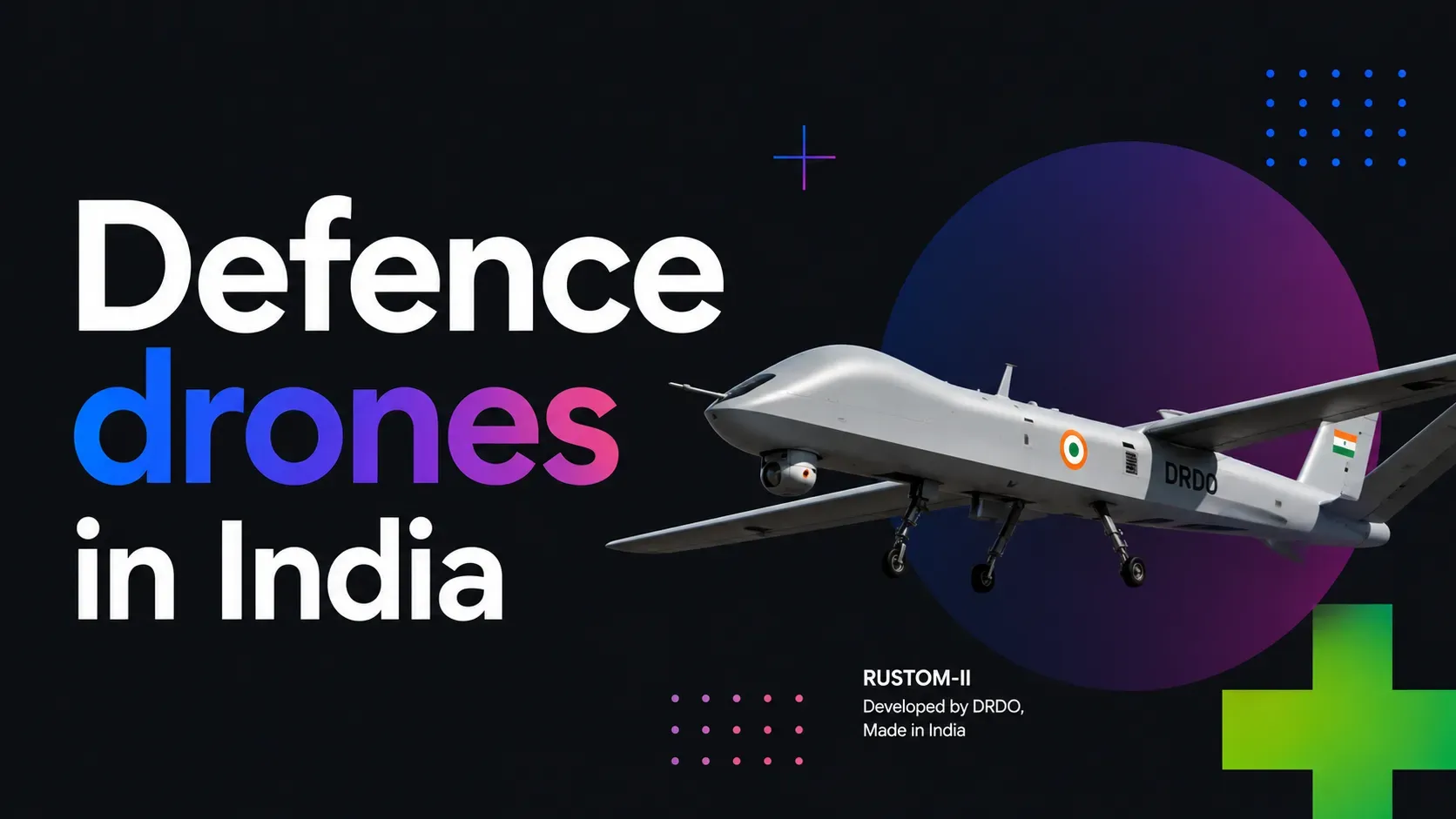
The DRDO TAPAS-BH-201 programme demonstrates the aeroplane-class logic at the medium-altitude long-endurance tier. The MALE UAV completed its maiden flight on 17 November 2016 from the Aeronautical Test Range at Chitradurga (DRDO ADE Programme Briefs, 17 November 2016). The platform was designed around long-duration surveillance rather than vertical hover capability. Fixed-wing aircraft support extended range because propulsion power primarily sustains forward thrust rather than continuous vertical lift.
For survey companies, that translates into lower battery turnover across large corridors. A fixed-wing platform can map agricultural land, transmission lines, or highway stretches with fewer launch cycles than a multi-rotor aircraft. Fixed-wing drone endurance India profiles routinely cover four to ten hours of cruise flight against the typical thirty to forty minutes of multi-rotor endurance.
The trade-off is operational footprint. Aeroplane-class UAS typically require catapult launch systems, runways, or recovery nets unless they integrate hybrid VTOL capability. Field teams operating in dense urban environments or confined industrial sites therefore face deployment constraints. Inspection work around towers, refineries, or substations also suffers because fixed-wing aircraft cannot maintain stationary hover.
The DGCA structural drone categories framework pushes fixed-wing platforms toward missions where distance, persistence, and area coverage outweigh hover precision. Operators weighing drone categories in India by weight alongside structural classification treat aeroplane-class systems as endurance assets rather than close-range inspection tools.
Operating rotorcraft-class UAS: where multi-rotor platforms win
Rotorcraft UAS India deployments dominate inspection, photography, industrial monitoring, and tactical short-range operations. Rotor-driven lift allows precise hovering and vertical manoeuvring. Multi-rotor platforms launch from confined spaces, maintain stable position around structures, and operate without runway infrastructure. Those characteristics explain why rotorcraft systems became the first large-scale commercial drone category deployed under the Drone Rules 2021 framework (Ministry of Civil Aviation, 25 August 2021).
The operational advantage shows cleanly in inspection environments. A rotorcraft platform can hold position near a transmission tower, wind turbine, or bridge surface while carrying optical or thermal payloads. Multi-rotor drone applications therefore default to inspection-led commercial deployments across power, oil and gas, and infrastructure verticals.
Survey firms performing asset inspection prioritise hover precision over endurance. The same logic applies to public-safety and infrastructure monitoring inside urban airspace corridors. Rotorcraft systems also dominate training pipelines because pilots transition faster into hover-based flight control than fixed-wing flight management.
The limitation is energy efficiency. Rotorcraft aircraft consume continuous power to sustain vertical lift, which reduces endurance compared with aeroplane-class systems. Multi-rotor drone payload limit calculations therefore become more restrictive as payload weight rises. Additional payload mass directly reduces flight duration because propulsion systems must maintain constant lift.
That trade-off shapes procurement decisions across industrial inspection and tactical-response operations. A rotorcraft platform delivers higher positional control but lower operational radius. Fixed-wing aircraft invert that equation. Hybrid systems bridge the gap.
Operators planning NPNT enforcement chain workflows must also account for rotorcraft density in low-altitude airspace. The DGCA and DigitalSky platform treat rotorcraft-heavy urban corridors with separate operational scrutiny because those operations generate concentrated short-range traffic patterns around infrastructure sites (DGCA DigitalSky Documentation).
Mapping the hybrid UAS class for VTOL cruise
Hybrid UAS India classification covers aircraft that combine vertical takeoff capability with fixed-wing cruise flight. Under the Drone Rules 2021, hybrid platforms form a distinct structural category (Ministry of Civil Aviation, 25 August 2021). The class merges rotorcraft launch characteristics with aeroplane endurance profiles. That classification now sits at the centre of India's BVLOS delivery and long-range survey conversation.
A hybrid VTOL platform lifts vertically using rotors, transitions into forward cruise flight, then returns to vertical landing during recovery. That architecture removes runway dependence while preserving aerodynamic cruise efficiency. The result is a platform class suited to long-range operations from confined deployment areas.
India's first DGCA hybrid VTOL type certificate award in 2023 marked a regulatory inflection point (DGCA DigitalSky Platform, 2023). It validated hybrid VTOL certification pathways inside the Indian compliance stack. Before that moment, hybrid aircraft sat in a regulatory grey area between rotorcraft and fixed-wing evaluation methods. The hybrid drone DGCA type certificate route now follows a documented test schedule.
Hybrid VTOL drone India procurement interest accelerated across both commercial and defence verticals. Hybrid VTOL UAV Indian Army deployments support dispersed launch operations without sacrificing operational reach. Defence units operate the class from short clearings, elevated terrain, or mobile logistics points without dedicated runway infrastructure. The same operational logic applies to remote medical delivery and corridor inspection work in civilian operations.
The engineering challenge is complexity. Hybrid aircraft introduce transition control systems, redundant propulsion logic, and aerodynamic balancing requirements that pure rotorcraft and pure fixed-wing aircraft do not carry independently. Certification pathways therefore involve deeper testing around transition reliability, failure recovery, and control redundancy (QCI CSUAS Scheme Documentation). Operators managing hybrid fleets require personnel trained across both hover and cruise flight envelopes.
Tracing the type certification pathway by airframe
Drone type certification structural class routing sits among the highest-priority operational decisions for Indian operators. Under the QCI Certification Scheme for Unmanned Aircraft Systems, structural class drives flight testing requirements, safety validation, and DigitalSky enlistment workflows (QCI CSUAS Scheme Documentation).
The pathway forks by airframe inside the same scheme.
Structural class | Lift mechanism | Testing emphasis | Enlistment category |
|---|---|---|---|
Aeroplane | Fixed wings, forward thrust | Aerodynamic stability, cruise endurance, recovery reliability | AEROPLANE |
Rotorcraft | Rotating blades, vertical lift | Hover stability, propulsion redundancy, low-altitude control response | ROTORCRAFT |
Hybrid | Rotors plus fixed-wing surfaces | Aeroplane and rotorcraft testing plus transition-phase validation | HYBRID |
The DigitalSky Type Certified Drone Models list reflects that distinction publicly by categorising every enlisted aircraft under one of the three labels (DGCA DigitalSky Drone Models List). The classification becomes operationally important during procurement because buyers can trace certification history against the intended mission profile.
The Bharatiya Vayuyan Adhiniyam 2024 supersedes the Aircraft Act 1934 as the parent aviation framework (Government of India Gazette Notification, 2024). It carries forward the broader regulatory authority governing unmanned aviation in India. Structural classification therefore remains embedded inside the evolving aviation stack rather than functioning as a temporary regulatory category.
Defence operators tracking military drone platforms in the Indian inventory see this distinction clearly. TAPAS-BH-201 and Archer-NG sit in the aeroplane class. Hybrid VTOL inductions into the Indian Armed Forces sit in a separate certification track with distinct test requirements.
What the structural choice signals for operators
Mission profile drives structural-class selection more than headline specifications. Survey companies comparing fixed-wing vs rotary vs hybrid VTOL drone platforms begin with launch environment, route length, payload requirements, and recovery conditions before evaluating endurance figures. The comparison becomes clearer when mapped operationally.
Mission profile | Preferred class | Operational reason | Primary limitation |
|---|---|---|---|
Large-area mapping | Aeroplane | Longer endurance and efficient cruise flight | Requires launch and recovery footprint |
Infrastructure inspection | Rotorcraft | Precise hover around assets | Lower flight duration |
BVLOS corridor delivery | Hybrid | VTOL launch with long-range cruise | Higher system complexity |
Tactical field deployment | Hybrid | No runway requirement with extended reach | Certification and maintenance burden |
Dense urban imaging | Rotorcraft | Stable low-altitude manoeuvring | Payload endurance constraints |
BVLOS drone India platform class approvals concentrate around endurance stability, telemetry continuity, and route predictability during longer missions (DGCA DigitalSky Documentation). Survey operators evaluating the Indian airspace map and zone permissions also weigh airspace density. Rotorcraft operations dominate urban inspection corridors while aeroplane and hybrid systems push into long-range green-zone and corridor missions.
The eGCA-DigitalSky split adds an administrative layer. Registration workflows moved into eGCA in July 2025 while NPNT and airspace authorisation functions stayed on DigitalSky (DGCA Public Notice, 3 July 2025). Operators therefore manage platform-class decisions alongside dual-platform compliance management.
The structural class signals intended operational use to regulators, insurers, and procurement teams. Hybrid systems indicate BVLOS ambition. Rotorcraft systems indicate close-range operational density. Aeroplane systems indicate endurance-first mission planning.
The next certification cycle in India will concentrate around hybrid VTOL aircraft. Regulators, procurement agencies, and commercial operators are all converging on missions that require vertical deployment flexibility and fixed-wing operational reach in the same airframe.