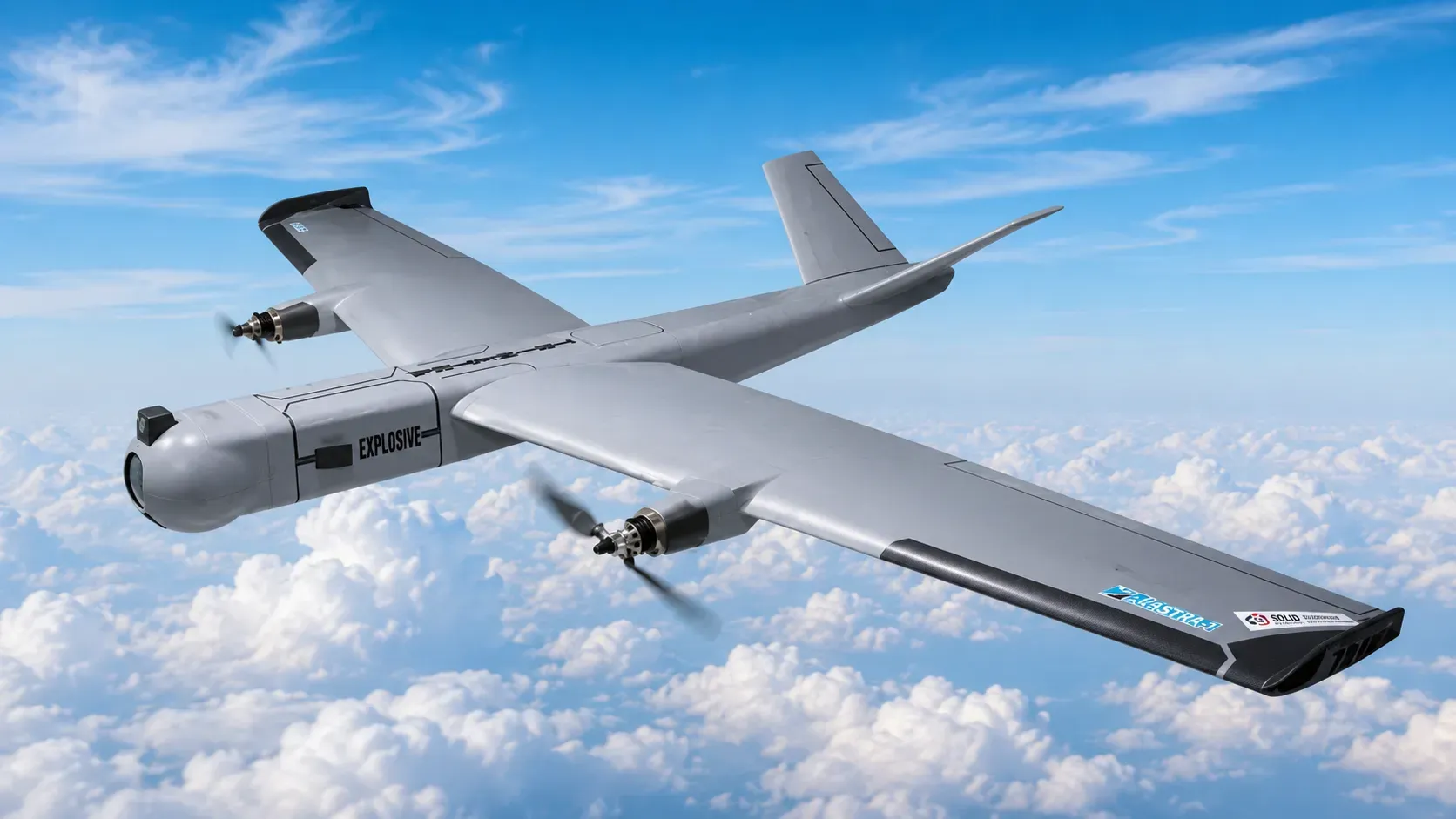
MALE, HALE, and HAPS drones are no longer three separate procurement conversations inside the Indian Armed Forces. Each tier is now anchored to a specific unmanned aerial vehicle class, a specific mission profile, and a specific procurement pathway. On 12 February 2026, the Defence Acquisition Council accorded Acceptance of Necessity for an Air-Ship Based High Altitude Pseudo Satellite programme. The estimated value is Rs 15,000 crore (Ministry of Defence, 12 February 2026).
It is the third tier-specific approval in eighteen months. This article maps each altitude band to its mission class and traces the procurement architecture that ties the three tiers together.
Defining the three-tier long-endurance ladder
The MALE-HALE-HAPS framework separates long-endurance unmanned aerial vehicle systems by altitude band, endurance profile, and mission persistence rather than by aircraft size alone. A medium altitude long endurance UAV, in searched form the MALE UAV or MALE drone, operates between 25,000 and 35,000 feet. It supports tactical ISR, maritime monitoring, and precision targeting roles as the tactical layer of India's military drone architecture.
The HALE drone class, or HALE UAV, operates above 40,000 feet for strategic ISR and long range drone strike coordination. HAPS platforms operate above 60,000 feet in the stratosphere and function as a fixed wing UAV built for solar endurance rather than for cruise. They remain airborne for days or weeks using solar-electric propulsion and ultra-light airframes (International Telecommunication Union, ITU-R F.1500 series).
The distinction matters because propulsion, certification, and procurement pathways change at each altitude tier. A medium altitude long endurance UAV depends on turbocharged piston engines or turboprops. It operates within conventional military airworthiness frameworks.
A high altitude long endurance drone requires higher fuel efficiency, larger wingspans, and beyond-line-of-sight mission persistence above forty thousand feet. A high altitude pseudo satellite enters a stratospheric regime where payload weight, solar charging efficiency, and atmospheric stability define mission viability.
India's defence establishment now funds all three tiers in parallel. The October 2024 contract for 31 HALE-class platforms formalised India's strategic ISR layer under the Foreign Military Sales route (Ministry of Defence, 15 October 2024). The August 2025 DAC clearance for 87 MALE UAVs moved the tactical ISR layer toward domestic manufacturing.
The clearance falls under the Defence Acquisition Procedure 2020 IDDM category (Ministry of Defence, August 2025). The February 2026 AS-HAPS approval extended the ladder into the stratospheric tier.
Tier | Altitude band | Mission profile | Propulsion regime | Indian programme direction |
|---|---|---|---|---|
MALE | 25,000 to 35,000 feet | Tactical ISR and targeting | Turbocharged piston or turboprop | Archer-NG, TAPAS BH-201, 87-aircraft procurement |
HALE | Above 40,000 feet | Strategic ISR and maritime persistence | Turboprop or jet | 31-aircraft HALE acquisition |
HAPS | Above 60,000 feet | Persistent stratospheric ISR | Solar-electric | AS-HAPS and CSIR-NAL HAPS |
The broader architecture connects with the wider conversation on military drones in the Indian Armed Forces. It informs the engineering distinctions across types of drones that define how endurance, payload, and persistence scale together along the long-endurance ladder.
Sizing the medium-tier MALE envelope
The MALE category forms the backbone of India's tactical ISR expansion and the largest single segment of the Indian Army drone pipeline. The MALE drone envelope balances endurance, payload capacity, and operating cost within conventional military aviation infrastructure, and it is the tier where indigenous military drone production is closest to operational scale.
A medium altitude long endurance UAV typically remains airborne for 18 to 30 hours on a single sortie. It carries electro-optical, infrared, synthetic aperture radar, and communication relay payloads inside the same mission window.
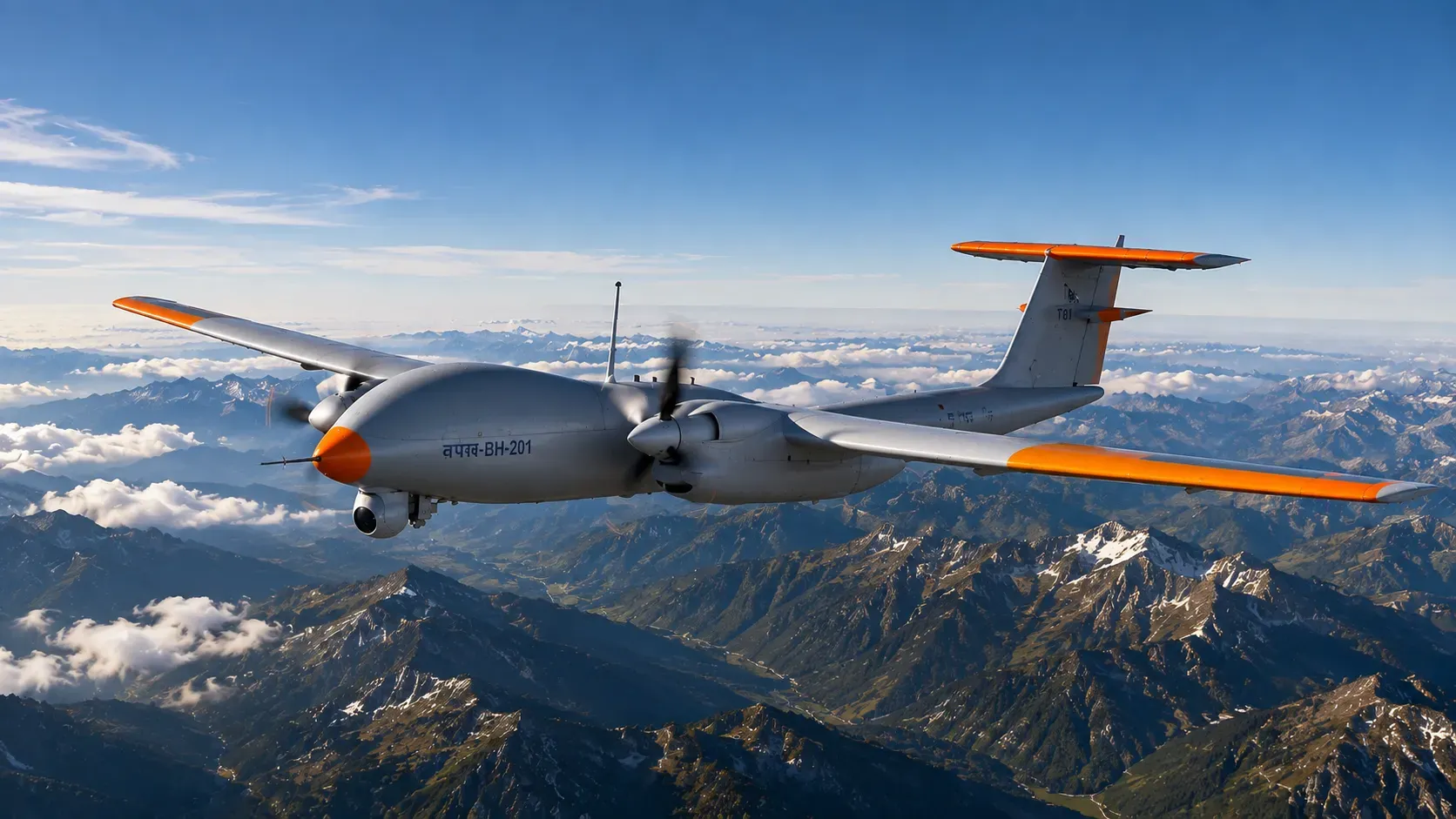
The DRDO long endurance UAV programme reflects this operational logic across two flagship platforms. TAPAS BH-201 was developed by the Aeronautical Development Establishment. It has logged more than 200 test flights. The platform demonstrates an endurance window near 18 hours and a service ceiling close to 28,000 feet (Parliamentary Standing Committee on Defence briefing, August 2025).
The platform was originally known as Rustom-II until 2016. It was then reclassified as the Tactical Airborne Platform for Aerial Surveillance-Beyond Horizon 201.
Archer-NG entered its maiden flight phase in October 2025. The platform carries an all-up weight near 1,800 kilograms and an endurance window of 24 to 29 hours. It operates with a service ceiling close to 30,000 feet (DRDO, October 2025).
The Archer-NG MALE UAV uses a 177-horsepower indigenous turbocharged engine and a single-engine twin-boom configuration. It carries four external hardpoints rated for a payload of up to 300 kilograms.
The TAPAS BH-201 MALE UAV is now in flight evaluation with an indigenous 180-horsepower engine. The engine was developed by the Vehicle Research and Development Establishment with an Indian automotive partner (DRDO ADE submission to SCoD, August 2025). The transition from imported to domestic propulsion raises the platform's indigenous content close to 80%.
These platforms also reflect India's push toward indigenous propulsion and sensor integration. Electro-optical payloads, SATCOM links, and synthetic aperture radar modules remain essential because the MALE tier depends on persistent surveillance. The engineering focus sits on fuel efficiency, redundant flight controls, and payload integration.
Tracking India's MALE platform stack
The Indian MALE programme set now spans two parallel tracks. The first is the DRDO long endurance UAV programme that produced TAPAS BH-201 and Archer-NG as technology demonstrators and operational prototypes.
The second track is the 87 MALE UAV tender launched under the IDDM category in August 2025, the largest single MALE drone procurement in the history of the Indian Armed Forces. The tender is open to bids from Indian firms partnering with foreign original equipment manufacturers (Ministry of Defence, August 2025).
The 87-aircraft procurement is one of the largest unmanned aviation acquisitions ever planned by the Indian Armed Forces. The Defence Procurement Board has confirmed bids from more than two dozen Indian firms covering domestic designs and joint-venture proposals (Defence Procurement Board briefing, November 2025). The programme value sits between Rs 20,000 crore and Rs 32,350 crore.
The structural ambition of the 87 MALE drone tender India is to lock indigenous content above 60% across airframes, mission computers, sensor payloads, satellite communications, and propulsion units. Each platform must clear an endurance threshold beyond 30 hours and a service ceiling above 35,000 feet.
The Ministry of Defence has extended the bid submission deadline from late March 2026 to late May 2026. The extension accommodates the technical and commercial finalisation cycle (Ministry of Defence, March 2026).
The two tracks feed each other technologically. DRDO has formally transferred TAPAS-derived technologies to private participants in the tender. Platform designs inherit avionics, autonomous take-off and landing systems, and data-link architecture already validated through the technology-demonstrator cycle (DRDO Chairman briefing, May 2026).
The programme architecture also signals where the Indian MALE tier is heading. Deliveries from the 87-aircraft tender are projected between 2029 and 2030, with an expected order split near 64:36 between two domestic production lines. The dual-track production model builds redundancy at the manufacturing layer rather than at a single national champion.
Scaling the strategic-tier HALE airframe
The HALE layer sits above the MALE envelope, and the HALE drone class focuses on strategic ISR missions across maritime zones, border sectors, and long-range operational corridors. A high altitude long endurance drone, sometimes searched as HALE UAV, must remain airborne above weather systems for more than 30 hours while carrying heavy-lift drone payloads including multi-mode radar, satellite-linked communications, and signals intelligence packages.
Persistent ISR drone India requirements now point at this tier rather than the MALE layer for wide-area surveillance. The engineering envelope at HALE altitudes differs sharply from MALE platforms. Operating altitudes above 40,000 feet require turboprop or turbofan propulsion sized for sustained cruise.
Wingspan scales to support fuel volumes that enable 35 to 40 hours of endurance. Payload integration must accommodate multi-mode maritime radars, electro-optical and infrared sensors, signals intelligence packages, and synthetic aperture radar suites within a single mission profile.
The mission rationale also widens at the HALE tier, and the HALE UAV is the wide-area surveillance drone at the centre of India's persistent ISR posture. A single HALE-class aircraft can surveil the Line of Actual Control, the Arabian Sea, and the Andaman and Nicobar approaches across overlapping mission windows.
Continuous data feeds support tri-service interoperability with maritime patrol aircraft, surface combatants, and ground-based command nodes. This is the mission band where ISR begins to fold into networked command-and-control rather than tactical observation.
The Indian Armed Forces approached the HALE tier through two parallel paths. The first is rapid induction through Foreign Military Sales, locked in through the October 2024 contract signing for 31 HALE-class platforms. The second is indigenous development through DRDO and HAL programmes targeting a domestic HALE airframe with a turboprop powerplant in the 940-horsepower class.
The indigenous programme aims for a maximum take-off weight between 4,800 and 5,700 kilograms. The design targets a service ceiling near 35,000 feet and an endurance window of 24 hours. The HALE tier is therefore the layer where India's procurement architecture has split urgency from indigenisation.
Tracing the HALE acquisition path
HALE UAV procurement in India formalised on 15 October 2024, when the Ministry of Defence signed a tri-service contract for 31 HALE drone platforms under the Foreign Military Sales framework (Ministry of Defence, 15 October 2024). The contract is the largest single tri-service unmanned aerial vehicle acquisition ever concluded by the Indian Armed Forces.
The 31 HALE drone India contract distributes the aircraft across all three services. The Indian Navy receives 15 platforms. The Indian Air Force and the Indian Army each receive eight. The contract value sits near Rs 32,000 crore.
The procurement was preceded by a Defence Acquisition Council clearance dated 15 June 2023 that endorsed the Foreign Military Sales route. The Cabinet Committee on Security granted final approval in October 2024. Deliveries are projected to begin in January 2029, with the full fleet expected by September 2030.
The Indian Navy has prior operational experience with the platform class. Two HALE-class aircraft were leased in 2020 for maritime domain awareness across the Indian Ocean Region. The leased fleet has flown over 12,000 hours in operational missions according to official assessments.
The Defence Acquisition Council has continued to evaluate further lease extensions through 2028. The bridging arrangement maintains coverage until the 31-aircraft induction window opens.
The doctrinal context at the HALE tier is splitting along service-specific lines. The Indian Army's preference points at turboprop HALE platforms that can loiter inside Indian airspace for sustained border surveillance. The Indian Air Force has shown stronger interest in jet-powered, stealth-optimised HALE designs for survivability in contested airspace.
The indigenous HALE programme led by DRDO sits parallel to the FMS track. The Aeronautical Development Establishment has proposed a single turboprop-powered HALE airframe. The design under evaluation features six underwing hardpoints with a total payload capacity of 2,000 kilograms.
Two aerodynamic configurations are under domestic evaluation. The first is a Swept-Edge-Twin-Boom layout that offers lateral stability and easier sensor integration. The second is a Y-tail configuration designed to reduce radar cross-section and aerodynamic drag.
Building the stratospheric HAPS tier
The HAPS category shifts the endurance conversation from hours into weeks. A high altitude pseudo satellite operates inside the stratosphere using solar-electric propulsion, ultra-light composite structures, and persistent station-keeping rather than continuous transit flight.
The operating altitude band sits between 18 and 20 kilometres above ground level for airship designs. It sits between 60,000 and 90,000 feet for fixed-wing solar designs.
The engineering envelope changes sharply at this altitude. Solar powered HAPS India platforms must minimise payload weight while sustaining communication relays, ISR sensors, and power management systems across multi-day endurance cycles.
Atmospheric density above 60,000 feet alters both lift and propulsion behaviour. The design response is high aspect-ratio wings, lightweight solar arrays, and battery systems engineered to survive the diurnal thermal cycle inside the stratosphere.
The payload window also tightens at HAPS altitudes. A MALE platform carries 200 to 400 kilograms across its payload hardpoints. A HALE platform carries up to 2,000 kilograms across multiple hardpoints. A stratospheric HAPS platform typically operates within a 10 to 50-kilogram payload envelope.
The trade is endurance against weight. Mission duration scales from hours and days into weeks and months. Every additional kilogram subtracts from station-keeping range and sustained-altitude capability.
The operating altitude itself carries doctrinal value. HAPS systems fly above commercial air traffic, above weather, and below the orbital regime occupied by Earth-observation satellites.
A satellite in low Earth orbit overflies a target area for a minute or two on each pass. A HAPS platform can hold position over a geographic sector for weeks at a stretch. The platform behaves operationally like a satellite while retaining the recovery economics of an unmanned aircraft.
The stratospheric UAV India category therefore changes how ISR persistence is measured. MALE and HALE platforms operate through sortie cycles. HAPS systems aim for quasi-continuous coverage over defined geographic sectors.
Charting the HAPS development tracks for India
The Indian HAPS programme set entered procurement scale on 12 February 2026. The Defence Acquisition Council accorded Acceptance of Necessity for an Air-Ship Based High Altitude Pseudo Satellite programme. The estimated value is Rs 15,000 crore inside a Rs 3.60 lakh crore capital acquisition package (Ministry of Defence, 12 February 2026).
The AS-HAPS procurement is the first procurement-scale Indian Air Force entry into the stratospheric ISR layer. It will support persistent intelligence, surveillance, and reconnaissance, electronic intelligence collection, telecommunications relay, and remote sensing for military applications (Ministry of Defence release, 12 February 2026).
The platform class operates at altitudes between 18 and 20 kilometres above commercial air traffic. The procurement uses the Defence Acquisition Procedure framework with the AoN as the first formal milestone before Request for Proposal issuance.
A parallel fixed-wing HAPS development track runs through Hindustan Aeronautics Limited and a private partner. The fixed-wing solar HAPS platform is sized for endurance windows of approximately 90 days and an operating altitude above 70,000 feet. The same private partner achieved a flight endurance of 27 hours at 26,000 feet on a sub-scale HAPS prototype in May 2024.
The Indian Navy entered the HAPS category through a separate iDEX-backed contract awarded in March 2024 (Indian Navy iDEX release, 14 March 2024). The Innovations for Defence Excellence framework structures the contract under a Make-I cost-sharing arrangement. The government funds 70% of the development cycle.
The Indian Air Force has separately committed a Rs 1,000 crore Make-I project for HAPS development. The Make-I HAPS project sits parallel to the AS-HAPS AoN.
The Council of Scientific and Industrial Research – National Aerospace Laboratories runs an independent HAPS development track. A scaled HAPS prototype demonstrated 8 hours and 30 minutes of endurance at 3 kilometres altitude in February 2024 (CSIR-NAL, February 2024).
The same prototype reached 25,000 feet altitude in March 2024 while carrying a prototype synthetic aperture radar payload. The full-scale CSIR-NAL HAPS is projected to carry a wingspan of 24 to 25 metres at maturity.
Why India needs all three tiers, and how MALE, HALE, and HAPS work together
India is not building three versions of the same drone. It is building three persistence layers. MALE provides tactical flexibility, HALE expands strategic coverage, and HAPS aims for near-continuous presence over a defined sector. The engineering differences at each altitude tier are the reason no single unmanned aerial vehicle can absorb all three roles at once.
The long-endurance ladder is ultimately a trade between altitude, payload, energy, and persistence. Moving upward does not simply increase performance. It changes which capability the aircraft must sacrifice.
Tier | Strategic or tactical role | Payload envelope | Persistence trade-off |
|---|---|---|---|
MALE | Tactical ISR, targeting, and battlefield surveillance | 200 to 400 kg | Higher payload, endurance 18 to 30 hours |
HALE | Strategic and maritime ISR at heavy-lift drone scale | Up to 2,000 kg | Multi-payload capacity, endurance 30 to 40 hours |
HAPS | Persistent stratospheric ISR and communications relay | 10 to 50 kg | Endurance in weeks, minimal payload mass |
The value of the three-tier fleet is not the number of aircraft the Indian Armed Forces operate. It is the ability to combine tactical flexibility, strategic reach, and stratospheric persistence into one ISR architecture that feeds a single command-and-control network. A MALE UAV cues a HALE surveillance drone to shift orbit. The HALE fuses signals intelligence with the HAPS station-keeping window overhead. The HAPS platform then relays the composite picture through SATCOM back to the fusion node. That is the mission grid the ladder is being built to serve.
Reading the procurement architecture across the three tiers
India's long endurance UAV India roadmap now spans three procurement models operating in parallel. Each tier maps to a different combination of urgency, industrial maturity, and sovereign manufacturing ambition.
The Ministry of Defence has explicitly matched the procurement route to the indigenisation maturity of each altitude band. The architecture is not accidental.
The MALE UAV procurement India model follows Defence Acquisition Procedure 2020 IDDM pathways. The 87 MALE UAV programme approved in August 2025 targets a 64:36 production split between two domestic manufacturing lines. Deliveries are projected between 2029 and 2030 (Ministry of Defence, August 2025).
The IDDM category requires at least 50% indigenous content across air-frames, avionics, engines, sensors, and communication systems. This is the procurement layer where domestic industry is closest to operational scale.
The HALE tier uses the Foreign Military Sales route because strategic ISR requirements demanded accelerated induction. The 31-aircraft tri-service contract closed in October 2024 alongside a Performance-Based Logistics arrangement. The arrangement locates depot-level maintenance, repair, and overhaul inside India (Ministry of Defence, 15 October 2024).
The HAPS category uses a hybrid innovation model built around Make-I and iDEX structures. Stratospheric systems remain in a technology-demonstration phase globally. The Indian approach therefore combines government cost-sharing, laboratory partnerships, and limited-scale prototypes before moving toward full operational procurement.
The procurement-architecture logic also explains the timeline divergence. MALE deliveries are projected for 2029 to 2030 because the IDDM cycle accommodates technology transfer and dual-line manufacturing setup. HALE deliveries are projected for 2029 to 2030 because the FMS production cycle runs 51 months from contract signing.
HAPS procurement remains in the AoN-to-RFP phase because the platform class itself is still maturing through demonstration flights. The Defence Acquisition Council drone approvals across the three tiers show how procurement structure follows technology maturity rather than service preference.
Date | Programme | Tier | Estimated value | Procurement pathway |
|---|---|---|---|---|
15 October 2024 | 31-aircraft HALE contract | HALE | Approximately Rs 32,000 crore | Foreign Military Sales |
August 2025 | 87 MALE UAV clearance | MALE | Rs 20,000 crore to Rs 32,350 crore | DAP 2020 IDDM |
12 February 2026 | AS-HAPS AoN | HAPS | Approximately Rs 15,000 crore | Make-I and strategic procurement |
The procurement-architecture answer to why each tier carries a different route is now visible. MALE went IDDM because the industrial base is mature enough for domestic scaling. HALE went FMS because strategic ISR was urgent and indigenous HALE remained in laboratory phase. HAPS went Make-I because stratospheric systems are pre-commercial globally.
Locating the indigenisation lab chain behind every tier
The long-endurance ladder rests as much on the indigenisation lab chain as on procurement contracts. The Aeronautical Development Establishment UAV ecosystem forms the engineering centre of gravity for indigenous long-endurance programmes.
ADE leads development on TAPAS BH-201 and Archer-NG. Supporting DRDO laboratories handle propulsion, composite structures, electronic warfare payloads, and communication links across the three tiers.
The Vehicle Research and Development Establishment developed the 180-horsepower indigenous engine that now powers TAPAS BH-201 flight trials. The Combat Vehicles Research and Development Establishment developed the indigenous retractable landing gear used on the same platform.
The Centre for Military Airworthiness and Certification cleared the platform for its first flight. TAPAS BH-201 became the first R&D prototype UAV in India to clear CEMILAC and Directorate General of Aeronautical Quality Assurance certification at the prototype stage.
The HAPS tier draws on a different laboratory chain. CSIR-NAL leads the fixed-wing solar HAPS programme through its National Aerospace Laboratories campus. Hindustan Aeronautics Limited partners with a private start-up on a separate full-scale HAPS programme aimed at altitudes above 70,000 feet.
This laboratory chain operates inside a legal framework reshaped by the Bharatiya Vayuyan Adhiniyam 2024. The Adhiniyam superseded the Aircraft Act 1934 for civil aviation governance and broader airworthiness administration (Ministry of Civil Aviation Gazette Notification, December 2024). Military UAV certification continues to run through CEMILAC and DGAQA.
The testing-infrastructure layer is just as critical as the laboratory layer. The Aeronautical Test Range at Chitradurga in Karnataka serves as the central node for fixed-wing UAV trials, including TAPAS BH-201, Archer-NG, and the sub-scale HAPS prototype.
The Karwar naval base and Andaman test corridors support maritime-tier validation for Navy ISR platforms. The Pokhran range supports armed-variant testing for weaponised MALE and HALE platforms.
The Aeronautical Development Establishment UAV chain therefore connects four roles inside one architecture. Platform design originates inside ADE and its sister DRDO labs. Engine, sensor, and landing-gear modules are produced through partner DRDO laboratories.
Certification flows through CEMILAC and DGAQA. Production transfers to Bharat Electronics Limited, Hindustan Aeronautics Limited, and private partners selected through the 87 MALE drone tender, forming the industrial backbone behind India's Indian Army drone induction targets for 2029 and 2030.
Sequencing the capital calendar for the next thirty-six months
The next thirty-six months will convert the three approvals into airworthy capability. The 31-aircraft HALE contract triggers its first deliveries in January 2029, with the full fleet expected by September 2030. The 87 MALE UAV procurement is projected to move from RFP into RFQ phase by mid-2026.
The AS-HAPS programme remains in the AoN-to-RFP phase, with cost negotiation and Cabinet Committee on Security clearance still ahead. The induction calendar therefore sits behind three parallel certification cycles.
CEMILAC airworthiness clearance must be completed for every indigenous platform entering Indian service. DGAQA quality assurance signs off on production-line readiness for every domestic manufacturing partner. The Joint Services Qualitative Requirements set by the Indian Army, Indian Air Force, and Indian Navy define the operational thresholds each platform must clear.
Each tier carries a separate set of unresolved engineering milestones. TAPAS BH-201 must clear its first flight with the indigenous engine before the certification-trial cycle can complete. Archer-NG must finish its weapon-integration trials before the armed variant moves into operational evaluation.
The 31-aircraft HALE platforms must complete the FMS production cycle and the technology-transfer arrangements that locate MRO inside India. The AS-HAPS and fixed-wing HAPS platforms must move beyond demonstration flights into reproducible station-keeping at the stratospheric altitudes that define the platform tier.
The engineering agenda across the ladder is now visible. Indigenous high-altitude propulsion, lightweight composite structures, long-duration energy storage, persistent SATCOM data links, high-altitude sensor performance, airworthiness certification, reliable mass production, HAPS station-keeping, and payload-to-endurance optimisation are the nine unresolved problems that will decide whether the three-tier ladder converts from procurement approvals into operational capability inside the next thirty-six months.
The thirty-six month window is therefore not a delivery window. It is a certification, integration, and induction window. The procurement architecture has been built. The capital has been committed.
India's long-endurance fleet will begin operating as a connected ISR architecture only when its three tiers feed a unified operational picture. Tactical MALE persistence, strategic HALE coverage, and stratospheric HAPS endurance must converge on a single mission grid. The next inflection point will be the first co-deployment exercise that flies a MALE-class platform, a HALE-class platform, and a HAPS-class platform across a single mission window. That exercise will mark the moment the altitude ladder converts from a procurement framework into an operational reality for the Indian Armed Forces.