Drone cloud seeding in India cleared its first test on 1 September 2025 at Ramgarh Dam, recording 0.8 mm in 40 minutes (Rajasthan Agriculture Department, 1 September 2025). The IIT Kanpur led Delhi pilot then failed on atmospheric moisture in late October 2025 (Government of NCT of Delhi, 2025). This article maps the permission-payload-precision triad that decides which seeding cycles produce rain. It draws the compliance line operators must clear before a recurring state contract is possible.
Tracing what the Ramgarh dam pilot proved about cloud seeding
Drones for cloud seeding in India have now demonstrated that unmanned aircraft can execute an operational weather-modification mission under Indian civil aviation oversight. The Ramgarh dam operation moved the discussion beyond laboratory work. It combined a certified drone platform, atmospheric modelling, and operational flight approvals into a measurable field outcome (Rajasthan Agriculture Department, 1 September 2025).
The mission ran as part of a sixty-day weather-modification programme over the Ramgarh dam catchment near Jaipur. Operators dispersed cloud-seeding material into moisture-bearing clouds after atmospheric analysis confirmed suitable conditions. State officials reported 0.8 mm of rainfall within forty minutes. This was India's first publicly documented Ramgarh dam cloud seeding result under a government programme (Rajasthan Agriculture Department, 1 September 2025).
How does drone cloud seeding work in India? Cloud physics, not the aircraft, defines the answer. A drone carries a calibrated payload of seeding agents and releases the material only after meteorological observations confirm suitable cloud structures. The drone delivers the payload; atmospheric conditions decide whether precipitation develops.
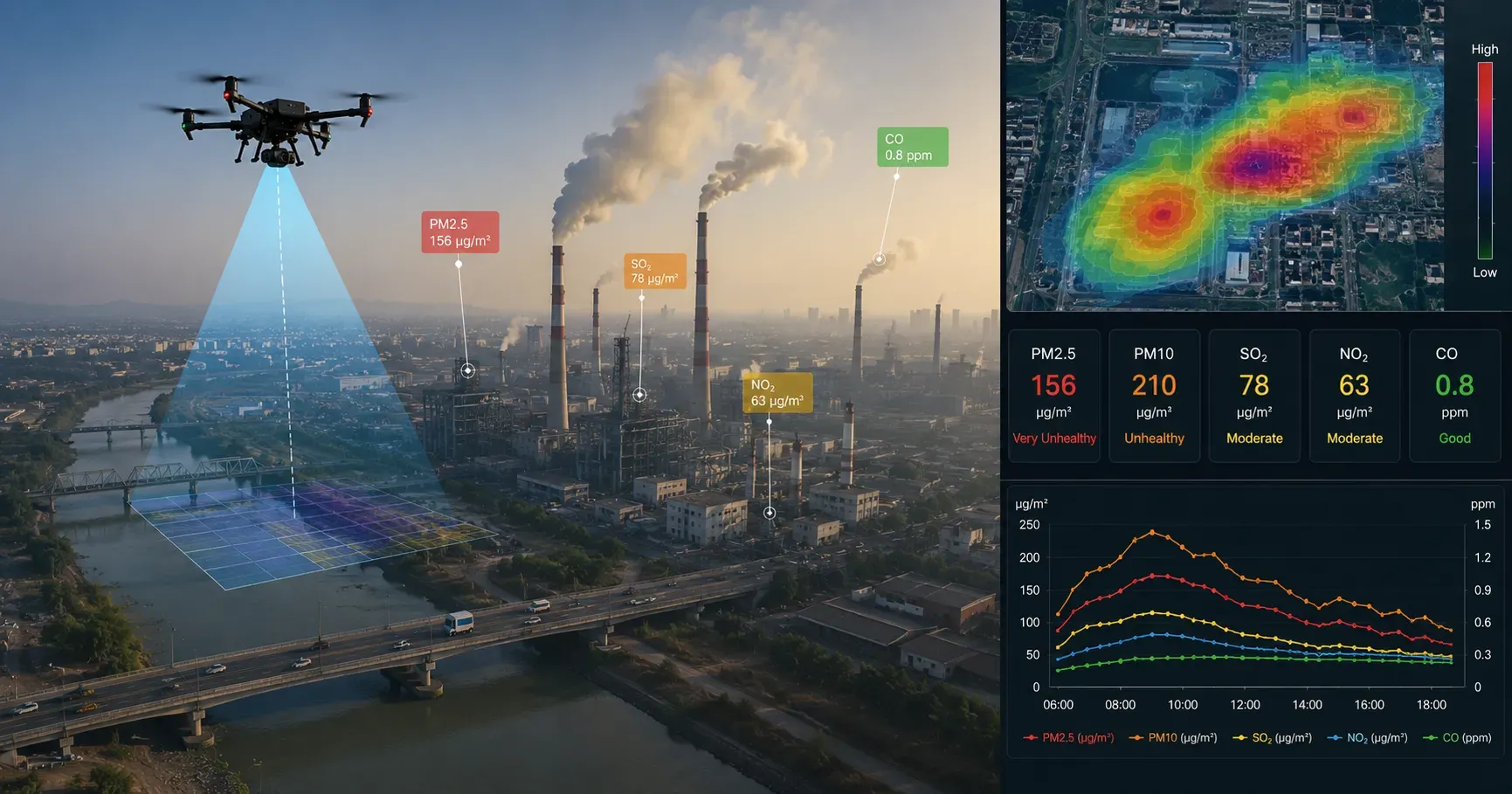
The contrast with the Delhi manned-aircraft campaign sharpens the point. The Delhi operation, mounted against a severe particulate episode of the kind aerial pollution monitoring now documents, followed approved procedures and deployed cloud-seeding equipment through a manned aircraft under scientific oversight from the Indian Institute of Technology Kanpur. Insufficient atmospheric moisture prevented rainfall despite the operation meeting every aviation requirement (Government of NCT of Delhi, 2025). The atmosphere never satisfied the scientific conditions for precipitation.
This is the operator reality the existing drone laws in India frame but do not solve. A successful cloud-seeding mission depends on three independent systems: regulatory approval, compliant payload, and favourable cloud microphysics. Failure at any one layer prevents measurable rainfall regardless of aircraft type.
Reading the DGCA aerial work permission framework for cloud seeding
The Directorate General of Civil Aviation treats cloud seeding as a specialised aerial work activity rather than a routine drone operation. Every organisation planning a DGCA cloud seeding permission must satisfy aviation safety requirements before considering meteorological or operational planning (Directorate General of Civil Aviation, accessed 28 June 2026).
This distinction is the first point cloud-seeding discussions consistently miss. Drone Rules 2021 govern unmanned aircraft operations in India, while cloud seeding introduces an additional approval layer through weather modification and controlled aerial release. Understanding who regulates drones in India clarifies why an operator cannot rely on drone registration or airspace permissions alone. The mission itself must receive approval under the DGCA's aerial work framework.
The Delhi weather-modification campaign demonstrated how DGCA approval for cloud seeding drones operates in practice. The Delhi Government secured DGCA approval before flight operations began. The mission was coordinated with the India Meteorological Department, Air Traffic Control authorities, and the participating scientific institution (Government of NCT of Delhi, 2025). The approval defined the operating window, authorised airspace, and flight conditions before any aircraft entered the mission area.
The permission framework includes operational conditions that reduce aviation risk while preserving the integrity of the scientific experiment. These conditions commonly include:
Operational area | Purpose | Responsible authority |
|---|---|---|
Approved airspace | Restricts flights to authorised locations | DGCA and Air Traffic Control |
Visual Flight Rules operations | Maintains safe separation from other aircraft | DGCA |
Air Traffic Control coordination | Integrates the mission with civil aviation traffic | Airports Authority of India and ATC |
Mission-specific operating window | Limits flights to approved dates and times | DGCA |
Meteorological coordination | Confirms suitable cloud conditions before launch | India Meteorological Department |
Cloud seeding therefore differs from agricultural surveying or infrastructure inspection. Those missions primarily assess flight safety and operational risk. Cloud seeding combines aviation regulation with atmospheric science because the mission objective depends on controlled interaction with weather systems rather than simply reaching a destination. The same logic applies to drone work in adjacent agri use cases such as drone spraying services in India, but with a far tighter weather-science overlay.
The legal foundation is also evolving. The Bharatiya Vayuyan Adhiniyam 2024 replaced the Aircraft Act 1934 as India's principal civil aviation legislation. The Adhiniyam provides the statutory framework under which future aerial work approvals will continue to develop (Ministry of Civil Aviation, 2024). State governments expanding weather-modification programmes should expect drone-specific cloud-seeding guidance rather than relying solely on approvals built for manned aircraft.
Mapping payload restrictions under the Drone Rules 2021
The Drone Rules 2021 breakdown for Indian operators establishes the legal framework for carrying payloads on unmanned aircraft in India. For cloud seeding missions, cloud seeding payload regulation is as important as flight approval. The material released into the atmosphere may also fall under India's dangerous goods regulations (Ministry of Civil Aviation, 25 August 2021).
The regulatory discussion begins with Rule 28 of the Drone Rules 2021. The rule requires compliance with the Aircraft Carriage of Dangerous Goods Rules 2003 for any drone payload classed as dangerous (Ministry of Civil Aviation, 25 August 2021). This carriage of dangerous goods drone cloud seeding requirement creates a dual compliance test. Operators must satisfy both the Drone Rules and any provisions governing the transport and release of seeding materials.
Rule 27 introduces a second operational safeguard. It prohibits drones from carrying arms, ammunition, explosives, or military stores without prior approval from the Central Government (Ministry of Civil Aviation, 25 August 2021). Cloud-seeding agents do not fall into these categories. The rule still demonstrates that India regulates payloads by composition rather than aircraft size, an approach that informs the wider classification of drone categories by weight.
This creates a compliance question for commercial operators. Common cloud-seeding compounds, including silver iodide, sodium chloride, and hygroscopic seeding mixtures, require regulatory assessment before deployment. Whether a particular material qualifies as dangerous goods depends on its chemical properties, method of carriage, packaging, and operational use. The Aircraft Carriage of Dangerous Goods Rules 2003 govern that classification (Ministry of Civil Aviation, 2003; amended 2024).
Cloud-seeding drones therefore require integration between the aircraft, payload controller, meteorological sensors, and mission-planning software. Modern mission software combines weather forecasts, radar observations, and onboard telemetry to calculate release points before take-off. Onboard computers fuse sensor data with mission parameters during flight to refine the payload release sequence. The system assists the operator by optimising precision without authorising deployment outside approved operating procedures.
For procurement agencies, payload compliance should appear alongside aircraft specifications during technical evaluation. Endurance, payload capacity, and flight stability remain important. None replaces documented compliance with the Drone Rules 2021 and the Aircraft Carriage of Dangerous Goods Rules 2003.
Benchmarking the drone outcome against the CAIPEEX manned aircraft baseline
The Indian Institute of Tropical Meteorology's Cloud Aerosol Interaction and Precipitation Enhancement Experiment, or CAIPEEX cloud seeding India, provides the strongest scientific benchmark for evaluating weather modification. CAIPEEX measured rainfall enhancement across multiple campaigns and published peer-reviewed findings through the Ministry of Earth Sciences (Indian Institute of Tropical Meteorology, November 2023).
The fourth phase of CAIPEEX ran over Solapur between 2018 and 2019. The IITM CAIPEEX cloud seeding scientific results showed an average relative rainfall enhancement of approximately 18 percent across seeded clouds covering nearly 100 square kilometres. The programme also estimated a cost of about 18 paisa per litre of additional rainfall. This sits among the few public benchmarks for the cost of drone cloud seeding India will measure future programmes against (Indian Institute of Tropical Meteorology, November 2023).
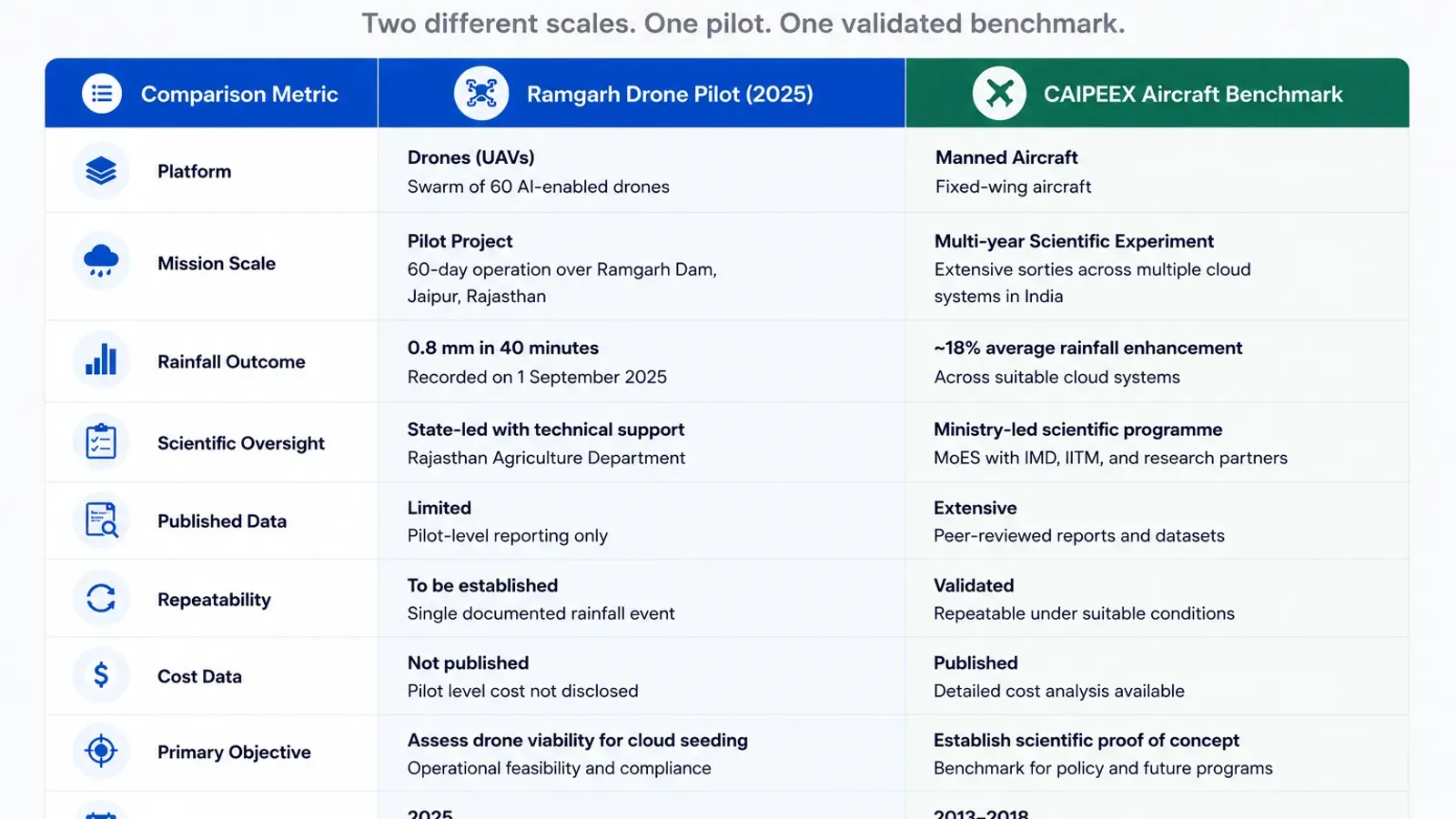
The Ramgarh drone mission should be evaluated against this baseline rather than as a replacement for manned aircraft. The Rajasthan operation showed that a drone can execute a cloud-seeding mission and produce measurable rainfall under suitable atmospheric conditions. CAIPEEX demonstrated the long-term scientific effectiveness of weather modification through repeated observation, statistical validation, and controlled atmospheric analysis.
The difference between drone and manned cloud seeding therefore lies in operational delivery rather than atmospheric science. A manned aircraft can carry larger payloads, operate over wider geographical areas, and remain airborne for longer periods. A drone offers faster deployment, lower mobilisation requirements, and access to smaller operational zones where repeated sorties may be more practical. Both platforms ultimately depend on identical cloud physics.
The current evidence also exposes a data gap. CAIPEEX published cost-per-litre estimates after multiple years of evaluation, but the Ramgarh mission has not yet released equivalent figures or long-term rainfall enhancement statistics. Future pilot projects should publish repeatability across multiple monsoon cycles, payload efficiency, mission cost, and water yield per sortie. These indicators will determine whether drone seeding scales beyond demonstration.
Operating inside the cloud microphysics precision envelope
Cloud microphysics determines whether weather modification drones India operate as scientific tools or as expensive flight tests. Aviation approvals, compliant payloads, and capable drones enable a mission. Only suitable atmospheric conditions allow seeded particles to influence precipitation (Indian Institute of Tropical Meteorology, November 2023).
This scientific layer explains why two technically successful flight operations can produce different outcomes. The Ramgarh mission released cloud-seeding material after atmospheric analysis identified suitable clouds, and rainfall was recorded shortly after payload release (Rajasthan Agriculture Department, 1 September 2025). The IIT Kanpur cloud seeding Delhi campaign was the opposite case. Approved procedures were followed, but the Delhi cloud seeding outcome IIT Kanpur documented showed insufficient atmospheric moisture prevented rainfall (Government of NCT of Delhi, 2025).
Cloud-seeding drones therefore operate inside a narrow environmental window rather than on a fixed operational schedule. Suitable clouds must contain adequate liquid water, appropriate vertical air movement, and temperatures that support the selected seeding agent. Wind speed, cloud thickness, atmospheric stability, and humidity also influence whether seeded particles can accelerate droplet formation before the cloud dissipates.
Can drones do cloud seeding in India outside this envelope? The honest operator answer is no, because AI-supported planning improves mission timing rather than changing atmospheric science. Modern cloud-seeding workflows combine satellite observations, Doppler weather radar, numerical weather prediction models, and ground-based stations to identify candidate clouds. The software assists pilots by improving precision while operational authority stays with the flight crew under approved mission procedures.
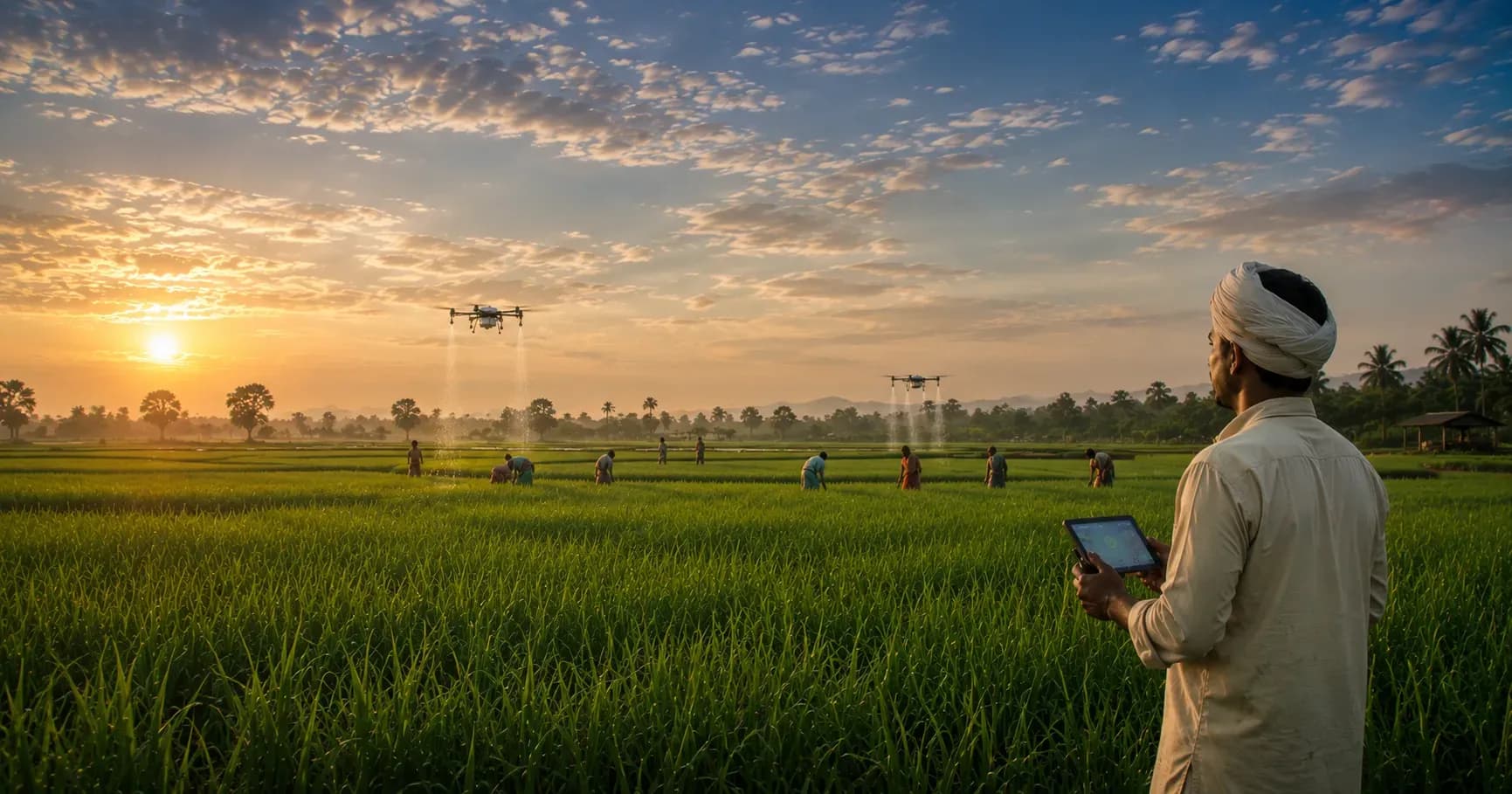
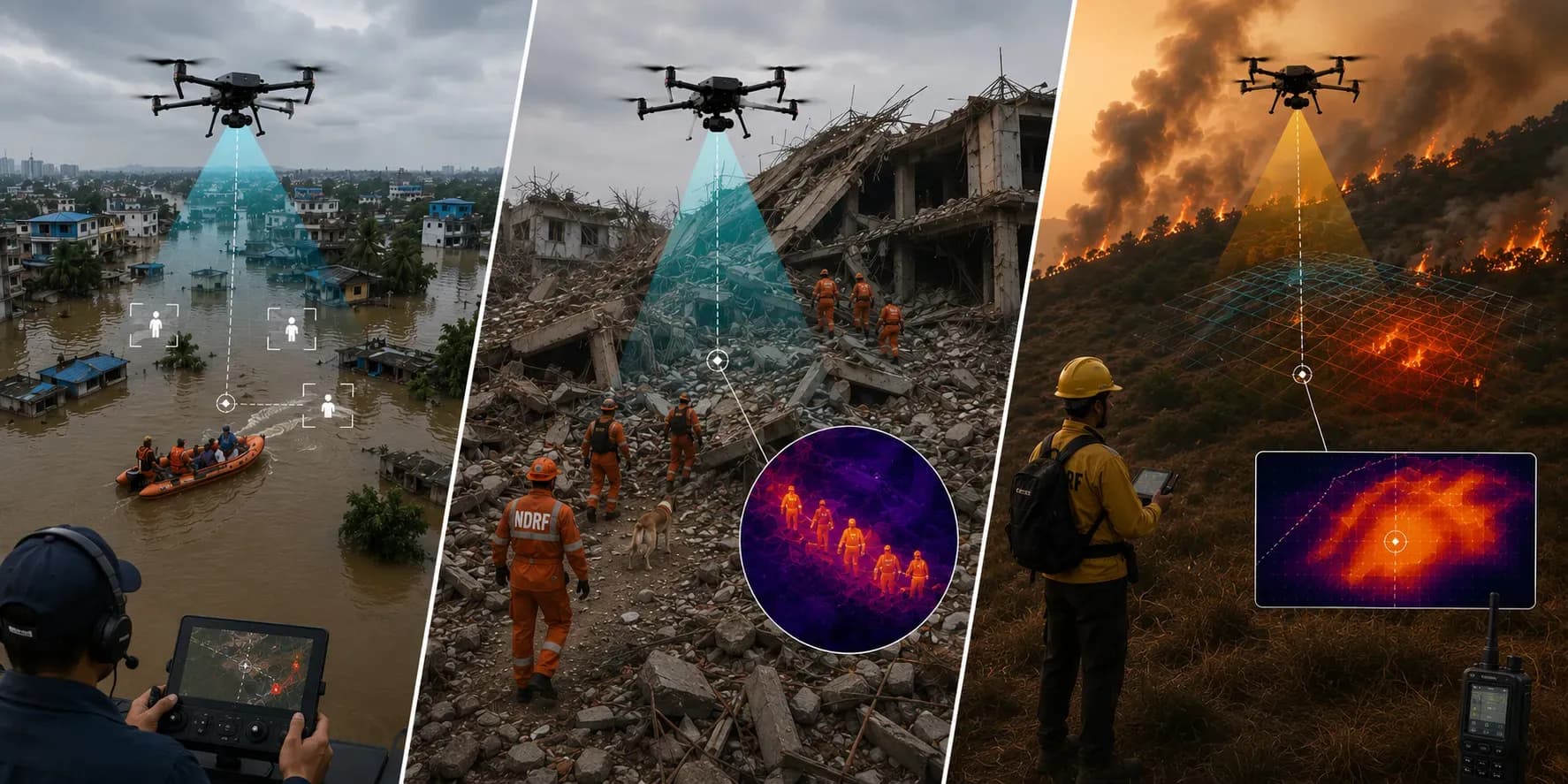
The same logic applies across adjacent civil drone work, including drones in agriculture where weather modelling drives spraying windows and forest fire detection where the same atmospheric data drives suppression planning. A cloud-seeding aircraft can complete every planned flight exactly as authorised and still produce no rainfall if the atmosphere lacks the required moisture content. Favourable cloud conditions cannot compensate for missing regulatory approvals or non-compliant payload procedures. Every successful mission needs scientific and regulatory readiness at the same time.
Building the compliant operator workflow for a cloud seeding mission
A compliant drone cloud seeding mission combines regulatory approval, scientific validation, and operational execution into a single workflow. Removing any one layer prevents the mission from progressing to measurable rainfall. The HydroTrace cloud seeding platform used at Ramgarh illustrates how AI tooling and human flight authority sit on the same workflow.
The workflow begins with mission planning. State governments or authorised agencies define the operational objective, target catchment, and weather window. Meteorological specialists evaluate forecasts, cloud models, radar imagery, and historical data to determine whether seeding is scientifically justified (Indian Institute of Tropical Meteorology, November 2023).
The second stage establishes regulatory compliance. The operator secures DGCA aerial work approval, coordinates with Air Traffic Control, and confirms the operating area. The aircraft is verified against the applicable provisions of the Drone Rules 2021. Payload documentation must demonstrate compliance with the Aircraft Carriage of Dangerous Goods Rules 2003 (Directorate General of Civil Aviation, accessed 28 June 2026).
The operational stage integrates the aircraft with the mission management system. Flight planning software combines approved airspace boundaries, weather forecasts, and terrain information to generate the sortie profile before take-off. Onboard navigation, sensor fusion, and edge inference support accurate positioning inside the flight corridor while maintaining the payload release sequence.
After payload deployment, the mission enters validation. Radar, rainfall gauges, and satellite imagery measure precipitation against pre-flight forecasts. Scientific validation remains the foundation for future procurement decisions.
The next phase will depend less on proving drones can fly and more on proving they can deliver repeatable outcomes. The Drone Rules 2021 and the Bharatiya Vayuyan Adhiniyam 2024 provide the statutory floor. Three questions remain unresolved before recurring state contracts become possible.
Regulators must clarify payload classification under the Aircraft Carriage of Dangerous Goods Rules 2003. Standardised pathways under existing drone type certification routes will help procurement agencies compare technical proposals. Transparent economic benchmarks against manned-aircraft campaigns will close the cost-per-litre gap the Ramgarh pilot left open. These three answers will decide whether artificial rain drones India deploys move from experimental demonstration into recurring public infrastructure.