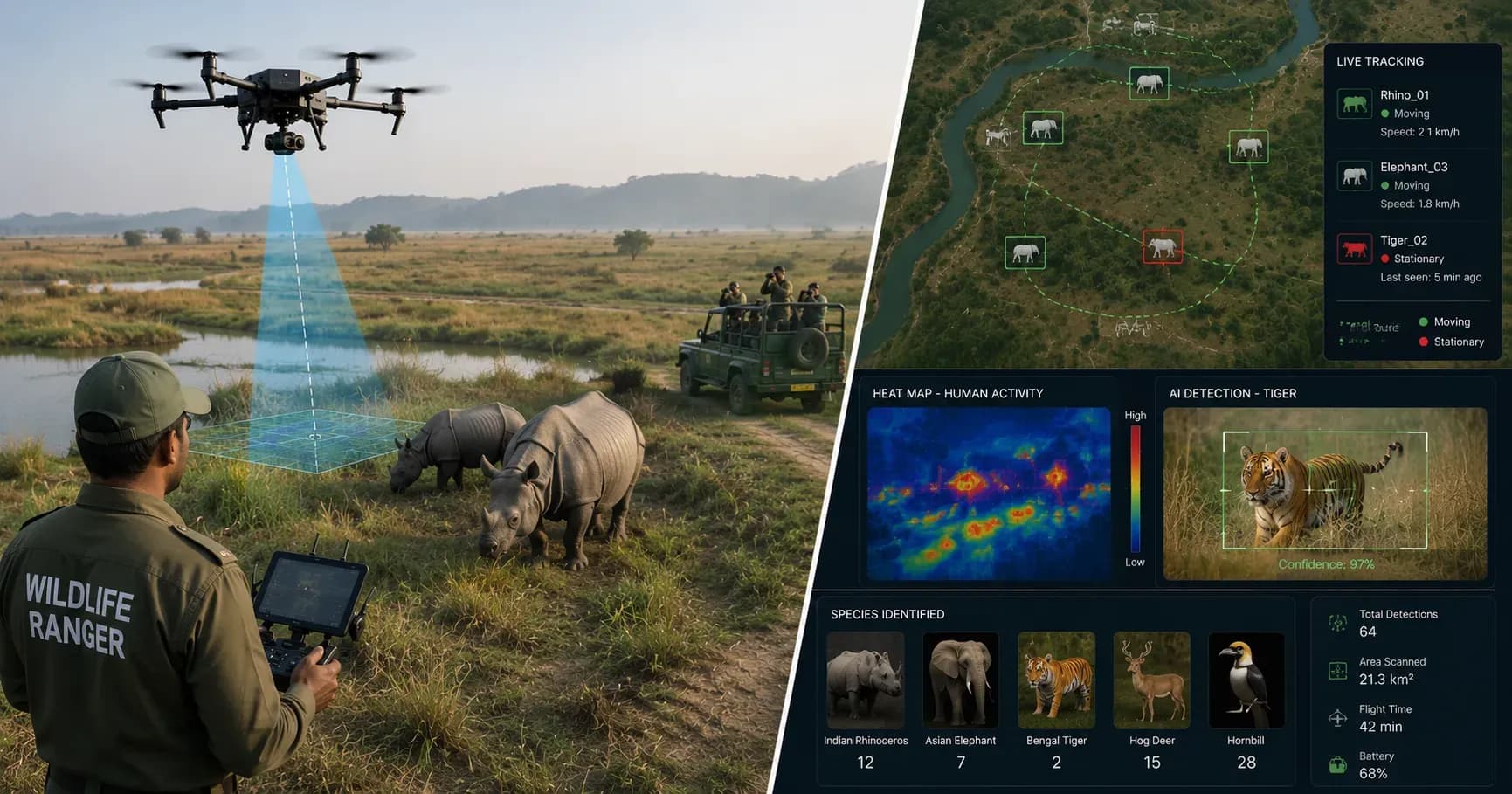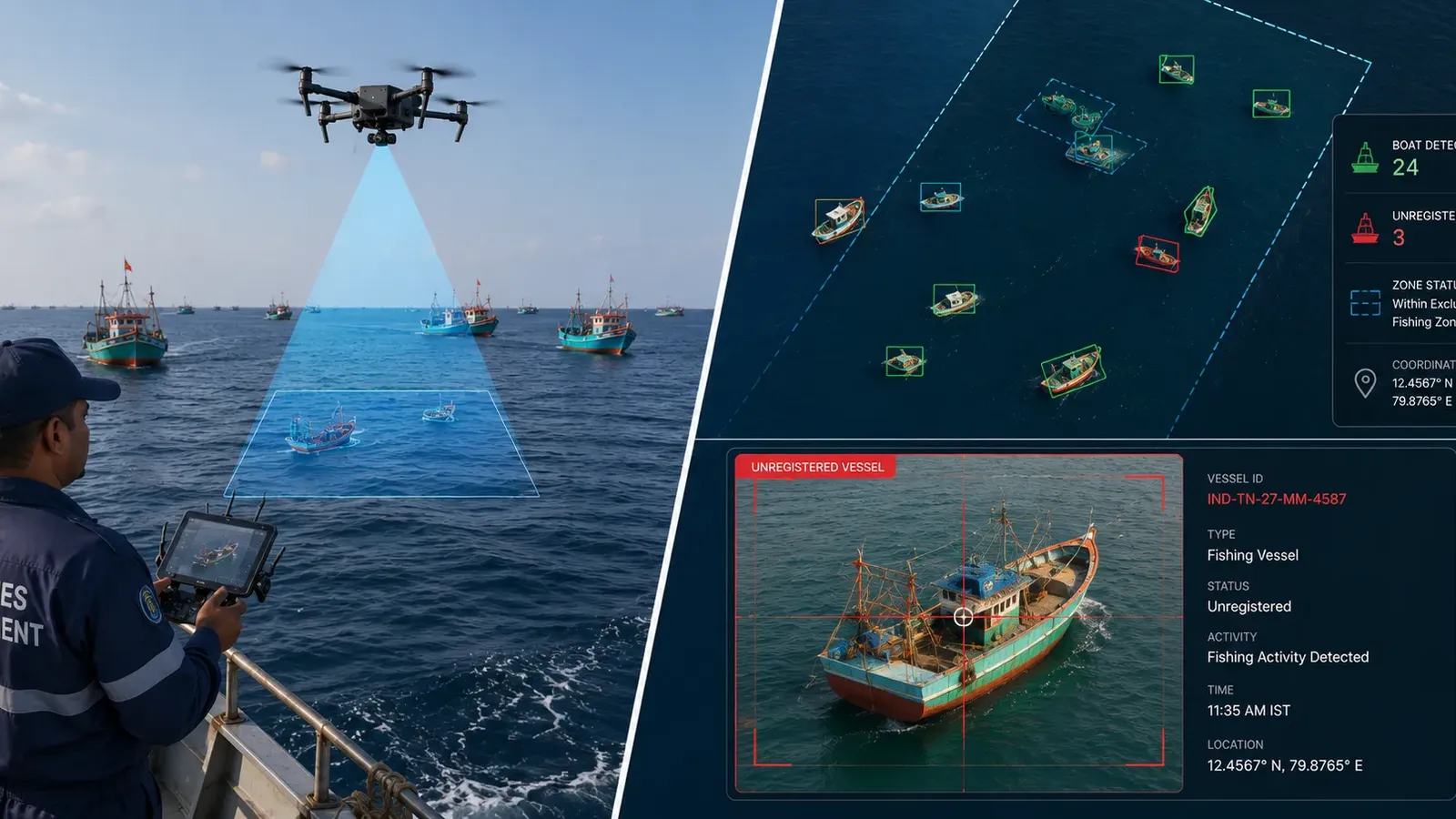
Drones for marine fisheries surveillance in India sit at the intersection of three operational chains: the platform class, the mandate-holder, and the governing statute. Maharashtra's Fisheries and Ports Minister directed the procurement of ten additional drones in April 2026, taking the state fleet to nineteen (Government of Maharashtra, April 2026). The Department of Fisheries Technical Committee constituted the drone-technology SOP in July 2025 (Press Information Bureau, 23 July 2025). The Indian Coast Guard's UAV induction plan now sets the federal architecture.
Tracing the dual surveillance mandate across central and state authorities
Marine fisheries surveillance in India does not operate under a single authority. The Department of Fisheries under the Ministry of Fisheries, Animal Husbandry and Dairying manages state-level fisheries enforcement. The Indian Coast Guard protects India's maritime interests across the Exclusive Economic Zone under federal law (Government of India, 1976). This structural split defines how India's unmanned maritime systems programme routes data between civil and defence users.
The state chain focuses on enforcing Marine Fishing Regulation Acts enacted by coastal states. These laws regulate fishing seasons, vessel registration, prohibited fishing zones, gear restrictions and illegal fishing activity inside territorial waters. State fisheries departments now use unmanned aircraft to monitor fishing vessels, document violations and improve inspection efficiency. The expansion of Maharashtra's surveillance fleet illustrates how this operational model is beginning to scale (Government of Maharashtra, April 2026).
The federal chain serves a different mission. The Indian Coast Guard monitors illegal, unreported and unregulated fishing, maritime security, smuggling and piracy across India's Exclusive Economic Zone. The zone extends up to 200 nautical miles from the coastline under the Territorial Waters, Continental Shelf, Exclusive Economic Zone and Other Maritime Zones Act, 1976 (Government of India, 1976). These missions require longer endurance aircraft, integration with coastal radar infrastructure and coordination with maritime security agencies.
Although both organisations operate UAVs, their objectives, legal authority and operational environment remain different. The Department of Fisheries is closing some of that gap through a national Standard Operating Procedure now in committee (Press Information Bureau, 23 July 2025). Every discussion of coastal surveillance drones in India tends to merge these two systems. In practice, they perform complementary missions.
Mapping the platform classes for near-shore, EEZ, and underwater operations
Fishing vessel monitoring requires different unmanned platforms across operational distance, endurance and mission profile. No single aircraft can efficiently cover every maritime mission.
Near-shore enforcement relies on multirotor UAVs. These aircraft launch from coastal stations within minutes, hover above fishing vessels and collect high-resolution imagery for enforcement teams. Their limited endurance suits inspections close to the shoreline rather than long-distance patrols.
Fixed-wing vertical take-off and landing systems extend operational range while retaining deployment flexibility. These platforms suit coastal districts that must monitor larger stretches of shoreline without requiring conventional runways. They also support how drones monitor illegal fishing in India by covering wider patrol corridors during a single sortie. Coastline mapping work runs adjacent to surveillance and overlaps with broader aerial mapping solutions deployed by state survey teams.
Long-endurance unmanned aircraft become necessary once surveillance extends into the Exclusive Economic Zone. Missions run multiple hours and require electro-optical sensors, infrared cameras, Automatic Identification System receivers and maritime surveillance payloads. The Indian Coast Guard's announced UAV induction programme reflects these operational requirements rather than state fisheries inspection needs (Indian Coast Guard, August 2025). The platform spectrum is laid out across the MALE, HALE and HAPS drone classes explainer.
Underwater surveillance introduces another platform category altogether. AUV programmes under indigenous development and remotely operated underwater systems support seabed observation, marine habitat assessment and underwater inspection rather than aerial patrols. Surface unmanned vessels flagged in the Indian Navy USV programme complement aerial surveillance by extending sensor coverage during maritime operations.
Platform class | Primary operating area | Typical mission | Lead authority |
|---|---|---|---|
Multirotor UAV | Coastal waters | Vessel inspection, evidence collection | State Department of Fisheries |
Fixed-wing VTOL UAV | Extended coastline | Fishing vessel monitoring | State Department of Fisheries |
Long-endurance UAV | Exclusive Economic Zone | Maritime surveillance and IUU detection | Indian Coast Guard |
Unmanned Surface Vessel | Coastal and offshore waters | Persistent maritime monitoring | Maritime security agencies |
Autonomous Underwater Vehicle | Underwater domain | Seabed inspection and marine research | Research and defence organisations |
This layered architecture explains why marine fisheries surveillance now combines airborne, surface and underwater systems.
Reading Maharashtra's Marine Fishing Regulation Act and the state-level model
The Maharashtra fisheries drone programme demonstrates how state governments are translating legislation into operational surveillance. Rather than introducing a separate drone law, the state strengthens enforcement under the Maharashtra Marine Fishing Regulation Act, 1981 (Government of Maharashtra, 1981). The 2021 amendment carries revised compliance provisions (Government of Maharashtra, 2021).
The Act regulates fishing licences, authorised fishing zones, seasonal restrictions and prohibited fishing practices along Maharashtra's coastline. Enforcement traditionally depended on patrol boats and physical inspections. Drone surveillance under the Maharashtra Marine Fishing Regulation Act expands the inspection footprint without proportionally increasing patrol manpower across the state's 720 km coastline.
The operational push accelerated in April 2026. Maharashtra Fisheries and Ports Minister Nitesh Rane directed the procurement of ten additional surveillance drones during a review meeting on implementation of the Act. The decision expanded the state's surveillance fleet from nine aircraft to nineteen. The decision sat inside a wider review covering fisheries enforcement, coastal security and illegal fishing detection (Government of Maharashtra, April 2026).
The review also examined enforcement across the state's seven coastal districts, namely Palghar, Thane, Mumbai Suburban, Mumbai City, Raigad, Ratnagiri and Sindhudurg. Drone imagery supports evidence collection, identifies unauthorised fishing activity, verifies vessel movement and assists enforcement officers before patrol boats arrive.
The ministerial review also identified ninety-one sensitive coastal landing points for enhanced monitoring through the Maharashtra State Security Corporation (Government of Maharashtra, April 2026). The fisheries surveillance infrastructure is also supporting coastal governance when agencies coordinate under existing legal frameworks.
The Maharashtra model is less about adopting an unfamiliar technology than improving enforcement efficiency under an existing statute. Other coastal states will likely follow once the national SOP is finalised.
Anchoring the PMMSY SOP and Department of Fisheries committee
State deployments are advancing ahead of a common national operating framework. The Department of Fisheries has started closing that gap through the Pradhan Mantri Matsya Sampada Yojana. PMMSY is India's flagship fisheries development programme, launched in September 2020 with a financial outlay of ₹20,050 crore (Department of Fisheries, September 2020). The scheme funds technology adoption across fisheries production, infrastructure and resource management.
A major milestone arrived on 23 July 2025. The Department of Fisheries announced the constitution of a Technical Committee to prepare a Standard Operating Procedure for drone technology in fisheries and aquaculture. The committee will recommend operational practices, identify suitable use cases and build a consistent framework for state drone projects under PMMSY (Press Information Bureau, 23 July 2025).
That announcement built on earlier work. On 7 November 2024, the Department of Fisheries, NFDB and the ICAR-Central Marine Fisheries Research Institute (CMFRI) organised a national workshop in Kochi. The CMFRI drone workshop marine fisheries session demonstrated marine surveillance, fish stock and wildlife population assessment, coastal monitoring and emergency response (Press Information Bureau, 7 November 2024). The CMFRI drone technology demonstration brought researchers and officials together.
The July 2025 release also flagged a logistics initiative. ICAR-Central Inland Fisheries Research Institute is developing a prototype drone for 70 kg fish and shrimp payloads (Press Information Bureau, 23 July 2025). The Department of Fisheries treats unmanned systems as broader transformation, not enforcement alone.
The PMMSY drone technology fisheries SOP will clarify mission planning standards, surveillance workflows, operator qualifications and sensor requirements. The Department of Fisheries drone Standard Operating Procedure should also create a common reference for commercial UAS providers. Operators bidding for drone-as-a-service contracts under PMMSY will face a consistent national baseline. States can adapt implementation against their own fisheries regulations.
Connecting Coast Guard UAV induction to IUU fishing in the EEZ
The Indian Coast Guard's UAV programme addresses a different surveillance problem from state fisheries enforcement. State fisheries departments focus on licensed fishing activity inside territorial waters. The Coast Guard monitors India's maritime domain across the Exclusive Economic Zone. Illegal, unreported and unregulated fishing, maritime crime and search-and-rescue missions across that zone demand persistent surveillance (Indian Coast Guard, August 2025).
India's Exclusive Economic Zone extends up to 200 nautical miles from the coastline (Government of India, 1976). The zone is defined under the Territorial Waters, Continental Shelf, Exclusive Economic Zone and Other Maritime Zones Act, 1976. Exclusive Economic Zone surveillance over that area is resource intensive when patrol vessels operate alone. Long-endurance UAS for maritime patrol expand surveillance reach while reducing the need for continuous ship deployments.
The Indian Coast Guard UAV induction EEZ patrol roadmap includes unmanned aircraft with extended sensor suites (Indian Coast Guard, August 2025). Payloads include electro-optical sensors, thermal imaging, Automatic Identification System receivers and artificial intelligence-assisted analytics for maritime target identification. These aircraft support detection of suspicious vessel movement, illegal fishing activity, piracy, smuggling and distress situations before surface assets are dispatched. EEZ patrols run as BVLOS operations for coastal patrol by definition.
The UAV programme also complements the Coast Guard's Coastal Surveillance Network. Phase 1 of the network operates forty-six radar stations positioned along India's coastline. Phase 2 adds thirty-eight additional stations to improve maritime domain awareness (Indian Coast Guard, August 2025). Together, coastal radar, AIS feeds, patrol vessels and UAVs create a layered surveillance architecture rather than independent monitoring systems.
This architecture illustrates why the dual-mandate model matters. State fisheries drones investigate compliance close to shore while Coast Guard UAVs monitor strategic activity offshore. Search-and-rescue overlaps with drones in disaster management doctrine when distress events arise. The Indian Navy's MQ-9B Sea Guardian lease is the only comparable long-endurance precedent for extended maritime surveillance today.
Aligning fisheries drone operations with the Drone Rules and Bharatiya Vayuyan Adhiniyam
Every fisheries drone mission must also comply with India's civil aviation framework. Whether a UAV supports fisheries monitoring, coastal inspection or maritime research, its operation remains subject to the Drone Rules 2021 unless specific exemptions apply (Directorate General of Civil Aviation, 25 August 2021).
The Drone Rules establish aircraft categories, registration requirements, type certification provisions, airspace classification and operational responsibilities for civil unmanned aircraft. Fisheries departments and authorised operators must therefore satisfy both fisheries legislation and aviation regulation before conducting routine surveillance missions.
The legal foundation for this framework also changed with the Bharatiya Vayuyan Adhiniyam (Ministry of Civil Aviation, 2024). The Adhiniyam replaced the Aircraft Act, 1934 as India's principal civil aviation legislation. Day-to-day drone operations continue under the Drone Rules. The Adhiniyam provides the statutory basis for future aviation regulation as unmanned aircraft enter wider government use.
For fisheries departments, this creates a layered compliance model. The first layer covers why the drone is flying: Marine Fishing Regulation Acts, PMMSY guidelines and departmental authorisations. The second layer covers how the aircraft flies through Indian airspace.
Registration, airspace permissions, pilot qualifications and operational restrictions remain subject to the Directorate General of Civil Aviation. Commercial UAS operators pursuing government contracts satisfy both sector-specific regulations and national drone rules.
Charting the next twelve months of marine fisheries drone integration
The next stage of India's marine fisheries surveillance programme will depend less on aircraft procurement than on institutional integration. Maharashtra has demonstrated that state governments will invest in operational fleets before a national Standard Operating Procedure is published. The Department of Fisheries is developing that common operating framework, and the Indian Coast Guard continues building long-endurance maritime surveillance capability across the Exclusive Economic Zone.
Other drone-served industries are following a similar pattern of policy modernisation through unmanned systems. Three developments will determine how quickly the dual-grid architecture matures. First, publication of the Department of Fisheries Standard Operating Procedure should establish consistent operating practices for PMMSY-supported drone deployments across coastal states (Press Information Bureau, 23 July 2025). Second, continued expansion of the Coast Guard's UAV fleet and Coastal Surveillance Network will improve persistent maritime monitoring beyond territorial waters (Indian Coast Guard, August 2025).
Third, implementation of the Bharatiya Vayuyan Adhiniyam alongside the Drone Rules will continue shaping how government agencies conduct unmanned operations within India's civil aviation framework (Ministry of Civil Aviation, 2024). If these three developments progress together, India will move closer to an integrated surveillance model. State fisheries enforcement, federal maritime security and civil aviation regulation would then operate as complementary rather than isolated systems.
The next inflection point will not be another drone purchase. It will be the publication of common operational standards. Those standards must let state and federal surveillance networks exchange information while staying inside their respective legal mandates.