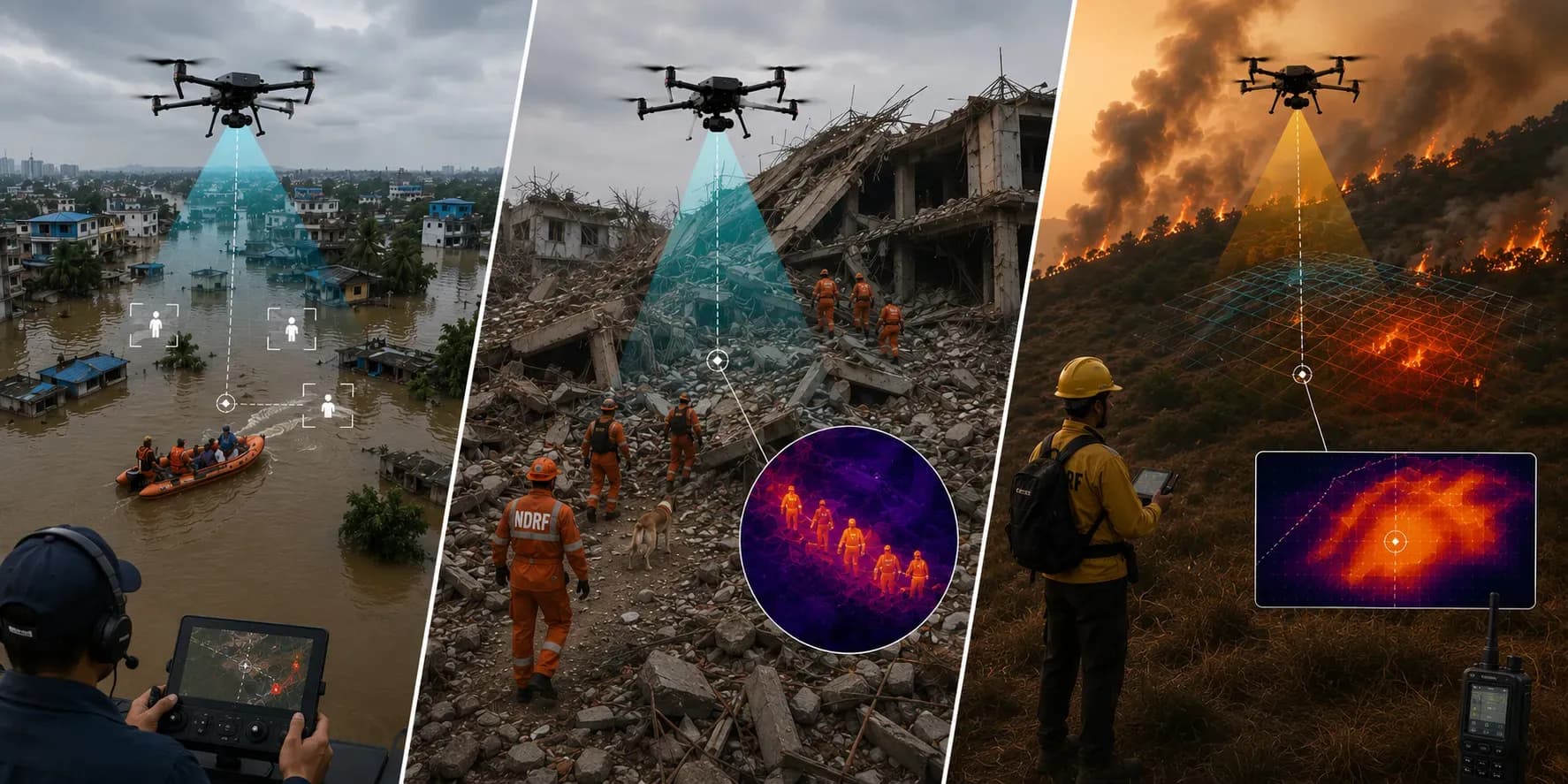
Drones for forest fire detection in India occupy the middle rung of a three-stage detection-decision-deployment ladder. The framework runs from Forest Survey of India satellite alerts, through state forest department drone reconnaissance, to helicopter or ground suppression coordinated by disaster-response agencies. FSI itself directs subscribers not to rely on those satellite alerts for tactical firefighting. The Parliamentary Standing Committee on Science and Technology, Environment, Forests and Climate Change reinforced this architecture in its 405th Report. Uttarakhand's Forest Fire Control and Management 2026 strategy anchors operational deployment.
Reading the FSI satellite alert ladder
Drones for forest fire detection in India begin with information generated by the Forest Survey of India rather than by aircraft in the field. Understanding this first layer explains why drones have become an operational requirement instead of an optional surveillance tool.
The Forest Survey of India operates the Forest Fire Alert System (FAST 3.0), the foundation for the forest fire alerts India relies on each season. The system combines observations from the MODIS instruments aboard the Terra and Aqua satellites with the SNPP-VIIRS sensor. MODIS provides alerts at one-kilometre spatial resolution; SNPP-VIIRS refines detection to 375 metres. Together they generate six observation opportunities during every 24-hour period. The resulting FSI MODIS VIIRS fire alerts are distributed through registered SMS, email and the Van Agni Geo-Portal (Forest Survey of India, FAST 3.0).
Satellite alerts answer one question: where a fire may exist.
They do not answer equally important operational questions. Fire boundary, flame height, direction of spread, accessibility for ground teams, and the risk to nearby villages, power infrastructure and wildlife habitats all remain unresolved. Forest Survey of India guidance explicitly advises agencies not to rely on satellite alerts alone for tactical firefighting. The alerts are designed for strategic detection rather than real-time fire suppression (Forest Survey of India, FAST 3.0).
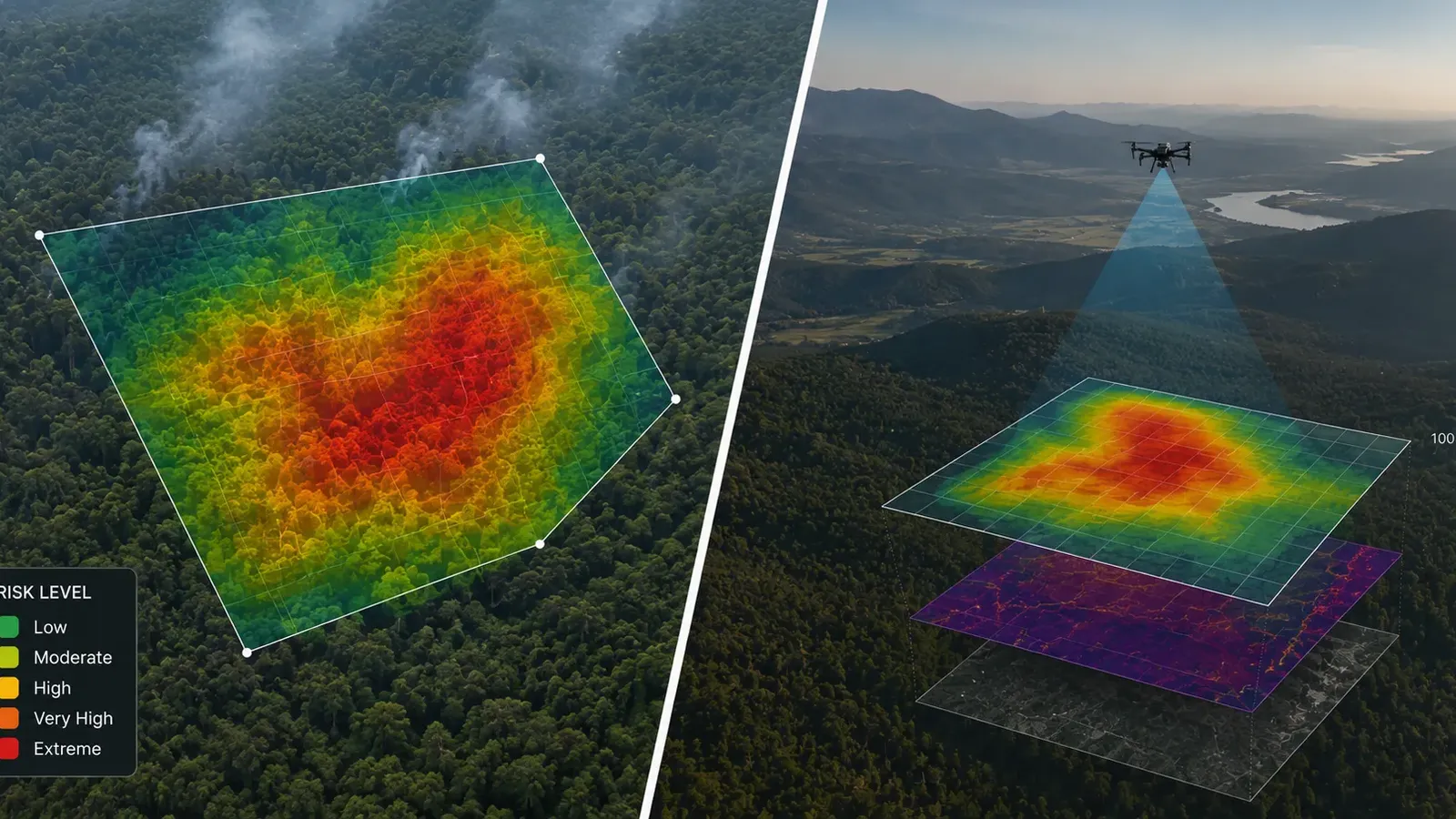
This distinction matters because 36 per cent of India's forest cover falls within fire-prone categories, according to the India State of Forest Report 2023. During the 2023 to 2024 fire season, Uttarakhand, Odisha and Chhattisgarh recorded the largest number of forest fire incidents nationwide (Forest Survey of India, 21 December 2024). The Forest Fire Danger Rating System strengthens this strategic layer by combining satellite observations with weather conditions and vegetation data. It helps state authorities estimate fire risk before ignition occurs, but it cannot replace low-altitude reconnaissance once an alert reaches the control room.
This is where any forest fire early warning drone India programme earns its place. A drone converts a satellite warning into a verified tactical picture before suppression resources move toward the incident.
Closing the orbital-to-ground tactical gap on fire detection
Drone surveillance for forest fire detection in India exists because there is a measurable gap between orbital observation and field response. The Parliamentary Standing Committee's 405th Report identifies this middle layer as a capability that should be formalised across state forest departments (Parliamentary Standing Committee, March 2026).
A satellite alert may indicate smoke inside a one-kilometre grid. Fire managers still need to determine whether the ignition is active, how large the affected area has become, and whether nearby settlements require evacuation.
A drone can answer those questions within minutes.
Multi-rotor and fixed-wing UAS provide live optical imagery, thermal imagery, terrain mapping and georeferenced coordinates while remaining above hazardous terrain. Computer vision algorithms can identify active hotspots, distinguish residual heat from surrounding vegetation and prioritise sections of the fire perimeter requiring immediate attention. Edge inference allows these classifications to occur onboard instead of waiting for cloud processing, reducing response time during communications outages.
This capability forms the operational centre of the FSI forest fire alert system drone integration proposed by the Standing Committee. Instead of dispatching helicopters immediately after every satellite notification, state forest departments gain an intermediate verification layer that reduces unnecessary deployments and improves resource allocation.
The sequence is cleaner this way: satellite systems detect, drones verify, and ground crews and helicopters suppress. That order reduces uncertainty before expensive aviation assets enter mountainous terrain.
The same framework also supports continuous monitoring after containment begins. Instead of ending reconnaissance after the first water drop, drones monitor flare-ups, identify residual hotspots and direct crews toward remaining ignition points before they expand again.
Mapping platform classes against pre-monsoon mission profiles
Forest fire operations require aircraft selected by terrain, endurance and communications coverage. Platform selection should begin with mission requirements rather than aircraft category. India's drone classification under category-A through category-E sets the regulatory band; the operational choice between fixed-wing, rotary and hybrid VTOL platforms follows from mission profile.
Multi-rotor UAS perform well during initial reconnaissance because they can hover above a fire edge and inspect specific locations with high positional accuracy. They support detailed thermal inspection, route planning and close coordination with firefighters operating below.
Fixed-wing UAS provide longer endurance across large forest divisions where multiple fire alerts appear simultaneously. Their greater coverage allows state forest departments to inspect wider landscapes before assigning suppression teams.
Hybrid VTOL platforms combine vertical take-off capability with fixed-wing endurance. They suit mountainous terrain where runway access is unavailable but long patrol distances remain necessary.
The comparison below illustrates how each platform fits operational planning.
Mission | Preferred platform | Primary advantage | Operational objective |
|---|---|---|---|
Initial hotspot verification | Multi-rotor | Hover capability | Confirm ignition location |
Forest patrol | Fixed-wing | Long endurance | Survey multiple alerts |
Mountain surveillance | Hybrid VTOL | Vertical launch plus range | Cover remote valleys |
Post-fire assessment | Multi-rotor | High-resolution inspection | Identify remaining hotspots |
One operational distinction deserves attention: detection and suppression are separate missions. Some experimental payloads carry water capsules, foam agents or fire retardants, but their payload capacity remains limited compared with helicopter-based suppression systems. Drones therefore contribute greatest value during detection, mapping and continuous situational awareness rather than replacing aerial firefighting aircraft.
Pairing thermal payloads with chir pine combustion signatures
Thermal imaging drones for forest fire missions match sensor capability to vegetation behaviour. Different forest ecosystems generate distinct thermal signatures during ignition and spread, and the payload choice has to follow.
Chir pine forests in Uttarakhand illustrate the challenge. Accumulated pine needles create combustible fuel beds that ignite quickly during dry seasons, and surface flames may spread beneath tree cover before becoming visible through conventional daylight imagery. The chir pine forest fire Uttarakhand operators handle every March to May is the textbook case for thermal payloads.
Thermal cameras detect temperature differences rather than visible smoke, which allows operators to identify active hotspots through vegetation cover, during twilight operations or after visible flames have reduced. A thermal drone for forest fire monitoring continues delivering useful intelligence after optical cameras become less effective. Thermal reconnaissance of the fire perimeter is now standard practice across state forest divisions running drone programmes.
How drones detect forest fires in India depends on combining multiple sensing modes instead of relying on a single payload. Typical mission payloads bring four sensing layers together.
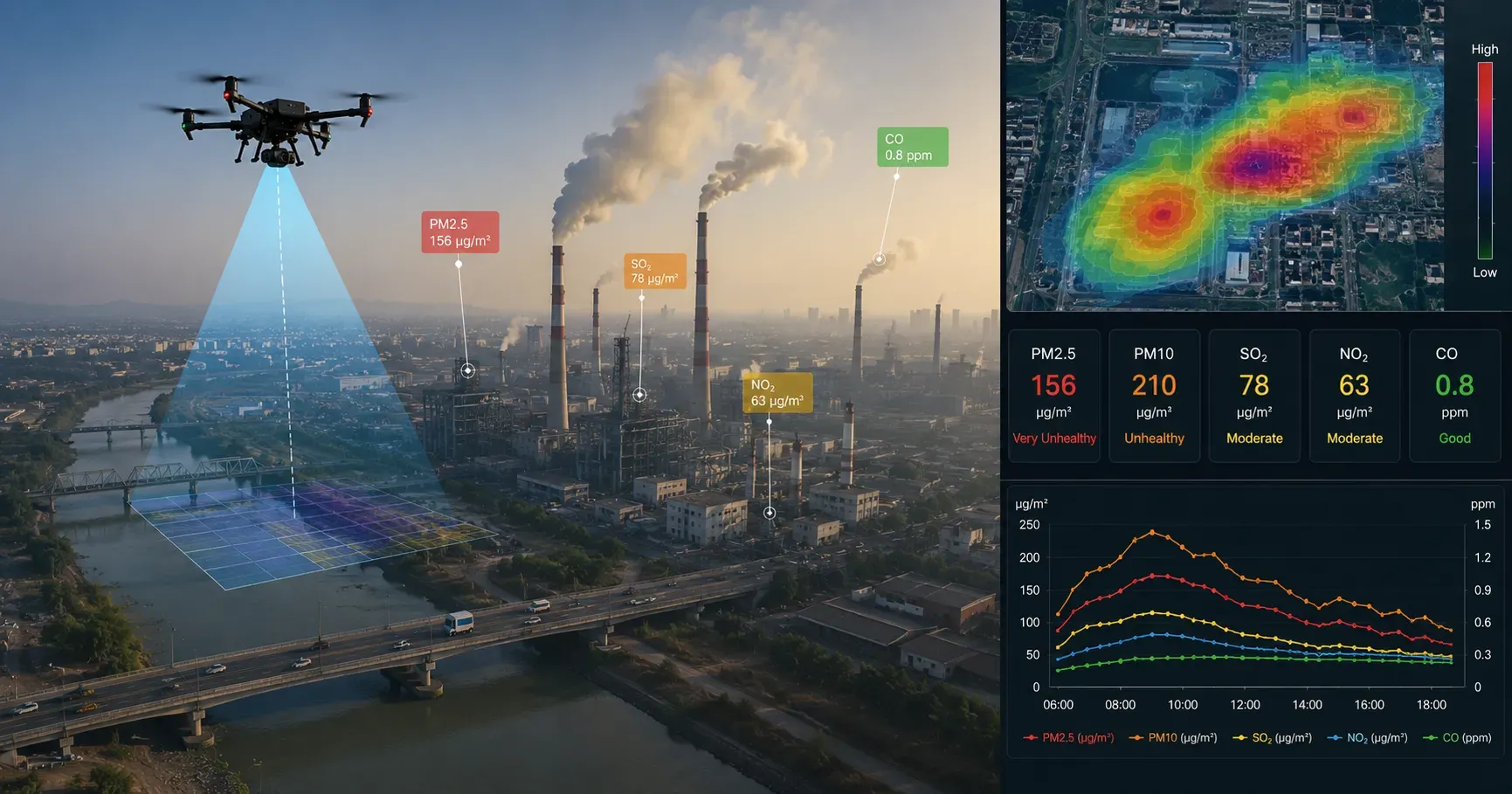
High-resolution daylight cameras handle visual confirmation and terrain mapping. Thermal imaging sensors identify active heat signatures through smoke and vegetation, while the same aerial sensing base supports smoke-plume and air-quality monitoring once containment begins. GPS-based mapping systems produce georeferenced fire perimeters for operational planning. AI-assisted computer vision classifies hotspots and supports route planning for ground teams.
Computer vision does not replace trained operators. Onboard algorithms identify candidate hotspots, classify thermal anomalies and reduce the workload facing remote pilots during extended surveillance missions. Human operators remain responsible for operational decisions; AI accelerates image interpretation and prioritisation, particularly when monitoring large forest divisions where hotspots emerge simultaneously across difficult terrain.
Flying under DGCA permissions in restricted airspace zones
DGCA permissions for forest operations define the legal framework within which state agencies conduct drone missions. Every operational deployment must satisfy civil aviation requirements alongside emergency response procedures.
Drone operations remain governed by the Drone Rules 2021 framework and the broader legal architecture established through the Bharatiya Vayuyan Adhiniyam 2024 transition. Registration now occurs through the eGCA platform. DigitalSky manages airspace permissions and NPNT compliance, a separation set by the eGCA-DigitalSky platform split completed during 2025 (DGCA Public Notice; Bharatiya Vayuyan Adhiniyam 2024).
Emergency operations do not automatically remove aviation obligations, and remote pilots still require valid Remote Pilot Certificates where applicable. Aircraft must comply with applicable registration requirements, airspace restrictions and operational approvals issued under the relevant regulatory framework.
Fire-prone forests frequently overlap controlled or sensitive airspace, which makes advance coordination between forest departments, district authorities and aviation regulators essential before major fire seasons begin. The yellow zone permission flow on DigitalSky is the standard pathway state forest departments clear, and planning permissions before emergencies occur reduces administrative delay when incidents develop.
Future Beyond Visual Line of Sight operations could further improve forest surveillance across mountain corridors. Until broader regulatory pathways mature, operators continue flying within approved operational envelopes established under DGCA guidance.
Sequencing the state forest department response workflow
State forest department drone deployment succeeds when every agency understands its place within the response chain. The National Action Plan on Forest Fires provides the institutional framework supporting this coordination across the broader drones in disaster management architecture (Press Information Bureau, 23 July 2024).
The workflow begins when FAST 3.0 generates an alert, and control rooms validate the notification before assigning drone reconnaissance teams. Live imagery then determines fire size, terrain accessibility and suppression priorities. Verified intelligence supports decisions involving district authorities, disaster management agencies and aerial firefighting resources where required.
The Uttarakhand forest fire drone deployment strategy announced on 27 May 2026 demonstrates this operational model. The state forest department deployed 5,625 fire watchers, prepared 13,085 kilometres of fire lines and introduced reward incentives reaching ₹1 lakh for successful fire-control teams (DD India, 27 May 2026).
Operational coordination may also include the National Disaster Response Force and Indian Air Force aviation assets during major incidents. During severe Northeast forest fires in early 2026, Mi-17 V5 helicopters released more than 1.4 lakh litres of water in the Walong sector. The aerial support sustained containment operations after widespread fires exceeded local suppression capacity (Indian Air Force operational summary, March 2026).
Drones shorten the time required to determine whether those aviation resources are necessary. They also improve firefighter safety by reducing the need for personnel to enter uncertain terrain before accurate situational awareness becomes available.
Funding procurement through the FPM scheme and CAMPA
The Forest Fire Prevention and Management Scheme provides the primary funding pathway for drone procurement supporting forest fire operations. The Ministry of Environment, Forest and Climate Change administers the Centrally Sponsored scheme in partnership with state governments under different cost-sharing formulas. Northeastern and Western Himalayan states receive support through a 90:10 Centre-State funding model, while other participating states operate under a 60:40 arrangement (Press Information Bureau, 23 July 2024).
The Ministry has also confirmed that drone technology forms part of forest protection activities undertaken in sensitive areas. This gives procurement officers a practical framework for drone procurement for state forest departments rather than treating aerial surveillance as an isolated technology initiative. The GeM portal pathway for drone procurement is the standard route for state-government tenders. CAMPA funding can complement these investments by supporting broader forest management activities where programme guidelines permit.
The Parliamentary Standing Committee's recommendation strengthens this procurement pathway. Rather than funding isolated pilot projects, the committee proposed that drones become an institutional layer between satellite detection and suppression response across Himalayan forest departments. That changes the conversation for procurement teams. Future tenders are likely to evaluate not only aircraft performance but also thermal payload capability, AI-enabled mapping, interoperability with government GIS systems and compliance with national drone regulations. Drones under Forest Fire Prevention and Management Scheme funding will sit at the heart of those evaluations.
The next operational test arrives with the 2027 fire season. MoEFCC's response to the Standing Committee's recommendation will be the inflection point. A national protocol with line-item funding under the next FPM cycle would close the satellite-to-ground tactical layer. Remaining at "applied in sensitive areas" (Press Information Bureau, 23 July 2024) would not. The strongest bidders in the next procurement window will treat drones as one component of a connected response system. A connected detection, decision and deployment chain wins where an isolated flying sensor does not. Aircraft, thermal payloads, AI-assisted image analysis, communication systems and regulatory compliance combine into a repeatable response process from satellite alert to field deployment.