AI in Indian defence modernisation entered a publicly-recorded operational phase at the India AI Impact Summit at Bharat Mandapam from 16 to 20 February 2026. There, the Strategic Forces Command disclosed field use of AI predictive tools along the Line of Actual Control and inside Operation Sindoor. The doctrine-institutions-deployment triad now frames the story. Doctrine anchors on the ETAI Framework, institutions on DAIC and DAIPA, and deployment on 140 border surveillance systems, 75 AIDef products, IACCS upgrades and Operation Sindoor use.
Framing AI as India's defence multiplier
Artificial Intelligence in Indian defence modernisation is the structured application of machine learning, computer vision, sensor fusion, mission planning and decision-support systems across military operations. AI reduces the time required to process information, classify threats and coordinate responses across operational domains. The Ministry of Defence has treated the capability as institutional rather than as an isolated technology project.
In February 2018, the Department of Defence Production constituted the Task Force for Strategic Implementation of AI for National Security and Defence, chaired by Natarajan Chandrasekaran. It submitted its report in June 2018, recommending permanent governance institutions and defence use cases across logistics, surveillance and autonomous platforms. The recommendations became architecture rather than a memo. Doctrine, research, procurement and deployment now evolve inside one coordinated ecosystem, which separates India's approach from the early defence AI programmes that treated AI as a sidebar.
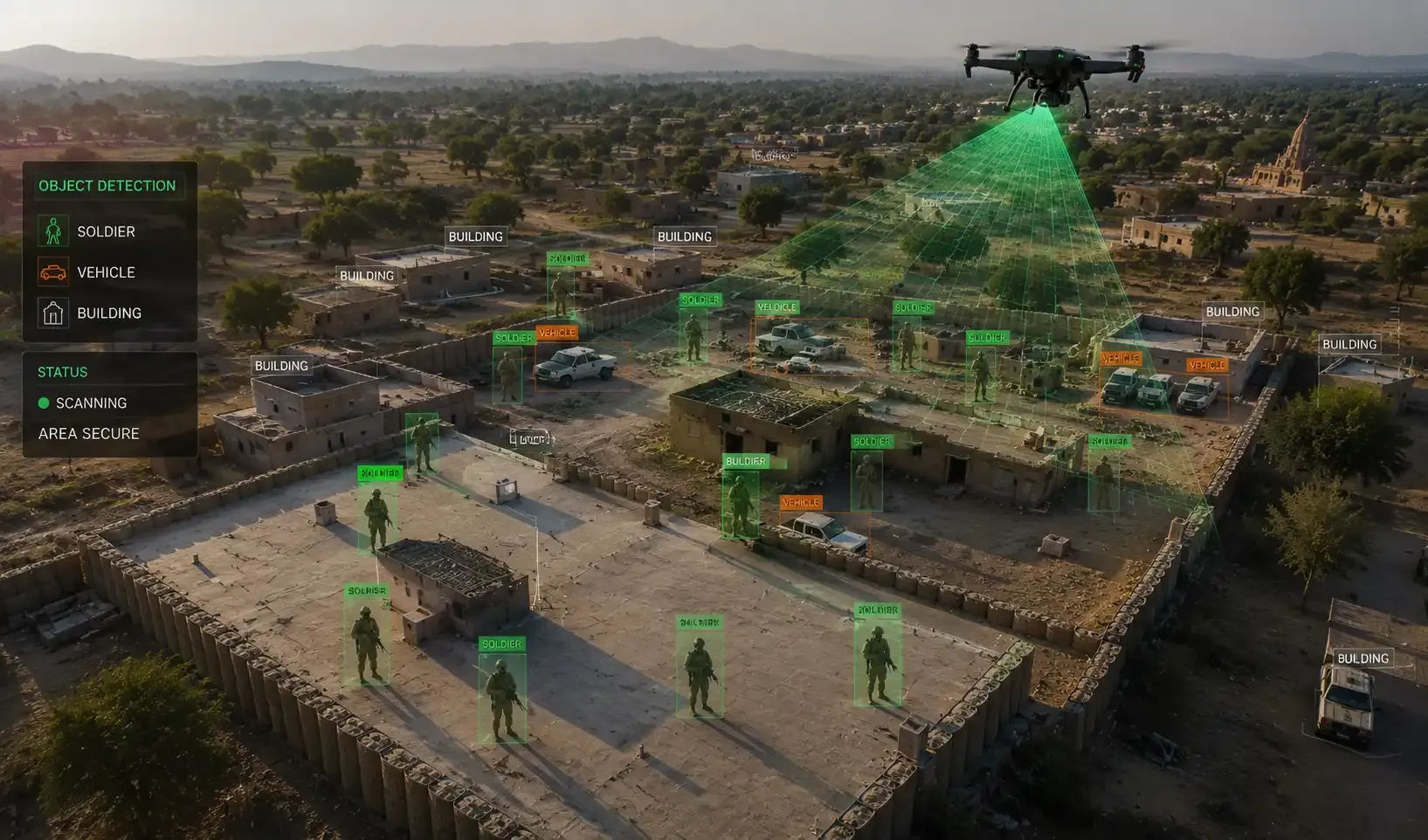
AI now supports six operational functions across the Indian Armed Forces: border surveillance, air defence, maritime domain awareness, intelligence processing, logistics and mission planning. Computer vision processes electro-optical imagery while machine learning classifies patterns in surveillance feeds. Sensor fusion combines radar and acoustic inputs into one operational picture, and edge inference allows models to operate close to deployed sensors. That layered stack is how autonomous drones think and act across the Indian defence ecosystem.
The same computer-vision and sensor-fusion techniques drive AI in drone platforms. They also support Command, Control, Communications, Computers, Intelligence, Surveillance and Reconnaissance (C4ISR) architectures where information speed shapes operational effectiveness.
Tracing the doctrine backbone from task committee to ETAI
Military AI requires doctrine before deployment. Without governance, operational AI creates uncertainty around accountability, reliability, cybersecurity and human oversight. India's doctrine layer answers those questions through a sequence running from the AI task force of 2018 to the Evaluating Trustworthy AI (ETAI) Framework.
The first milestone was institutional. In February 2019, the Ministry of Defence created the Defence AI Council and the Defence AI Project Agency by executive order. The order translated the task-force recommendations into permanent structure. It set a five-year budget corpus of ₹1,000 crore, with each service earmarking ₹100 crore per year for AI-specific application development.
The doctrinal foundation expanded on 17 October 2024. The Chief of Defence Staff and the DRDO Chairman jointly released the ETAI Framework and Guidelines for the Armed Forces. Developed by DRDO's Scientific Analysis Group under Director General Suma Varughese, the framework defines five governing principles: reliability and robustness, safety and security, transparency, fairness, and privacy.
The ETAI Framework is the element most published coverage leaves out. It is a risk-based assessment framework applicable across the AI pipeline. Independent analysis has described it as an operational governance model that neither the United States nor China has matched (Centre for Land Warfare Studies, 22 May 2026). Every defence AI system now demonstrates reliability, cybersecurity, explainability and human accountability before operational deployment, which is the same discipline underwriting AI battle management in India.
That doctrinal layer sits above the institutional stack. Permanent bodies then convert policy into funded programmes, technology partnerships and deployable capability.
Building the institutional stack around DAIC and DAIPA
India's defence AI capability rests on permanent institutions rather than one-off initiatives. The Defence AI Council (DAIC) sets strategic direction. The Defence AI Project Agency (DAIPA) converts that direction into programmes, partnerships and deployable capability. It works across research laboratories, defence public sector enterprises, startups and procurement agencies.
The Raksha Mantri chairs DAIC, making it the highest policy body for defence AI. The Secretary, Department of Defence Production, heads DAIPA. The Council owns strategic decisions on which operational capabilities to prioritise and how defence AI aligns with national security objectives. The Agency owns execution: which organisations build the capability, how projects are funded, and how programmes move from prototype to deployment.
The separation mirrors mature acquisition models where strategy and execution operate through different bodies while remaining institutionally aligned. DAIPA coordinates across DRDO, the Defence Public Sector Undertakings (DPSUs), Innovations for Defence Excellence (iDEX), academic institutions, defence startups and technology partners. That alignment reduces duplication, encourages technology reuse and creates a structured pathway from laboratory research to military deployment.
AI systems cannot be procured on hardware-only evaluation. Performance depends on datasets, algorithms, software updates and operational validation. DAIPA provides the lifecycle programme management needed to evaluate those systems from prototype through fielded update.
Funding reflects that long-term posture. The Department of Defence Production earmarked ₹100 crore annually for AI activities across DPSUs. The DPSU AI Roadmap identified roughly 70 defence-specific AI projects for development.
Wiring the DRDO and DPSU delivery pipeline
Institutions establish direction. Operational capability depends on technology delivery. India's defence AI delivery pipeline is led by the Defence Research and Development Organisation (DRDO), supported by the DPSUs, the iDEX ecosystem and specialised AI laboratories. Together they feed the wider capability portfolio covered under defence drones in India.
The Centre for Artificial Intelligence and Robotics (CAIR) is one of DRDO's premier laboratories. It has worked on military AI, intelligent control systems, command-and-control software and autonomous platforms for over three decades. The DRDO Young Scientists Laboratory for Artificial Intelligence (DYSL-AI) complements CAIR by accelerating research on machine learning, computer vision and autonomous systems.
The Indian Air Force added its own unit inside this pipeline. The Unit for Digitisation, Automation, AI and Networking (UDAAN) develops applications for campaign planning and e-Nirikshan workflows (Press Information Bureau, 4 August 2022). The Defence Institute of Advanced Technology (DIAT) has trained over one thousand professionals in AI and machine learning to feed the technical base.
A milestone arrived on 11 July 2022. The Raksha Mantri launched 75 AI-enabled products and technologies at the first Artificial Intelligence in Defence (AIDef) Symposium at Vigyan Bhawan. Those systems spanned surveillance, logistics, predictive maintenance, cyber defence and operational decision support. Of the 70 defence-specific AI projects identified under the DPSU roadmap, 40 had already been completed by that stage.
The iDEX programme opened the pipeline to startups. As of 18 June 2025, the Department of Defence Production reported engagement with 632 startups, MSMEs and innovators, alongside 452 procurement and development contracts. The same ecosystem underwrites the commercial layer visible under drone as a service. Programmes are designed to feed future General Staff Qualitative Requirements (GSQRs), so AI capabilities can transition into formal acquisition rather than remaining demonstrations.
Fielding AI across surveillance, command and border operations
Operational deployment sits at the base of the triad. Surveillance platforms generate electro-optical imagery, thermal video, radar returns and acoustic signals at scale. AI models perform object detection, target classification, movement analysis and anomaly identification before presenting prioritised information to operators. In August 2022, the IndiaAI initiative recorded that the Indian Army had deployed approximately 140 AI-based surveillance systems to strengthen border monitoring.
Border management extended that architecture. The Ministry of Home Affairs launched CIBMS Smart Fencing on 5 March 2019, folding sensors, cameras, command centres and automated intrusion detection into a unified system (Press Information Bureau, 5 March 2019). AI-based Intrusion Detection Systems analyse surveillance imagery, identify movement patterns and filter false alarms before information reaches control centres. That approach aligns with the Akashteer air defence system philosophy of shortening detection-to-response cycles.
The air and maritime domains follow the same pattern. The Integrated Air Command and Control System (IACCS) connects radar stations, airborne sensors, air defence units and command centres into a nationwide network. Indian Air Force planning documents indicate an AI-native upgrade for data fusion and response timelines (Convergence Now, 13 May 2026).
At sea, the Information Management and Analysis Centre (IMAC) integrates coastal radar, AIS feeds, satellite data and patrol assets. The Information Fusion Centre for the Indian Ocean Region (IFC-IOR) extends the same picture across the wider IOR. AI supports vessel classification and anomaly detection inside both, complementing combat air teaming system integration models.
The command layer is where operational AI is publicly visible. The Directorate General of Information Systems has integrated the Trinetra application with Project Sanjay. The Electronic Intelligence Collation and Analysis System (ECAS) processes intelligence inputs before presenting a unified picture to commanders. Both draw on the same object-recognition stacks powering computer vision on drone platforms.
At the India AI Impact Summit on 17 February 2026, Lieutenant General Dinesh Singh Rana disclosed field use of a locally developed AI system. The system detected early warning indicators along the Line of Actual Control, enabling pre-positioning without casualties. Public reporting on Operation Sindoor drone use cites approximately 23 AI applications supporting surveillance, intelligence analysis and command workflows during the operation (Observer Research Foundation, 27 February 2026). AI accelerates information processing while operators retain final judgement, consistent with the human-in-the-loop principle inside the ETAI Framework.
Reading the union budget signal for AI-enabled procurement
Budget allocations reveal whether defence AI has moved beyond policy intent. India's Union Budget for 2026-27 provides the signal. The Ministry of Finance allocated ₹7.85 lakh crore to the Ministry of Defence on 1 February 2026 (Ministry of Finance, 1 February 2026). The allocation includes ₹2.19 lakh crore for capital expenditure and ₹29,100.25 crore for DRDO, with ₹1.85 lakh crore of the capital outlay earmarked for capital acquisition.
AI capability depends on sustained investment rather than one-time procurement. Software development, dataset refinement, model validation, cybersecurity testing and edge computing infrastructure require continuous funding. Capital acquisition funding lets the Services integrate AI into future platforms as core capability rather than as an optional subsystem. The DRDO allocation supports research programmes that mature technologies before they enter procurement pipelines.
Procurement philosophy is shifting alongside the budget. Traditional acquisitions focused on hardware specifications, while AI-enabled systems require software assurance, algorithm verification, cybersecurity evaluation and lifecycle updates. The General Staff Qualitative Requirement (GSQR) process is expected to evolve accordingly. Future specifications will fold in measurable AI performance parameters covering inference accuracy, sensor-fusion capability, latency, explainability and resilience.
The Ministry of Defence is also rolling out the Sampurna digital procurement management system to streamline contract lifecycles and payment tracking across acquisition. The ETAI Framework provides the governance foundation for those future evaluation standards by defining the principles for trustworthy deployment (Press Information Bureau, 17 October 2024). Together, the budget signal and the procurement architecture shape how aerial mapping and other AI-heavy capability categories enter fielded service.
Scaling AI capability toward Viksit Bharat
The India AI Impact Summit at Bharat Mandapam from 16 to 20 February 2026 marked an inflection point in India's defence AI journey. Earlier discussion focused on research and experimentation. The summit shifted attention toward operational deployment, governance and national capability development (Press Information Bureau, 16 February 2026).
Defence AI does not develop in isolation. It intersects with semiconductor manufacturing, secure cloud infrastructure, high-performance computing, cyber resilience, communications networks and advanced sensors. Progress in one domain strengthens capability across the entire defence technology ecosystem, and the industry hub map covers the adjacent verticals feeding the same base.
For defence organisations, the next stage is integration. Individual AI applications matter less than their ability to exchange information across platforms, domains and command networks. Computer vision systems must integrate with sensor fusion engines. Mission planning tools must exchange information with logistics platforms.
The ETAI Framework provides the governance model for that transition. As more AI-enabled capabilities enter operational service, evaluation standards will matter as much as algorithms. Reliability, transparency, cybersecurity and human accountability will determine whether the fiscal signal converts into fielded capability and whether the doctrine-institutions-deployment triad delivers on Viksit Bharat.
The defining engineering challenge for the next generation of Indian autonomous defence systems is not building capable AI. It is building AI that can be trusted, integrated and fielded at scale. The next phase of Indian defence modernisation will be defined by how effectively trusted AI is embedded inside General Staff Qualitative Requirements. That embedding will determine whether the ₹2.19 lakh crore capital outlay approved on 1 February 2026 converts into fielded capability rather than announced pilots.