AI battle management in India became a matter of public record on 30 September 2025. Defence Minister Rajnath Singh, speaking at a tri-services seminar at Subroto Park, named three service-level systems by name. The IAF's IACCS, the Army's Akashteer, and the Navy's Trigun functioned as the joint operational backbone during Operation Sindoor (News on AIR, 30 September 2025).
This piece maps the underlying stack node by node. It walks the Tac C3I architecture from sensor to shooter and locates where the integration gap actually sits.
Defining the AI battle management stack
AI battle management in India is a sensor-fusion and decision-support architecture. It connects surveillance systems, communication networks, command centres, and weapon platforms into a single operational workflow that supports commanders at every echelon.
A practical view of how AI battle management works in the Indian Army starts with the sensor-to-shooter chain. Sensors collect data. Networks transport that data to command centres. Command systems fuse the inputs into a common operating picture, and decision-support engines assist commanders.
Weapon systems then receive validated instructions through human-authorised workflows. The objective is not autonomous warfare. The objective is shortening the time between sensor collection and commander action while keeping a human at every authorisation gate.
The architecture sits across multiple layers rather than a single platform. At the tactical layer, the Indian Army operates a set of Tac C3I subsystems. These cover decision support, surveillance, tactical management, artillery, air defence, and upward dissemination across formations.
The named components include CIDSS, SANJAY, the BMS, ACCCS, ADC&RS, and ASTROIDS (DRDO CAIR; Directorate General of Information Systems). At the operational layer, Akashteer integrates air-defence assets across Army formations. Above that sits the joint layer, where IACCS, Akashteer, and Trigun exchange operational data to support tri-service coordination (News on AIR, 30 September 2025).
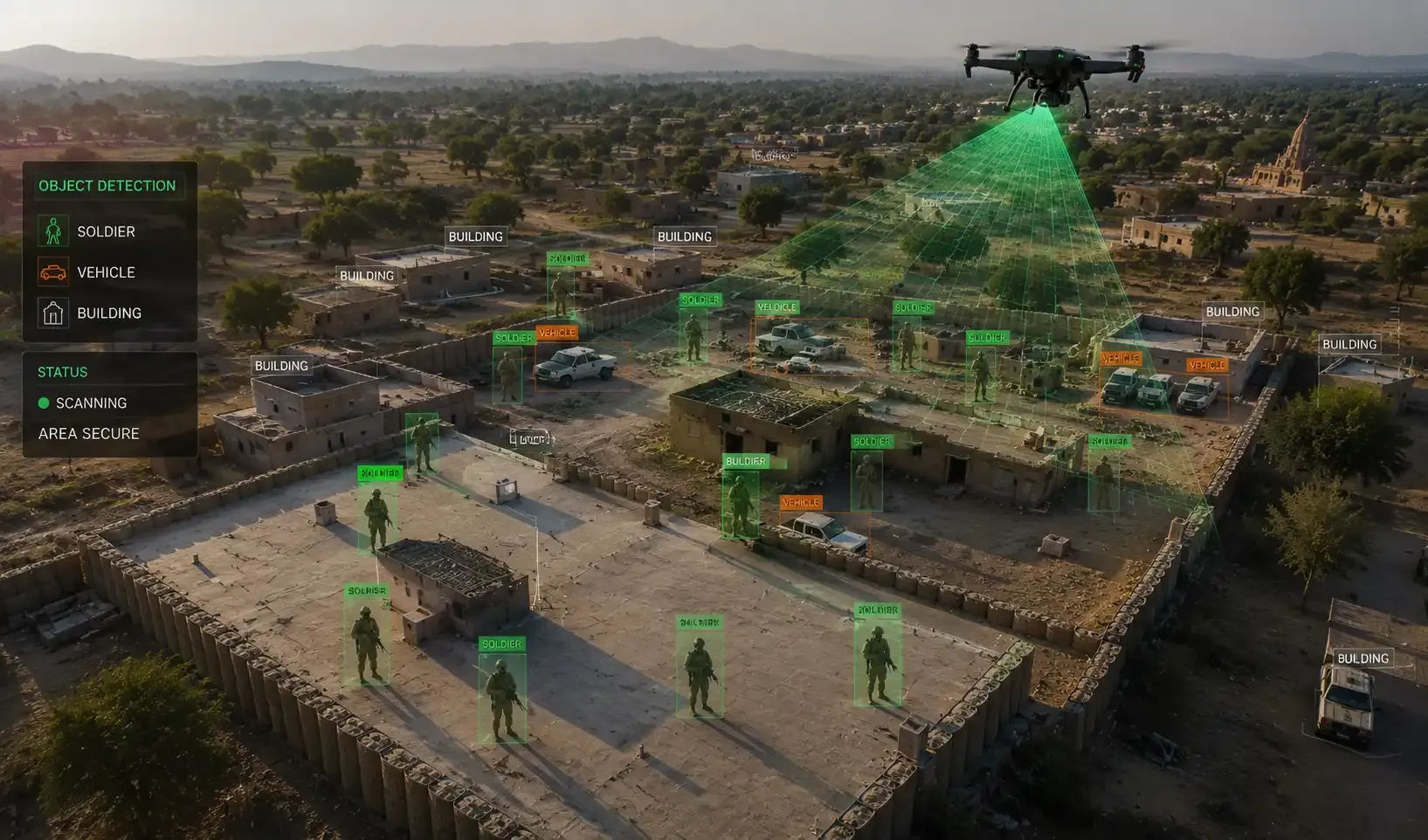
Artificial intelligence enters the architecture through sensor fusion, target classification, anomaly detection, route planning, surveillance analytics, and decision-support workflows. This is also the foundation layer for defence drones in India and other unmanned platforms feeding the broader operational picture. AI does not replace the commander. It compresses the cycle time between observing a battlefield event and authorising a response.
Tracing Tac C3I from the sensor to the shooter
The Tac C3I architecture is the Indian Army's digital nervous system. It links battlefield sensors to operational decision-makers across a Corps Zone covering one corps, three divisions, nine brigades, and twenty-seven battalions (BEL, accessed 8 June 2026).
The sensor-to-shooter loop India is building begins with battlefield observation. Data originates from radars, electro-optical systems, unmanned platforms, artillery sensors, communications-intercept systems, and human observers. Information then enters the Battlefield Surveillance System for collection, processing, and distribution across formations (Ministry of Defence, 24 January 2025).
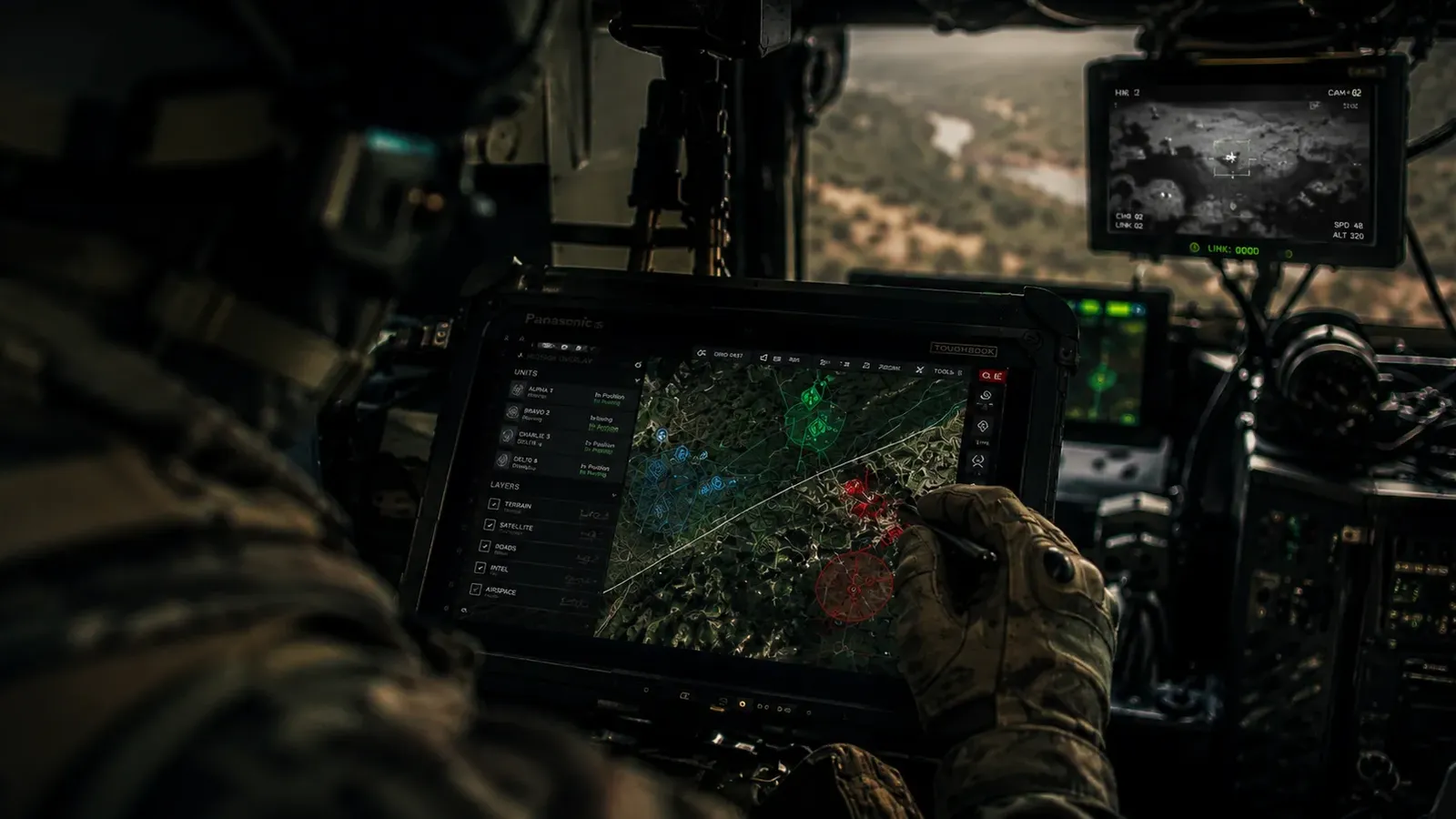
The next stage involves CIDSS integration. CIDSS functions as the information hub that aggregates data from multiple battlefield sources. It presents commanders with a unified operational picture (DRDO CAIR, accessed 8 June 2026).
Each Tac C3I subsystem in the Indian Army's architecture carries a specific role. Artillery operations feed through ACCCS. Air-defence information flows through ADC&RS. Battlefield surveillance enters through SANJAY, and strategic information moves upward through ASTROIDS to Army Headquarters.
Together these subsystems form a digital command environment. The challenge is that information superiority depends on network quality. Every subsystem can generate useful data, but operational value emerges only when the right information reaches the right commander in time to influence action.
Communication infrastructure therefore matters as much as software. Tactical communication networks decide whether the Tac C3I architecture functions as one integrated system or a collection of disconnected applications. The Indian Army has been working through this integration challenge since the early 2010s. Progress has accelerated under the Decade of Transformation framework that anchors the AI roadmap, with each Tac C3I subsystem fielded in 2024 and 2025 tightening that linkage.
Placing Akashteer at the air-defence command node
The Akashteer air defence command and control system functions as the Indian Army's command-and-control node for air-defence operations. The Ministry of Defence signed the ₹1,982 crore Akashteer contract with BEL in March 2023 under the Aatmanirbhar Bharat framework (PIB, 29 March 2023).
The programme was designed to automate air-defence control processes. It also produces a unified operational picture across Army air-defence formations operating in contested airspace.
Akashteer differs from general battlefield management platforms. Its primary mission is air-defence integration rather than infantry or armour command-and-control. Radar feeds, sensor tracks, weapon locations, engagement status, and airspace information consolidate into one common interface.
The operational significance of the Akashteer air defence system became visible during Operation Sindoor. The Ministry of Defence described Akashteer as a contributor to India's multi-layered air-defence capability across the operation (PIB, 16 May 2025). The system supported information flow and coordinated response mechanisms across formations on the western front.
Akashteer integrates feeds from Tactical Control Radars, 3D Tactical Control Radars, low-level lightweight radars, and the radar of the Akash weapon system. It is also linked to ISRO assets including the CARTOSAT-3 imaging satellite, the RISAT-2 radar satellite, and the NavIC navigation system (PIB, 16 May 2025). The result is a sensor pool that combines ground-based radar with space-based observation in one operational picture.
Artificial intelligence strengthens this layer through track correlation, threat prioritisation, target classification, and decision-support recommendations. Human operators still authorise engagements. Software reduces the cognitive workload of processing high volumes of incoming sensor data.
Akashteer should therefore be understood as one node inside a larger architecture, alongside anti-drone systems in India and the wider layered air-defence asset pool. Public discussion treats the programme as the entire story.
The architecture itself extends well beyond air defence. CIDSS, SANJAY, IACCS, Trigun, ACCCS, and ASTROIDS all contribute to the joint operational picture. Akashteer occupies the air-defence command node inside that broader structure.
Locating CIDSS-Samvahak at the hub of decision support
CIDSS-Samvahak is the Indian Army's principal decision-support and command-information hub within the Tac C3I architecture. The Command Information and Decision Support System was developed by the Centre for Artificial Intelligence and Robotics (CAIR). CAIR is a DRDO laboratory that focuses on mission-critical secure command and communication systems (DRDO CAIR, accessed 8 June 2026).
Its role is straightforward. CIDSS receives information from multiple battlefield sources. It fuses the data into a common operational picture and presents commanders with decision-support tools.
CIDSS is not a surveillance system or a communication network. It is the layer that converts information into operational awareness.
The programme reached a deployment milestone on 24 September 2025. BEL formally handed over the CIDSS contract documentation to Lieutenant General Rakesh Kapoor, the Deputy Chief of Army Staff for Information Systems and Coordination (ADGPI, 24 September 2025). The handover anchors the programme inside the Directorate General of Information Systems. That directorate has carried the Tac C3I integration mandate since the early phase of the Army's digitisation push.
The CIDSS contract with BEL marks the Indian Army's move from laboratory capability to fielded deployment architecture. The Army's transformation agenda depends on information fusion in addition to platform performance.
Artificial intelligence supports this mission through pattern recognition, information correlation, data prioritisation, and recommendation engines. Commanders gain faster access to relevant information without delegating authority to software.
In practical terms, CIDSS-Samvahak sits at the centre of the Indian Army's information architecture. Surveillance systems collect information, communication systems transport it, and CIDSS transforms it into a usable command picture.
Without that fusion function, data remains fragmented across formations even when every subsystem performs as designed.
Tracking SANJAY and the unfinished backbone network
The Battlefield Surveillance System SANJAY delivers a unified surveillance picture across Indian Army formations. Defence Minister Rajnath Singh flagged off SANJAY from South Block on 24 January 2025 (Ministry of Defence, 24 January 2025). The launch was part of the Army's digital transformation effort.
The programme was developed jointly by BEL and the DRDO. SANJAY collects information from battlefield sensors and distributes surveillance data across command structures. Inputs from operational formations are consolidated on a customised GIS platform with multi-sensor data fusion handled at the Surveillance Centre before being passed to CIDSS.
Its value comes from aggregation. Commanders gain access to a wider operational picture than any single sensor can deliver on its own.
SANJAY also surfaces the architecture's unfinished element. That element is the Tactical Communication System, the transport layer that connects surveillance platforms, command systems, and operational headquarters across the Tac C3I stack.
Without sufficient network capacity, even the strongest command applications run into information bottlenecks. Sensor fusion requires data movement. Data movement requires resilient networks. The TCS programme has been in procurement discussions through a long requirements cycle, and the Battlefield Management System sits behind it in the queue.
This is why discussions of AI battle management focus on algorithms while underweighting communications infrastructure. The gap between available software capability and available network capability remains one of the defining questions in India's battlefield digitisation effort.
Stitching IAF, Army, and Navy nodes into one operating picture
The Akashteer IACCS Trigun integration represents the joint operational layer of India's battle management stack. IACCS, the Integrated Air Command and Control System, is operated by the Indian Air Force. It functions as a nationwide air-defence and aerospace command network (Indian Air Force, IACCS programme documentation).
IACCS integrates radar feeds, airspace information, and operational data into a national-level picture. It runs on the Air Force Network (AFNET), a fibre-optic backbone that replaced the previous troposcatter communication system. AFNET delivers encrypted data, voice, and video traffic between IACCS nodes.
The significance of IACCS became publicly visible during Operation Sindoor. Defence Minister Rajnath Singh stated that IACCS, Akashteer, and Trigun operated as a unified backbone during the operation (News on AIR, 30 September 2025).
That statement confirms that C4ISR India efforts are progressing beyond service-specific networks. The objective is not three separate command systems. The objective is a shared operational picture across the Army, the Navy, and the Air Force.
The architecture resembles a layered model. IACCS provides air-force-level integration, Akashteer manages Army air-defence coordination, and Trigun supports naval operational integration. Data exchange between the three creates joint awareness.
Future developments in unmanned systems, autonomous mission planning, and multi-domain operations depend on this foundation. Concepts such as the Combat Air Teaming System CATS and manned-unmanned teaming require a common operational picture before they can scale across services.
Jointness therefore depends on software interoperability as much as on organisational reform. The 30 September 2025 statement signals that the architecture has cleared proof-of-concept and entered the institutional adoption phase across the three services. The next step is institutionalising the joint operating picture in peacetime rather than only under operational stress.
Each of the three service systems was designed for service-specific operations. Building the data-exchange layer between them is the work of the next eighteen months. Cybersecurity hardening is the parallel requirement for a joint architecture that handles classified operational data across service boundaries.
Mapping the DRDO and CAIR contribution layer
The DRDO and CAIR contribution layer provides the technical foundation behind India's defence AI effort. CAIR develops AI inside mission-oriented secure command and communication systems for the armed forces (DRDO CAIR, accessed 8 June 2026).
The DRDO portfolio of AI products for India's defence services spans decision-support systems, surveillance analytics, cybersecurity tools, information-management platforms, and mission-support applications. According to government disclosures, DRDO has developed more than seventy-five AI-related products and applications across defence domains (PIB, 1 August 2022).
CIDSS itself emerged from this ecosystem. So did the AI track-correlation and sensor-fusion work behind platforms like SANJAY. DRDO also developed Prajna, an AI-enabled satellite imaging system handed to the Ministry of Home Affairs in April 2026 to support internal security decision-making.
The Indian Air Force runs its own AI unit called UDAAN. UDAAN stands for Unit for Digitisation, Automation, AI and App Networking, and is focused on campaign planning and analysis applications (PIB, 1 August 2022).
The DRDO CAIR artificial intelligence portfolio also feeds adjacent unmanned-systems work, including AI inside autonomous drones, autonomous drones in India, and AI on drone platforms. The same algorithmic toolkit that supports a tactical headquarters also supports a forward UAV in surveillance or strike configuration.
DRDO produces value at the algorithm and product layer. Implementation depends on whether the products integrate into the Tac C3I subsystems already in the field.
That implementation gap is partly a procurement question. It is also a doctrine question that ties back to how commanders use AI under fire.
Reading the Indian Army roadmap as a sequencing document
The Indian Army AI Roadmap 2026-27 adds a sequencing framework to these efforts. Public reporting from the India AI Summit outlined a transformation roadmap (The Tribune, February 2026). The roadmap progresses through technology assimilation, structural reform, networking and data centricity, and full AI integration across operational workflows.
The Indian Army Decade of Transformation AI plan runs through five phases. Organisational reform anchored 2023. Technology assimilation followed in 2024.
Structural change carried 2025. Networking and data centricity define 2026. Full AI integration is the 2027 target.
The institutional architecture behind the roadmap is older. The Defence AI Council (DAIC) was established under the Raksha Mantri's chairmanship in February 2019. The Defence AI Project Agency (DAIPA) was established at the same time (PIB, 28 March 2022).
DAIC provides strategic guidance on AI adoption across defence services and defence public-sector organisations. DAIPA, chaired by the Secretary of Defence Production, runs the project-level execution framework for AI inside defence organisations.
The Ministry of Defence has earmarked roughly ₹100 crore per year for AI projects across the armed forces (PIB, 1 August 2022). Each service additionally sets aside dedicated budget for service-specific AI projects. The DAIC DAIPA defence AI India structure complements the iDEX and ADITI scheme grants that route private innovation into the same problem set.
The ADITI 2.0 grant scheme launched at DefConnect 4.0 on 7 October 2024 (PIB, 7 October 2024). The scheme offers grants of up to ₹25 crore for innovation in AI, quantum technology, military communications, and anti-drone systems. The Defence India Start-up Challenge 12, launched alongside ADITI 2.0, added another 41 challenges across UAVs, AI, networking, and communications.
The roadmap treats artificial intelligence as an enabling layer rather than a standalone capability. AI produces operational value only when connected to sensors, networks, command systems, and trained personnel. Policy architecture and technical architecture are moving in parallel.
Naming the procurement, doctrine, and integration gap
The integration gap is not an algorithm problem. It is a connectivity, procurement, and doctrine problem.
India holds the components. The list includes Akashteer, IACCS, Trigun, CIDSS, SANJAY, and the DAIC and DAIPA institutional layer. CAIR continues to develop mission-oriented AI systems for the same architecture (PIB, 1 August 2022). The challenge sits in connecting these systems at scale and holding a common operating picture across formations, services, and operational environments.
Procurement timing shapes that challenge. Every subsystem matures at a different pace. The Akashteer contract showed what fast-tracking looks like, signed in March 2023 and combat-tested by May 2025 (PIB, 29 March 2023; PIB, 16 May 2025). The Tactical Communication System has carried a long procurement cycle, and the Battlefield Management System sits behind it in the queue.
Communication infrastructure, middleware, cybersecurity frameworks (covered for the unmanned-systems angle in India's drone cybersecurity framework), and data standards must evolve alongside command applications. Each adds its own contracting cycle.
Doctrine shapes the second half of the gap. Commanders require clarity on human-machine interaction. Artificial intelligence supports target classification and information prioritisation. Command responsibility remains human.
Integration shapes the remainder. Disconnected excellence does not produce battlefield advantage; shared information does.
The next phase of India's transformation effort therefore depends less on building additional AI applications. It depends more on connecting existing systems into a resilient operational architecture that survives degraded communications and contested electromagnetic conditions.
Indian planners face an additional dimension that civilian AI roadmaps do not. Defence-grade AI architectures must hold together under jamming, sensor spoofing, and contested electromagnetic conditions on the battlefield. Hardening the joint operating picture against degraded communications is therefore part of the same problem set as integration.
Closing on the human-in-the-loop and what comes next
The next twelve to eighteen months will turn on three procurement decisions. The first is the Tactical Communication System backbone that the BMS and the Battlefield Surveillance System have been waiting on. The second is the BMS itself at unit level.
The third is the COP-level data-fusion middleware that has to survive navigation spoofing and degraded sensor inputs. It allows the Army, Navy, and Air Force to see the same picture in peacetime, not only when a crisis forces it.
Human-in-the-loop discipline sits across all three decisions. AI supports target classification, information correlation, and operational recommendation engines. Engagement authority remains with the commander at every level of the chain.
That discipline is the line between augmented decision-making and automated decision-making. The Indian architecture sits firmly on the augmented side. Future contracts and induction notices will reveal whether the line holds as the systems scale.
For the broader self-reliance arc, the next phase ties into the Atmanirbhar Bharat drone push and the wider indigenous-defence ecosystem. The systems are real. The architecture is visible.
The question is which node fields first. The deeper measure is whether the COP between IACCS, Akashteer, and Trigun extends into the rest of the Tac C3I stack before the next operational moment.