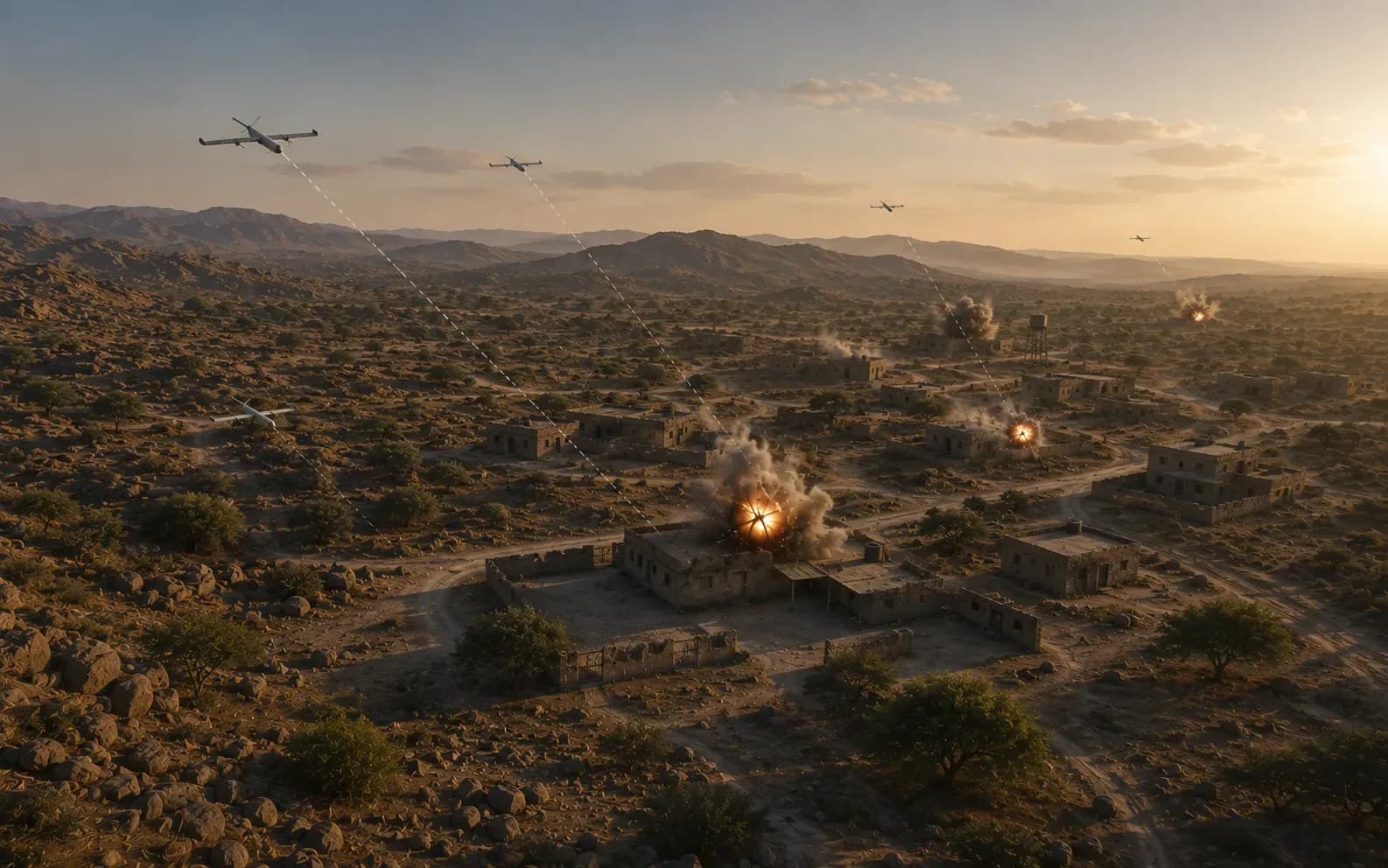
Operation Sindoor drones flew across India's western and northern frontier between 7 May 2025 and 12 May 2025 (Press Information Bureau, 14 May 2025), after the Pahalgam terror attack of 22 April 2025. The DGMO briefing on 12 May 2025 and the Ministry of Defence Year-End Review together describe a four-domain framework. It spans ISR overflight, loitering-munition strike, layered air defence anchored on Akashteer and IACCS, and counter-UAS interception. This article maps the framework and reads the procurement signal that follows.
Anchoring Operation Sindoor in context
Operation Sindoor drones marked the point where India's unmanned capability shifted from isolated platforms to one integrated combat system. The operation began on the night of 6-7 May 2025 after the Pahalgam terror attack of 22 April 2025 took 26 civilian lives. Over the next five days, the Indian Armed Forces struck nine identified terrorist infrastructure locations and defended the western and northern frontier. The operation ended with the DGMO cessation talks on 12 May 2025.
The defining feature of the operation was integration, not inventory. Every unmanned platform operated inside a wider command-and-control architecture in which reconnaissance fed the strike package. Strike systems engaged validated targets while air-defence systems protected friendly assets and counter-UAS units guarded military installations.
This sequence forms the four-domain drone integration framework that anchors the rest of this analysis. Kodainya's continuing coverage of India's defence drone fleet and post-Sindoor doctrine shows how each domain matured separately before May 2025. The convergence is what carries more weight than any single platform list, and the Ministry of Defence later identified it as the operation's defining lesson. The rest of this analysis unpacks each domain in turn, beginning with the reconnaissance signal collected before any kinetic action.
Mapping the four-domain deployment framework
The four-domain drone integration framework explains why Operation Sindoor became a milestone in India's military modernisation rather than a single sortie list. The operation was defined by how reconnaissance, strike, air defence, and counter-UAS capability functioned as one connected combat system (Observer Research Foundation, March 2026). Every unmanned system became one node inside a larger command network that linked sensors, communication infrastructure, decision-support software, and battlefield commanders. The architecture compressed the time between detecting a target and acting on validated intelligence while maintaining continuous protection for friendly forces.
Operational domain | Primary role | Operational objective |
|---|---|---|
Intelligence, Surveillance and Reconnaissance (ISR) | Persistent surveillance and target development | Build the operational picture before action |
Precision strike | Loitering munition employment against validated targets | Destroy designated infrastructure with controlled effects |
Layered air defence | Protection of friendly airspace | Defeat incoming aerial threats while sustaining the strike package |
Counter-UAS | Detection and neutralisation of hostile unmanned aircraft | Protect military assets and sustain operational tempo |
Artificial intelligence supports each domain by accelerating sensor fusion, classifying targets, and prioritising imagery for human review. Computer vision compresses the analyst workload while command authority stays with the officer. Mission-planning software adapts navigation routes against changing conditions, including weather and terrain. None of these systems replaces the commander; they shorten the decision cycle so the commander acts with greater speed and confidence.
The four-domain framework is not unique to India. Ukraine and the contemporary Middle East exhibit similar patterns. What distinguished May 2025 was the architecture operating under Indian doctrine, on Indian terrain, with predominantly indigenous systems (Royal United Services Institute, May 2025). The PIB note on the operation framed the same point in policy language, calling out the convergence of private-sector innovation, public-sector execution, and military vision (Press Information Bureau, 14 May 2025).
Tracing reconnaissance signals before the first sortie
Reconnaissance anchored Operation Sindoor because precision strike is only as effective as the intelligence behind it. The Ministry of External Affairs briefing on 9 May 2025 confirmed that every target engaged during the operation was selected through verified intelligence and carefully scoped planning (Ministry of External Affairs, 9 May 2025). The PIB note on the operation cited a sustained contribution from the National Technical Research Organisation and the Indian Space Research Organisation in the surveillance phase (Press Information Bureau, 14 May 2025).
Indigenous long-endurance reconnaissance carried the aerial layer of this work. Platforms such as DRDO's TAPAS BH-201 Rustom-II are designed for medium-altitude extended-endurance ISR. They remain on station for over 24 hours, providing persistent monitoring without exposing manned aircraft to operational risk. The wider class of MALE, HALE, and HAPS long-endurance drones gives Indian commanders the loiter time needed to confirm target identity before the strike package launches.
ISR drone operations in India now operate as a continuous intelligence cycle rather than a single sortie. Sensor fusion combines radar tracks, electro-optical imagery, satellite returns, electronic intelligence, and human-source verification into one operating picture. The fused picture lets multiple independent sources confirm the same observation before the commander authorises action. That discipline is what made the Operation Sindoor ISR pre-strike phase defensible under domestic and international review.
Examining the loitering munition strike profile
Loitering munitions formed the precision strike layer of Operation Sindoor because they combine persistent surveillance with controlled engagement. Unlike a conventional missile that follows a pre-planned trajectory after launch, a loitering munition can hold over a designated area until operators confirm a valid target. That additional observation window lets commanders match intelligence with battlefield conditions before authorising weapon release. The Press Information Bureau stated that Indian Armed Forces struck nine identified terrorist infrastructure locations during the opening phase of Operation Sindoor on 7 May 2025.
The loitering munition Operation Sindoor profile sits between reconnaissance UAVs and traditional precision-guided weapons. A surveillance platform collects information but carries no strike capability. A conventional missile delivers a payload after launch but cannot reassess the target in flight. A loitering munition does both — observing, classifying, and terminating the mission if conditions change.
The taxonomy matters because the term gets used interchangeably with FPV strike systems and one-way attack drones. Kodainya's standing references on kamikaze drones explained and kamikaze drone versus FPV drone draw the technical lines. For Operation Sindoor, the relevant class was the medium-range loitering munition with a 5 to 10 kilometre warhead delivery profile. The strike-package discipline of observe-confirm-engage supported the calibrated-force characterisation that international analysts later applied to the operation (Royal United Services Institute, May 2025).
Reading the layered air defence response
The layered air defence response carried the protection layer of the four-domain framework. On 12 May 2025, Lt Gen Rajiv Ghai, Director General of Military Operations, briefed the country on the operation (Press Information Bureau, 14 May 2025). He cited the layered AD performance against incoming aerial threats across the western and northern frontier. Air Marshal AK Bharti, Director General of Air Operations, separately credited the indigenous Akash system for sustained performance (Ministry of Defence Year-End Review, 31 December 2025).
The architecture stacked five layers. At the long range sat the surface-to-air missile regiments. At the medium range sat the Akash surface-to-air missile system, indigenous to DRDO and produced under Bharat Dynamics. Short-range quick-reaction systems including QRSAM, shoulder-fired weapons, and low-level AD guns covered the close-in layer.
Holding the stack together was Akashteer air defence command and control, Bharat Electronics' indigenous battle management network. It linked to the IACCS and gave Indian Army commanders the same picture the Air Force already saw. The Akashteer air defence approach treats every battery as a sensor and every interceptor as a shooter inside one shared picture. The MoD year-end review called this layered architecture a defining operational achievement of the campaign (Ministry of Defence Year-End Review, 31 December 2025).
Unpacking counter-UAS network performance under sustained pressure
Counter-UAS Operation Sindoor performance is where India's defensive integration earned its bandwidth. The MP-IDSA counter-drone primer maps the field across three pillars — electronic-warfare soft-kill, kinetic hard-kill, and the directed-energy horizon (MP-IDSA, September 2025). The May 2025 deployment exercised all three under sustained pressure.
The soft-kill layer rests on radio-frequency jamming, GPS denial, and electronic-optical detection sensors. DRDO and Bharat Electronics Limited have built the indigenous EW stack that supported the western frontier through the operation. The D-4 anti-drone system carried the deployable end of that stack, combining detection, classification, and soft-kill jamming in one vehicle-mounted unit.
The hard-kill layer covered the engagement end. Kinetic interceptors handled incoming aerial threats that survived the soft-kill envelope, with the layered AD network detailed in the previous section taking the higher-altitude engagements. Kodainya's broader analysis of counter-drone systems used by Indian forces catalogues the deployable inventory in detail.
What the counter-drone Operation Sindoor experience proved is that no single defensive layer wins on its own. Detection without engagement leaves the target intact; engagement without detection wastes ammunition. The MoD year-end review framed this lesson with policy weight. It recorded emergency procurement powers extended for counter-drone systems, weapon systems, precision ammunition, electronic-warfare equipment, and surveillance kits after the operation (Ministry of Defence Year-End Review, 31 December 2025).
Reviewing emergency procurement and capability acceleration
The emergency procurement drones India deployed during Operation Sindoor opened only one of two windows that the operation forced open. The second window is structural. In the weeks after the May 2025 deployment, the government extended emergency procurement powers to the armed forces. The covered domains spanned drone and counter-drone systems, weapon systems, precision ammunition, electronic-warfare equipment, and surveillance kits (Ministry of Defence Year-End Review, 31 December 2025).
The numbers carry the signal. The Ministry of Defence has stated that 29 capability development schemes were contracted under emergency procurement (Ministry of Defence Year-End Review, 31 December 2025). Another 16 schemes were expected to clear by December 2025. The procurement signal converts the four-domain integration thesis into a budget reality.
The supply side of this signal sits with the indigenous drone ecosystem under Aatmanirbhar Bharat. The Drone Federation India represents over 550 drone companies and 5,500 drone pilots, a base that did not exist at scale before the Drone Rules, 2021 (Press Information Bureau, 14 May 2025). Indian Army formations have absorbed the Operation Sindoor drone deployment lessons into the Technology Roadmap for UAS and Loitering Munitions (Ministry of Defence Year-End Review, 31 December 2025). The roadmap names 30 platform classes across 80 variants for surveillance, strike, air defence, special roles, and logistics.
The procurement window is also a timing signal. Schemes contracted under emergency procurement clear faster than standard Defence Acquisition Procedure cases, which means the next twelve months of unmanned-systems integration will compress earlier-planned multi-year decisions.
Looking ahead to the next doctrine inflection
Operation Sindoor doctrine after May 2025 has moved faster than the platforms underneath it. On Independence Day 2025, the Prime Minister announced Mission Sudarshan Chakra from the ramparts of the Red Fort (Ministry of Defence Year-End Review, 31 December 2025). The Prime Minister named it as the doctrinal extension of the four-domain integration model.
The Indian Army's response carries the structural answer. Drone training centres have been stood up at 19 establishments across the country including the Indian Military Academy, the Officers Training Academy, and the Infantry School (Ministry of Defence Year-End Review, 31 December 2025). Drone operations now sit inside the standard curriculum for officers and soldiers. The doctrinal centre of gravity has shifted from supplementing the rifle to teaching every soldier to fly.
Kodainya's coverage of the Indian Army's Bhairav Drone Force and the path to a 100,000-drone force across the services tracks the scale this implies. The India drone doctrine that follows Operation Sindoor is not a question of platform count. It is a question of how the soldier, sailor, and airman base will be trained to operate inside the four-domain framework.
The next inflection point sits in the procurement window between July 2026 and the end of FY 2027. The 16 schemes due to clear by December 2025 establish the baseline. The next twenty-four months will determine whether the four-domain framework becomes the standard architecture of the Indian battlespace or remains a May 2025 deployment that future operations approximate.