CAQM Statutory Direction 97 takes effect on 1 April 2026. It builds on the September 2025 CPCB OCEMS portal directive and the December 2025 PTZ-camera deadline for NCR industries. Together they shift India's pollution-control architecture from periodic inspection to continuous evidence. Drone pollution monitoring sits inside the gap-evidence-enforcement triad and helps regulators close the vertical gap CAAQMS networks miss.
Mapping the gap CAAQMS networks leave behind
Continuous Ambient Air Quality Monitoring Stations form the backbone of India's air-quality surveillance system, but they were never designed to inspect every pollution source. Drone pollution monitoring fills the operational space between fixed infrastructure and on-ground inspections by collecting evidence where stationary sensors cannot. This is why drone-based air quality monitoring in India is becoming part of CPCB pollution monitoring rather than a replacement for existing systems.
CPCB's National Air Quality Monitoring Programme operates 966 monitoring stations across 419 cities and towns. The network covers 28 States and seven Union Territories. PM2.5 monitoring is available at 611 stations across 277 cities. The stations report against the National Ambient Air Quality Standards and the National Clean Air Programme (Central Pollution Control Board, 19 November 2024).
Fixed stations provide reliable long-term datasets, but they monitor one location at a time. They cannot identify pollution from elevated stacks, distinguish emissions from neighbouring facilities, or inspect temporary dust events across large project sites. They also cannot access restricted assets, conveyors, storage yards, or confined process areas where emissions originate.
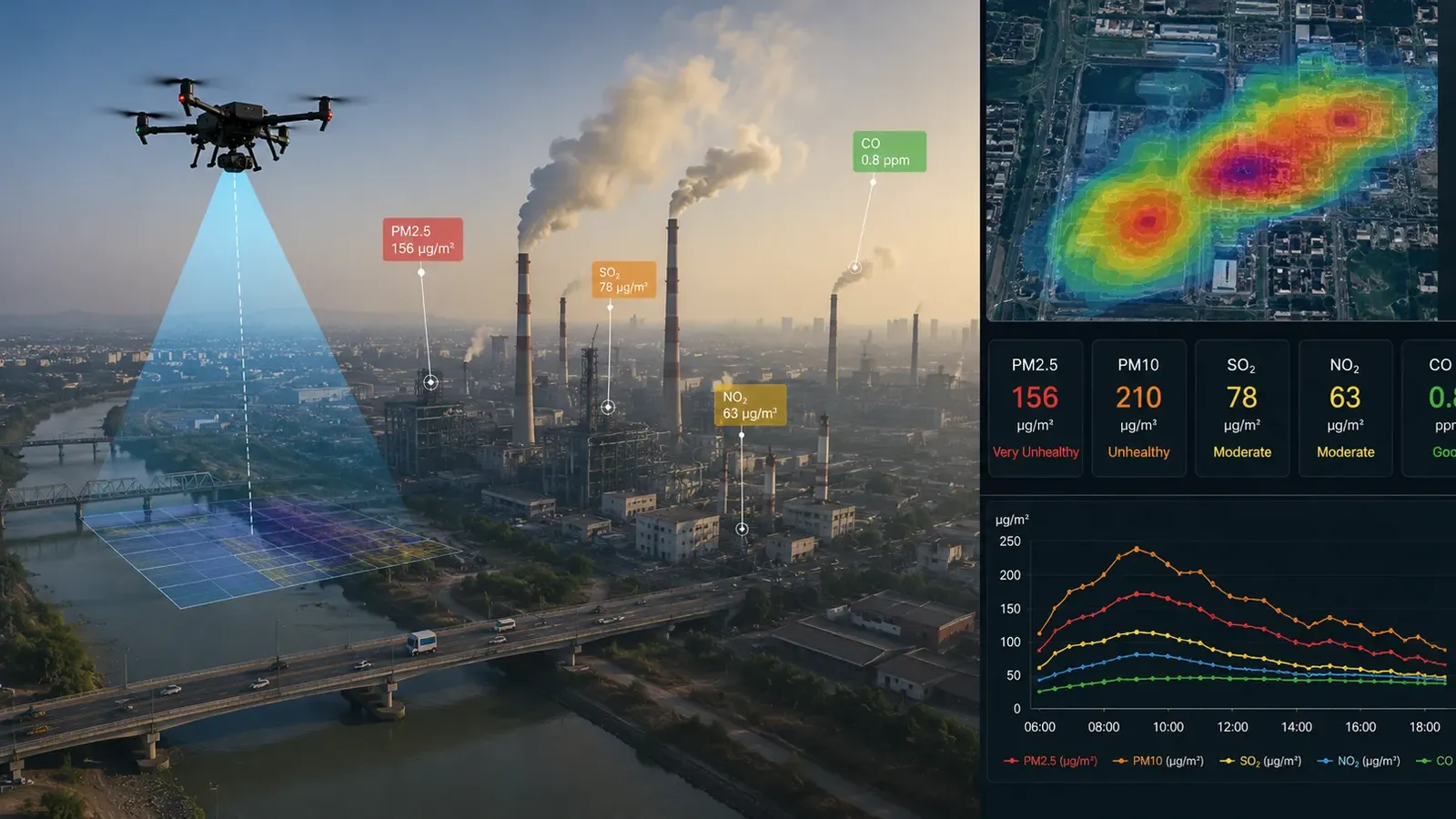
A drone equipped with calibrated sensors closes that operational gap. It follows a planned inspection route, samples emissions at multiple altitudes, and produces geo-tagged measurements linked to coordinates and timestamps. The dataset helps regulators determine whether elevated readings come from a stack, a construction site, waste handling, or another local source.
Tracing the regulatory chain to CAQM Direction 97
Drone pollution monitoring becomes useful only when its findings feed a recognised regulatory process. India's environmental framework already defines how pollution is measured, verified, and enforced. The Air (Prevention and Control of Pollution) Act, 1981, the Water (Prevention and Control of Pollution) Act, 1974, and the Environment (Protection) Act, 1986 anchor that chain.
The Air Act empowers CPCB and State Pollution Control Boards to set standards, inspect facilities, and issue directions. The Environment (Protection) Act extends those powers and lets the Central Government enforce corrective measures (Government of India, Air Act 1981; Government of India, Environment Protection Act 1986).
The CAQM Act, 2021 strengthens this chain for Delhi-NCR. The Commission coordinates enforcement across States and issues statutory directions that bind government agencies and regulated entities (Government of India, CAQM Act 2021).
This chain became data-driven during 2025. On 23 September 2025, CPCB directed industries to register on the upgraded OCEMS and Online Digital Automated Monitoring System portal (Central Pollution Control Board, 23 September 2025). Directives on 1 and 9 October 2025 required NCR industries to install PTZ surveillance cameras and connect CSIR-NPL certified systems to CPCB servers (Central Pollution Control Board, 1 October 2025; Central Pollution Control Board, 9 October 2025).
CAQM Statutory Direction 97, issued on 20 February 2026, added another evidence layer. It requires GPS tracking for construction and demolition waste, geo-tagged collection facilities, and integrated reporting across Delhi-NCR from 1 April 2026 (Commission for Air Quality Management, 20 February 2026). CPCB drone surveillance fits cleanly into this chain. It verifies whether emissions observed in the field match the OCEMS data industries report.
Reading the vertical profile a drone captures
Ambient air quality monitoring measures pollution where people breathe. It cannot describe how pollutants move above ground level. Drone pollution monitoring adds this missing dimension by collecting measurements at multiple altitudes, addressing the drone CAAQMS gap with three-dimensional data.
A CAAQMS samples air from a fixed intake point, typically a few metres above ground. The measurement represents local ambient conditions but does not show whether pollutant concentrations rise higher in the atmosphere. Industrial stacks, thermal inversions, and shifting wind can produce pollution layers that ground instruments miss.
Drone sampling over Delhi shows why this matters. A study published in npj Clean Air on 2 February 2026 measured particulate matter PM2.5 at 100 metres above Delhi. Concentrations were about 60 percent higher than ground-level observations during severe haze. The findings were validated against CPCB monitoring data and improved the scientific picture of vertical particulate transport in dense urban environments (npj Clean Air, 2 February 2026).
Vertical PM2.5 profile measurement strengthens source attribution. Inspectors can sample air at 20-metre intervals and compare particulate concentrations across heights. The technique applies around thermal power stations, volumetric mining survey sites, cement plants, ports, and waste-processing facilities. It also supports pipeline inspection drone workflows where leak detection and fugitive emissions matter.
A drone can be deployed immediately after a citizen complaint, an abnormal OCEMS reading, or an alert during a GRAP enforcement period. Regulators can investigate pollution events while they are still occurring rather than reconstructing them later from static datasets. The value lies in context, not replacement.
Operating safely around industrial stacks and construction sites
Industrial emissions monitoring depends on collecting reliable data without creating safety risks. Drone pollution monitoring missions follow both environmental regulations and aviation rules. Before any inspection begins, operators confirm airspace restrictions, build a safe flight plan, calibrate sensors, and document the evidence chain.
The legal framework starts with the Drone Rules, 2021, which govern civil UAS operations in India. Operators may need prior flight permission through DigitalSky when industrial facilities sit inside yellow airspace zones. The yellow-zone permission flow on DigitalSky sets the operational baseline, and DGCA permission for environmental monitoring is not optional. Every mission complies with airspace restrictions, remote pilot certification, and operational limitations prescribed by the DGCA (Directorate General of Civil Aviation, 25 August 2021).
The Bharatiya Vayuyan Adhiniyam 2024 transition replaced the Aircraft Act, 1934 as India's primary civil aviation legislation (Government of India, Bharatiya Vayuyan Adhiniyam, 2024). The choice of platform also matters. The drone categories under DGCA rules determine which weight class can carry the sensor payload required for a given environmental survey.
The regulatory path matters for construction projects under CAQM Direction 97. From 1 April 2026, construction and demolition activity across Delhi-NCR must maintain GPS-tracked waste transportation, geo-tagged disposal records, and stronger dust mitigation. Drone monitoring construction dust in NCR verifies whether green barriers, wheel-washing systems, anti-smog guns, covered storage, and dust suppression remain operational (Commission for Air Quality Management, 20 February 2026). The use case applies across drone work in the construction industry.
Industrial facilities create their own challenges. Tall stacks generate turbulence, thermal currents, and restricted zones. Inspection flights follow predetermined sampling patterns at safe stand-off distances and multiple altitudes, with sensors calibrated, time-synchronised, and documented before take-off.
Building evidence packs regulators accept
Collecting environmental data is only one part of a compliance inspection. Regulators must also demonstrate the evidence is accurate, traceable, and suitable for enforcement. Drone pollution monitoring documents the inspection process as carefully as it measures emissions. A complete evidence pack links aerial observations to statutory records under the Air Act, 1981.
A typical inspection begins with a documented flight plan covering the mission objective, location, airspace approval, pilot credentials, sensor calibration status, and weather conditions. During the mission, the UAS records GPS coordinates, timestamps, altitude, flight path, imagery, and environmental measurements as a single inspection record. Computer vision applied to emission imagery helps detect visible plumes, fugitive dust, and stack defects from the captured footage.
This matters for OCEMS compliance. More than 4,433 industries across 17 highly polluting sectors transmit continuous emissions data to CPCB and SPCB servers (Press Information Bureau, 30 March 2022). OCEMS provides continuous readings, but regulators still need independent ways to confirm reported values match field conditions. Drone evidence for pollution enforcement fills that verification role inside the CAQM enforcement workflow.
During a site inspection, regulators compare aerial particulate and gaseous measurements with OCEMS values. They observe visible emissions, identify fugitive dust sources, and document operational activities. Where readings align, inspectors gain confidence in the reported data; where they diverge, authorities can open further investigation before notices are issued. The same workflow extends to construction progress monitoring where dust-control verification runs alongside site progress checks.
Evidence quality depends on an unbroken chain of custody. Raw outputs, processed datasets, calibration certificates, imagery, and mission logs stay linked to the original record. Documentation becomes especially important when findings support notices issued by SPCBs or proceedings before the National Green Tribunal.
Pricing the programme against fixed-station spend
Drone pollution monitoring is best evaluated as a targeted inspection capability, not an alternative to permanent infrastructure. CAAQMS and OCEMS run continuously and generate long-term datasets that support regulatory reporting and trend analysis. Drones deploy only when additional evidence is needed.
The economics differ accordingly. A fixed monitoring station needs permanent infrastructure, power, communications, calibration, and long-term operational support. Those costs are justified at strategic locations but hard to scale across every industrial estate, construction project, landfill, mining area, or transport corridor.
Drones follow a different cost model. A single inspection team surveys multiple locations in one operational cycle, collecting imagery, thermal observations, and calibrated measurements without permanent equipment. The platform reassigns as priorities change, suiting temporary investigations, complaint-based inspections, seasonal monitoring, and enforcement campaigns.
This flexibility aligns with India's Drone-as-a-Service procurement model. Instead of buying aircraft, sensors, and software, pollution control authorities contract qualified service providers for defined inspection outcomes. Typical engagements specify survey frequency, sensor requirements, reporting standards, and evidence-delivery timelines rather than aircraft specifications.
For commercial UAS operators, the value proposition extends beyond data collection. Procurement officers assess proposals on planning, regulatory knowledge, sensor calibration, evidence management, and reporting workflows. Procurement decisions now centre on inspection outcomes rather than equipment ownership.
Anchoring environmental compliance in the next inspection cycle
India's compliance system is entering a phase where continuous monitoring, digital reporting, and field verification operate together instead of as separate programmes. Drone pollution monitoring sits inside that integrated framework and supplies evidence fixed networks cannot collect while supporting enforcement powers already available to pollution control authorities.
CAQM Statutory Direction 97 from 1 April 2026 illustrates the transition. GPS-tracked construction waste, geo-tagged facilities, and stronger dust-control verification reshape the inspection environment. Aerial surveys now validate whether mitigation measures hold throughout a project (Commission for Air Quality Management, 20 February 2026). The same trend runs across industrial regulation as OCEMS reporting, PTZ camera deployments, and expanding digital compliance platforms shorten the time between detection and response.
The National Clean Air Programme enters an important review period as India evaluates progress toward PM10 reduction targets across 131 non-attainment cities. Future strategies will emphasise source attribution, rapid incident verification, and evidence-led enforcement during GRAP enforcement cycles (Ministry of Environment, Forest and Climate Change, National Clean Air Programme).
Commercial UAS providers should view this through a compliance lens. Successful environmental monitoring engagements depend on regulatory knowledge, calibrated sensor workflows, documented quality assurance, aviation compliance, and secure evidence management. The full set of Kodainya drone solutions for compliance and inspection maps to this shift.
India's next phase of environmental compliance will be shaped by organisations that combine statutory knowledge, verified evidence, and safe UAS operations into a single inspection workflow.