Drone pipeline inspection in india sits at the intersection of three rule sets. Petroleum and Natural Gas Regulatory Board technical standards, Oil Industry Safety Directorate integrity codes, and the DGCA Drone Rules together govern how operators fly. India operated 24,945 km of natural gas pipelines as of 30 September 2024, with another 10,805 km under construction (Press Information Bureau, 7 January 2025). This piece maps the patrol-detect-document triad against GAIL, IndianOil and ONGC programmes, the payload stack operators field, and the BVLOS gap that constrains long-corridor flying.
Mapping india's pipeline grid and where drones fit
Drone pipeline inspection forms one layer inside a broader pipeline monitoring strategy. Operators combine aerial surveillance, ground patrols, fibre-optic sensing, SCADA, pressure analytics and maintenance records to protect long-distance pipeline corridors.
India's oil and gas network now spans more than 34,000 km of operational transmission infrastructure across natural gas and petroleum product pipelines (Press Information Bureau, 7 January 2025). That scale makes manual inspection alone impractical. Remote corridors pass through forests, agricultural land, rivers, industrial zones and expanding urban areas where encroachment risks change continuously.
Traditional inspection cycles depend on scheduled patrol teams. A pipeline inspection drone shortens those cycles by collecting georeferenced imagery, thermal data and terrain models without sending personnel along the full right of way. The economics improve sharply when drone surveillance of pipeline corridors replaces helicopter sorties. Drone surveying and mapping in india routinely covers 50 to 100 km of route in a single working day depending on terrain.
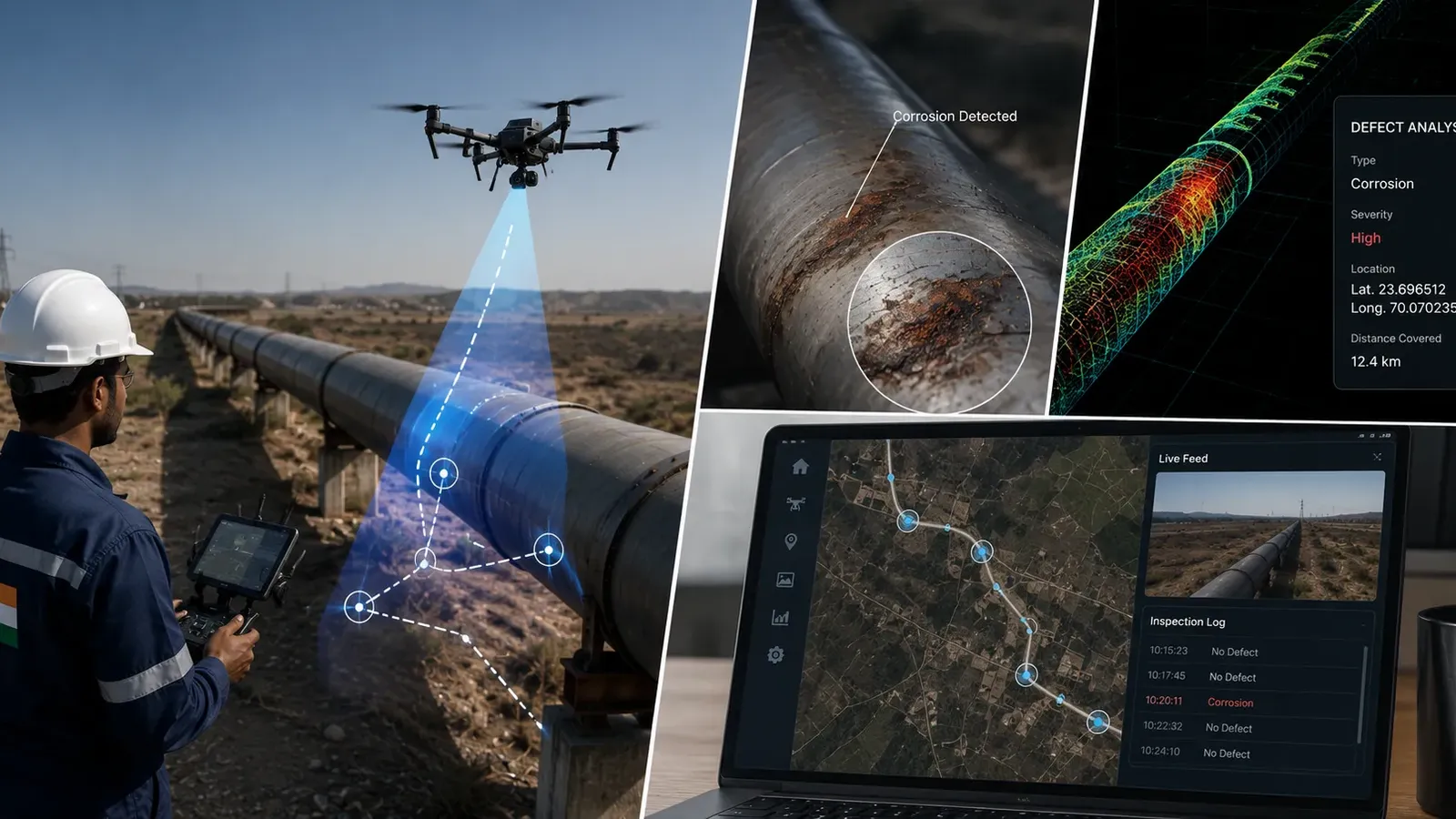
A single flight generates multiple inspection products at once. High-resolution imagery supports corridor surveillance while thermal cameras flag abnormal heat signatures. Computer vision algorithms classify vegetation growth, excavation activity and construction equipment that may indicate third-party interference. Survey payloads also create accurate digital records for future comparison.
Unlike crewed aircraft, small unmanned aircraft inspect specific pipeline sections repeatedly with lower operational overhead while capturing centimetre-level imagery suitable for engineering documentation.
Patrolling right of way and detecting encroachment
Right of way monitoring focuses on protecting the land surrounding a pipeline from activities that threaten safe operation. Drone pipeline inspection lets operators patrol these corridors more frequently while documenting every observation with precise location data.
GAIL drone pipeline surveillance dates back to 2017, when the company piloted aerial coverage of sections of the Hazira-Vijaipur-Jagdishpur (HVJ) pipeline and the Chambal ravines. The programme used drones to monitor inaccessible terrain where conventional patrols required substantial manpower (Business Standard, 6 December 2017). The pilot followed the June 2014 explosion at GAIL's pipeline near Nagaram in Andhra Pradesh. The blast killed 18 people and prompted PNGRB to review the operator's safety framework (Oil Industry Safety Directorate, November 2024).
IndianOil pipeline drone monitoring followed a similar trajectory across the Mathura-Jalandhar product pipeline. The company also expanded its Pipeline Intrusion Detection Warning System, which now covers 5,474 km of pipeline length on optical fibre sensing (Business Standard, 25 August 2021). The system complements aerial surveillance rather than replacing it.
Drone imagery supports the integrity team across four parallel objectives. Aerial patrols flag unauthorised excavation close to buried pipelines and identify fresh construction activity inside the right of way. Each flight also records vegetation changes that obstruct inspection access and produces evidence for maintenance planning and the audit records PNGRB and OISD inspectors review later.
Modern inspection workflows now combine onboard edge processing with computer vision models as standard. Operators receive prioritised alerts highlighting excavation equipment, heavy vehicles or newly disturbed ground for further assessment. BVLOS rules in india still govern how far the camera can fly from its pilot. Human inspectors validate operational decisions before maintenance teams respond.
Pipeline encroachment detection therefore becomes a continuous surveillance process rather than a periodic visual exercise.
Finding leaks with thermal and methane payloads
Pipeline leak detection drone payloads extend inspection beyond visible imagery. Their primary value comes from carrying specialised sensors that identify anomalies invisible to standard optical cameras.
Thermal infrared payloads detect abnormal surface temperature patterns around buried pipelines, with anomaly thresholds running as low as 0.05 to 0.1 °C under stable atmospheric conditions. Optical Gas Imaging (OGI) systems visualise hydrocarbon emissions when ambient contrast allows. Tunable Diode Laser Absorption Spectroscopy (TDLAS) sensors measure methane concentration remotely across gas infrastructure. Reported sensitivity sits in the range of 1 to 5 ppm above background at 30 to 60 m line of sight.
Each payload serves a different purpose. Thermal sensors flag abnormal heating or cooling patterns along the buried line. Methane leak detection drone payloads quantify gas concentration over an active corridor. High-resolution optical cameras document the surrounding environment for the maintenance team.
The limits matter. OGI does not penetrate the ground, and TDLAS measures only the integrated methane concentration along the laser path. Thermal contrast depends on the temperature differential between the product and the surrounding soil. None of these payloads replace subsurface integrity tools such as inline inspection pigs or instrumented leak detection systems; they screen and prioritise.
Artificial intelligence strengthens the workflow by processing inputs from multiple sensors at once. Sensor fusion algorithms combine thermal imagery, optical imagery, GPS coordinates and historical inspection records into one operational dataset. Integrity teams receive a consolidated anomaly report ranked by inspection priority, and computer vision now drives the classification layer.
Repeated flights across identical routes help engineers compare seasonal changes, verify repairs and identify degradation trends before failures occur. The algorithm identifies inspection candidates, while qualified engineers evaluate findings against established integrity procedures.
Surveying corridors with lidar and photogrammetry
LiDAR pipeline survey work produces three-dimensional representations of pipeline corridors that optical imagery alone cannot match. Photogrammetry drone workflows generate accurate orthomosaic imagery and terrain models from overlapping aerial photographs.
Both technologies support drone pipeline inspection, but they solve different engineering problems. Pipeline corridor photogrammetry in india captures detailed visual records suitable for documenting vegetation, road crossings, drainage channels and construction activity. LiDAR measures terrain structure through vegetation, producing accurate elevation models where optical imagery cannot reach ground features. Reported vertical accuracy on survey-grade systems runs between ±2 cm and ±5 cm at point densities of 50 to 200 points per square metre.
Survey-grade positioning carries the dataset's authority. RTK and PPK positioning improves positional accuracy, allowing inspection datasets collected months apart to align consistently for engineering comparison. The same alignment supports cathodic protection surveys, where engineers track the spacing and condition of CP test posts along a buried corridor.
These datasets support corridor planning, erosion monitoring, slope assessment and infrastructure documentation, the same asset-inspection stack behind wind turbine inspection drones. Each output feeds the integrity engineer's geohazard model rather than sitting in a separate visual archive.
ONGC operates 336 offshore and 609 onshore installations, while india's petroleum pipeline system continues expanding across diverse operating environments (Oil Industry Safety Directorate, November 2024). ONGC drone aerial survey work, alongside crude oil pipeline corridor coverage, reduces inspection time across these geographically dispersed assets while improving record quality. As classification models mature, drone survey crews can identify terrain changes, water accumulation, vegetation growth and surface disturbance automatically across repeated corridor surveys.
Documenting inspections for OISD and PNGRB audits
Documentation completes the patrol-detect-document workflow. Inspection only creates operational value when findings become traceable engineering records.
PNGRB pipeline safety standards set the floor. The Petroleum and Natural Gas Regulatory Board Technical Standards and Specifications for Petroleum and Petroleum Product Pipelines Regulations came into force in 2014 (Petroleum and Natural Gas Regulatory Board, 2014). The T4S framework governs pipeline design, materials, fabrication, corrosion control, operation, maintenance and safety. The Oil Industry Safety Directorate codes sit alongside the T4S framework and run through 121 separate OISD standards covering everything from refinery furnaces to LPG installations (Oil Industry Safety Directorate, November 2024).
OISD compliance drone inspection therefore lives at the documentation layer. Drone inspection supports these obligations by generating time-stamped imagery, flight logs, georeferenced observations and inspection reports that remain available for future audits. Digital inspection records also improve maintenance planning, since engineers can compare historical datasets before scheduling excavation or repair work. Instead of relying solely on written observations, inspection teams review visual evidence collected during previous flights.
This is the editorial point that separates drone pipeline inspection from drone demonstrations: every flight produces an artefact a PNGRB or OISD auditor can read. Pipeline monitoring becomes a permanent information layer rather than a one-off patrol decision.
The documentation approach scales with the pipeline network. Every additional kilometre adds inspection workload, while digital records improve consistency across multiple operating regions. Drone operations therefore function as an information system as much as an aerial surveillance capability.
Closing the BVLOS gap for long-corridor flying
Beyond Visual Line of Sight (BVLOS) operations represent the next major step for the BVLOS pipeline drone. The Drone Rules, 2021 established india's regulatory framework for civil drone operations under the Ministry of Civil Aviation (Ministry of Civil Aviation, 25 August 2021). These Drone Rules now operate under the Bharatiya Vayuyan Adhiniyam 2024, which superseded the Aircraft Act of 1934 as the foundation statute for civil aviation. Commercial operations continue under Visual Line of Sight conditions unless a specific BVLOS permission applies.
Long-distance pipeline corridors create a practical challenge because inspection routes frequently extend well beyond visual range. A 200 km HVJ surveillance pass cannot be flown one visual-line-of-sight hop at a time. The same goes for a 120 km Delhi-Panipat segment of the Mathura-Jalandhar product pipeline or a multi-state crude oil corridor. DGCA BVLOS approval pipeline work therefore becomes the operational ceiling on how scaled drone patrolling can grow.
International regulators have begun recognising drone-based right-of-way patrols more explicitly. The United States Pipeline and Hazardous Materials Safety Administration issued a direct final rule on 1 July 2025 (US Federal Register, 1 July 2025). The rule states that drone and satellite technology is eligible for inspecting pipeline rights-of-way under 49 CFR §195.412. The European Union Aviation Safety Agency separately publishes a Predefined Risk Assessment for line inspection (PDRA-G03) that defines BVLOS conditions for linear-infrastructure flying.
India has not yet adopted an equivalent pipeline-specific BVLOS operating framework. Future policy development may include standard operational scenarios for long linear infrastructure. Qualified operators could then inspect extensive pipeline corridors under defined safety conditions while maintaining DGCA oversight.
Building the PSU drone programme from pilot to integrity workflow
Indian pipeline operators no longer evaluate drones as standalone flying cameras. They evaluate them as inspection platforms integrated with digital maintenance systems, sensor analytics and compliance workflows.
The progression follows a consistent maturity path. Pilot demonstrations validate operational feasibility before routine patrols establish inspection procedures. Integrated digital workflows then connect aerial surveys with maintenance planning, engineering documentation and regulatory reporting. Drone-as-a-service in india underpins much of this delivery model, since few PSUs build full in-house drone fleets at scale.
The same model already shows up in adjacent inspection work, from wind turbine blade inspection to drones in indian railways. Artificial intelligence will strengthen this progression by accelerating image review, anomaly classification and maintenance prioritisation. Human engineers continue making operational decisions while software reduces inspection workload and improves consistency across thousands of inspection images.
For procurement teams, the primary question is no longer whether drones can inspect pipelines. The question is how aerial inspection integrates with existing integrity programmes governed by PNGRB standards, OISD guidance and DGCA flight regulations. The pipeline monitoring layer that PSUs build today becomes the audit trail PNGRB and OISD inspectors examine tomorrow.
The next twelve months will show whether DGCA issues a pipeline-specific BVLOS standard scenario. The same window will test whether PNGRB writes drone-based ROW patrolling explicitly into its T4S regulations. It will also signal whether GAIL, IndianOil and ONGC move from per-corridor pilots to operator-wide drone fleets. The trajectory points toward inspection systems where autonomy, computer vision and mission software sit inside the infrastructure lifecycle rather than alongside it as separate technology demonstrations.