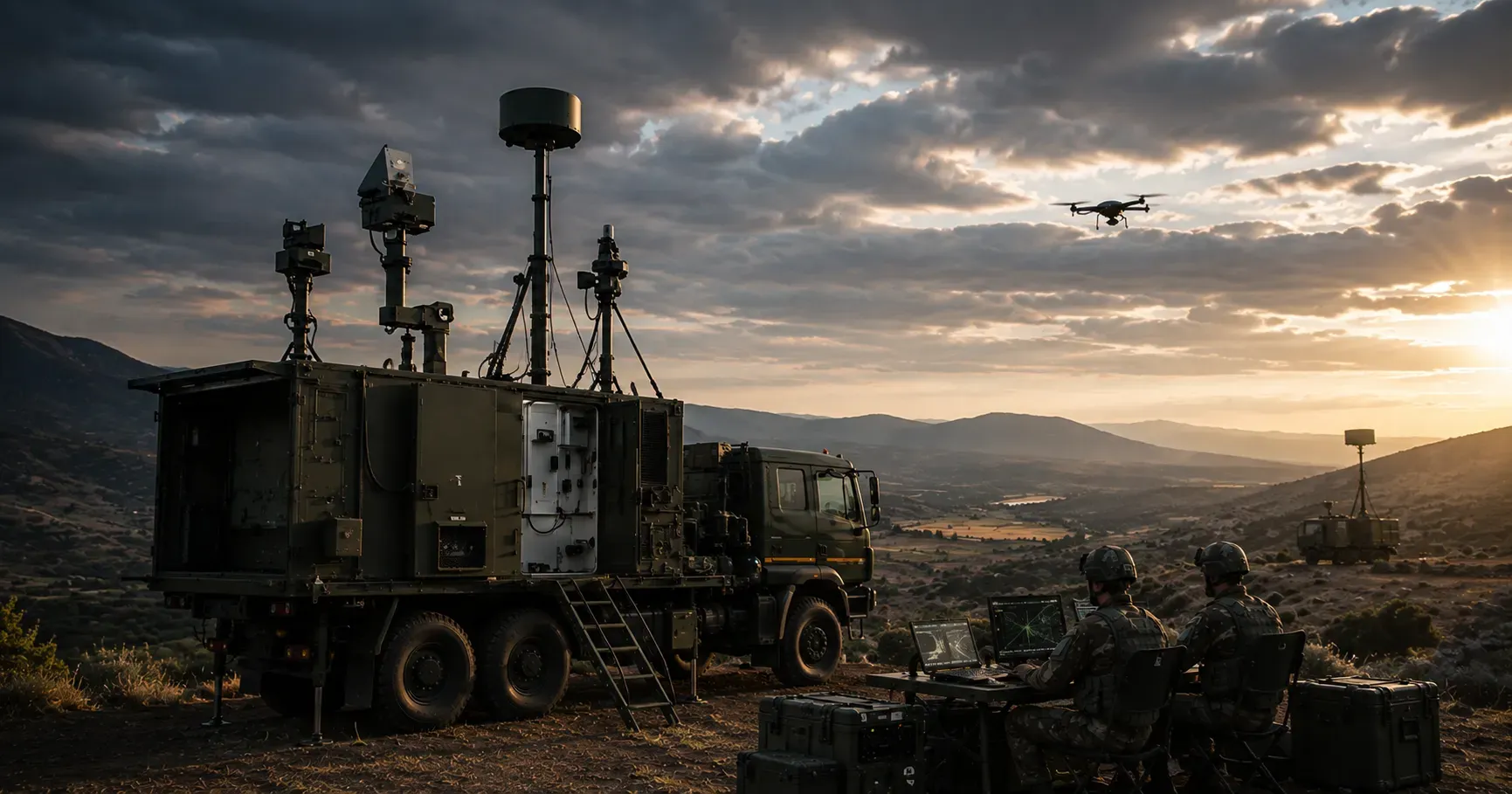
GPS spoofing in Indian defence drones moved from a technical vulnerability to an operational requirement during the 2025 electronic warfare cycle. The September 2025 Dehradun trials, where forty-six indigenous manufacturers failed GPS-denied evaluations (India Today Investigation, September 2025), turned the threat into a procurement gate. The response is layered, not singular. A four-layer resilience stack of NavIC-anchored GNSS diversity, inertial navigation, vision-aided fixes, and antenna hardening shapes the indigenous answer.
Defining GPS spoofing in contested airspace
GPS spoofing occurs when a false satellite-navigation signal is transmitted to a drone, causing its navigation system to calculate an incorrect position. Unlike GNSS jamming, which blocks navigation signals to drones outright, spoofing deceives the aircraft into believing the false coordinates are genuine.
For defence operators, the distinction matters. A jammed drone may lose navigation capability and trigger fail-safe procedures. A spoofed drone can continue flying while drifting away from its intended route. That makes spoofing a serious challenge for unmanned systems operating near contested borders and military formations.
The challenge sits within the wider cyber-resilience environment discussed in India's drone cybersecurity framework. While the Bharatiya Vayuyan Adhiniyam 2024 provides the broader civil aviation framework, military operators face a separate challenge where navigation integrity must survive hostile electronic conditions.
GPS spoofing in Indian defence drones is therefore not merely a navigation problem. It is a mission assurance problem. A reconnaissance drone that cannot trust its location data cannot reliably deliver intelligence, target coordinates, or battle damage assessments.
The concern moved beyond theory after the Indian Army embedded electronic warfare simulations into field demonstrations across Babina, Pokhran, Joshimath, Agra, and Gopalpur (Press Information Bureau, 27 May 2025). The Capacity Development Demonstrations signalled that electronic warfare conditions had become a standard evaluation parameter, not a specialist test category.
Tracing how the threat reached India's western frontier
The operational context changed during the Operation Sindoor electronic warfare lessons of May 2025. Public discussion around drone survivability shifted from endurance, payload, and range toward navigation resilience and GPS denied navigation.
The Indian Army's expanding use of unmanned systems highlighted a fundamental reality. A drone that depends on a single satellite-navigation source becomes vulnerable in electronically contested environments. Defence analysts had already flagged how Indian Army handles GPS denied environments and the need for satellite-navigation alternatives in military operations (Observer Research Foundation, 5 December 2023).
The Army's May 2025 demonstrations marked the first official indication that electronic warfare conditions had moved into standard evaluation, not a specialist test category (Press Information Bureau, 27 May 2025). Four months later, the Dehradun trials produced a result that drew attention across the defence ecosystem. The India Today investigation documented that forty-six indigenous drone manufacturers failed GPS-denied evaluations during the exercise (India Today Investigation, September 2025).
That outcome changed procurement conversations. Navigation resilience became a measurable requirement rather than an engineering aspiration. The shift accelerated interest in India's defence drone fleet after Operation Sindoor and in how India's anti-drone systems handle GNSS jamming.
The lesson from these trials was direct. Future military drones must assume that satellite navigation signals may be unavailable, degraded, or manipulated during operations.
Mapping the four-layer resilience stack
The indigenous response across government programmes, military trials, and defence research is best understood as a four-layer navigation resilience stack. Each layer addresses a different mode of attack inside the electronic warfare environment Indian drone operators now face.
Layer | Function | Primary role |
|---|---|---|
GNSS diversity | Multiple navigation constellations including NavIC | Reduces dependence on a single source |
Inertial backbone | Internal motion measurement | Maintains navigation without external signals |
Vision-aided positioning | Terrain and feature recognition | Corrects accumulated drift |
Antenna hardening | Signal filtering and protection | Improves resistance to interference |
Each layer compensates for limitations in the others. Satellite navigation provides absolute positioning. Inertial systems continue operating during signal loss.
Vision-based systems validate location estimates using ground features. Antenna technologies reduce exposure to hostile signals before they enter the navigation chain.
This layered approach mirrors broader developments in autonomous drones and the sensor-fusion stack, where multiple sensors contribute to a common navigation solution. The principle is direct: redundancy reduces single-point failure.
The significance of the framework lies in redundancy. No individual technology eliminates spoofing risk. The combination creates resilience.
Building NavIC into the indigenous drone navigation backbone
NavIC drone navigation forms the first layer of India's long-term response. Developed by ISRO and the Department of Space, NavIC provides regional positioning, navigation, and timing services 1,500 kilometres beyond India's landmass (Department of Space, 4 August 2022).
The launch of NVS-01 on 29 May 2023 introduced a second-generation NavIC satellite equipped with an indigenous atomic clock and L1-band capability (ISRO, 29 May 2023). The subsequent NVS-02 mission on 29 January 2025 carried additional L1-band capability and marked ISRO's 100th launch from Sriharikota (Press Information Bureau, 29 January 2025).
For defence integrators, NavIC L1 band drone navigation matters because L1 compatibility broadens receiver options while preserving NavIC's regional architecture. The dual-frequency design using L5 and S-band signals also provides technical advantages for position calculation and signal validation (Department of Space, 4 August 2022). Programmes such as Akashteer and the indigenous air-defence command and control loop demonstrate how indigenous positioning services support military command networks.
NavIC is not a single-source replacement for GPS. The NVS-02 satellite reached its transfer orbit on 29 January 2025, but the orbit-raising sequence could not be completed because the oxidiser valves did not open (Press Information Bureau, 29 January 2025). ISRO has signalled NVS-03, NVS-04, and NVS-05 launches to restore constellation redundancy and strengthen coverage for defence applications.
NavIC also reduces strategic dependence on foreign satellite navigation systems. That sovereignty matters because access to civilian GPS, GLONASS, Galileo, or BeiDou cannot be assumed in a contested theatre.
Pairing inertial systems with terrain-aided fixes
An inertial navigation system drone architecture provides the second layer of resilience. Unlike satellite navigation, inertial systems do not depend on external signals. They calculate position using accelerometers and gyroscopes that measure motion continuously.
This capability matters during signal denial events. Even when satellite-navigation inputs disappear, the aircraft continues estimating its location using onboard sensors.
The challenge is drift. Small measurement errors accumulate over time and gradually reduce positional accuracy. That is why inertial navigation for Indian military drones works best when combined with additional correction mechanisms.
DRDO-supported field trials with an Indian Air Force transport-aircraft squadron at Chandigarh demonstrated horizontal accuracy of 1.2 metres and vertical accuracy of 2.0 metres using IRNSS (DRDO, May 2022). The study indicates that even pre-NavIC-L1 hardware delivers usable positioning under controlled conditions, which sets a baseline the four-layer stack now extends.
Modern military drone architectures therefore combine inertial navigation with terrain-referenced updates, map matching, and visual corrections. Similar concepts appear in RTK and PPK positioning for centimetre-grade GNSS accuracy, though defence applications operate under different operational tolerances.
The result is a navigation backbone capable of bridging temporary satellite outages while preserving mission continuity. Tactical-grade inertial units carry cost, weight, and integration penalties that small platforms must absorb, which is why hybrid stacks remain the indigenous design choice.
Reading the battlefield through vision and feature matching
Vision-aided navigation drone systems represent the third layer of the resilience stack. Instead of relying on satellite signals, these systems compare live imagery against known terrain features, maps, and landmarks.
The approach is especially relevant when electronic interference affects satellite navigation. Cameras, optical sensors, and onboard processing can identify roads, rivers, terrain edges, and infrastructure features that assist position estimation.
Visual inertial odometry for defence drones combines image processing with inertial measurements. The algorithm identifies changes between successive frames and calculates movement relative to the environment. When fused with inertial navigation data, the resulting position estimate remains usable even without GNSS inputs.
The concept connects directly with Indian Army FPV drone doctrine, where onboard autonomy reduces dependence on a tether to ground-control links. Readers approaching the platform layer can ground the discussion in the fundamentals of how drones work. As onboard processing capability improves, drones perform more navigation tasks without constant dependence on external positioning systems.
Vision-based navigation is not a replacement for satellite navigation. Weather, lighting conditions, and terrain characteristics still influence performance. Its value lies in providing an additional independent source of navigation information.
Hardening antennas and signal processing against jamming
The fourth layer focuses on preventing hostile signals from corrupting navigation systems in the first place. Controlled reception pattern antenna drone technologies, commonly referred to as CRPA systems, use advanced antenna designs and signal-processing techniques to reduce susceptibility to interference. Instead of accepting signals uniformly from all directions, these systems suppress unwanted transmissions while preserving legitimate satellite signals.
CRPA antenna drone India solutions gained traction after electronic warfare trials exposed the vulnerability of conventional navigation architectures. Defence planners evaluating counter-drone systems in India now treat antenna hardening as part of the overall survivability package rather than a standalone subsystem. The same logic applies to the most advanced military drones in India, where ECCM features have moved from option to baseline.
Signal authentication, adaptive filtering, and interference detection provide additional protection layers. Together, these technologies help identify suspicious signals before they influence navigation calculations.
The objective is direct. If spoofed signals never enter the navigation chain, downstream correction systems face a smaller burden.
Acting on the September trial verdict
The September 2025 Dehradun trials delivered a procurement signal as much as a technical assessment. The failure of forty-six manufacturers under GPS-denied conditions documented a capability gap between conventional drone architectures and future military requirements (India Today Investigation, September 2025).
Subsequent reporting connected the outcome to a broader Emergency Procurement-6 cycle valued at ₹9,000 crore, where navigation resilience became an important evaluation criterion (Raksha-Anirveda, 7 December 2025). The procurement message reframed electronic warfare testing for Indian drones as a baseline gate, not a stretch goal.
For defence integrators, the message is direct. Future platforms must demonstrate survivability under electronic warfare conditions rather than relying on favourable signal environments. For procurement officers, the implication is equally direct. Tender language is moving toward measurable resilience requirements covering NavIC compatibility, inertial performance, vision-assisted navigation, and antenna hardening.
The shift mirrors a broader doctrinal evolution. Drones are no longer assessed only on what they can do when signals are available. They are assessed on what they continue doing when those signals disappear.
The next phase of indigenous drone navigation rests on three moves. NVS constellation completion, tighter integration between NavIC and military command networks, and procurement frameworks that treat GPS-denied operation as a baseline requirement.