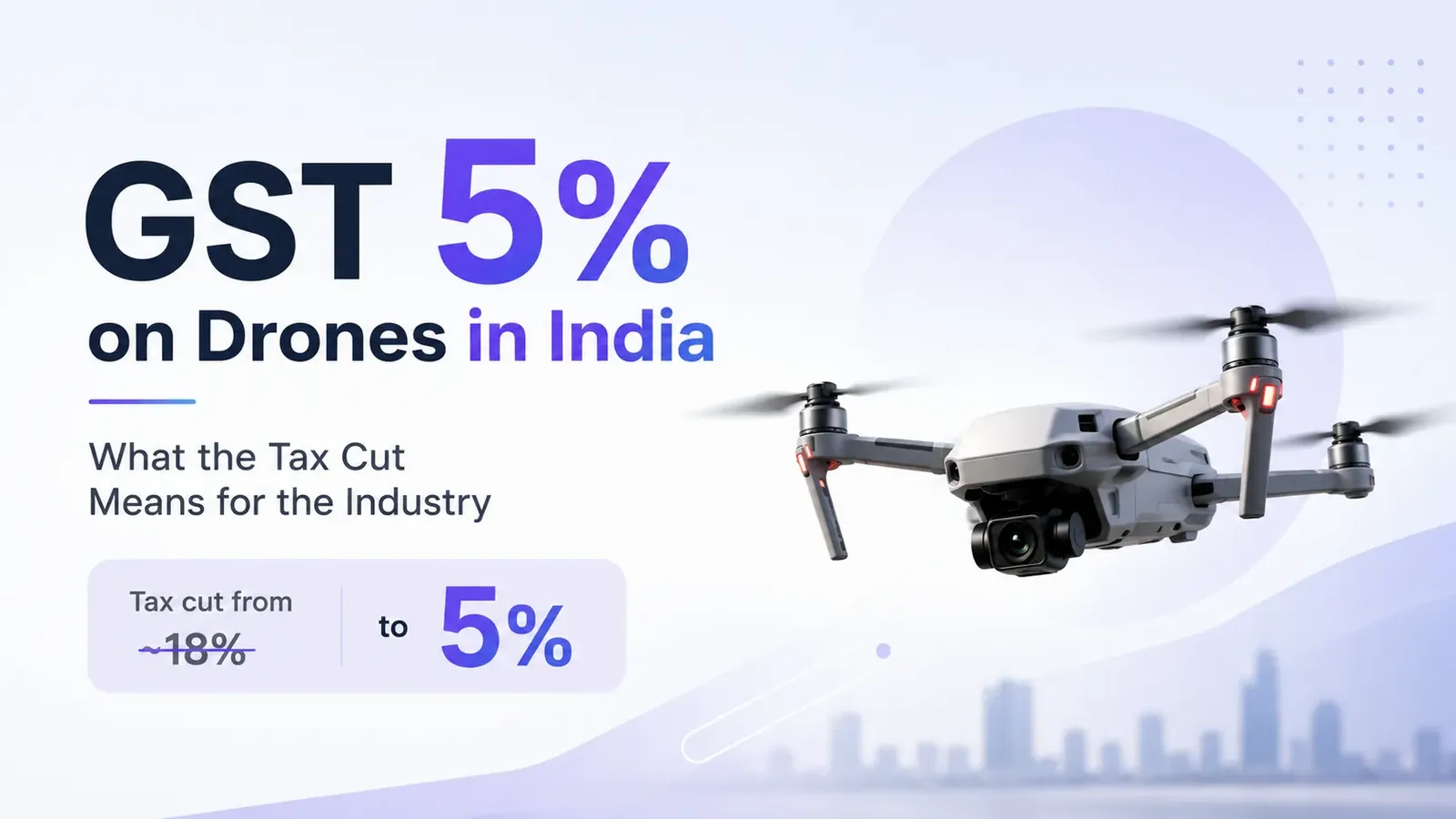
GST on drones in India moved to a uniform 5% rate at the 56th GST Council meeting on 3 September 2025. The change took statutory effect from 22 September 2025 under Notification No. 9/2025-Central Tax (Rate) (CBIC, 17 September 2025). Using the Council-notification-operator-reality framework, this article examines what changed, where the benefits accrue, and why the inverted duty structure remains the defining issue for Indian drone manufacturers.
Tracing the GST decision from the 56th Council meeting
The 56th GST Council drone decision capped six months of consultation. The process began on 21 March 2025, when drone-related stocks on Indian exchanges rallied on early signals of a rate cut. GST on drones in India had become a known classification mess, with similar platforms taxed at 5%, 18%, or 28% depending on configuration.
Chaired by Finance Minister Nirmala Sitharaman, the Council met on 3 and 4 September 2025 and recommended a uniform 5% rate (GST Council, 3 September 2025). Civil Aviation Minister Ram Mohan Naidu framed the rationalisation as the largest indirect-tax intervention in the sector since the Drone Rules 2021.
The decision aligns the GST architecture with the Next Generation GST reforms announced from the Red Fort on 15 August 2025 (Press Information Bureau, 9 September 2025). For drone operators and manufacturers, the rate change is the demand-side counterpart to the supply-side incentives already in place. Those incentives sit inside India's broader drone regulation framework through the Production Linked Incentive scheme for drones and the Drone Shakti Mission.
The Ministry of Civil Aviation projected the domestic drone market could reach USD 1.8 billion by 2030 (Ministry of Civil Aviation, 9 September 2025). The 5% GST on drones is the price-side instrument designed to unlock that demand.
Reading the HSN dispute the rate change resolved
The drone GST rate dispute before September 2025 was fundamentally a classification problem. Drones for business use sat under HSN 8806 as aircraft and attracted 5% GST. Drones with integrated cameras fell under HSN 8525 alongside digital cameras at 18%, while drones classified for personal use, still under HSN 8806, attracted 28%.
The result was that two functionally similar platforms could attract a four-and-a-half-fold difference in tax purely on configuration. Integrated cameras drove a sizeable share of the enforcement disputes.
A survey drone carrying imaging optics could be assessed as aircraft or as a digital camera depending on which HSN line an officer applied. Operators and importers absorbed assessment notices on the question. The drone HSN classification dispute became a structural drag on procurement planning because invoicing tolerance and Input Tax Credit recovery both swung on the classification call.
The 56th GST Council resolved the dispute by making the HSN line irrelevant for rate purposes. A uniform 5% rate now applies to all drones, whether or not they carry integrated cameras. Commercial and personal end uses receive the same treatment (CBIC FAQ-2, 16 September 2025).
For procurement officers running multi-state fleet purchases, the call no longer turns on whether the camera is detachable. For Type Certification under CSUAS buyers, the rate is now decoupled from product configuration entirely. The decision does more than reduce the rate; it reduces transaction uncertainty across the procurement cycle.
Mapping the notification mechanics and effective dates
Notification No. 9/2025-Central Tax (Rate), issued on 17 September 2025 and effective from 22 September 2025, operationalised the Council's recommendation through statutory rate notification (CBIC, 17 September 2025). The notification superseded the original master rate schedule under Notification 01/2017-Central Tax (Rate) and aligned CGST treatment with parallel notifications covering IGST and UTGST. Notification 9/2025 drones therefore moved through three parallel statutory instruments at the same time.
The drone GST rate before and after the change tracks across three buckets. Commercial drones moved from a split 5% or 18% bracket to a uniform 5%. Consumer and recreational categories moved from up to 28% to 5%. Defence-grade categories and specified simulators moved to nil rate.
Category | Before reform | After reform |
|---|---|---|
Commercial drones | 5% or 18% depending on classification | 5% |
Consumer and recreational categories | Up to 28% in some cases | 5% |
Defence carve-out categories | Different treatment depending on item | Nil for specified categories |
Simulator ecosystem | Mixed treatment | Exempt for specified categories |
For businesses importing drones, the effective date matters separately from the rate itself. Inventory invoiced before 22 September 2025 carries the old rate. Goods cleared by customs after 22 September 2025 fall under the revised schedule.
Import duty sits separately from GST. The drone import duty India regime is governed by the Directorate General of Foreign Trade and runs through customs notifications, not the GST Council. Operators tracking landed cost should reconcile the GST change against drone import duty norms and the basic customs duty schedule.
Unpacking the zero-GST carve-out for defence drones
Defence drone GST treatment is the principal carve-out inside the reform. The exemption covers flight simulators, motion simulators, high-performance batteries used in defence-grade systems, and specified communication equipment (Ministry of Civil Aviation, 10 September 2025). The carve-out architecture sits alongside the 5% commercial slab as a deliberate two-track design.
The flight simulator GST exemption India regime follows a design precedent set in July 2024. On 15 July 2024, the government extended uniform 5% IGST treatment to aircraft and engine parts (Ministry of Civil Aviation, 15 July 2024). In both cases, the objective was to align taxation with strategic industrial goals rather than treat capital goods as consumer items.
For defence organisations, training infrastructure carries the same weight as platform acquisition. Drone operations rely on simulator environments that reproduce mission planning, sensor workflows, route optimisation, and operator decision-support processes. The drone simulator GST exemption lowers the cost of building those training ecosystems and accelerates the pace at which armed forces can scale operator output. The Civil Aviation Minister noted that the carve-out helps airlines, defence academies, and certification schools reduce capital expenditure on training (Press Information Bureau, 9 September 2025).
The result is a two-track tax architecture. Commercial operators receive a uniform 5% rate while defence-related training and capability categories receive targeted exemptions supporting the indigenous defence drone fleet build-out under Atmanirbhar Bharat. The carve-out is therefore not a discount; it is a procurement instrument.
Calculating the operator-side working capital gain
The operator-side arithmetic is the easiest part of the reform to model. For a Type-Certified spraying drone with an ex-GST price near ₹6 lakh, the rate change moves the tax outlay from 18% to 5%. The shift releases ₹78,000 of working capital per aircraft (Quality Council of India, CSUAS Scheme Documentation).
The effect compounds with fleet size. GST on commercial drones India therefore matters when scaled across drone-as-a-service rollouts rather than single-aircraft purchases.
Fleet size | Approximate working capital released |
|---|---|
1 drone | ₹78,000 |
10 drones | ₹7.8 lakh |
100 drones | ₹78 lakh |
500 drones | ₹3.9 crore |
For drone-as-a-service operators, the released capital flows into pilot training, spare inventories, maintenance infrastructure, sensor payloads, or software systems. The shift is sharpest in agri-spray and survey contracts, where deployment economics depend on fleet utilisation rates and amortised acquisition cost.
The Ministry of Civil Aviation projects the domestic drone market could reach USD 1.8 billion by 2030 (Ministry of Civil Aviation, 9 September 2025). A 13-percentage-point reduction in indirect tax compounds across that projected demand curve. Aggregated across the next five years of fleet build-outs, the working capital released sits in the low thousands of crore rupees.
The released capital does not flow directly into AI capability development. But it expands the operator's ability to fund payload software, computer-vision modules, and edge-inference platforms that anchor AI-led drone operations.
Examining the inverted duty structure for manufacturers
The inverted duty structure is the principal consequence of the reform for India's drone manufacturing ecosystem. An inverted duty structure exists when input taxes exceed output taxes. Under the revised drone manufacturing GST framework, the output rate is 5%, but the input stack continues to attract GST rates around 18%.
Motors, electronic speed controllers, flight controllers, GNSS modules, polymer batteries used in commercial drones, structural frames, and cameras outside the integrated aircraft configuration all sit at 18%. A manufacturer paying 18% on this component stack against a 5% output rate accumulates Input Tax Credit faster than the output tax can absorb it. The arithmetic compounds across every unit shipped.
Section 54(3) of the Central Goods and Services Tax Act 2017 permits refunds of accumulated Input Tax Credit arising from an inverted duty structure. Rule 89(5) of the CGST Rules sets the refund calculation formula tied to net Input Tax Credit and inverted-rated turnover (CBIC, CGST Act and Rules). The refund pathway exists, but the recovery cycle is slower than the input outflow.
Compliance complexity adds drag. Manufacturers reconcile GSTR-2B against GSTR-3B, file refund applications under Form RFD-01, and absorb processing timelines that run into months. The inverted duty structure drone manufacturers now face mirrors the issue documented across textile, agri-machinery, EV, and packaged-food sectors after GST 2.0 (TaxO, 4 May 2026).
The reform therefore creates two simultaneous realities. Operators gain immediately from lower acquisition costs. Manufacturers gain demand growth but must manage Input Tax Credit accumulation until refund mechanisms return capital to the business.
Stacking the reform against PLI and Atmanirbhar Bharat
The drone industry tax cut sits on top of a supply-side policy stack that has been four years in the making. The Production Linked Incentive scheme for drones carries an outlay of ₹120 crore over three financial years (Ministry of Civil Aviation, 30 September 2021). The Drone Shakti Mission framed drones as a service-delivery layer across agriculture, mining, logistics, and infrastructure (Ministry of Finance, 1 February 2022).
Namo Drone Didi extends the demand side. The Cabinet approved the scheme as a Central Sector intervention with an outlay of ₹1,261 crore for the period 2023-24 to 2025-26. The intervention targets the supply of 15,000 drones to women Self Help Groups under DAY-NRLM (Cabinet Committee on Economic Affairs, 29 November 2023).
The GST reform changes the price-side calculus. By moving the rate from 18% or 28% to 5%, the reform reduces unit acquisition cost. The shift lifts domestic drone manufacturing under Make in India without using public capital.
Alongside the Bharatiya Vayuyan Adhiniyam 2024 and the Civil Drone (Promotion and Regulation) Bill architecture, the reform moves policy past permission toward scale (Government of India, 2024). The stack now covers legislation, regulation, manufacturing incentive, demand subsidy, and rate rationalisation.
Sizing demand pickup across agriculture, mining, and healthcare
The impact of GST cut on drone industry adoption is the easiest to model in three sectors where unit economics have been the binding constraint. Agriculture leads on volume. The ₹78,000 saving on a Type-Certified spraying drone changes the breakeven case for agri-spray providers operating under the Sub-Mission on Agricultural Mechanisation. Each Drone Didi Self Help Group is structured to cover roughly 2,000 to 2,500 acres annually, and lower acquisition cost reduces the per-acre amortisation. Custom Hiring Centres and Farmer Producer Organisations operating under SMAM see a similar shift in payback timelines.
Mining and surveying capture the second wave. DGMS-compliant volumetric surveys, stockpile measurement work, and SVAMITVA cadastral mapping at the village scale all depend on photogrammetry and LiDAR-equipped UAS fleets. A 13-percentage-point reduction on the acquisition stack changes the contract economics for survey companies bidding on state-government and central-government workloads.
Healthcare logistics is the third demand vector. Medical-payload UAS deployments span the northeastern corridor, Andhra Pradesh's tribal healthcare network, and Telangana's emergency-response rollouts. Each depends on per-flight cost economics that the rate cut improves directly. Lower acquisition cost compresses the period over which a state health department can amortise the platform.
Construction monitoring, railway corridor inspection, and power-transmission audits sit in the second tier of demand response, each driven by capex-sensitive routine inspection. The reform's reach across these sectors anchors the Ministry of Civil Aviation's USD 1.8 billion 2030 projection.
Looking ahead to the next policy window
The next policy window will be defined by two open questions. The first is whether GST 2.0 extends rationalisation deeper into the component stack. Motors, GNSS modules, polymer batteries, and flight controllers continue to attract 18% GST. Pulling those rates down to 5% would resolve the inverted duty structure at source rather than through Section 54(3) refunds. The fiscal cost is modest relative to the manufacturing competitiveness gain.
The second is whether the Insurance Regulatory and Development Authority of India aligns drone-insurance product approvals with the revised tax architecture next financial year. The current product slate predates the rate change.
Both questions sit alongside the legislative refresh under the Bharatiya Vayuyan Adhiniyam 2024 and the operator framework shaped by the Civil Drone (Promotion and Regulation) Bill 2025. The reform window is open. The component-stack question is what closes it.