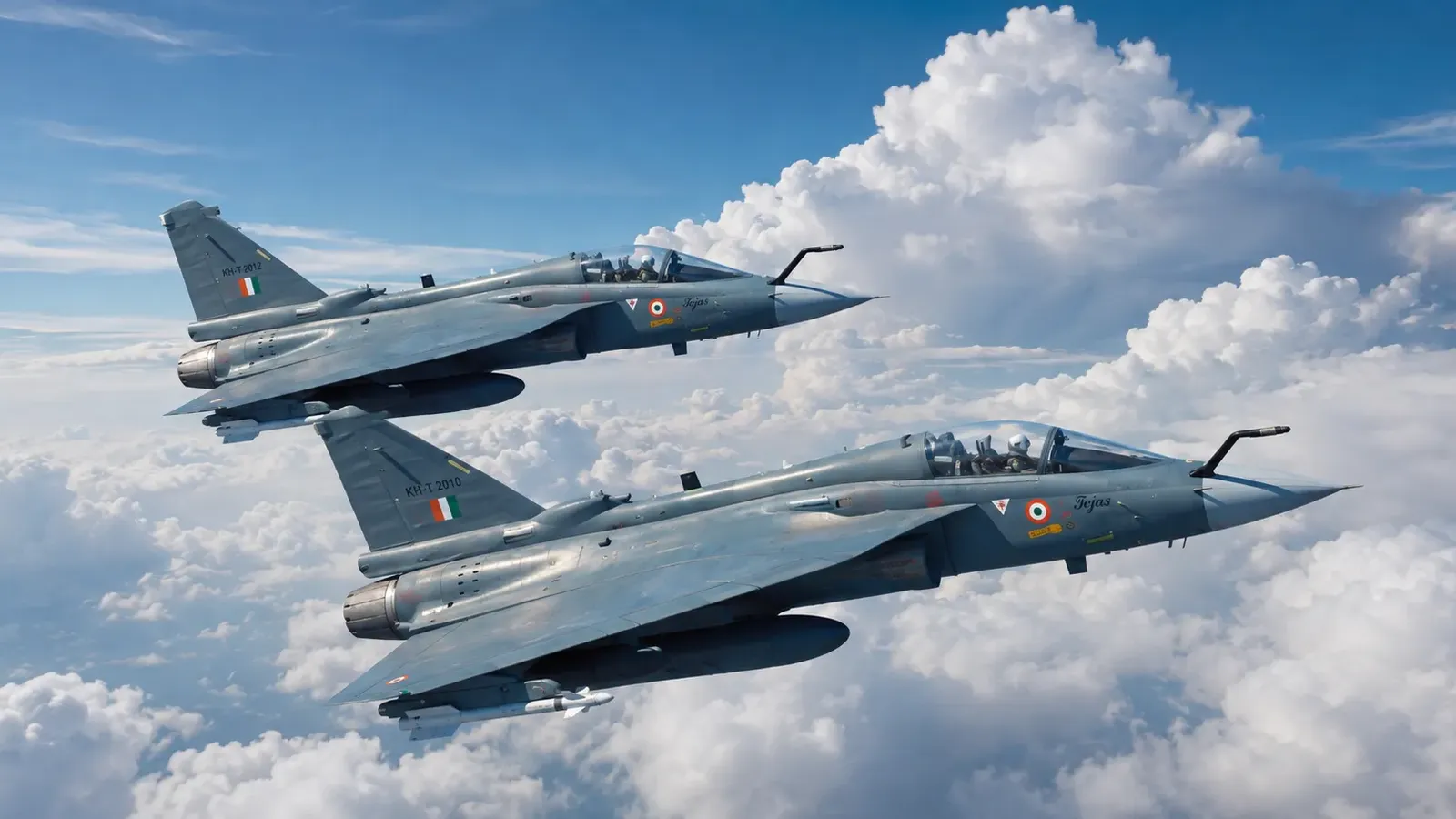
HAL Tejas has moved from an indigenous aircraft development programme to an operational fighter fleet with a scaled production base. The airframe-systems-teaming triad now provides a useful way to understand its next phase. That phase covers 97 Mk1A aircraft contracted on 25 September 2025. It also covers an expanding indigenous systems stack and a future role inside Combat Air Teaming System operations. (Ministry of Defence, 25 September 2025)
Tracing the Tejas programme from LCA to Mk1A
HAL Tejas is India's indigenous light combat aircraft programme developed around a single-engine, supersonic, multirole fighter. The Aeronautical Development Agency manages the design and development programme, while Hindustan Aeronautics Limited manufactures the aircraft. (Ministry of Defence, 1 July 2016)
The programme was conceived to replace the MiG-21 fleet and establish an indigenous foundation for fighter aircraft design. Tejas uses a compound delta configuration, extensive composite structures and a quadruplex digital fly-by-wire flight control system. (Ministry of Defence, 17 May 2016)
LCA Tejas received Initial Operational Clearance in December 2013 and Final Operational Clearance in February 2019. The first operational squadron, No. 45 Squadron, began flying the aircraft in July 2016. That milestone established Tejas as an Indian-designed fighter in IAF service. (Ministry of Defence, 20 February 2019)
The progression from Mk1 to Mk1A is therefore more than an equipment refresh. The Mk1 established the airframe, flight-control architecture and operational foundation. The Mk1A adds an upgraded avionics and electronic warfare architecture intended to provide a more capable production standard for the Indian Air Force.
HAL positions the Mk1A as the leading Tejas variant in production. The aircraft includes an Active Electronically Scanned Array radar, electronic warfare suite, digital map generator, smart multifunction displays and an advanced radio altimeter. (Hindustan Aeronautics Limited, accessed 11 August 2026)
That distinction matters for India's defence drone ecosystem and the broader aerospace industry. A fighter programme becomes strategically valuable when its design, production, suppliers and upgrade pathways can support successive variants without restarting the industrial base. HAL Tejas indigenous content has climbed variant on variant, and the Mk1A extends that climb.
Understanding the Mk1A contract and delivery cadence
The Tejas Mk1A programme received its largest production commitment on 25 September 2025. The Ministry of Defence signed a contract worth Rs 62,370 crore (about $7.5 billion) with HAL for 97 aircraft. The fleet comprises 68 fighters and 29 twin-seat trainers.
Deliveries are scheduled to begin in 2027-28 and continue over six years. The Tejas Mk1A contract 97 aircraft procurement falls under the Buy (India-IDDM) category of Defence Acquisition Procedure 2020. (Ministry of Defence, 25 September 2025)
The contract also raises indigenous content of the aircraft to more than 64 percent. The Ministry of Defence said the order adds 67 items over the earlier Mk1A contract. Those additions include the UTTAM AESA radar, Swayam Raksha Kavach and control surface actuators. (Ministry of Defence, 25 September 2025)
The order follows the earlier procurement of 83 Tejas aircraft. In January 2021, the Cabinet Committee on Security approved 73 Mk1A fighters and 10 Mk1 trainers at a cost of Rs 45,696 crore. Additional sanctions covered design, development and infrastructure. The Ministry of Defence later described the contract as a major step in indigenous fighter manufacturing. (Ministry of Defence, 13 January 2021)
Production capacity is now becoming as important as aircraft design. HAL commissioned a third Tejas Mk1A production line at Nashik in October 2025. The addition takes stated production capacity across its lines to 24 aircraft per year, with the Nashik line itself rated at eight aircraft annually. (Ministry of Defence, 17 October 2025)
The industrial scale also extends beyond HAL. The 25 September 2025 contract identified nearly 105 Indian companies directly involved in detailed component manufacturing. The Ministry estimated the programme would generate close to 11,750 direct and indirect jobs annually across six years. Those jobs feed into India's drone manufacturing hubs and the wider aerospace supplier base. (Ministry of Defence, 25 September 2025)
The 2021 order established a production commitment for Mk1A. The Buy India IDDM Tejas contract signed in 2025 increases fleet scale, indigenous content and the role of Indian suppliers in the manufacturing chain.
Mapping the indigenous systems stack inside the Mk1A
The Tejas Mk1A is defined not only by its airframe but by the indigenous fighter aircraft India stack integrated around the pilot. This systems layer includes radar, electronic warfare, mission computing, navigation, communications and weapon interfaces.
The UTTAM AESA radar Tejas platform is one of the indigenous systems identified by the Ministry of Defence for the 97-aircraft contract. The Swayam Raksha Kavach EW suite provides the electronic warfare component. Indigenous control surface actuators support aircraft flight-control functions. (Ministry of Defence, 25 September 2025)
HAL's published Mk1A specification also identifies an open-architecture mission computer and quadruplex-redundant fly-by-wire controls. The architecture supports interoperability and future integration, which matters as sensors, weapons and electronic warfare systems evolve. (Hindustan Aeronautics Limited, accessed 11 August 2026)
The Tejas programme therefore illustrates a broader principle in defence aerospace. Indigenous content is not simply the percentage of material manufactured inside India. It also includes the ability to design, integrate, test and upgrade the systems that determine how an aircraft performs its mission.
The aircraft's digital architecture creates a natural interface with mission software. Computer vision, sensor fusion and edge inference are not substitutes for the pilot in Tejas. They support the pilot by processing sensor information, presenting relevant data and reducing workload in complex missions. This is where the Tejas story begins to connect with India's wider combat-air architecture.
Building the Mk2 as the medium-weight bridge
Tejas Mk2 is a larger medium-weight fighter programme intended to extend the indigenous fighter family beyond the Mk1A. The aircraft is being developed by the Aeronautical Development Agency with HAL as the production partner, building on experience accumulated through the LCA programme. (Ministry of Defence, 2 December 2019)
The Mk2 represents a substantial redesign rather than a simple enlargement of Mk1A. Earlier government and DRDO material describes a larger airframe with increased fuel and weapons capacity, additional hardpoints and a more capable propulsion system. The programme received development approval from the Cabinet Committee on Security in 2022. (DRDO, 2022)
The medium-weight bridge role positions the Mk2 alongside the imported Rafale fleet in Indian Air Force service, not against it. The Mk2 gives India another indigenous platform on which to mature avionics, weapons integration, mission software and manufacturing processes before the Advanced Medium Combat Aircraft enters production. The specification gap between the Mk1A and the planned Mk2 shows the shape of that bridge.
Feature | Tejas Mk1A | Tejas Mk2 |
|---|---|---|
Category | Light multirole fighter | Medium-weight multirole fighter |
Length | 13.2 metres | 14.6 metres |
Empty weight | 6,560 kilograms | 7,850 kilograms |
Maximum takeoff weight | 13,500 kilograms | 17,500 kilograms |
Engine | F404-IN20 turbofan | F414-INS6 turbofan |
Maximum speed | Mach 1.6 | Mach 1.8 |
Combat radius | 500 kilometres | 800 kilometres |
Hardpoints | 8 stations | 11 stations |
Payload capacity | 3,500 kilograms | 6,500 kilograms |
AESA radar | UTTAM (indigenous) | Upgraded indigenous AESA |
Electronic warfare suite | Swayam Raksha Kavach | Advanced indigenous EW suite |
Flight controls | Quadruplex digital fly-by-wire | Quadruplex digital fly-by-wire |
Airframe | Compound delta, composite structures | Compound delta, upgraded composites |
Status as of 11 August 2026 | Deliveries scheduled 2027-28 | First-flight target 2026 |
Sources: Hindustan Aeronautics Limited published Mk1A specifications, Aeronautical Development Agency Mk2 configuration briefings, and the Ministry of Defence contract announcement of 25 September 2025.
The Tejas Mk2 first flight timeline targets 2026, though earlier iterations of the schedule have slipped. DRDO leadership has positioned Mk2 induction ahead of AMCA, with Mk2 rolling out in three to four years followed by AMCA. (DRDO Director General B.K. Das, 20 January 2026)
The Mk2 programme also matters for industrial learning. Fighter development requires repeated iteration across structures, flight controls, avionics, propulsion, weapons and certification. Each milestone creates engineering knowledge that transfers into subsequent aircraft programmes and feeds building a self-reliant drone industry at the wider unmanned systems layer.
Tejas Mk2 should therefore be viewed as part of an aircraft development chain rather than as an isolated replacement for Mk1A. The chain runs from the LCA technology base through Mk1A production and into larger combat aircraft programmes. Future fighters will operate inside networks containing manned aircraft, unmanned aircraft, sensors and command systems. The aircraft that can exchange mission data reliably will have a different operational role from a standalone platform.
Teaming Tejas with the CATS Warrior loyal wingman
Tejas becomes strategically interesting when it is viewed as a manned node inside India's Combat Air Teaming System. CATS Warrior UCAV is a loyal-wingman unmanned combat aerial vehicle being developed by HAL to operate alongside manned fighters, including Tejas.
The CATS Warrior concept places an unmanned platform ahead of or alongside a manned aircraft. The formation then distributes sensing, electronic warfare and strike functions across multiple aircraft. This allows manned-unmanned teaming doctrines to reshape how missions are planned. HAL has presented Tejas as one of the potential mothership platforms for this architecture. (Hindustan Aeronautics Limited, National Defence Industries Conclave 2026)
The distinction between Tejas and CATS Warrior is fundamental. Tejas is a piloted fighter designed to carry a human operator through a broad set of combat missions. The CATS Warrior loyal wingman India programme extends the reach and mission options of that manned aircraft through an unmanned platform.
The architecture creates a human-machine division of labour. The pilot remains responsible for mission command and human authorisation. The unmanned aircraft supports reconnaissance, electronic warfare, route execution and weapons delivery within its authorised mission.
This is where AI becomes an operational layer rather than a marketing label. Computer vision can support target classification. Sensor fusion can combine information from multiple onboard systems. Mission autonomy can support route planning, while edge inference can reduce the need to send every sensor input back to a distant control station.
HAL has continued development of CATS Warrior, with the programme moving through prototype manufacturing and ground-development milestones. Reporting from 2026 has placed the platform in the roughly two-tonne class. The HAL brief identifies a projected IAF requirement approaching 100 units, a first-flight window around 2026-27, and a design range of about 700 kilometres. (HAL presentation, National Defence Industries Conclave 2026)
The CATS Warrior sits in the same weight class as advanced military drones elsewhere. Peers include Boeing's MQ-28 Ghost Bat in Australia and the XQ-58 Valkyrie in the United States. That places India inside a peer group building loyal-wingman architectures around indigenous manned fighters.
The architecture also changes how Tejas should be understood. The fighter is not simply carrying weapons from one location to another. It can become the human command node for a distributed combat formation in which unmanned aircraft expand sensing and effect options. That makes the CATS relationship strategically different from adding another weapon to a fighter.
Reading the Tejas across three industrial layers
The Tejas programme now sits across three layers of India's air combat industrial base: the airframe, the indigenous systems stack and the manned unmanned teaming India doctrine. The framework maps cleanly onto the active programmes and their status.
Layer | Component | Programme | Status as of 11 August 2026 |
|---|---|---|---|
Airframe | Light combat aircraft | Tejas Mk1A | 97 aircraft contracted 25 September 2025 |
Airframe | Medium-weight fighter | Tejas Mk2 | Prototype rollout target 2026 |
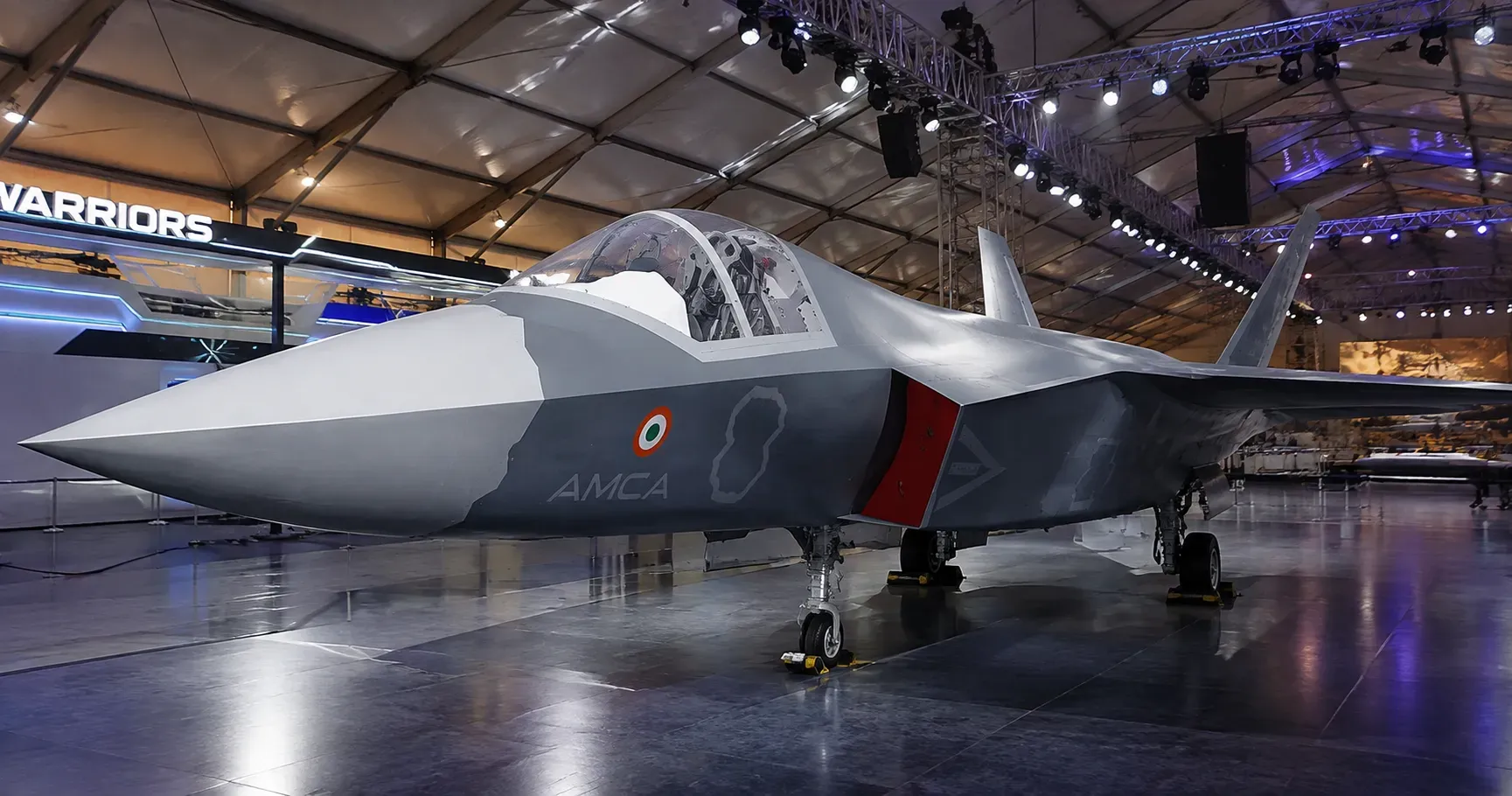
Airframe | Stealth fighter | AMCA | Development phase |
Systems | AESA radar | UTTAM | Included in the Mk1A 97-aircraft contract |
Systems | Electronic warfare suite | Swayam Raksha Kavach | Included in the Mk1A 97-aircraft contract |
Teaming | Loyal wingman UCAV | CATS Warrior | First-flight target 2026-27 |
Teaming | Combat architecture | Combat Air Teaming System | Prototype and ground-development milestones |
The airframe layer provides a production fighter that is already in IAF service. The systems layer increases the indigenous contribution to radar, electronic warfare, actuators and mission architecture. The teaming layer points toward formations in which Tejas can operate with unmanned combat aircraft. This mirrors the arc of TAPAS BH-201, the Rustom-II, which turned HAL and DRDO's earlier indigenous UAV work into a production pathway.
For defence integrators, the opportunity is systems integration rather than airframe production alone. Future combat architectures require reliable interfaces between sensors, mission computers, communications, electronic warfare systems and autonomous platforms.
For government procurement teams, production cadence becomes a capability metric. A fighter design has limited operational value if the industrial base cannot deliver aircraft, spares, upgrades and software at the required rate.
For India's autonomy industry, the Tejas-CATS relationship points toward a Tejas AMCA transition roadmap. That roadmap runs from the light combat aircraft, through the medium-weight bridge, and into stealth-generation induction. India's indigenous fighter jet ecosystem now has a visible three-decade trajectory.
The next milestones will show whether the three layers mature together. Tejas Mk1A production, Tejas Mk2 development and CATS Warrior flight testing will determine how quickly India's indigenous air combat architecture moves from individual platforms toward integrated formations. The next twelve months will answer one question. Either India's air combat sovereign lattice fields the Mk1A and CATS Warrior pairing as a single doctrine, or it leaves them as parallel programmes.