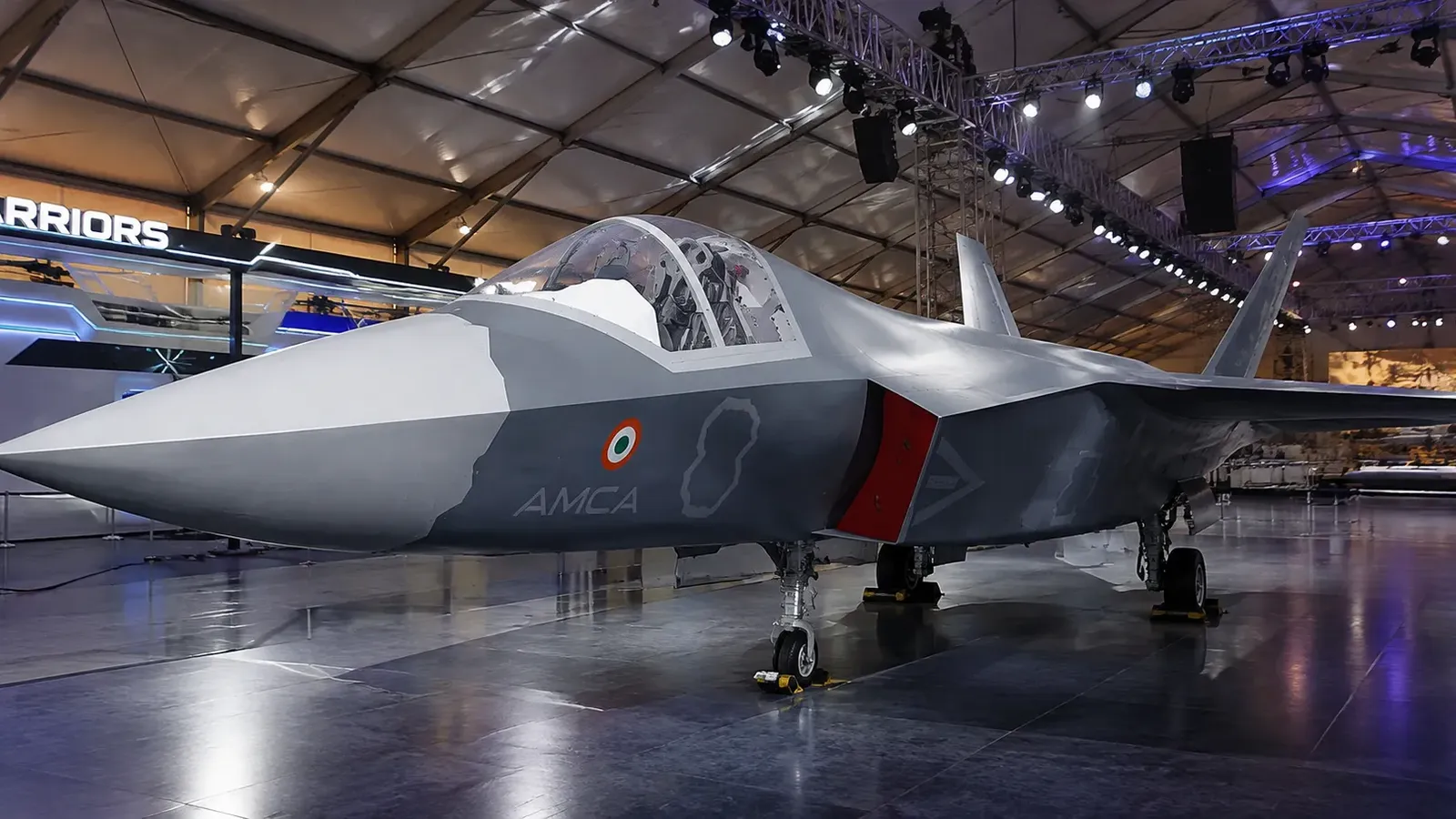
The AMCA fighter jet has moved from a development proposal into an industrial competition. The Ministry of Defence issued the prototype development RFP to three private-sector-led consortia on 27 May 2026, one year after approving the programme execution model (Ministry of Defence, 27 May 2026; PIB, 27 May 2025). This article reads AMCA through four sovereignty tracks: airframe, propulsion, avionics, and manned-unmanned teaming. Each track has a different technology challenge, industrial structure, and milestone before Indian Air Force induction.
Defining the Advanced Medium Combat Aircraft
The AMCA fighter jet is India's indigenous twin-engine fifth generation fighter, led by the Aeronautical Development Agency under the Defence Research and Development Organisation. It combines low-observable airframe design, internal weapon carriage, advanced sensors, electronic warfare, and networked combat operations into one aircraft architecture (DRDO, 11 February 2025).
The Cabinet Committee on Security committed the effort formally in March 2024. About ₹15,000 crore was cleared for AMCA design and prototype development, establishing the effort as a national aerospace priority (Cabinet Committee on Security, 7 March 2024).
The aircraft is designed around a low-observable configuration rather than a fourth-generation layout with external stores as the default. Internal weapon bays and stealth shaping reduce radar signatures across relevant aspects. That places the aircraft in a different design class from the fighters it will complement in service.
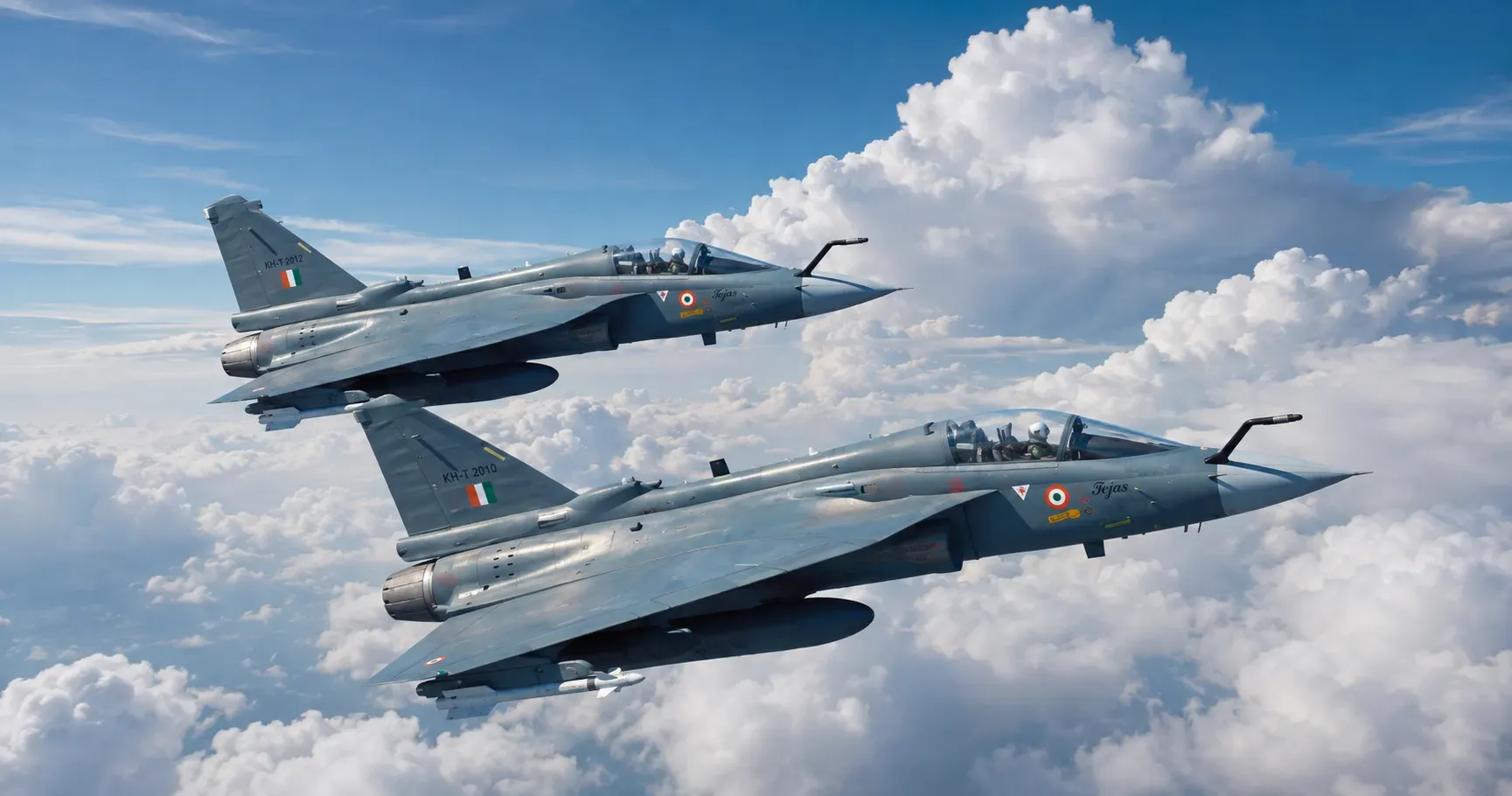
The India indigenous fifth generation fighter aircraft effort also inherits capability from the Light Combat Aircraft ecosystem. Composite structures, digital flight controls, avionics integration, radar development, flight testing, and industrial supply chains all matured under Tejas and now feed AMCA (DRDO, 7 May 2025). The parallel with DRDO's underwater autonomy programme is instructive. Sovereignty over a complex platform is built through iterated system-of-systems programmes, not one aircraft alone.
AMCA is therefore best read as a combat-air architecture, not a single artefact. The airframe carries the physical platform, while mission systems determine how the aircraft collects, processes, shares, and acts on information.
Tracing the timeline from FSED approval to IAF induction
The AMCA prototype effort now enters the industrial phase that follows government approval, design development, and execution-model selection. Prototype construction, flight testing, certification, production preparation, and Indian Air Force induction each carry their own timeline gate.
The Full Scale Engineering Development phase was approved by the Cabinet Committee on Security in March 2024. About ₹15,000 crore was cleared to fund it (Cabinet Committee on Security, 7 March 2024). Five prototypes were subsequently identified as part of the development plan. Each is budgeted at around ₹1,000 crore (Aeronautical Development Agency disclosures, Aero India 2025; Ministry of Defence, 30 May 2025).
The structural shift came on 27 May 2025. Defence Minister Rajnath Singh approved the AMCA Programme Execution Model. Indian public and private-sector entities can now compete independently, through joint ventures, or through consortia (PIB, 27 May 2025). ADA retained programme design authority while prototype development opened to competitive industrial participation.
On 27 May 2026, the Ministry of Defence issued the RFP to three shortlisted private-sector-led consortia for prototype development (Ministry of Defence, 27 May 2026). The RFP marked the transition from an approved development architecture to an active industrial process.
The AMCA programme cost and prototypes therefore read as one fiscal architecture. The ₹15,000 crore figure covers design and prototype development. Five prototypes at ₹1,000 crore each account for a defined slice. The propulsion pathway carries its own budget and approval track.
The planned schedule places prototype rollout around late 2026 or early 2027. First flight is targeted around 2028 to 2029, certification around 2032, and induction from 2035 (ADA disclosures, 2025; Indian Air Force statements). These dates are programme targets.
When will AMCA be inducted in Indian Air Force is therefore not a question with a single date. The planning horizon points to induction from around 2035, subject to prototype development, flight testing, certification, production readiness, and engine availability.
The urgency is shaped by the Indian Air Force's own force structure. The service operates around 31 fighter squadrons against a sanctioned strength of 42. Eight further squadrons are set to retire over the next decade (Indian Air Force disclosures, 2025). Every slip in the AMCA timeline extends the window in which the shortfall must be managed with fourth and 4.5-generation platforms.
Understanding the execution model and industry partnership
The AMCA execution model defines how government design authority and industrial production responsibility interact. ADA remains responsible for programme-level design and development, while selected Indian industry partners receive a larger role in prototype development and industrialisation.
The 27 May 2025 approval opened the development model to public and private sectors on a competitive basis. Indian companies can bid independently or form joint ventures and consortia, creating a procurement structure different from a single-source state manufacturing model (PIB, 27 May 2025).
The 2026 RFP applies that model to prototype development. Three private-sector-led groups received the RFP, creating a competitive selection process for the prime industrial role (Ministry of Defence, 27 May 2026). Final assembly, integration, and flight testing are planned at the upcoming Integration and Flight Testing Complex in Andhra Pradesh. That gives the programme its first dedicated stealth-fighter production geography.
Who will manufacture AMCA fighter jet is therefore not answered by naming one organisation alone. The programme separates design authority, prototype execution, subsystem supply, propulsion development, and eventual series production across an industrial architecture.
That architecture matters because a fifth generation aircraft requires control over thousands of interfaces. Fighter aircraft development cannot tolerate uncontrolled changes across those interfaces. A change in one subsystem can affect flight behaviour, electromagnetic compatibility, thermal loads, weight distribution, or software certification.
The execution model also enlarges the role of India's private aerospace supply chain. MSMEs can participate through machining, composites, electronics, software, testing equipment, sensors, wiring, tooling, and specialised materials. Their entry depends on qualification requirements and supplier selection by the prime industrial entity.
The model differs from the earlier approach in which a state-owned manufacturer carried the dominant production responsibility after government laboratories completed development. AMCA instead builds a competitive bridge between government design capability and industrial delivery. The execution model becomes a test of India's ability to run a distributed combat-air programme. Prototype selection is only the first gate.
Mapping the airframe track and the 25-tonne stealth platform
The AMCA stealth fighter is built around a twin-engine, low-observable airframe. The design combines stealth, supersonic performance, internal weapon carriage, and long-range sensor operations. The baseline aircraft sits in the 25-tonne maximum take-off weight class, with stealth shaping and internal weapon carriage integrated from the ground up.
The full-scale AMCA model displayed at Aero India 2025 gave the public a detailed view of the aircraft's physical architecture. DRDO described AMCA as India's first 5.5-generation stealth aircraft and displayed a full-scale model at the India Pavilion (DRDO, 11 February 2025). The 5.5-generation framing rests on more than the airframe. It requires AI-assisted mission computing, sensor fusion, and manned-unmanned teaming at a level of integration older 5G designs did not attempt.
AMCA specifications should therefore be read as a design architecture rather than a final production datasheet. Performance figures can change as the prototype moves through detailed design, structural testing, propulsion integration, and flight testing.
The intake is a defining part of the airframe track. A 2026 study associated with ADA reported 98 per cent pressure recovery for the tested stealth intake configuration (Aeronautical Development Agency, February 2026). That figure relates to the tested configuration, not the complete aircraft's operational performance.
The internal weapons architecture changes the relationship between aircraft size and usable combat load. Internal carriage requires larger structural volume, thermal management, door mechanisms, and weapon-release validation without the drag and signature penalties of external carriage.
Materials sovereignty runs beneath the airframe track. The Defence Metallurgical Research Laboratory has developed single-crystal turbine blade metallurgy. The Mishra Dhatu Nigam displayed SuperNi 41 nickel-chromium superalloy plates at Aero India 2025. The domestic materials base for high-temperature aero-engine and airframe applications is being built alongside the aircraft (DMRL disclosures, 2025; MIDHANI displays, 11 February 2025).
The airframe also has to accommodate mission computing and sensors without compromising low observability. Radar apertures, electronic warfare antennas, electro-optical systems, communications equipment, and data links must fit inside the signature-management architecture. Sensor fusion and mission computing then determine how efficiently the aircraft converts multiple sensor inputs into a coherent tactical picture.
Following the propulsion track through Mk1 and Mk2
The AMCA Mk1 versus AMCA Mk2 engine plan separates the first aircraft configuration from the longer-term indigenous propulsion architecture. The baseline plan uses an imported engine for Mk1 while the later Mk2 configuration flies with an Indian-developed engine created through a co-development partnership.
The first AMCA prototypes are planned around the F414-INS6 engine. The later aircraft are planned around a higher-thrust indigenous engine associated with the India-France propulsion partnership. The two-track approach allows airframe development to proceed while the domestic engine programme matures.
AMCA variant | Propulsion approach | Programme role | Sovereignty objective |
|---|---|---|---|
AMCA Mk1 | F414-INS6 | Prototype and initial development configuration | Enable flight development while indigenous engine work proceeds |
AMCA Mk2 | Indigenous 120 kilonewton-class engine | Later production configuration | Increase Indian control over propulsion technology and intellectual property |
The AMCA Safran engine track is anchored in a proposed joint development structure involving the Gas Turbine Research Establishment and the French engine partner. The proposed engine is in the 120-kilonewton class and is intended to power the later AMCA configuration (Ministry of Defence reporting, August 2026). The venture proposal covers nine engine prototypes for the design and certification cycle before the powerplant enters production. That gives the propulsion track its own hardware-count gate independent of the airframe (Cabinet Committee on Security proposal reporting, August 2026).
The propulsion track carries strategic weight because the fighter engine is one of the hardest technologies in combat aviation. High-pressure compressors, turbine materials, cooling systems, combustion, afterburning, digital engine control, and manufacturing tolerances all affect engine performance and durability.
The AMCA engine partner Safran deal is therefore larger than a supply contract. The programme is structured around co-development and technology transfer. The objective is to retain intellectual property generated under the partnership in India.
The proposed ten-year propulsion cooperation sits inside the wider Horizon 2047 framework announced in 2025. The reported deal value was around ₹61,000 crore, distinct from the AMCA aircraft development budget (Ministry of Defence reporting, 25 August 2025).
The propulsion roadmap also creates a direct dependency between engine certification and aircraft certification. A propulsion slip does not stay inside propulsion. Aircraft integration folds engine mass, thrust, thermal load, and cross-section changes into airframe testing, flight-control tuning, and certification schedules.
That coupling explains why AMCA Mk1 and Mk2 cannot be treated as simple engine swaps. The two configurations represent different propulsion baselines with consequences across the aircraft system.
The National Aero Engine Mission launched in 2026 adds another layer to India's propulsion strategy. The mission seeks coordination between government laboratories, industry, and academia around aero-engine capability (Ministry of Defence and DRDO, February 2026).
Building the avionics track around the Uttam AESA family
The AMCA avionics track connects radar, electronic warfare, communications, mission computing, sensor fusion, and cockpit systems into one combat architecture. The Uttam Active Electronically Scanned Array radar family provides the Indian technology base for this track.
DRDO's Electronics and Radar Development Establishment leads the Uttam programme, with Bharat Electronics Limited as the principal system integrator. The variant planned for AMCA uses Gallium Nitride transmit-and-receive modules, upgraded from the Gallium Arsenide baseline that flies on the Tejas Mk1A (DRDO, 11 February 2025).
AESA radar changes the role of the fighter's front-end sensor because the radar can perform multiple functions through electronic beam steering. Airborne search, tracking, mapping, and other modes integrate into software-defined mission workflows.
The AMCA architecture requires more than a radar with higher detection performance. The aircraft must combine radar information with electronic support measures, electro-optical inputs, communications data, navigation information, and information from other aircraft. Sensor fusion is the bridge between these sources, and it is where AI-enabled battle management and AI-driven defence modernisation become on-platform capabilities rather than doctrinal talking points.
The cockpit consequently becomes more than a flight-control station. It functions as a command node connecting the pilot with onboard sensors, weapons, offboard assets, and other combat systems.
Indian control of mission software and sensor integration is the industrial payoff of the avionics track. It determines how quickly the aircraft receives upgrades after induction. It also determines how independently those upgrades can be released without a foreign vendor's clearance.
The avionics track will therefore be judged by integration quality rather than component specifications. A capable radar, an electronic warfare suite, or a mission computer has limited operational value if the aircraft cannot fuse and distribute their outputs in time.
Positioning AMCA inside the manned-unmanned teaming doctrine
Manned-unmanned teaming connects AMCA with unmanned combat aircraft, sensors, and other networked systems. A human pilot directs multiple unmanned assets while mission autonomy handles defined navigation, coordination, sensing, and task-execution functions.
The AMCA cockpit is planned as part of this wider combat architecture. The Combat Air Teaming System, including the CATS Warrior loyal wingman, gives India a domestic pathway to integrate unmanned aircraft with manned fighters. It sits at the centre of the manned-unmanned teaming doctrine the Indian Air Force is developing for future combat.
AMCA loyal wingman CATS Warrior integration matters because the aircraft becomes a command node rather than an isolated shooter. The unmanned assets can extend sensing, carry weapons, support electronic warfare, or perform other assigned missions. The human pilot retains authority over mission objectives while the unmanned platforms execute assigned behaviours within defined constraints.
Route planning, computer vision-based target classification, sensor fusion, and swarm-coordination logic are the operational technologies that make the doctrine work. A waypoint-following aircraft is automated. An aircraft that adapts its route against changing mission constraints demonstrates a higher level of autonomy. That difference decides what tasks the loyal wingman can be trusted with.
The CATS Warrior concept also connects AMCA to Project Ghatak and the Remote Pilotless Strike Aircraft direction. These programmes create an opportunity to develop common technologies across manned and unmanned combat aviation, and to reuse AMCA-programme sensors and mission software on unmanned platforms.
AMCA can therefore provide the human command layer while unmanned aircraft expand the sensing and effects envelope. The value comes from the network, not from treating the loyal wingman as another standalone aircraft. The AMCA fighter jet then joins a wider argument about how drones sit against traditional air power. The tactical unit is the manned-unmanned formation rather than the airframe.
Future combat-air procurement will need to evaluate aircraft, autonomous systems, mission software, communications, and weapons as connected capability packages. The Indian fifth generation fighter becomes more relevant through this lens. Fifth-generation capability depends on how effectively the aircraft operates inside a connected combat system, not only on stealth or sensor performance.
Reading the Aatmanirbhar Bharat thesis behind the design
The Aatmanirbhar Bharat objective in AMCA extends from aircraft production to control of the technologies that determine future upgrades. The execution model, propulsion plan, radar development, and industrial participation all support this wider sovereignty objective.
The 2025 execution model explicitly positioned AMCA as an industry-partnership programme supporting indigenous aerospace capability, with equal competitive opportunity for public and private sectors (PIB, 27 May 2025). The model creates a different industrial question from simple local assembly. Local assembly can place an aircraft inside India without transferring design authority, source-code control, manufacturing knowledge, or subsystem ownership.
AMCA's four sovereignty tracks address those dependencies at different levels. Airframe sovereignty requires design and integration authority.
Propulsion sovereignty requires engine development and intellectual-property control. Avionics sovereignty requires a domestic sensor and mission-system base. Manned-unmanned teaming sovereignty requires control over autonomy, communications, and mission architecture.
The programme also builds on the industrial ecosystem created around earlier fighter development. DRDO has highlighted the aerospace supplier base, composite structures, digital design, flight controls, and indigenous radar development that emerged through the LCA programme. Indigenous content on Tejas Mk1A has crossed 60 per cent, and AMCA carries that industrial benchmark forward (DRDO, 7 May 2025). The wider India's defence drone programmes reuse the same supplier and technology base.
The fifth generation fighter jet India develops through AMCA will also test the country's ability to sustain complex aircraft without external technology dependencies. Software updates, radar upgrades, engine maintenance, weapons integration, and electronic warfare libraries have to remain manageable through Indian institutions and industry. The same discipline runs through the self-reliant defence industry thesis that shapes Kodainya's editorial line on aerospace sovereignty.
Aatmanirbhar Bharat is therefore measured through lifecycle control. The decisive question is not whether an aircraft leaves an Indian production line. It is whether India can design, modify, integrate, maintain, and upgrade that aircraft on its own terms. The surrounding command architecture, from Akashteer air defence architecture upward, must remain in Indian hands.
Framing the export ambition and the Horizon 2047 pact
AMCA's export potential depends on industrial maturity, production capacity, certification, sustainment, and government-to-government policy. A fighter cannot become an export product through design ambition alone.
The Horizon 2047 framework gives the programme a wider strategic context. India and France announced deeper defence and aerospace cooperation in 2025, including cooperation around advanced aircraft propulsion (Ministry of Defence reporting, 25 August 2025).
The export proposition differs from selling an airframe alone. A modern combat aircraft becomes the centre of a support ecosystem that can run for decades. The ecosystem is where the recurring revenue and the diplomatic capital both live.
India's domestic procurement requirement provides the initial industrial base. Production for the Indian Air Force can establish manufacturing processes, supplier qualification, maintenance facilities, and flight-test experience before any export campaign reaches scale.
The programme can also create exportable subsystems. Radar technology, mission computers, electronic warfare systems, communication architectures, and unmanned teaming components have applications beyond the AMCA platform. Some of these subsystems will find early demand alongside the most advanced military drones in the market for high-end unmanned combat capability.
Export ambition must remain subordinate to operational delivery. A fighter programme gains international credibility when its domestic operator fields the aircraft, sustains it, upgrades it, and demonstrates reliable industrial support. The export pathway is decided after the programme proves its design, production, certification, and sustainment architecture.
Setting the twenty-four month risk window and the next milestones
The AMCA induction timeline now depends on a sequence of industrial and technical decisions over the next twenty-four months. Consortium selection, propulsion approval, detailed design, prototype construction, and the first integration demonstrations will each generate a public signal.
The Ministry of Defence's 27 May 2026 RFP creates the immediate industrial gate. The selected L1 consortium will carry responsibility for translating the approved aircraft design into prototype hardware under the ADA-led programme architecture (Ministry of Defence, 27 May 2026).
The propulsion gate follows. The 120-kilonewton-class indigenous engine partnership remains a separate development path from the first AMCA prototype configuration. Its Cabinet Committee on Security clearance, expected before 15 August 2026, will unlock the Mk2 propulsion pathway.
Detailed design and prototype manufacturing come next. Aircraft integration must bring together structures, flight controls, landing gear, fuel systems, avionics, radar, electronic warfare, communications, weapons interfaces, and propulsion. Each interface adds its own configuration control and qualification workload.
Flight testing is the fourth gate. First flight is targeted around 2028 to 2029, followed by a certification pathway around 2032. Those milestones are targets, not completed programme achievements.
Manned-unmanned teaming is the fifth gate. A demonstrated CATS Warrior integration flight would move the networked combat-air architecture from system concepts to flight hardware. It would validate the AMCA loyal wingman CATS Warrior integration thesis on live sensors and live datalinks.
The AMCA fifth generation stealth fighter timeline therefore has multiple dependencies rather than one launch date. Delays in one sovereignty track propagate into the others because aircraft integration brings the tracks together. The four-track model is only as fast as its slowest gate.
For defence integrators, the priority is interface readiness. Suppliers need clear configuration control, qualification requirements, software baselines, testing standards, and production schedules before prototype work reaches high tempo.
For government stakeholders, the priority is synchronisation. Procurement, technology development, industrial capacity, testing infrastructure, engine development, and certification must progress against one integrated programme schedule.
Three signals will define the programme's phase change over the next twenty-four months. L1 consortium selection by early 2027 will decide the industrial prime. The Cabinet Committee on Security clearance on the joint-venture engine, expected before 15 August 2026, will unlock the Mk2 propulsion pathway. The first CATS Warrior integration flight will move manned-unmanned teaming from an architecture on paper to hardware in the air.