AUVs in India crossed a structural threshold on 14 November 2025. The Naval Science and Technological Laboratory confirmed successful harbour trials of its man-portable mine-countermeasure system, with production readiness within two months (Press Information Bureau Release ID 2190096, 14 November 2025). The milestone completed a three-class indigenous lineup spanning sub-50 kg vehicles to six-tonne platforms. Read through a mass-class × mission-lane × industrial-partner framework, the lineup gives a clearer view of how the Indian Navy's underwater autonomy ecosystem is taking shape.
Defining the autonomous underwater vehicle role in service
AUVs in India operate as unmanned platforms that work below the surface without continuous tethering to a support vessel. They execute pre-planned missions using onboard navigation, sensor fusion, route planning, and mission-management software. Unlike remotely operated vehicles, which rely on real-time operator control, an autonomous underwater vehicle in India deploys and completes its task on its own logic.
The Indian Navy and associated research organisations use AUVs across mine countermeasure operations, underwater intelligence collection, seabed mapping, harbour security, and oceanographic survey missions. These mission sets require different endurance profiles, payload configurations, and deployment methods. That requirement explains why the indigenous programme evolved into multiple mass classes rather than a single platform family. The same pattern shows up across our pillar coverage of unmanned maritime systems in India.
The architecture became more visible after the DRDO HEAUV lake trials validated vehicle dynamics, sonar performance, and communications in surface and submerged conditions during March 2025 (DRDO, March 2025). At the opposite end, the NSTL man-portable system demonstrated swarm-enabled mine countermeasure operations during harbour trials (Press Information Bureau, 14 November 2025).
Endurance platforms and mine-hunting platforms solve different operational problems. A high-endurance vehicle can remain deployed for days and cover large maritime areas. A mine-countermeasure platform operates closer to ports, approaches, and shipping channels where rapid detection and classification are essential.
The indigenous programme therefore reflects mission design rather than platform design. Mass class follows operational need, and autonomy enables each platform to complete tasks with reduced operator workload.
Mapping the indigenous AUV programme by mass class
The indigenous AUV programme is organised around three distinct mass classes: man-portable, medium, and high-endurance. Each class occupies a separate mission lane and deployment model.
The lightest category emerged from the man-portable autonomous underwater vehicle DRDO programme led by the Naval Science and Technological Laboratory. DRDO reported that the MP-AUV family includes surveillance and neutraliser variants designed for mine countermeasure missions, with indigenous content exceeding 70 percent (DRDO Newsletter, December 2025). The system was developed with support from the Naval Physical and Oceanographic Laboratory, Research Centre Imarat, High Energy Materials Research Laboratory, and DYSL-AT (DRDO Newsletter, December 2025). The MP-AUV is therefore both a defence-laboratory programme and an industrial-base programme.
The medium tier is represented publicly by Neerakshi AUV. The platform measures 2.15 metres, weighs about 45 kg, and operates to a depth of 300 metres (Garden Reach Shipbuilders and Engineers, 28 July 2023). Mission profiles include mine detection, mine disposal support, underwater survey, and passive acoustic monitoring (Garden Reach Shipbuilders and Engineers, 28 July 2023). Endurance sits at roughly four hours on the prototype, with later variants targeting longer runs.
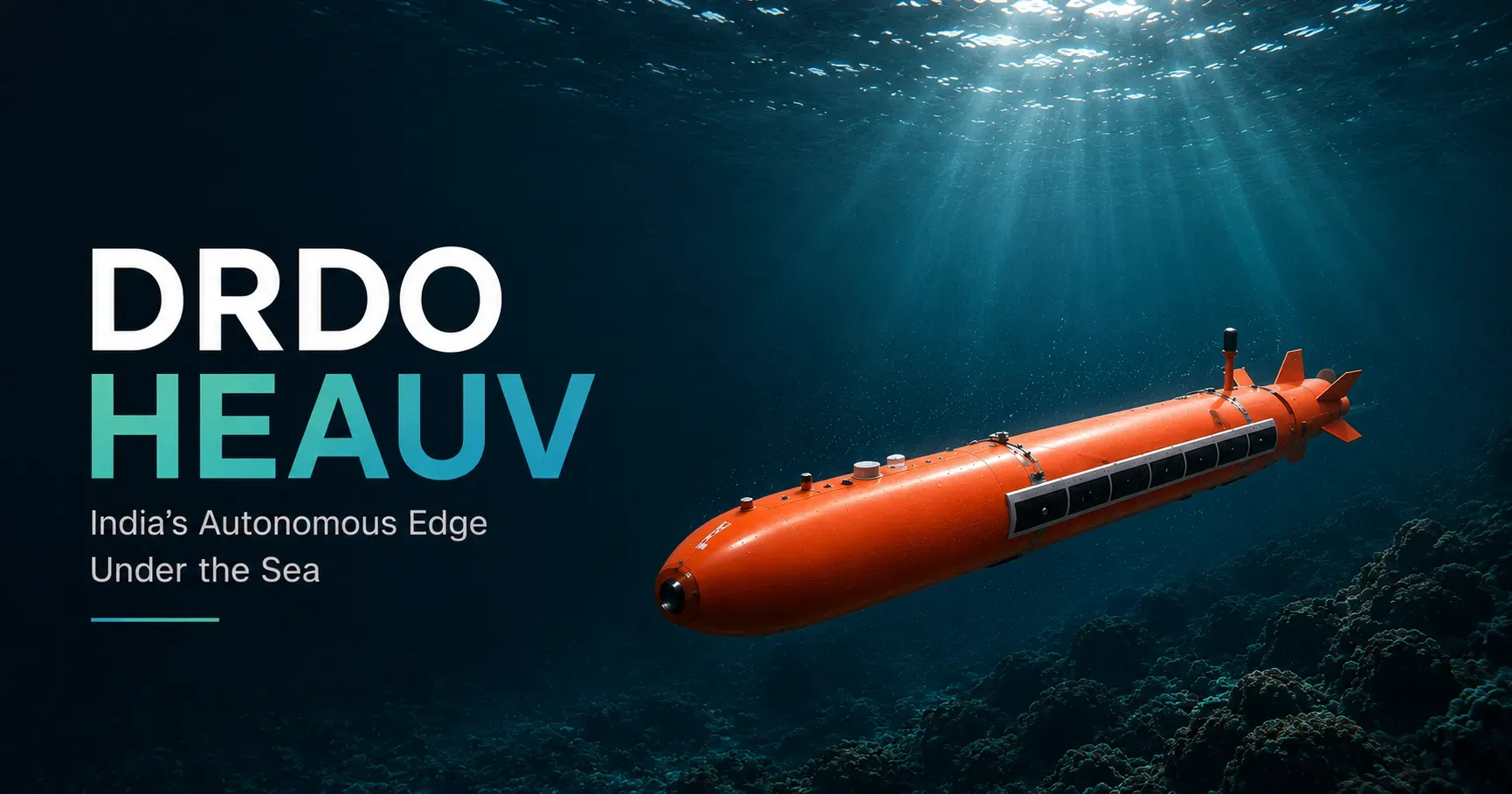
The upper tier is occupied by the High Endurance Autonomous Underwater Vehicle, or HEAUV. The vehicle is roughly 10 metres long and six tonnes in mass, with endurance reaching 15 days at three knots (DRDO, March 2025). Operating depth is 300 metres, and the payload bay carries front-looking sonar, flank-array sonar, side-scan sonar, and a low-power 360-degree surveillance radar (DRDO, March 2025).
Together these classes create a continuous operational spectrum. The MP-AUV addresses harbour and near-shore mine warfare. Neerakshi fills tactical survey and monitoring roles. HEAUV extends reach across long-duration surveillance and undersea reconnaissance missions, in the same way our sibling overview of unmanned ground vehicles maps the land-side equivalent.
Tracing the DRDO, NSTL, and shipyard ecosystem
The DRDO AUV ecosystem combines defence laboratories, research institutes, shipyards, and ocean-science organisations into a distributed development structure. No single institution owns the entire programme.
The Naval Science and Technological Laboratory serves as the primary defence laboratory behind both the HEAUV and the MP-AUV programme. The NSTL AUV portfolio now anchors both classes, making it the single largest underwater-autonomy laboratory inside DRDO. Its MP-AUV programme draws on expertise from multiple DRDO laboratories covering sensors, navigation, propulsion, explosives, and mission systems (DRDO Newsletter, December 2025). This collaborative structure reduces dependence on imported subsystems while expanding indigenous design capability.
Shipyards play a parallel role. Cochin Shipyard Limited supported HEAUV developmental activity, including the platform's maiden surface run at Kochi on 7 March 2024 (DRDO and Cochin Shipyard Limited, 7 March 2024). Garden Reach Shipbuilders and Engineers introduced Neerakshi at a ceremony led by DRDO Chairman Dr Samir V Kamat in July 2023 (GRSE, 28 July 2023). Together they create two production and integration pathways for underwater systems, anchored to India's drone manufacturing ecosystem and the public-sector chain.
The CSIR-CMERI AUV programme provides a complementary civilian and scientific lineage. CSIR-CMERI developed AUV-150 with Ministry of Earth Sciences support for seabed mapping, coastal surveillance, mine countermeasure support, and oceanographic measurement (CSIR-CMERI, accessed 20 June 2026). The same laboratory also advanced the AUV-500 demonstrator for deeper-water operations (CSIR-CMERI, March 2017).
The NIO Maya AUV history illustrates the programme's earlier foundation. The National Institute of Oceanography developed Maya between 2003 and 2007 as an indigenous underwater vehicle for oceanographic applications (National Institute of Oceanography, 2007). That work established design and operational experience later programmes built on, including the broader pattern explored in how India's defence drone ecosystem fits together.
The result is a layered ecosystem. DRDO drives defence-specific capability, while CSIR institutes contribute scientific platforms. Public-sector shipyards provide manufacturing and integration capacity, forming the industrial base behind India's underwater autonomy roadmap.
Sequencing mine countermeasure missions and ocean survey lanes
Mission lanes explain why different AUV classes continue to coexist. Each mission imposes unique requirements on endurance, payload, depth rating, and deployment method.
[ALT TEXT: Mission-lane chart mapping indigenous AUVs to mine countermeasure, anti-submarine warfare ISR, oceanographic survey, and deep-ocean exploration lanes.]
Mission lane | Primary platform type | Key capability | Typical user |
|---|---|---|---|
Mine countermeasure | MP-AUV and medium-class systems | Mine detection and neutralisation support | Indian Navy |
Underwater ISR | High-endurance systems | Persistent surveillance and mapping | Indian Navy |
Oceanographic survey | Scientific AUVs | Seabed and environmental data collection | Research agencies |
Deep-ocean exploration | Specialised deep-diving systems | Deep-sea inspection and research | Ministry of Earth Sciences |
Mine countermeasure AUV India requirements sit at the top of the Navy's operational priority list, anchored to harbour and approach security (Ministry of Defence, July 2025). Harbours, approaches, and shipping channels demand rapid classification of underwater objects. Modern systems combine sonar imagery, target classification algorithms, and acoustic networking to reduce search times during clearance operations.
Oceanographic missions operate differently, and the surface-side monitoring equivalent runs through drone-based marine fisheries surveillance. The National Institute of Ocean Technology employs underwater platforms within Deep Ocean Mission activities, while the Samudrayaan programme develops deep-submergence capabilities (NIOT, accessed 20 June 2026).
AUVs also differ from traditional survey vessels because they can collect data closer to the seabed and across complex underwater terrain. This allows more detailed bathymetric mapping and infrastructure inspection. For defence users, the same navigation and sensing technologies support intelligence collection and route reconnaissance.
Mission diversity therefore drives platform diversity. The indigenous programme reflects that operational reality.
Reading the MP-AUV sensor, payload, and autonomy stack
The MP-AUV and HEAUV families are connected by a common technology trend: greater reliance on onboard processing and autonomous mission execution.
Modern AUVs combine inertial navigation, sonar systems, acoustic communication links, route-planning software, and mission-management computers. Sensor fusion enables the vehicle to correlate information from multiple sources and maintain navigation accuracy when satellite positioning signals are unavailable underwater.
The MP-AUV programme demonstrates this shift clearly. DRDO reported that the system uses advanced autonomy features and collaborative mission behaviour suitable for mine-countermeasure operations (Press Information Bureau, 14 November 2025). The pattern follows the swarm-intelligence pattern that powers underwater coordination: multiple vehicles cover larger search areas while sharing mission information through underwater communications.
HEAUV extends the same principle across longer missions. Its sensor suite includes multiple sonar systems designed for surveillance, navigation, and underwater target detection (DRDO, March 2025). Long-endurance operations require efficient energy management and autonomous route execution because direct operator intervention is limited.
Artificial intelligence enters the picture through target classification, anomaly detection, and mission-priority management. The principle is the same as how AI sits inside autonomous unmanned platforms above water. Underwater the engine is sonar interpretation and acoustic data processing rather than computer vision for unmanned target classification. The operational objective remains similar: identify relevant objects, reduce false positives, and improve operator decision speed.
This is why autonomy matters. Endurance alone does not create capability. Useful capability emerges when sensors, processing, navigation, and mission software operate as a unified stack.
Procuring Indian Navy AUVs through mothership architecture
Since the July 2025 Defence Acquisition Council approval for the Mine Countermeasure Vessel programme, the Indian Navy AUV roadmap has shifted. Underwater vehicles now sit inside larger fleet programmes rather than being treated as standalone acquisitions. The Indian Navy mine countermeasure programme illustrates this approach.
The Defence Acquisition Council cleared the 12-vessel MCMV programme with an outlay close to ₹44,000 crore (Ministry of Defence, July 2025). Each vessel will host autonomous surface vessels, heavyweight AUVs, and remotely operated systems as a common mission package. Deliveries are scheduled between 2030 and 2037 (Indian Navy 15-year Technology and Capability Roadmap, 2025).
This model mirrors broader trends in unmanned systems procurement. Platforms become components within a larger operational architecture. Surface vessels provide launch, recovery, command, maintenance, and logistics support. AUVs provide underwater reach and sensing.
The architecture also creates demand signals for industry. Shipbuilders, sensor suppliers, software developers, autonomy specialists, and payload manufacturers can align development programmes with a defined operational requirement. That improves continuity between research projects and eventual induction pathways.
A parliamentary review of NSTL's underwater portfolio highlighted technologies under development across torpedoes, autonomous systems, mine warfare, and sensors (Parliamentary Standing Committee on Defence, 20 January 2026). The review reinforced the strategic importance of indigenous underwater capability.
The next procurement phase will determine how quickly research programmes transition into fielded systems. The existence of multiple indigenous classes now makes that transition more practical than at any earlier stage.
Pointing to dual-domain platforms as the next inflection
India's indigenous underwater autonomy effort now has a visible architecture. Procurement officers can evaluate platforms by mission lane rather than by individual project. Researchers can track technology progression across man-portable, medium, and high-endurance classes. Defence journalists can anchor reporting around primary-source milestones rather than isolated platform announcements.
The November 2025 MP-AUV milestone matters because it completed the lower end of the architecture while demonstrating indigenous content above 70 percent (DRDO Newsletter, December 2025). HEAUV established the long-endurance tier. Neerakshi provided a medium-class reference point. Together they form a coherent portfolio rather than disconnected programmes.
The next signal to watch is cross-domain autonomy. Bharat Dynamics Limited received a contract linked to an indigenous aquatic-aerial system effort with NSTL that combines aerial and underwater operating concepts (Bharat Dynamics Limited, 3 January 2026). The BDL NSTL aquatic-aerial system remains separate from today's AUV classes, but it points toward future unmanned platforms capable of operating across multiple domains. The effort sits alongside the Make in India and Atmanirbhar Bharat industrial spine that powers the wider self-reliance push.
As the Indian Navy's underwater requirements expand, the decisive factor will not be a single vehicle. It will be the ability to connect platforms, sensors, autonomy software, and mothership infrastructure into an integrated operational system.
The next phase of the indigenous programme will be defined by production transition, fleet integration, and cross-domain autonomy rather than another standalone prototype announcement.