The Indian Navy USV inventory now spans four operational stages: certified systems in service, active trials, procurement-approved programmes, and roadmap requirements. Certification of the Autonomous Fast Interceptor Boat running Advanced Autonomous Navigation and Control Software in January 2026 created the first operationally certified Indian Navy USV. Defence Acquisition Council approvals from 2022 and 2025 established a procurement pathway for autonomous maritime systems. This article applies the trials-certification-procurement-roadmap framework to map where each programme sits today.
Drawing the line between USV, UUV and ASV terminology
An Indian Navy unmanned surface vessel operates on the water surface without an onboard crew. An Unmanned Underwater Vehicle operates below the surface, while an Autonomous Surface Vessel refers to a surface platform with higher onboard autonomy.
The Indian Navy USV vs UUV boundary matters because the two domains carry different procurement, certification, and sensor pathways. The Kodainya overview of unmanned maritime systems in India frames the cross-domain story.
Indian Navy procurement documents also use different terms for different mission sets. Surface craft focus on surveillance, harbour security, mine countermeasure support, logistics, and maritime patrol. Underwater systems focus on seabed mapping, mine hunting, underwater reconnaissance, and anti-submarine missions (Ministry of Defence, 3 July 2025).
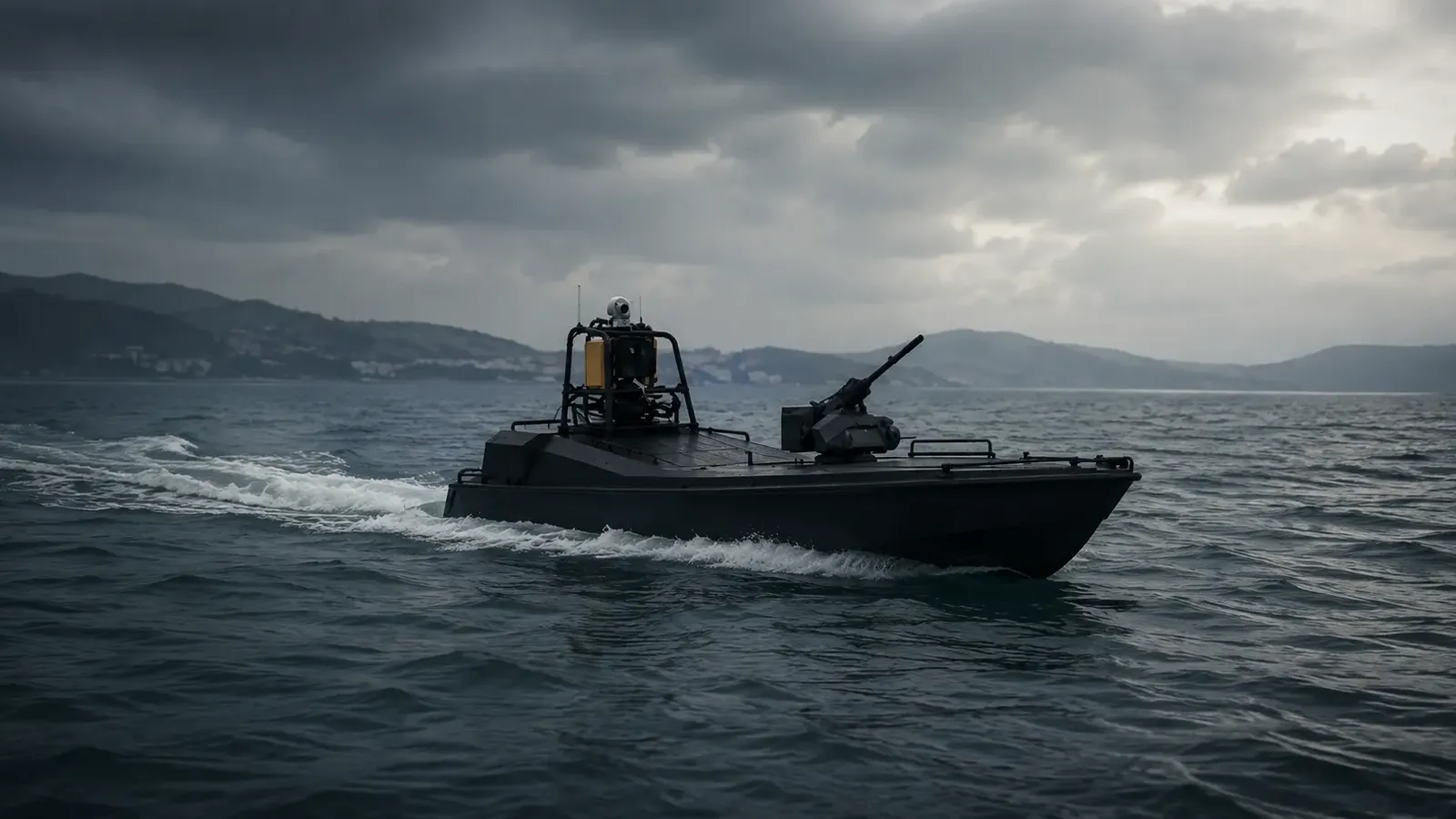
The Indian Navy USV ecosystem covers multiple operational categories. Fast interceptor platforms support coastal and harbour operations, while autonomous mine countermeasure platforms support maritime security tasks.
Endurance-focused platforms are intended for longer patrol missions across the wider Indian Ocean Region. These categories differ in endurance, payload integration, sensor suites, and autonomy requirements. The taxonomy matters more as the Indian Navy expands its portfolio alongside defence drones in Indian service, autonomous systems, and the sibling category of unmanned ground vehicles.
Autonomy itself carries a specific meaning, mirroring patterns from wider work on how autonomous unmanned platforms operate in Indian service. Modern naval platforms operate through automated navigation, route execution, and obstacle avoidance functions.
Higher-end systems combine sensor fusion, route planning, edge computing, and computer-vision-assisted navigation to reduce operator workload. That distinction separates simple remote-control craft from platforms operating across dense maritime traffic.
Tracing the operational A-FIB story
The Autonomous Fast Interceptor Boat represents the first operationally certified Indian Navy USV platform. The programme combines an existing interceptor vessel with the Advanced Autonomous Navigation and Control Software. The software was jointly developed by Bharat Electronics Limited (BEL) and the Indian Navy's Weapons and Electrical Engineering Systems Establishment, or WESEE (BEL, 17 January 2026).
BEL WESEE autonomous software performs route planning, collision avoidance, autonomous navigation, and maritime traffic compliance functions. The A2NCS stack was designed for naval operational conditions and integrated into a Fast Interceptor Boat used in mine countermeasure and combat-support scenarios (BEL, 17 January 2026).
The major milestone arrived in January 2026 when the Indian Register of Shipping certified the software after extensive sea trials. The certification process included verification against maritime navigation requirements and International Regulations for Preventing Collisions at Sea compliance criteria (Indian Register of Shipping, January 2026). That Indian Navy A-FIB IRClass certification became the first such USV software cleared by an independent classification society.
Software certification carries a higher evidentiary bar than platform demonstration. Prototype craft can operate successfully during trials. Operational certification requires repeatable performance, documented testing, safety validation, and independent assessment.
A2NCS also demonstrates how AI-enabled navigation has entered live Indian naval operations. The software combines sensor inputs, navigation data, route optimisation, and obstacle classification to support safe vessel movement. This mirrors the autonomy patterns examined in how unmanned systems think and act.
The result is a transition from experimentation to fielded capability. For the first time, the Indian Navy possesses a domestically developed autonomous navigation stack certified for operational deployment aboard an unmanned surface platform.
Mapping CASCADE and the mine countermeasure programme
CASCADE Indian Navy is one of the flagship future autonomous surface vessel programmes. The programme links directly to mine countermeasure operations, a mission area where unmanned systems can reduce operational risk while extending sensor coverage.
Technology Perspective Capability Roadmap 2025 identifies autonomous mine warfare and unmanned maritime systems as priority capability areas for future naval force development (Department of Defence Production, September 2025). The CASCADE programme is associated with Compact Autonomous Craft All Domain Effects, while procurement documentation refers to Compact Autonomous Surface Craft.
The two names describe the same capability line. The 5 August 2025 Defence Acquisition Council AoN for Compact Autonomous Surface Craft is the procurement face of the wider CASCADE programme (Ministry of Defence, 5 August 2025).
Indian Navy mine countermeasure vessel work creates a strong use case for autonomous platforms. Traditional mine clearance missions require specialised vessels operating in potentially hazardous waters. Unmanned systems allow sensors, sonar payloads, and mine-detection equipment to move forward while operators remain at safer distances.
CASCADE-related concepts align with broader trends in maritime autonomy. Modern mine countermeasure systems combine unmanned surface craft, unmanned underwater vehicles, sonar payloads, and mission-management software into a connected operational architecture.
The roadmap vision extends beyond navigation alone. Future systems are expected to integrate towed sonar systems, underwater sensors, mission autonomy modules, and cooperative operations with crewed naval platforms. That approach connects maritime autonomy with the wider manned-unmanned teaming doctrine across defence services.
Reading the Defence Acquisition Council ladder
Defence Acquisition Council USV approvals provide the clearest picture of Indian Navy USV procurement priorities. The approvals establish which capability lines have moved beyond experimentation and entered the formal acquisition pipeline.
The first major approval arrived on 22 December 2022. The Defence Acquisition Council granted Acceptance of Necessity for High Endurance Autonomous Vehicles under a package valued at ₹84,328 crore (Ministry of Defence, 22 December 2022).
The next milestone arrived on 3 July 2025. The Defence Acquisition Council approved acquisition proposals worth approximately ₹1.05 lakh crore through indigenous sourcing. The package included Mine Counter Measure Vessels and Submersible Autonomous Vessels for the Indian Navy (Ministry of Defence, 3 July 2025).
A further milestone followed on 5 August 2025. The Defence Acquisition Council granted Acceptance of Necessity for Compact Autonomous Surface Craft within a package valued at approximately ₹67,000 crore (Ministry of Defence, 5 August 2025). The Compact Autonomous Surface Craft AoN gave the CASCADE programme its first formal procurement footprint.
These approvals create a visible acquisition ladder:
Stage | Programme | Approval Date | Status |
|---|---|---|---|
Endurance autonomy | High Endurance Autonomous Vehicles | 22 December 2022 | AoN approved |
Mine warfare autonomy | MCMV and Submersible Autonomous Vessels | 3 July 2025 | AoN approved |
Surface autonomy | Compact Autonomous Surface Craft | 5 August 2025 | AoN approved |
Operational deployment | A-FIB with A2NCS | January 2026 | Certified |
The progression shows how Indian Navy autonomous surface vessel programmes are moving from concept demonstrations toward operational acquisition.
Detailing the GRSE Swadheen and Jaldoot pair
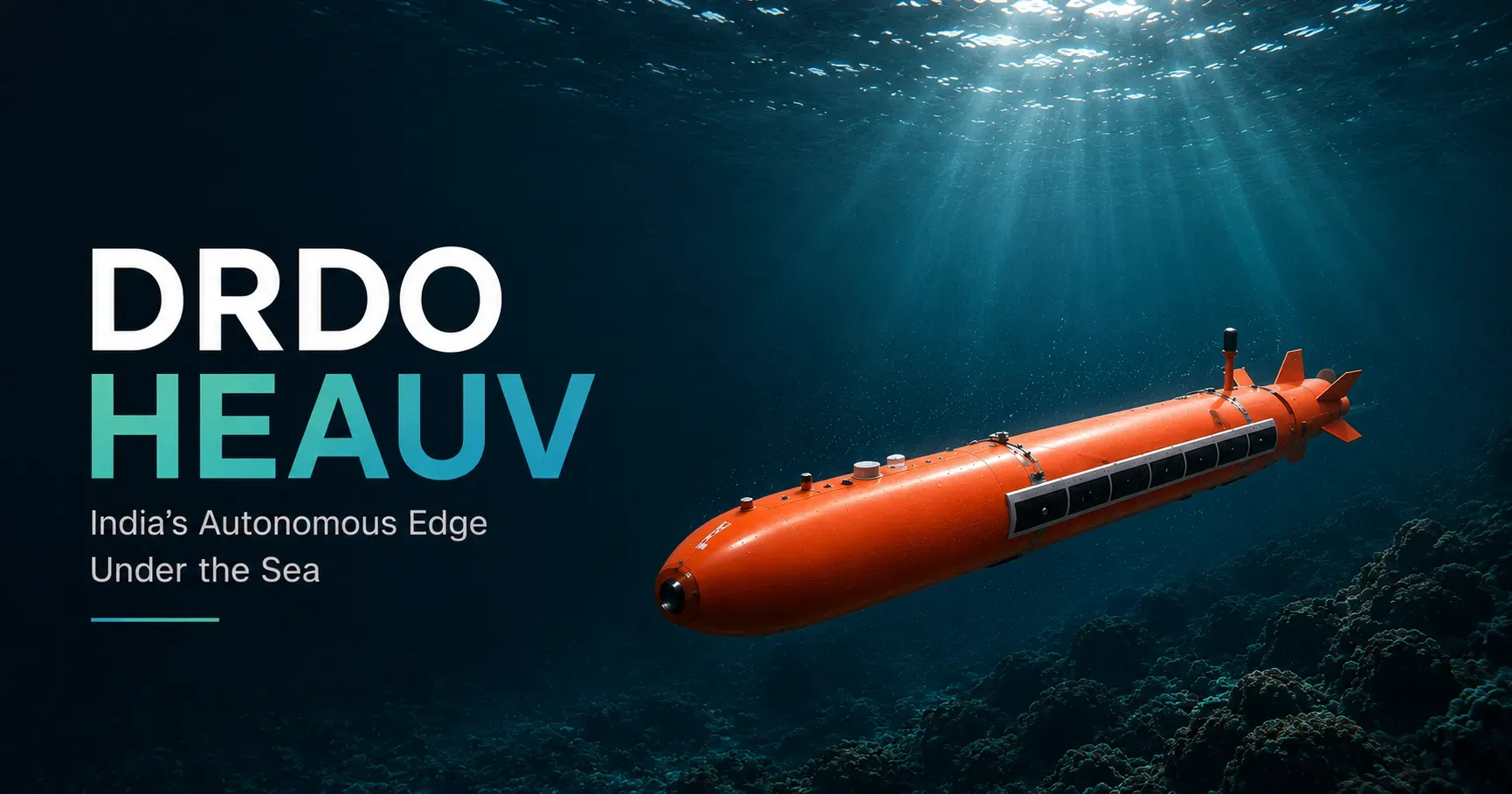
Garden Reach Shipbuilders and Engineers (GRSE) has emerged as a major public-sector contributor to the Indian Navy unmanned maritime ecosystem. Its portfolio includes the Swadheen and Jaldoot unmanned surface vessels and the Neerakshi autonomous underwater vehicle (GRSE Product Documentation).
GRSE Swadheen was developed as a modular unmanned surface platform suitable for surveillance and maritime security missions. Jaldoot follows a similar philosophy while supporting different operational profiles and payload configurations.
These programmes matter because they bridge the gap between laboratory demonstrations and acquisition programmes. Naval operators require platforms that can survive operational maritime conditions, integrate sensors, support mission payloads, and operate alongside the broader Indian military drone fleet.
The GRSE effort also demonstrates a broader pattern across Indian defence modernisation. Public-sector shipbuilders are moving beyond hull construction into autonomy integration, sensor deployment, and digital mission systems, reinforcing the Atmanirbharta drive in unmanned platforms.
AI-enabled maritime systems depend on this integration layer. Navigation software, mission planning tools, computer-vision systems, and platform management systems must operate together. Successful autonomy programmes depend as much on systems engineering as on individual algorithms.
Swadheen and Jaldoot therefore occupy an important position in the stage map. They sit within the trials layer, helping convert roadmap requirements into deployable platforms.
Walking through Swavlamban and the iDEX pipeline
Swavlamban Indian Navy serves as the service's primary innovation and technology-induction platform. The initiative is managed through the Naval Innovation and Indigenisation Organisation (NIIO). It is supported through wider defence innovation programmes that fund USV problem statements through iDEX.
Swavlamban 2025 was held on 25 and 26 November 2025 with a strong emphasis on unmanned and counter-unmanned technologies (Indian Navy, November 2025). The event connected naval operators, government organisations, startups, defence technology developers, and research institutions.
The broader innovation pipeline includes Innovations for Defence Excellence, commonly known as iDEX. According to official iDEX data, more than 565 challenges had been launched across defence services by November 2025, including 198 linked to Indian Navy requirements (iDEX Bulletin, 20 November 2025).
This innovation structure matters because operational capability does not begin with procurement. Capability begins with problem definition, challenge creation, prototype development, testing, and user evaluation.
The pipeline supports the technology blocks unmanned maritime systems depend on. Autonomous navigation software handles route planning, while computer-vision-based maritime awareness classifies radar and electro-optical contacts. Sensor fusion architectures combine those inputs into one situational picture, and secure communications carry that picture between platforms and shore. Cooperative operations between unmanned and crewed platforms close the autonomy stack the Indian Navy USV roadmap is built on.
Costing endurance against persistent maritime presence
Persistent maritime presence is one of the strongest arguments for unmanned surface systems. Naval forces require continuous surveillance across large maritime areas, yet crewed platforms carry manpower, training, and lifecycle costs.
An autonomous surface vessel can remain on station for routine monitoring missions without assigning sailors to every platform. Operators can supervise multiple systems while focusing crewed vessels on higher-priority missions.
The value proposition is not platform replacement. The value proposition is mission distribution. Unmanned systems extend surveillance coverage, improve maritime awareness, and support specialist tasks such as mine warfare, harbour security, and infrastructure monitoring.
AI plays a supporting role in this model. Computer-vision systems classify contacts. Navigation software manages routine transit functions. Sensor fusion engines combine radar, optical, and navigation inputs into a unified operational picture.
This approach creates the cost asymmetry that unmanned systems unlock. Routine maritime coverage can be distributed across lower-cost autonomous systems while crewed vessels concentrate on missions requiring human judgement and force projection.
Examining the TPCR roadmap and the decade ahead
Technology Perspective Capability Roadmap 2025 provides the clearest long-term view of Indian Navy USV development. The document identifies TPCR 2025 unmanned surface vessel requirements as part of future force-modernisation planning across surface, subsurface, and mine warfare missions (Department of Defence Production, September 2025).
The roadmap suggests an expanding role for autonomous surface vessels, autonomous underwater vehicles, and integrated mine countermeasure systems. Industry analysis linked to TPCR-2025 places future requirements at approximately 400 unmanned surface vessels across multiple categories, although that figure remains analyst-reported rather than officially announced (Naval News, September 2025).
What matters more than the exact number is the direction of travel. The Indian Navy has already moved through each stage of the operational ladder: a certified platform, multiple prototypes, formal procurement approvals, and a long-term roadmap. That combination did not exist even a few years ago.
The next phase will focus on scaling. Additional autonomous navigation deployments, procurement conversions, mine warfare trials, and wider autonomy integration are logical next steps. Mission autonomy, sensor fusion, route optimisation, and cooperative maritime operations, alongside swarm intelligence in unmanned operations, will shape the next generation of naval unmanned systems.
Charting the maturity curve across the four stages
The Indian Navy USV operational reality reads as a maturity curve rather than a platform list. Each programme occupies a different point on the operational ladder.
A-FIB with A2NCS sits in the certified and operational category (BEL, 17 January 2026; Indian Register of Shipping, January 2026). Swadheen and Jaldoot sit within the trials layer (GRSE Product Documentation). Compact Autonomous Surface Craft, MCMV support systems, and Submersible Autonomous Vehicles sit within procurement planning through Defence Acquisition Council approvals (Ministry of Defence, 3 July 2025; Ministry of Defence, 5 August 2025).
For defence integrators, this stage map identifies where partnerships and subsystem opportunities are likely to emerge. For procurement teams, it clarifies which programmes have formal acquisition backing. For researchers and journalists, it separates operational capability from roadmap ambition.
The key operational reality is straightforward. The Indian Navy no longer treats unmanned surface systems as experimental technology. The force now has certified capability, active trials, approved procurement pathways, and a documented roadmap.
The next inflection point will be the transition of procurement-approved autonomous surface programmes into contracted and operational fleets.