The DRDO HEAUV programme moved from an R&D concept to a formal Indian Navy requirement between March 2024 and September 2025. The Technology Perspective and Capability Roadmap 2025 lifted intake from eight to twenty units, with NSTL Visakhapatnam developing the platform and Cochin Shipyard Limited integrating it. This analysis uses the policy-programme-platform triad to map the platform's specifications, sensor stack, mission profile, and procurement signal. The shift from eight to twenty units is the development that changes the programme's strategic significance.
Tracing the DRDO HEAUV programme timeline
The DRDO HEAUV programme sits within the Naval Science and Technological Laboratory, or NSTL, in Visakhapatnam. HEAUV stands for High Endurance Autonomous Underwater Vehicle. The NSTL autonomous underwater vehicle effort represents the deepest undersea autonomy work inside DRDO. The platform forms part of a broader effort to build India's unmanned maritime systems landscape for the Indian Navy (Ministry of Defence, 22 March 2021).
The programme appeared publicly in DRDO's portfolio of strategic development projects through a Rajya Sabha written reply that listed HEAUV among major ongoing initiatives (PIB, 22 March 2021). The policy baseline traces back to a Ministry of Defence Request for Information issued in 2018, which identified a requirement for eight high-endurance underwater vehicles. That figure remained the cited benchmark across industry coverage between 2018 and 2024.
The first major public trial milestone arrived on 7 March 2024. DRDO confirmed the HEAUV maiden surface run at the International Ship Repair Facility Jetty in Kochi. The Cochin Shipyard HEAUV partnership had integrated the platform for this test. The trial validated propulsion, navigation, control logic, and surface handling behaviour under operational conditions (DRDO, 7 March 2024).
The second milestone followed in March 2025. The HEAUV lake trials validated both surface and submerged dynamics. These tests moved the programme beyond laboratory validation and into integrated vehicle evaluation (DRDO, March 2025).
Public reporting through 2025 stops at these trials. The more consequential development arrived later through the Technology Perspective and Capability Roadmap 2025, which expanded the requirement from eight platforms to twenty. That shift transformed HEAUV from a technology demonstrator path into a fleet-scale capability target inside India's defence drone fleet (Ministry of Defence, September 2025).
Unpacking the HEAUV platform specifications
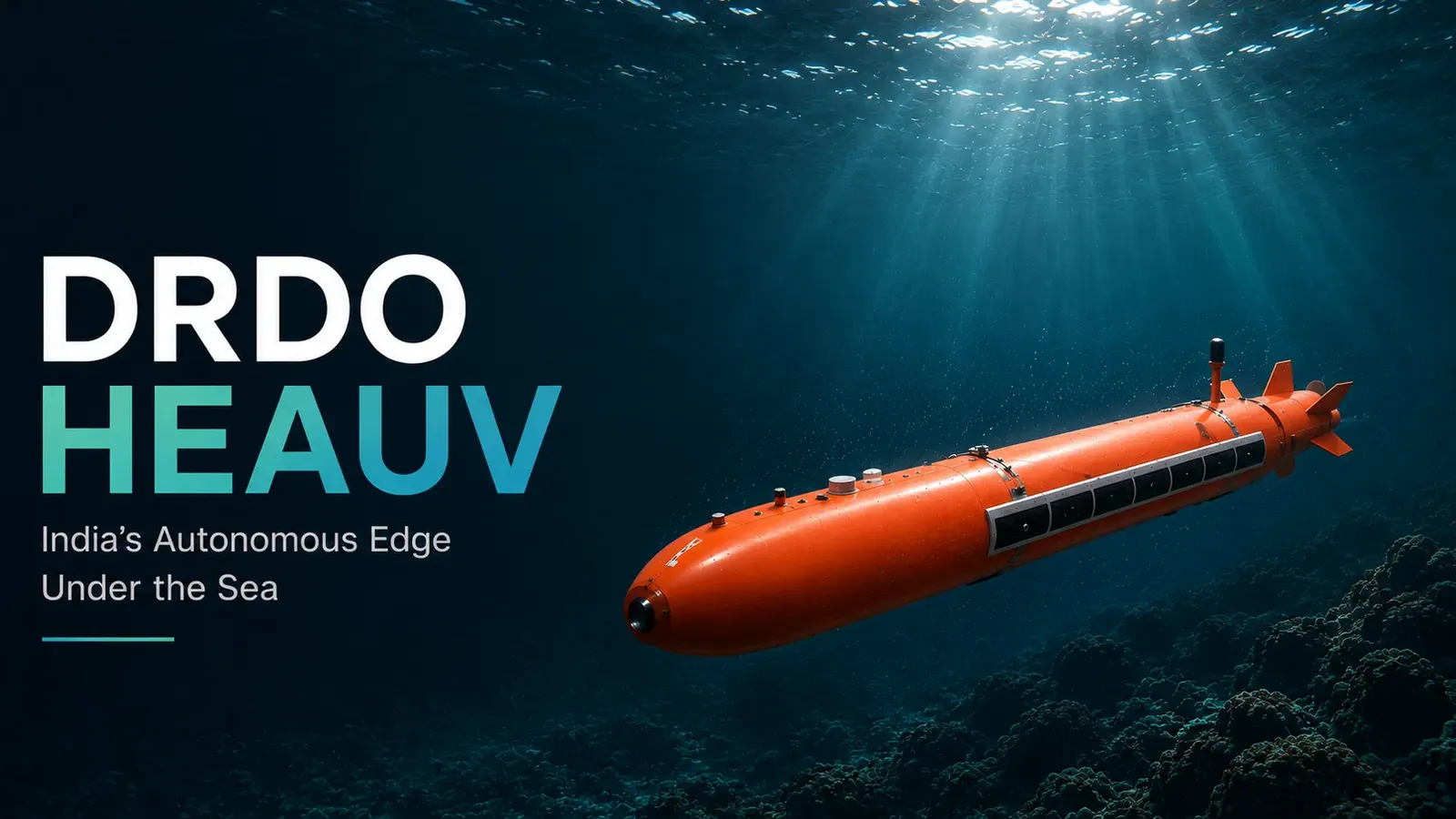
HEAUV specifications define a large autonomous underwater platform designed for long-duration missions rather than short tactical deployments. The platform occupies a capability tier above compact survey vehicles and mine inspection systems.
Available technical disclosures indicate a vehicle weighing approximately 6 tonnes, measuring 9.75 metres in length and 1 metre in diameter. The platform is designed for operations at depths of up to 300 metres and for endurance approaching 15 days at a cruising speed of roughly 3 knots (Naval News, 20 April 2025).
Attribute | HEAUV value | Operational significance |
|---|---|---|
Weight | 6 tonnes | Long-duration payload capacity |
Length | 9.75 metres | Large sensor and energy volume |
Diameter | 1 metre | Hydrodynamic efficiency |
Operating depth | 300 metres | Extended underwater mission envelope |
Endurance | 15 days | Persistent surveillance capability |
The phrase "HEAUV endurance and depth" appears frequently in search queries because these parameters determine mission relevance. A vehicle capable of remaining submerged for fifteen days can support intelligence collection, route reconnaissance, and maritime surveillance missions that would otherwise require crewed assets.
The platform also reflects a broader shift in unmanned systems design. Endurance depends on energy management, route planning algorithms, sensor prioritisation, and onboard computing efficiency. Computer vision, sensor fusion, and edge inference systems help reduce unnecessary manoeuvres and conserve power during long missions.
HEAUV differs from smaller autonomous underwater vehicles because its design prioritises persistence rather than rapid deployment. The platform sits alongside other long-endurance unmanned platforms where mission duration matters more than dash speed. The operational value comes from sustained presence beneath the surface rather than speed alone.
Decoding the sensor and communication stack
The HEAUV sensor and communication architecture combines multiple sensing layers to support navigation, detection, classification, and mission execution. This layered approach allows the platform to operate in complex underwater environments where a single sensor type is insufficient.
The primary underwater sensing package includes front-looking sonar, flank array sonar, and side-scan sonar systems. DRDO's Naval Physical and Oceanographic Laboratory, or NPOL, supported their development (Naval News, 20 April 2025). Each sensor performs a different function. Front-looking sonar supports obstacle detection, flank arrays improve target tracking, and side-scan systems assist seabed mapping and mine identification.
Surface awareness requirements introduce additional sensors. Technical reporting indicates integration of a low-power X-band surveillance radar associated with the Electronics and Radar Development Establishment, or LRDE (Naval News, 20 April 2025). This capability supports situational awareness during surface transit and communication windows.
Communication architecture is equally important. Underwater platforms cannot rely on continuous high-bandwidth connectivity. The reported HEAUV design incorporates acoustic communications, radio-frequency channels, satellite links, and surface communication pathways depending on mission phase (Naval News, 20 April 2025).
This is where autonomy across unmanned systems becomes operationally relevant. Sensor fusion software combines sonar inputs, navigation data, and environmental information into a single mission picture. Classification algorithms can identify patterns, prioritise contacts, and support route adjustments without constant operator intervention. These functions remain automated rather than fully autonomous because mission authority remains within defined command structures.
The result is a platform capable of collecting, processing, and transmitting information across extended missions while operating with limited communication opportunities.
Mapping HEAUV mission roles across ASW and MCM
HEAUV mission roles span anti-submarine warfare, mine countermeasures, intelligence collection, surveillance, reconnaissance, electronic intelligence support, and hydrographic tasks. The Technology Perspective and Capability Roadmap 2025 identifies these mission categories as part of the capability requirement (Ministry of Defence, September 2025).
HEAUV anti-submarine warfare applications focus on persistent underwater sensing rather than direct engagement. The platform can support detection, tracking, and classification tasks across designated maritime zones. Long endurance allows coverage periods that are difficult for crewed systems to sustain economically.
HEAUV mine countermeasures missions represent another major use case. Autonomous underwater vehicles can survey large areas, identify anomalies, classify potential mine-like objects, and reduce risk to personnel. This role aligns closely with wider DRDO efforts in autonomous mine countermeasure technologies (PIB, 14 November 2025).
The platform also supports intelligence, surveillance, and reconnaissance operations. Persistent underwater surveillance creates opportunities for maritime domain awareness, seabed monitoring, infrastructure inspection, and route reconnaissance. These functions gain operational value as undersea infrastructure shifts into the strategic tier.
A DRDO underwater drone for ASW differs from a conventional patrol platform because it trades crew capacity for endurance and persistence. The platform extends India's advanced military drone fleet into the subsurface domain. The operational question is not whether an unmanned platform replaces a crewed vessel. The question is which missions can be performed more efficiently by a system that remains underwater for extended periods.
Mission autonomy also matters. Route planning software, environmental adaptation logic, and onboard target classification systems help maintain mission effectiveness while reducing operator workload. These capabilities become more important as fleet sizes increase.
Reading the TPCR-2025 quantum signal
The Technology Perspective and Capability Roadmap 2025 provides the policy signal attached to the programme. It converts technical progress into a formal capability requirement.
The Indian Navy AUV programme requirement expanded from eight HEAUVs under the earlier planning framework to twenty units under TPCR-2025 (Ministry of Defence, September 2025). This change is the defining strategic development in the programme's evolution.
Planning stage | Requirement | Implication |
|---|---|---|
2018 RFI baseline | 8 HEAUVs | Prototype-era planning |
TPCR-2025 requirement | 20 HEAUVs | Fleet-scale capability planning |
The Indian Navy 20 HEAUV requirement traces back to a 2018 Ministry of Defence Request for Information that set the baseline at eight units (Ministry of Defence, 2018). The TPCR-2025 update lifted the requirement to twenty (Ministry of Defence, September 2025). A fleet target of twenty platforms creates demand across India's drone manufacturing ecosystem for production support, maintenance infrastructure, sensor integration, communications equipment, propulsion systems, and mission software.
The signal also aligns with broader naval indigenisation objectives. The Indian Naval Indigenisation Plan 2015-2030 emphasises domestic capability development across strategic maritime systems (PIB, 3 December 2025). HEAUV fits directly within that framework.
Policy documents matter because they influence budget allocation and programme prioritisation. Trial success demonstrates technical feasibility. Formal requirements demonstrate institutional commitment. TPCR-2025 provides that commitment.
For defence integrators, the policy signal may carry greater weight than the technical specifications. Procurement pathways typically follow formal capability demand rather than prototype milestones.
Linking HEAUV to NSTL's wider undersea capability set
HEAUV is part of a broader ecosystem of undersea research programmes rather than a standalone effort. NSTL functions as the central node for multiple underwater capability initiatives within DRDO.
The autonomous underwater vehicle India landscape draws on four DRDO laboratories. NPOL contributes underwater sensing technologies. LRDE supports radar and electronic systems.
NSTL leads naval systems integration. Other DRDO organisations contribute propulsion, materials, and mission technologies across programme lines.
This multi-lab approach appeared again in DRDO's man-portable autonomous underwater vehicle initiative announced in November 2025. That programme involved collaboration across NSTL, NPOL, RCI, HEMRL, and DYSL-AT for mine countermeasure applications (PIB, 14 November 2025).
The NSTL Visakhapatnam underwater vehicle ecosystem also creates a pathway for future upgrades. One area worth tracking involves advanced energy systems. Public reporting has linked the Naval Materials Research Laboratory, or NMRL, to hydrogen fuel cell development that could support future endurance improvements for underwater platforms (Naval News, 20 April 2025).
The programme therefore extends beyond a single vehicle. It represents the accumulation of expertise across sensors, propulsion, navigation, communications, mission software, and energy storage.
Capability depth matters because underwater systems are difficult to develop through isolated projects. The same multi-lab pattern drives DRDO's TAPAS-BH long-endurance programme in the aerial domain. Sustained programme structures create the engineering base needed for long-term maritime autonomy.
Positioning HEAUV in India's autonomous maritime doctrine
The Indian Navy underwater drone now sits at the convergence of policy commitment, programme maturity, and platform capability. For defence integrators, the indicator that matters is the shift from eight to twenty projected platforms under TPCR-2025 (Ministry of Defence, September 2025). That change creates a stronger business case for subsystem development, integration partnerships, and production planning.
For policy researchers, HEAUV offers a useful case study in how defence programmes mature. The sequence is visible: research funding, prototype development, public trials, roadmap inclusion, and formal capability scaling. The programme now sits beyond the experimental stage and within a defined force-planning framework.
For naval planners, long-endurance underwater systems create persistence without expanding crew requirements. That characteristic gains weight as maritime surveillance demands cover larger operational areas across the Indian Ocean Region.
For the broader autonomy ecosystem, HEAUV demonstrates how AI-enabled mission software, sensor fusion, route optimisation, and onboard processing are becoming embedded within defence platforms. The next operational layer extends these capabilities into manned-unmanned teaming patterns across the surface, subsurface, and aerial domains. These technologies are no longer separate innovation themes. They are operational components of the platform itself.
The next indicators to watch are open-water sea trials, production planning milestones, subsystem procurement activity, and future energy-system upgrades. We will continue tracking how the twenty-platform requirement translates into sea trials, production decisions, and the next generation of India's autonomous undersea capability.