Bridge inspection with drones in India sits inside a tightening safety mandate. MoRTH issued a real-time bridge health monitoring circular on 4 March 2024 and the August 2025 SOP that made drone-based videography compulsory for highway inspections (Ministry of Road Transport and Highways, 4 March 2024). The Gambhira bridge collapse of 9 July 2025 triggered audits of about 1,800 bridges across Gujarat. This piece maps the safety, mandate, and capability stack a custodian now operates under, anchored in IBMS data and the Indian Railway Bridge Manual cadence.
Tracing the safety case for drone-based bridge surveillance in India
Bridge inspection with drones in India is driven by structural risk management rather than operational convenience. India's highway and railway networks carry thousands of ageing bridges that require periodic structural inspection. The defect classes inspectors must surface include cracks, corrosion, bearing displacement, scour around foundations, joint deterioration, and deck deformation.
The Ministry of Road Transport and Highways launched the Indian Bridge Management System to build a national inventory of bridges and culverts across the National Highway network. The platform records structural details, inspection history, condition ratings, and maintenance priorities for more than 172,000 assets (Ministry of Road Transport and Highways, IBMS).
The same dataset lists about 30 per cent of culverts and 12 per cent of minor bridges in poor condition. The figure stands at 8 per cent for major bridges and 5 per cent for extra-long bridges (Ministry of Road Transport and Highways, IBMS, 2024). Drone bridge inspection complements that database by replacing one-off visual surveys with repeatable aerial evidence.
Safety concerns intensified after multiple bridge failures across states. The Gambhira bridge collapse in Padra, Gujarat on 9 July 2025 killed 22 people and prompted the state to inspect about 1,800 bridges. Of those, 20 were closed fully and 113 partially closed for heavy vehicles.
The Bihar Bridge Maintenance Policy 2025 engaged IIT Delhi and IIT Patna to assess 85 major bridges within a wider scope of 3,968 structures (Government of Bihar, Bihar Bridge Maintenance Policy, 2025). Aerial inspection now sits inside the official audit trail rather than the engineer's preferred toolbox.
Aerial surveys shorten inspection windows, reduce traffic disruption, and create digital records that compare across cycles. The discipline mirrors drone surveying and mapping in India workflows on linear assets where repeatability decides procurement outcomes.
Mapping the MoRTH and NHAI mandate chain
The regulatory framework for bridge inspection with drones in India developed through successive policy actions rather than a single notification. Together, these directives establish how aerial inspection data should support highway maintenance, structural monitoring, and compliance documentation. The NHAI drone survey mandate is the spine of that chain.
The first operational shift came on 17 June 2021 when the National Highways Authority of India made drone-based video recording mandatory across all National Highway projects. The directive covered construction, development, operation, and maintenance activities, including assets under the National Highways and Infrastructure Development Corporation Limited (NHIDCL). Project teams were instructed to upload survey data to the NHAI Data Lake, creating a central repository for monitoring project quality (Press Information Bureau, 17 June 2021).
The next milestone arrived on 4 March 2024 when MoRTH issued guidelines for implementing real-time bridge health monitoring through sensors. The MoRTH bridge sensor mandate instructed bridge authorities to identify structures requiring continuous monitoring. The recommended measurement parameters covered strain, deflection, vibration, tilt, displacement, corrosion, and environmental conditions (Ministry of Road Transport and Highways, 4 March 2024). The objective was to combine sensor data with engineering inspections instead of relying on periodic visual assessment alone.
The policy direction strengthened after the Gambhira bridge collapse. In August 2025, MoRTH released a Standard Operating Procedure requiring drone-based videography and aerial imaging during highway inspections (Ministry of Road Transport and Highways, 11 August 2025). The SOP aligned inspection practices across construction and maintenance activities while supporting the Supreme Court's directions on highway asset monitoring. Drone imagery became part of the official inspection record rather than an optional engineering aid.
These initiatives work alongside the NHAI Drone Analytics Monitoring System. DAMS received the Gold Award from the Department of Administrative Reforms and Public Grievances (DARPG) at the National Conference on e-Governance 2025 (Press Information Bureau, 30 December 2025). The platform fuses drone imagery, artificial intelligence, Network Survey Vehicle data, and three-dimensional mapping, mirroring the procurement signal seen in drones in Indian construction projects. Together, these directives form the MoRTH bridge inspection mandate chain that custodians now plan around.
Reading the IBMS data behind every condition rating
The Indian Bridge Management System is the national framework for recording, assessing, and prioritising bridge maintenance across India's National Highway network. It transforms inspection from a paper-based exercise into a structured asset-management process supported by measurable engineering data.
Every bridge entered into IBMS receives a unique digital identity linked to its location, structural configuration, construction history, inspection records, maintenance activities, and condition assessments. Inspectors evaluate components including the deck slab, superstructure, bearings, substructure, foundations, waterway adequacy, and scour conditions (Ministry of Road Transport and Highways, IBMS). The observations create condition ratings that help authorities identify structures requiring maintenance, rehabilitation, strengthening, or replacement.
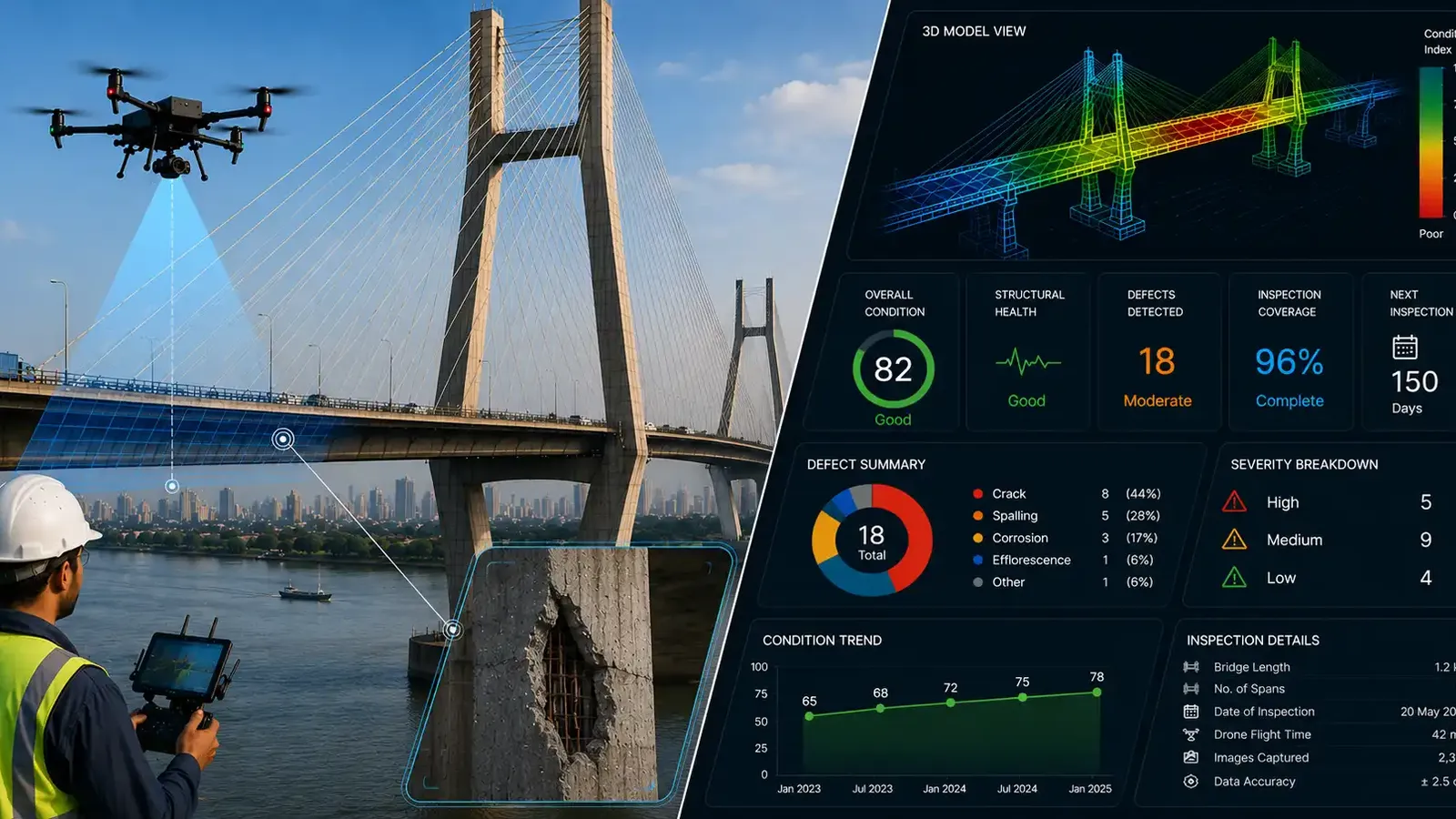
Drone inspections strengthen this assessment because they generate consistent visual documentation for every cycle. High-resolution imagery allows engineers to compare deterioration across months or years instead of relying on written observations alone. Photogrammetric models and LiDAR point clouds also create measurable records of bridge geometry, allowing engineers to detect gradual structural movement that may not surface during routine inspections.
The methodology follows the Indian Roads Congress manuals. IRC SP 35 bridge inspection guidelines govern inspection and maintenance, while IRC SP 52 sets the reference manual for bridge inspectors. IRC SP 18 anchors the manual for highway bridge maintenance inspection (Indian Roads Congress, IRC:SP:35; IRC:SP:52; IRC:SP:18). Drone data complements these standards rather than replacing them.
Engineering judgement, structural analysis, and field verification remain the basis of every maintenance decision. The combination of national asset databases, engineering standards, and aerial inspection allows bridge authorities to allocate maintenance budgets using objective evidence rather than reactive emergency repairs. As bridge inventories continue to expand, consistent inspection records become a recurring input into the IBMS condition-rating cycle.
Operating UAS over railway bridges under IRBM cadence
Bridge inspection over railway infrastructure follows a different operational framework from highway inspection. The Indian Railway Bridge Manual defines the inspection cadence, engineering responsibilities, and documentation requirements for railway bridges. Drone operations support these inspections by improving access to difficult locations, without replacing the statutory inspection process carried out by railway engineers.
The IRBM assigns inspection responsibilities across multiple engineering levels. Permanent Way Inspectors and Inspectors of Works inspect bridges before the monsoon each year. Assistant Engineers perform annual post-monsoon inspections, while Divisional Engineers inspect important bridges according to the prescribed schedule (Indian Railways, Indian Railway Bridge Manual). Steel bridges also undergo detailed Bridge Inspector examinations on longer maintenance cycles.
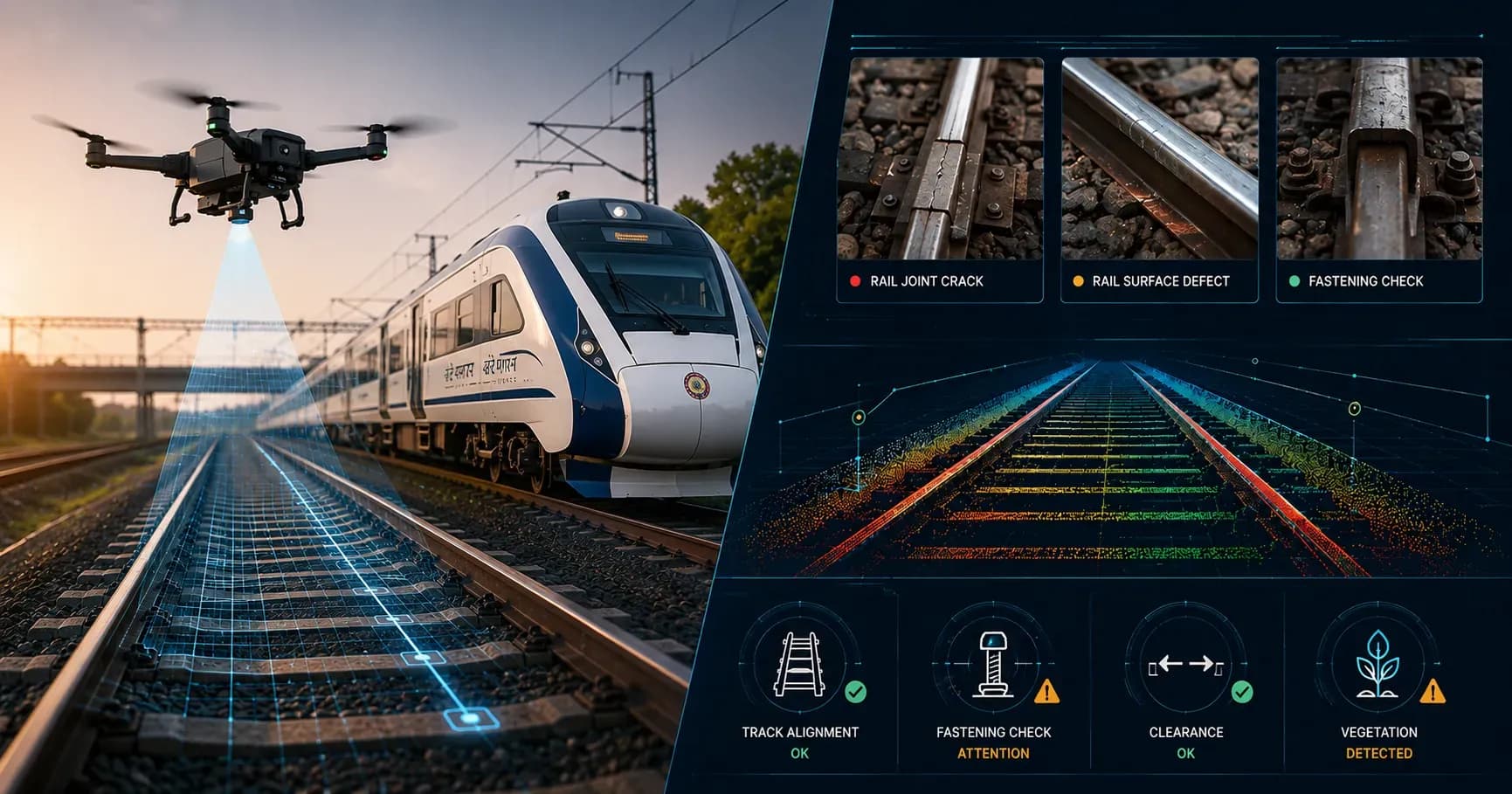
The structured inspection programme makes railway bridge drone survey India a routine line item in zonal civil engineering procurements. Railway bridges cross rivers, deep valleys, highways, and densely built environments where conventional access requires scaffolding, rope access teams, or temporary traffic restrictions. A multirotor UAS can safely capture imagery of bearings, gusset plates, truss members, pier caps, expansion joints, drainage paths, and underside structural elements without disrupting railway operations.
UAV bridge inspection on rail assets demands repeatable imagery so engineers can compare structural conditions over multiple cycles. Photogrammetric reconstruction creates measurable three-dimensional models, while LiDAR scanning improves dimensional accuracy around complex steel structures. The same payload pattern travels across zonal work covered in drones across Indian Railways practice.
Artificial intelligence flags recurring defect classes such as corrosion, coating degradation, loose fasteners, water seepage, vegetation growth, and concrete cracking. Bridge engineers remain responsible for the final structural assessment and maintenance recommendation.
Selecting the payload mix for structural defect detection
LiDAR bridge inspection combines multiple sensor technologies because no single payload can detect every structural defect, the same payload logic that governs drone pipeline inspection. The inspection objective determines which payload configuration produces the highest-quality engineering data.
Inspection objective | Primary payload | Typical output | Engineering value |
|---|---|---|---|
Surface crack mapping | High-resolution RGB camera | Orthomosaic and close-up imagery | Detects visible deterioration and concrete defects |
Dimensional measurement | LiDAR scanner | Three-dimensional point cloud | Measures deformation and structural geometry |
Moisture and heat anomalies | Thermal imaging camera | Temperature map | Identifies water ingress and hidden deterioration |
Precision surveying | RTK or PPK GNSS | Centimetre-level positioning | Improves mapping and repeat inspection accuracy |
Drone bridge inspection cost India depends on the inspection objective rather than aircraft size alone. A routine visual inspection requires an RGB payload paired with centimetre-level positioning, a stack covered in RTK and PPK positioning explained. Large infrastructure assessments cover long-span bridges, heritage structures, and complex river crossings. These programmes combine RGB imaging, LiDAR scanning, thermal inspection, and high-accuracy positioning to produce a complete structural record.
Thermal imaging bridge inspection identifies abnormal temperature patterns that may indicate moisture intrusion, delamination, or insulation defects. The findings require engineering verification because thermal signatures alone cannot confirm structural failure. Photogrammetry bridge survey India produces detailed three-dimensional surface models from overlapping aerial imagery, documented in our photogrammetry drone workflow coverage. The method suits concrete deterioration mapping, deck geometry capture, and approach-road condition records.
LiDAR scanning anchors dimensional accuracy in the inspection chain. The LiDAR drone surveying workflow covers how point clouds are processed into measurable three-dimensional models that feed the IBMS condition-rating cycle. Modern inspection workflows combine these payloads with computer vision algorithms that classify defect categories before engineers begin manual review.
The engineering decision continues to depend on structural analysis, field validation, and the maintenance standards established by bridge authorities.
Clearing the airspace permission stack
DigitalSky yellow zone permission defines how operators obtain approval to conduct bridge inspection flights near controlled airspace. Every bridge survey must satisfy aviation regulations and the operational requirements of the asset owner before a mission begins.
The Drone Rules, 2021 established India's risk-based regulatory framework for unmanned aircraft systems under the Ministry of Civil Aviation (Ministry of Civil Aviation, 25 August 2021). The rules operate under the Bharatiya Vayuyan Adhiniyam 2024, which supersedes the Aircraft Act of 1934 as the parent civil aviation legislation (Government of India, Bharatiya Vayuyan Adhiniyam, 2024). Operators planning bridge work should read the framework alongside the Drone Rules 2021 breakdown.
Since the July 2025 platform changes, aircraft registration and certification functions are managed through the eGCA platform. DigitalSky continues to manage airspace authorisation, No Permission No Take-off (NPNT), and flight permissions. Bridge inspections cross rivers, highways, urban corridors, and transport infrastructure that may fall inside Green, Yellow, or Red airspace zones.
The classification depends on proximity to airports, defence establishments, and controlled airspace. Operators must verify the airspace classification and follow the yellow zone permission on DigitalSky workflow before flying.
BVLOS bridge inspection remains subject to additional regulatory approvals because the operations introduce higher risk than conventional Visual Line of Sight missions. The beyond visual line of sight operations pathway covers how DGCA assesses applications for long-span bridge work. Today, bridge inspections operate predominantly under Visual Line of Sight procedures supported by qualified remote pilots, mission planning software, and real-time telemetry.
Compliance extends beyond flight permission. Operators must maintain approved procedures, calibrated payloads, trained personnel, maintenance records, and secure handling of engineering data collected during the survey.
Closing the inspection-to-decision loop with AI and digital twins
The discipline of structural health monitoring bridges aerial inspection, ground sensors, engineering analysis, and artificial intelligence into a single digital workflow. The objective is no longer to collect photographs but to generate engineering evidence that supports maintenance decisions throughout the bridge lifecycle.
A modern inspection begins with mission planning and aerial data collection. RGB imagery, LiDAR scans, thermal data, and centimetre-level positioning create a digital representation of the bridge. Computer vision algorithms then classify visible crack patterns, corrosion, vegetation growth, drainage blockage, concrete spalling, and surface anomalies. The computer vision in drones workflow covers how these classifiers are trained and validated against ground-truth datasets.
Engineers validate the observations before assigning condition ratings and maintenance priorities. Digital twins strengthen the process by maintaining a continuously updated three-dimensional record of each bridge. Bridge authorities can measure structural changes across successive inspection cycles and identify deterioration trends before they reach a service-affecting threshold.
The MoRTH real-time health monitoring directive of 4 March 2024 sits alongside aerial inspection in this loop. Ground sensors stream strain, deflection, and corrosion data while drone imagery records the surface and geometry, producing layered evidence the IBMS database can store and query. The combined record reshapes maintenance from a reactive activity into a planned engineering programme.
Bridge custodians can identify early-stage defects rather than respond after visible deterioration. Maintenance budgets are then allocated using measurable engineering data across thousands of infrastructure assets.
The mandate chain that ran from the 4 March 2024 sensor circular to the August 2025 highway-inspection SOP signals a clear direction for the next twelve months. Real-time sensor feeds will fuse with periodic drone-derived imagery inside the Indian Bridge Management System. IRBM cadence will be updated to recognise aerial inspection records as part of the formal log.
The procurement floor for commercial UAS contractors will shift from aircraft specifications to engineering-grade data delivery against IRC SP 35 and IRC SP 52 evidence rules. The next inflection point sits inside the MoRTH S&R Zone's review cycle for contractor-uploaded sensor and drone data.