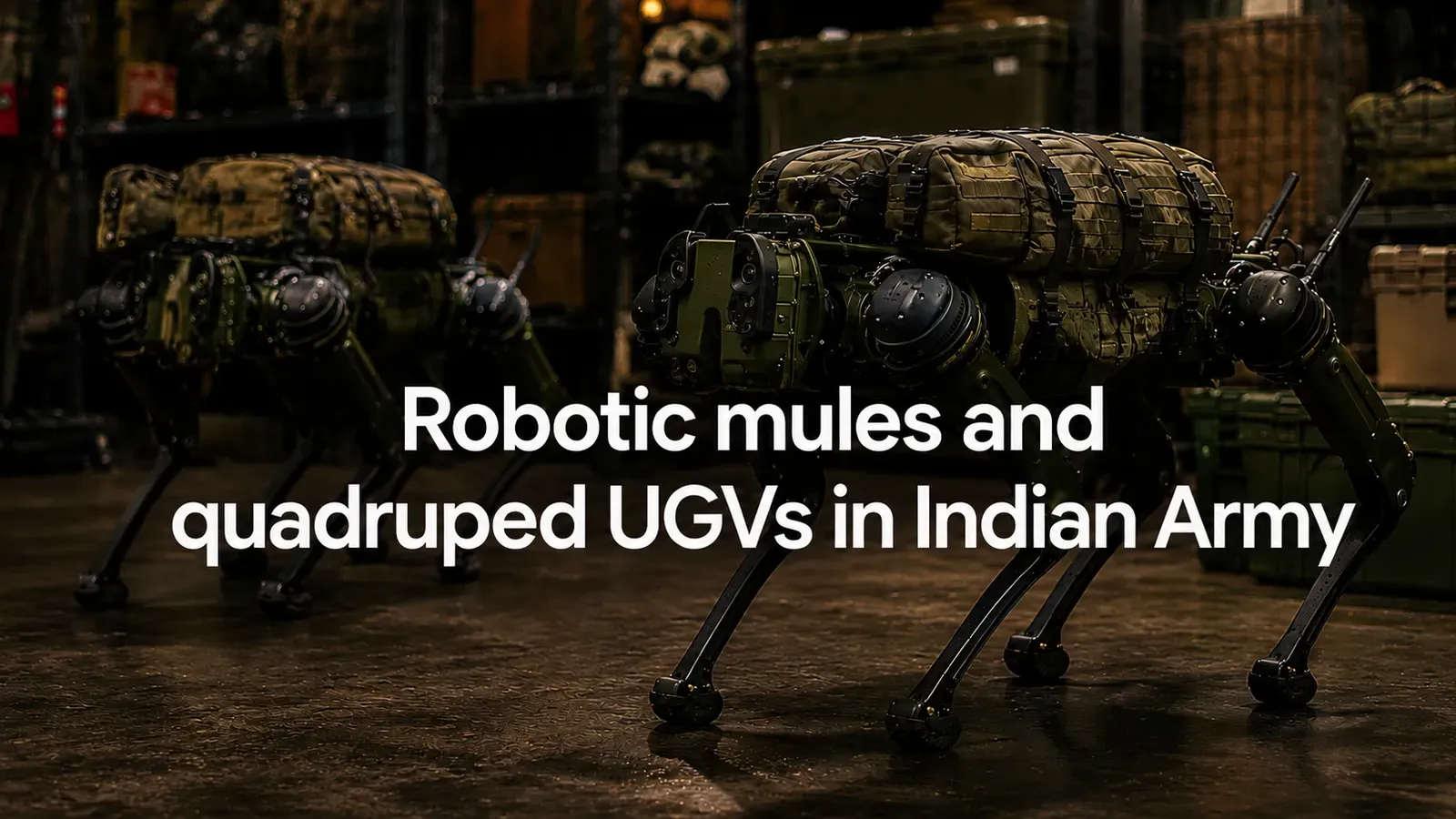
The Indian Army has shifted from pack mules to legged ground robots, with 100 Multi-Utility Legged Equipment (MULE) platforms inducted under the Tranche-IV emergency procurement (Indian Army, January 2025). On 13 March 2026, DRDO's R&DE(E) Pune demonstrated an indigenous robotic mule prototype through its Centre for Systems and Technologies for Advanced Robotics (DRDO, 13 March 2026). This piece reads the deployment through a mobility, mission, and modernisation lens. It maps the platform from emergency contract to LoC patrol, Operation Brahma rescue, and the next humanoid horizon.
Defining the legged ground robot class in Indian service
A robotic mule is a quadruped unmanned ground vehicle designed to carry loads, support troops, and operate across terrain that challenges wheeled or tracked systems. The Indian Army's operational platform belongs to the quadruped UGV category, sometimes referred to as a Q-UGV.
Unlike wheeled logistics robots that require prepared routes, a quadruped UGV uses articulated legs to traverse rocks, narrow mountain paths, forest trails, debris fields, and steep gradients. This mobility profile makes the platform relevant for mountain warfare and forward logistics operations (Indian Army, January 2025).
The Multi-Utility Legged Equipment platform represents India's first fielded legged robot capability. The platform occupies a middle ground between a conventional pack animal and a larger autonomous ground vehicle. It is designed to move supplies, sensors, communications equipment, and mission payloads while reducing the physical burden on soldiers operating in remote terrain (Indian Army, January 2025).
This category differs from tracked UGVs because terrain adaptability is prioritised over speed. It also differs from wheeled systems because stability on broken ground is the primary design requirement. The result is a platform class built for terrain where roads do not exist and where logistics remains the limiting factor for military operations.
The emergence of robotic mule India programmes also reflects a wider trend across modern armed forces. Ground robotics is moving beyond explosive ordnance disposal and reconnaissance into logistics, casualty support, and distributed operations under India's broader unmanned ground vehicle programme. The Indian Army's induction marks the beginning of that transition in operational service.
Tracing the Tranche-IV emergency procurement to one hundred platforms
The Indian Army acquired its first robotic mule fleet through the fourth tranche of emergency procurement initiated under Ministry of Defence fast-track procedures (Ministry of Defence, September 2023). The Tranche-IV emergency procurement framework allowed military formations to acquire operationally relevant systems within accelerated timelines. Under this framework, emergency procurements carried a financial ceiling of ₹300 crore per case and prioritised domestic industrial participation where feasible (Ministry of Defence, September 2023).
The result was the induction of 100 robotic mules Indian Army formations could deploy immediately across operational sectors (Indian Army, January 2025). The procurement represented more than a platform purchase. It established an operational test bed for doctrine, logistics, maintenance, and soldier-machine teaming.
The procurement also aligned with broader Make in India objectives that animate the self-reliant defence-industry build-out across the defence sector. Rather than waiting for a fully indigenous programme to mature, the Army created an operational pathway that could generate field data while domestic research institutions advanced indigenous alternatives. This dual-track structure now defines the robotic mule Make in India story.
The institutional backdrop matters. The Indian Army designated 2024-25 as the Year of Technology Absorption and 2025-26 as the Year of Transformation. The designation placed technology adoption at the centre of force modernisation efforts (Indian Army, 2024-2026). The robotic mule programme became one of the clearest examples of that approach in practice.
Army Day parade displays in Pune during January 2025 and Jaipur during January 2026 subsequently moved the platform from procurement documentation into public view (Indian Army, 15 January 2025; Indian Army, 15 January 2026). The MULE robot Indian Army formations now field is therefore both a procurement artefact and a visible symbol of force modernisation.
Mapping doctrine from counter-infiltration to forward logistics
Robotic mule doctrine is fundamentally a logistics and mobility doctrine before it becomes a combat doctrine. The Indian Army's operational deployment record shows the platform being used for forward logistics, surveillance support, counter-infiltration patrols, and humanitarian assistance missions. Northern Command highlighted robotic mule deployment along the Line of Control counter-infiltration grid during operational demonstrations in August 2025 (Northern Command, 14 August 2025).
In the robotic mule LoC Jammu Kashmir context, the platform helps patrol teams move equipment through difficult terrain while reducing physical load on personnel. This is particularly valuable in sectors where movement occurs on narrow mountain tracks and where sustained patrol duration matters as much as tactical mobility.
The doctrine extends beyond border security. During forward logistics missions, the platform can transport ammunition, batteries, communications equipment, medical supplies, and surveillance payloads. When paired with drones and sensor networks, the robotic mule becomes part of a wider unmanned logistics architecture.
The Indian Army also demonstrated combined deployment concepts involving drones, robotic mules, and networked surveillance systems during technology integration exercises in Arunachal Pradesh (Ministry of Defence, 2025). These experiments reflect a broader shift toward manned-unmanned teaming across the force and connect ground robotics to the wider Indian Army defence-drone inventory operating across border sectors.
AI also enters the picture at the platform level. Computer vision, route planning, obstacle avoidance, sensor fusion, and edge inference help the robotic mule navigate terrain and maintain formation movement. These functions differ from autonomous weapon systems. The platform remains a mobility and logistics asset rather than an autonomous combat system.
Reading the spec sheet against altitude, payload, and temperature
A military robotic mule succeeds or fails on mobility metrics rather than appearance. Indian Army disclosures indicate the platform can carry payloads of up to 15 kilograms and operate in temperatures from minus 40°C to plus 55°C. It can function at elevations reaching approximately 10,000 feet (Indian Army, January 2025). These parameters explain why the platform attracted attention from mountain formations.
Capability | Operational Value | Army-reported Performance |
|---|---|---|
Payload | Logistics support | 15 kg |
Temperature range | Extreme weather operations | -40°C to +55°C |
Altitude | Mountain deployment | Up to 10,000 feet |
Mobility type | Terrain adaptation | Quadruped legged platform |
The robotic mule high altitude payload requirement is particularly important. Mountain operations frequently involve carrying batteries, sensors, ammunition, and communications equipment over long distances. Even modest reductions in soldier load can improve endurance and operational flexibility.
Government technology assessments also indicate integration of navigation, obstacle avoidance, and positioning capabilities including NAVIC-based navigation support (NITI Aayog Frontier Tech, September 2025). These capabilities help maintain navigation reliability in remote environments.
A high-altitude robot India programme is therefore less about robotics as a novelty and more about logistics efficiency. The platform sits alongside India's advanced military drone programmes in the same modernisation push. Terrain, weather, and endurance remain the dominant operational variables.
Watching DRDO R&DE Pune build the indigenous parallel track
The indigenous track centres on DRDO's Research and Development Establishment (Engineers) Pune and its Centre for Systems and Technologies for Advanced Robotics. On 13 March 2026, DRDO publicly demonstrated a robotic mule prototype developed through this programme (DRDO, 13 March 2026). The event represented the first visible indication that India's indigenous legged robot effort had progressed beyond laboratory development.
The DRDO R&DE Pune robotic mule prototype is important because it creates a domestic design pathway independent of commercial procurement cycles. Operationally deployed platforms can generate field lessons while DRDO develops indigenous architectures, mobility systems, control software, and mission payload integration frameworks.
R&DE(E) Pune has already established robotics as a strategic focus area through programmes covering legged robotics, humanoid systems, autonomous mobility, and advanced robotic platforms (DRDO, 8 May 2025). The Centre for Systems and Technologies for Advanced Robotics is the focal point, echoing how autonomy reshapes Indian unmanned platforms across the wider portfolio.
The significance extends beyond a single platform. A successful DRDO robotic mule programme would create domestic expertise in actuators, mobility control, computer vision, mission autonomy, and robotic systems integration. Those capabilities are transferable across multiple defence robotics programmes and feed India's wider drone manufacturing ecosystem.
The indigenous track therefore complements rather than replaces the operational induction pathway. The legged robot defence pathway in India now runs on two tracks at once. One provides field experience. The other builds long-term technological sovereignty.
Phasing out four thousand animal mules over five years
The Indian Army's robotic mule programme sits within a larger logistics transformation effort. Army logistics formations historically maintained an animal transport fleet numbering approximately 4,000 mules across operational sectors (The Wire, 19 January 2025). These animals remain valuable in terrain inaccessible to vehicles, but they also require veterinary support, feed supply chains, transportation infrastructure, and dedicated handling personnel.
The robotic mule animal transport replacement effort is not an immediate one-for-one substitution. Instead, the Army appears to be pursuing gradual replacement in missions where robotics can deliver equivalent mobility while reducing sustainment requirements.
The transition aligns with the Year of Technology Absorption and Year of Transformation initiatives that seek to introduce automation and advanced systems into operational workflows (Indian Army, 2024-2026). Logistics is among the clearest areas where measurable gains can emerge.
The objective is not to remove every animal transport capability. The objective is to reduce dependence where technology can assume part of the workload while maintaining operational effectiveness.
Counting the field deployments from Operation Brahma onward
Field deployment provides the strongest evidence of capability maturity. One clear example occurred during Operation Brahma following the Myanmar earthquake of March 2025. Indian Army teams deployed robotic mules and nano drones to support relief operations in difficult terrain affected by infrastructure damage (Indian Army, 1 April 2025).
The robotic mule Operation Brahma deployment demonstrated utility beyond military operations. Search-and-rescue teams benefited from systems capable of moving equipment through debris and disrupted terrain. This expanded the platform's relevance into humanitarian assistance and disaster relief missions, echoing how drones support disaster relief operations elsewhere in the force.
Operational activity continued through Line of Control deployments and technology demonstrations across Northern Command formations during 2025 (Northern Command, 14 August 2025). Army Day 2026 displays further highlighted integration with infantry units and advanced technology formations (Indian Army, 15 January 2026). The pattern mirrors the Indian Army FPV drone doctrine building across infantry battalions.
Another institutional factor emerged following the loss of Army dog Tyson during Operation Trashi-I in February 2026, which renewed discussion around robotic alternatives for selected high-risk missions (Indian Army, February 2026). The incident reinforced the operational case for legged platforms in roles previously assigned to live animals.
Taken together, the deployment record shows a progression from parade demonstration to disaster response, border security, and operational experimentation. That progression matters because military robotics programmes succeed through sustained field use rather than isolated demonstrations.
Looking ahead to the humanoid combat pipeline
The robotic mule programme is likely the first step in a wider military robotics roadmap. The Ministry of Defence-backed iDEX ADITI 4.0 challenge includes a Humanoid for Combat track intended to accelerate advanced defence robotics development (iDEX, March 2026). While humanoid systems remain a distinct category from quadruped robots, both programmes rely on overlapping technologies.
Mobility control, computer vision, sensor fusion, edge inference, mission autonomy, and human-machine teaming all sit at the foundation of advanced military robotics. Progress in one programme strengthens the technological base supporting another, including air-defence platforms such as Akashteer's air-defence command backbone.
The robotic mule humanoid pipeline therefore extends beyond a single procurement decision. The next twelve months will provide three observable indicators.
The first is whether the Indian Army expands procurement beyond the initial fleet of 100 platforms. The second is how DRDO's C-STAR programme advances from prototype demonstration toward operational evaluation. The third is how the iDEX ADITI 4.0 challenge shapes the next generation of defence robotics programmes.
The convergence of operational deployment and indigenous development suggests that legged robots are moving from demonstration projects into the long-term force structure conversation. The next phase of Indian military robotics will hinge on how operational lessons from deployed robotic mules convert into indigenous platforms, doctrine, and autonomous ground-system capability.