Drone industry statistics India is best understood through four measurement pillars: civilian operator base, industrial base, defence demand, and government scheme uptake. Three developments changed the baseline over the past year.
Drone GST moved to a uniform 5 percent rate (Press Information Bureau, September 2025). Emergency defence procurement accelerated after Operation Sindoor. The Production Linked Incentive scheme for drones closed with ₹60.62 crore disbursed against a ₹120 crore allocation (Rajya Sabha Unstarred Question, 16 December 2024). The four pillars structure every figure that follows.
Framing the four-pillar measurement approach
Drone industry statistics India market size cannot be measured through revenue forecasts alone. A more reliable framework combines four observable indicators. They are the number of certified operators, the scale of manufacturing activity, the volume of defence procurement, and the adoption of government-backed drone programmes.
This differs from analyst reports that begin with projected revenue and then segment the market by platform type. Government records start from actual activity. They count Remote Pilot Certificates, approved training organisations, incentive disbursements, procurement contracts, and scheme beneficiaries. Those figures provide a measurable baseline that any reader of India's drone manufacturing ecosystem can verify against primary sources.
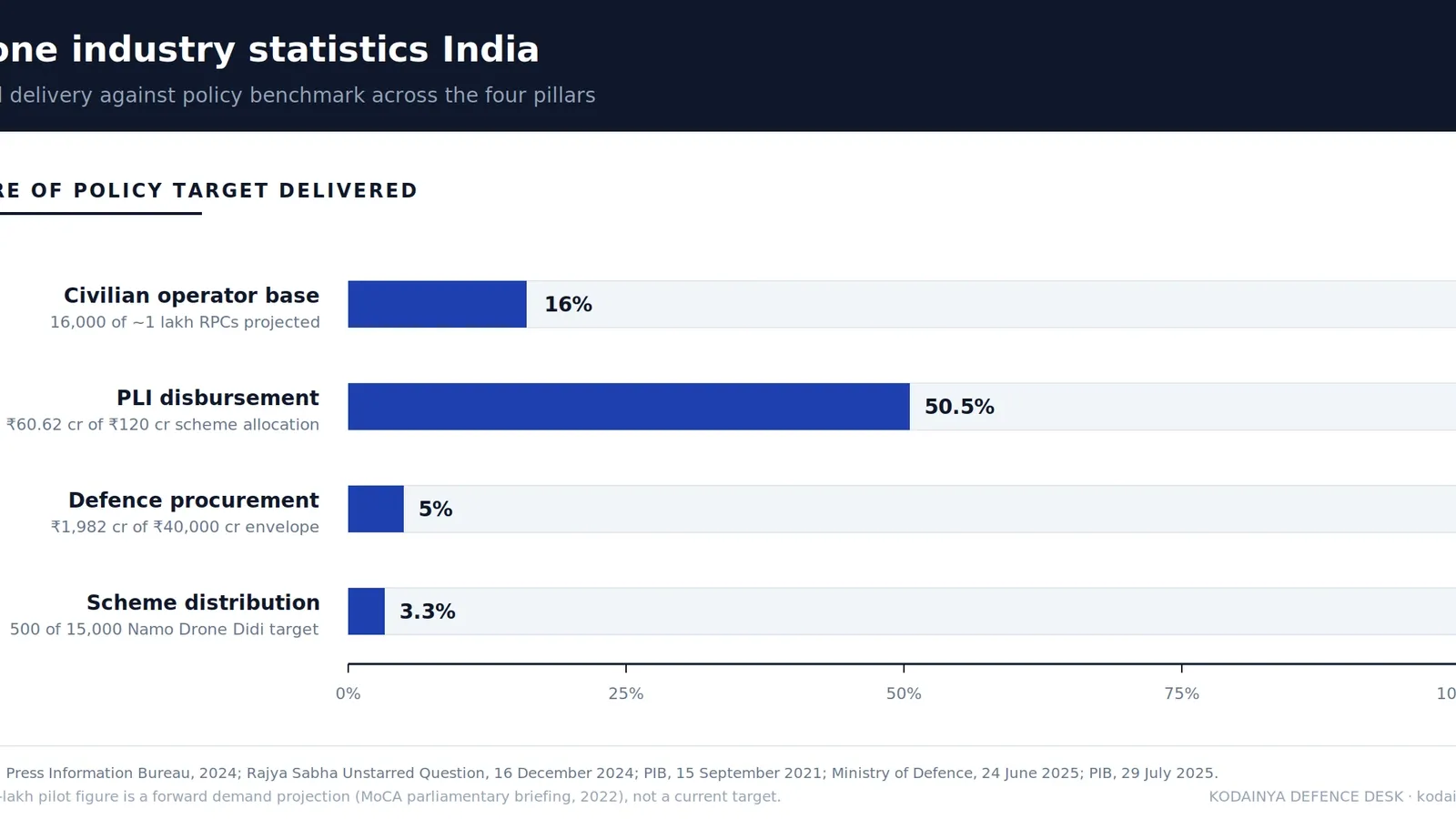
The first pillar is the civilian operator base regulated by the DGCA. The second is the industrial base shaped by the PLI scheme, import policy, and manufacturing turnover. The third is defence demand, where procurement decisions influence scale and investment. The fourth is programme adoption, which includes agricultural and public-sector deployments.
These pillars align with the policy architecture created by the Drone Rules, 2021 (Ministry of Civil Aviation, 25 August 2021). The DGFT import restrictions followed in February 2022 (DGFT Notification No. 54/2015-2020). The broader legal transition continues under the Bharatiya Vayuyan Adhiniyam, 2024.
Sizing the civilian operator base through DGCA data
DGCA drone statistics provide the clearest measure of civilian ecosystem maturity. The DGCA reported that more than 16,000 Remote Pilot Certificates had been issued through approved training pathways (Press Information Bureau, 2024). That figure represents the largest verified operator dataset available from a primary government source.
The Remote Pilot Certificate DGCA count matters because it measures operational capability rather than market sentiment. A certificate represents a trained operator capable of conducting missions within the regulatory framework established under the Drone Rules, 2021. Each additional operator expands the addressable market for inspection, mapping, agriculture, logistics, and public-sector missions.
The same government disclosures identified a wider network of Remote Pilot Training Organisations and type-certified unmanned aircraft systems. The Quality Council of India administers the Certification Scheme for Unmanned Aircraft Systems on the type-certification track. These figures show that the ecosystem is expanding across pilots, training infrastructure, and approved aircraft.
Another structural shift occurred in July 2025. Registration functions migrated to the eGCA platform while airspace permissions and No Permission No Takeoff workflows remained within DigitalSky (DGCA Public Notice, July 2025). That separation improved administrative clarity. For a deeper view of the platform split, see eGCA vs DigitalSky.
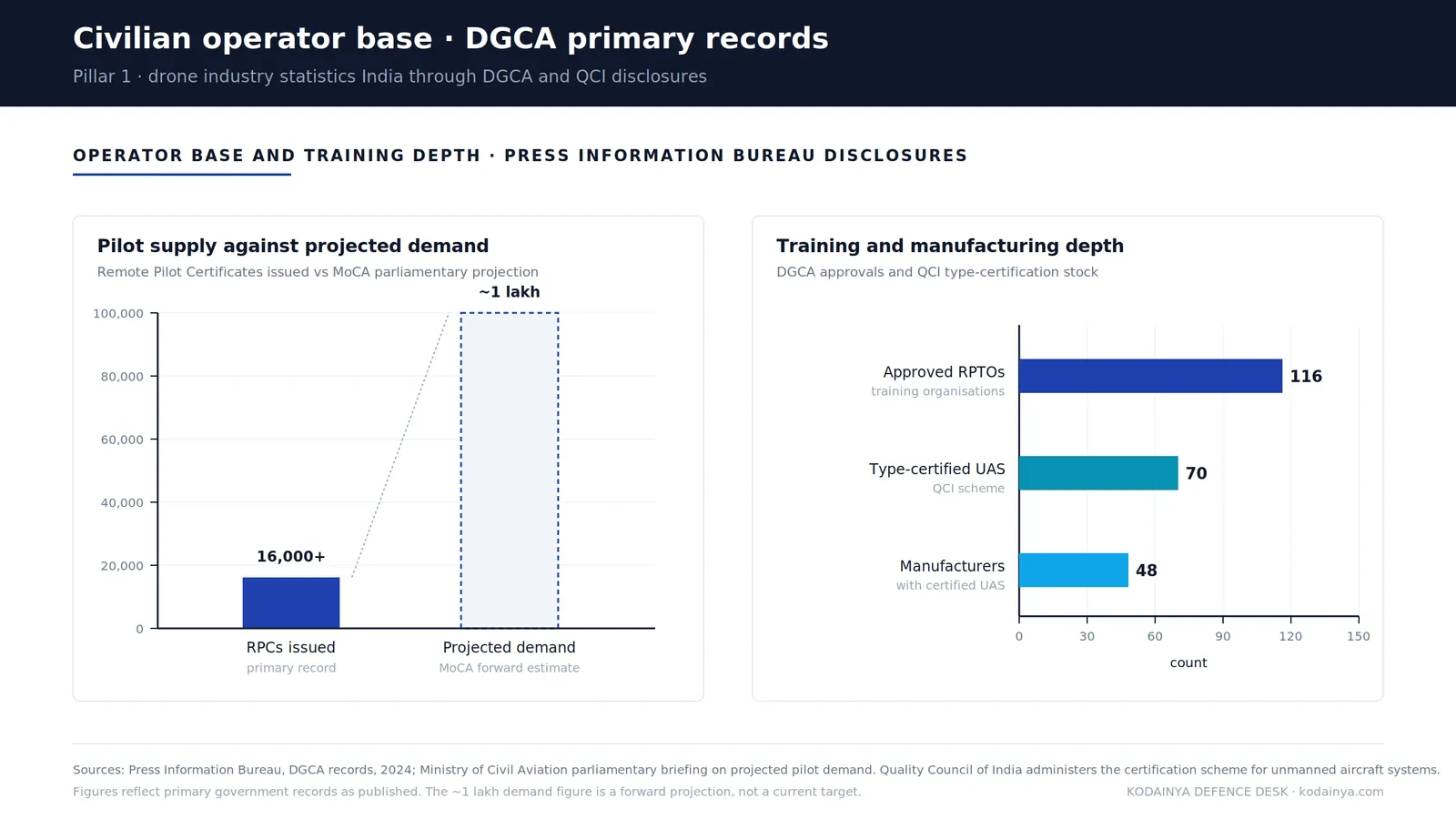
From a market-sizing perspective, operator growth is a leading indicator. Revenue forecasts can change. Certified pilots, approved training centres, and registered aircraft represent measurable activity already inside the system.
Mapping PLI 1.0 disbursement against the original outlay
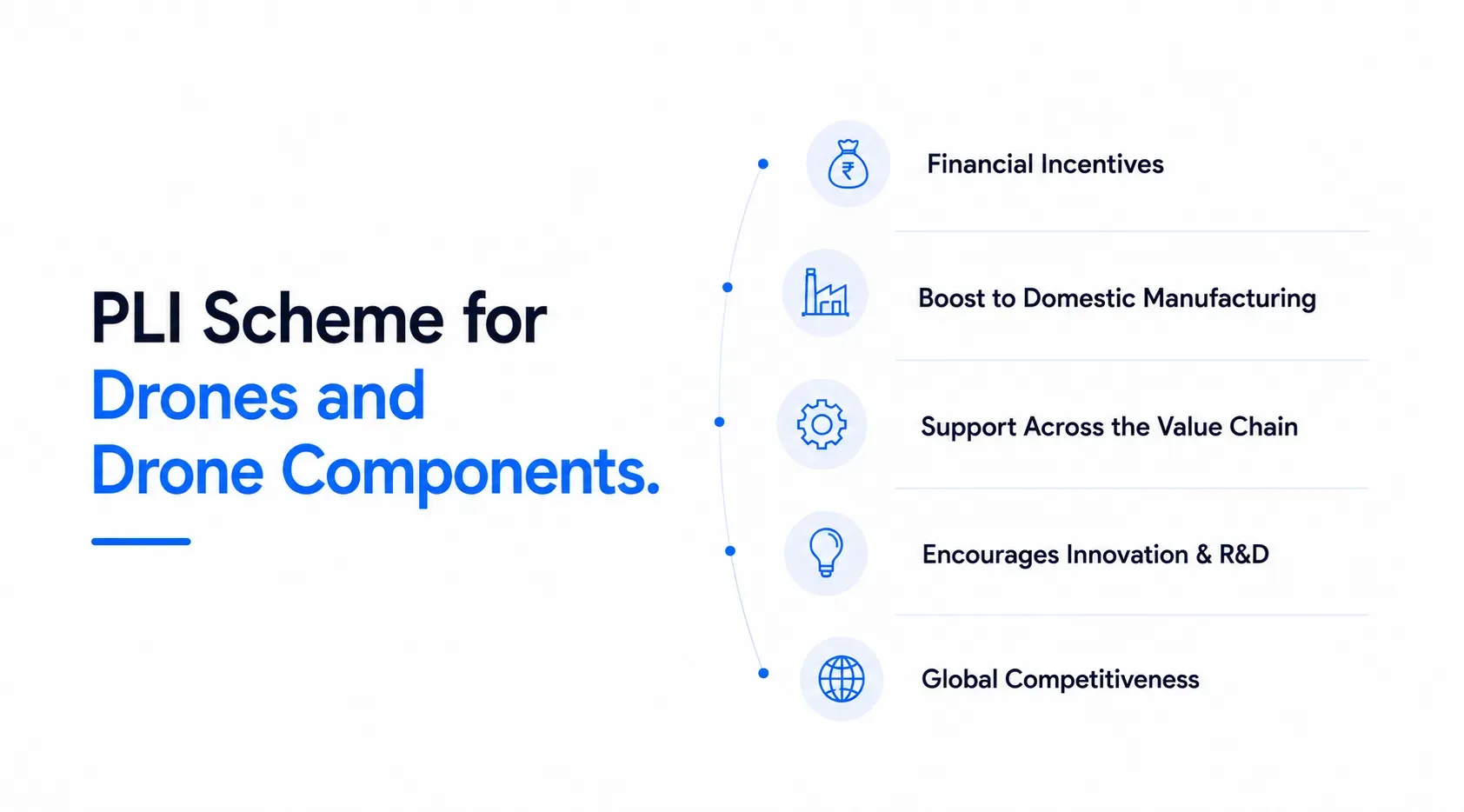
PLI scheme drones data reveals one of the under-cited statistics in the sector. The Production Linked Incentive scheme for drones launched in September 2021 with a total outlay of ₹120 crore (Press Information Bureau, 15 September 2021). The scheme spanned three financial years and set a value-addition threshold of 20 percent. The detailed scheme architecture sits at PLI scheme for drones.
The original policy objective was ambitious. The Ministry of Civil Aviation projected sector turnover of ₹12,000 crore to ₹15,000 crore by 2026. The scheme also targeted investment of ₹5,000 crore in the drone manufacturing industry and creation of 10,000 jobs (Press Information Bureau, 15 September 2021).
The PLI scheme drones disbursement story unfolded differently. A Rajya Sabha reply dated 16 December 2024 disclosed that ₹60.62 crore had been disbursed across FY23, FY24, and FY25. The yearly breakdown showed ₹29.43 crore in FY23, ₹28.76 crore in FY24, and ₹2.43 crore in FY25. The final disbursement reached roughly half of the original allocation (Rajya Sabha Unstarred Question, 16 December 2024).
That figure separates policy intent from industrial uptake. A scheme allocation measures what government is prepared to spend. Disbursement measures what qualified firms actually earned under the programme.
The PLI scheme also shortlisted 23 beneficiaries that included drone manufacturers and component makers. Their combined turnover rose from ₹88 crore in FY2020-21 to ₹319 crore on an unaudited basis in FY2021-22 (Press Information Bureau, 6 July 2022). Industrial expansion outpaced disbursement, even though payout stayed below the ceiling.
Tracking turnover progression among the manufacturers
India drone manufacturing is shaped by policy as much as demand. The industrial base expanded through a combination of the Drone Rules, 2021 and the February 2022 import restrictions on fully built drones.
The DGFT prohibition allowed component imports while restricting completely built and knocked-down units (DGFT Notification No. 54/2015-2020, 9 February 2022). For the import-policy detail, see drone import rules in India.
India drone manufacturing ecosystem data shows that turnover growth preceded large-scale disbursement outcomes. The 23 shortlisted PLI beneficiaries reported turnover growth from ₹88 crore to ₹319 crore within a year (Press Information Bureau, 6 July 2022). Industrial activity had already accelerated before the scheme reached maturity.
The startup count tells a parallel story. India recorded 221 drone startups by February 2022, a 34.4 percent rise from August 2021 (KPMG India, June 2022). Industry estimates place the operating manufacturer count at approximately 300 by early 2026, indicating continued ecosystem expansion. The Make in India drones framework anchors that trajectory.
Manufacturing capacity also depends on the composition of production. Airframes are only one part of the equation. Modern unmanned systems require flight computers, communications equipment, navigation modules, payload integration, and mission-management software. The value chain extends beyond aircraft assembly.
Government policy now reflects that reality. The emphasis has shifted from counting aircraft to strengthening domestic capability across components, software, and support infrastructure. For market observers, manufacturing turnover is therefore a stronger signal than a simple unit count.
Counting the defence demand surge after Sindoor
Defence drone procurement became the strongest demand-side signal after Operation Sindoor. The Ministry of Defence approved an emergency procurement envelope worth ₹40,000 crore. It subsequently cleared thirteen contracts worth ₹1,981.90 crore for operational capability enhancement (Ministry of Defence, 24 June 2025). The defence drones in India explainer covers the operational doctrine behind the wave.
India defence drone procurement after Sindoor matters because defence acquisition influences production planning, workforce investment, and technology development. Civilian demand tends to be fragmented. Defence demand is concentrated and capable of changing industry economics within a short period.
Another major indicator emerged through Defence Acquisition Council activity. The council moved forward with procurement plans covering 1,000 surveillance drones and 1,000 loitering munition systems under the Buy Indian-IDDM category. The volume represents one of the largest publicly disclosed drone procurement opportunities in the country (Ministry of Defence, 2025).
The defence market also drives technology requirements that later influence civilian systems. Computer vision, object classification, sensor fusion, secure communications, and mission-management software typically mature first in defence applications before spreading into industrial use cases.
This pillar explains why defence demand cannot be separated from broader industry growth. Procurement contracts create revenue and accelerate the adoption of autonomy technologies that strengthen the unmanned systems ecosystem.
Following central programme uptake across sectors
Government programme adoption provides the fourth pillar of measurement. It tracks how drones move beyond manufacturers and operators into day-to-day economic activity.
The Namo Drone Didi programme is the clearest example. The Ministry of Agriculture and Farmers' Welfare allocated ₹1,261 crore for the scheme. The target is the distribution of 15,000 drones to women Self-Help Groups between 2023-24 and 2025-26 (Press Information Bureau, 29 July 2025). The Namo Drone Didi Yojana explainer covers the operational architecture.
Namo Drone Didi distribution figures show that 500 drones were procured through Lead Fertilizer Companies during the first implementation phase. The Ministry targeted 3,090 Self-Help Groups during FY2024-25 activities (Press Information Bureau, 29 July 2025). Farmer Producer Organisations can also receive a subsidy of up to 75 percent on the cost of an agricultural drone (KPMG India, June 2022). The Drone Shakti Mission and the Kisan Drone scheme extend the agricultural uptake further.
Programme adoption matters because it measures utilisation rather than availability. Manufacturing capacity alone does not create economic activity. Aircraft must enter operational service, generate missions, and produce outcomes.
The same logic applies to agricultural spraying, infrastructure inspection, surveying, mining, public safety, and logistics. Each programme deployment expands operator demand and strengthens the commercial ecosystem.
This pillar also provides insight into India drone exports. A stronger domestic user base creates operational data, maintenance experience, software refinement, and production scale. Those capabilities improve export readiness more effectively than production volume alone. See India's drone export framework for the export-policy detail.
Comparing analyst forecasts to government figures
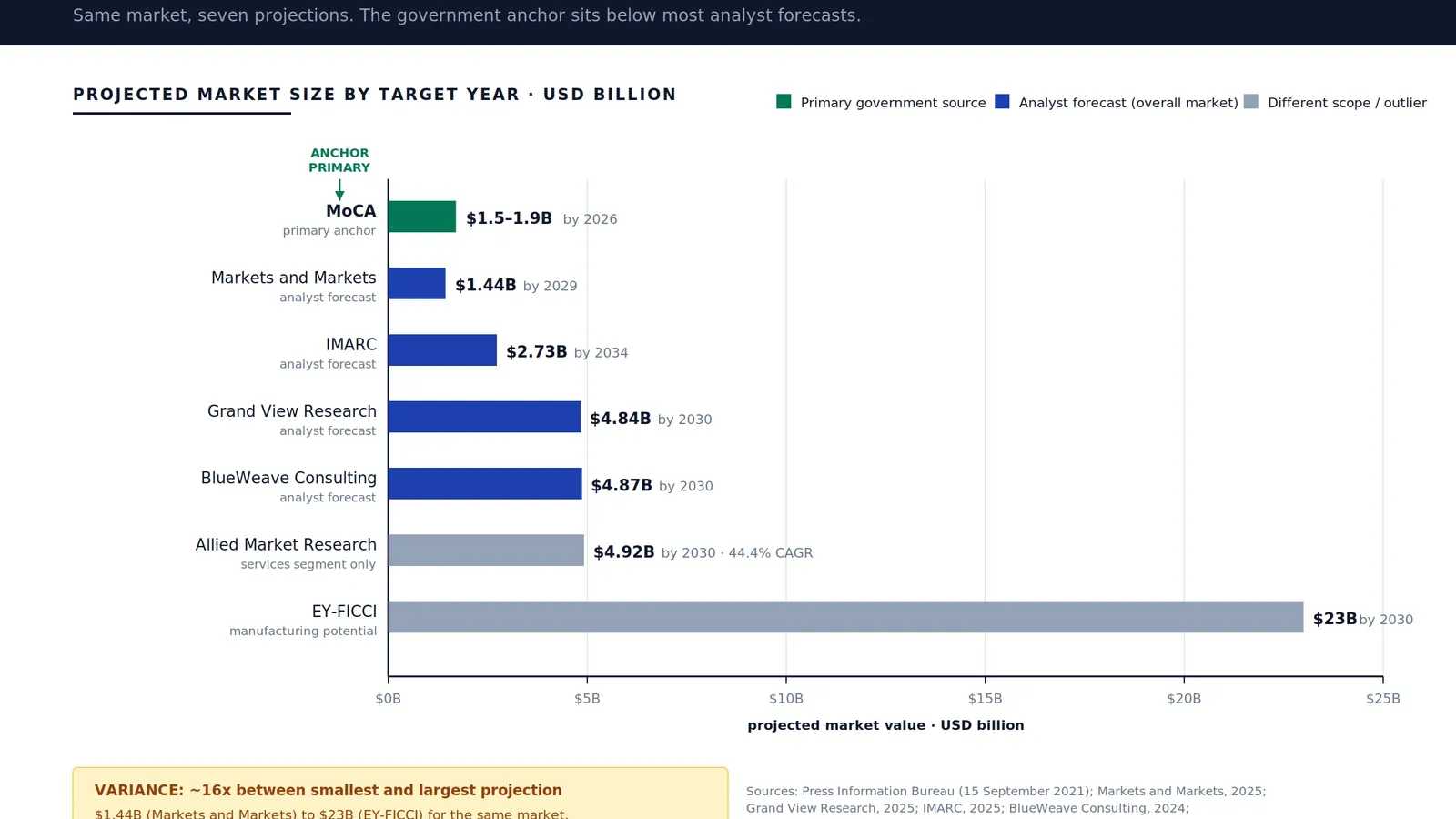
India drone market size forecasts vary dramatically. Some analyst estimates place the market below USD 3 billion during the next decade. Others project figures approaching multi-trillion-rupee outcomes by 2030. The variance itself is one of the defining statistics in the sector.
Markets and Markets projects a market expansion from USD 654 million in 2024 to USD 1.437 billion in 2029. Grand View Research projects USD 4.84 billion by 2030. IMARC projects USD 2.73 billion by 2034. EY-FICCI estimates a long-term manufacturing opportunity reaching USD 23 billion by 2030 (Markets and Markets, 2025; Grand View Research, 2025; IMARC, 2025; EY-FICCI, September 2022).
The Indian drone services market shows its own divergence. Allied Market Research estimated the segment at USD 130.4 million in 2020. The same firm projected USD 4,919 million by 2030 at a compound annual growth rate of 44.4 percent (Allied Market Research, June 2021). The Ministry of Civil Aviation projected a smaller sector turnover band of ₹120-150 billion by 2026 (Press Information Bureau, 15 September 2021).
The India drone market forecast variance exists because each organisation measures different variables. Some focus on hardware sales. Others include services, software, exports, maintenance, and defence applications.
Government figures approach the question differently. They count operators, beneficiaries, procurement contracts, incentive disbursements, and certified systems. Those metrics do not produce a single market-size number. They provide observable evidence of activity.
For policy researchers and procurement officials, that distinction matters. Forecasts estimate future outcomes. Government records measure what has already happened.
Watching the next incentive cycle take shape
Drone industry growth India will depend on what happens after the first PLI cycle. Discussions around a larger second-phase incentive framework indicate that policymakers are evaluating broader manufacturing support. The proposed outlay has been reported in the range of ₹1,000 crore to ₹10,000 crore across different policy notes. Final approval status must be confirmed through official government notifications.
The same four pillars frame the drone industry growth picture India ahead. The next twelve months turn on four watch-items.
The PLI 2.0 Cabinet decision will set the second-phase incentive architecture. The FY 2025-26 capital expenditure disclosure from the Ministry of Defence will quantify the post-Sindoor procurement wave. The DAC Request for Proposal award will reveal which manufacturers absorbed the surveillance and loitering munition demand. The next DGCA Annual Report will refresh the operator and type-certification figures.
The strongest signal comes from the interaction between the pillars, not any single statistic. A larger operator base creates demand. Defence procurement creates scale, manufacturing incentives expand supply, and government programmes create utilisation.
Operator demand has its own forward signal. Industry projections cited at parliamentary briefings have pointed to a requirement of roughly one lakh drone pilots in the coming years (Ministry of Civil Aviation, 2022). The trajectory rests on training-organisation expansion, remote pilot certificate issuance velocity, and corridor build-out across India's drone corridors.
The four pillars will continue to provide the clearest signal of where India's drone ecosystem moves next. Operator counts, manufacturing turnover, defence procurement value, and scheme distribution figures together form a measurable composite. That composite, anchored to primary government data, will outperform any single analyst forecast as the next twelve months of policy and procurement unfold.