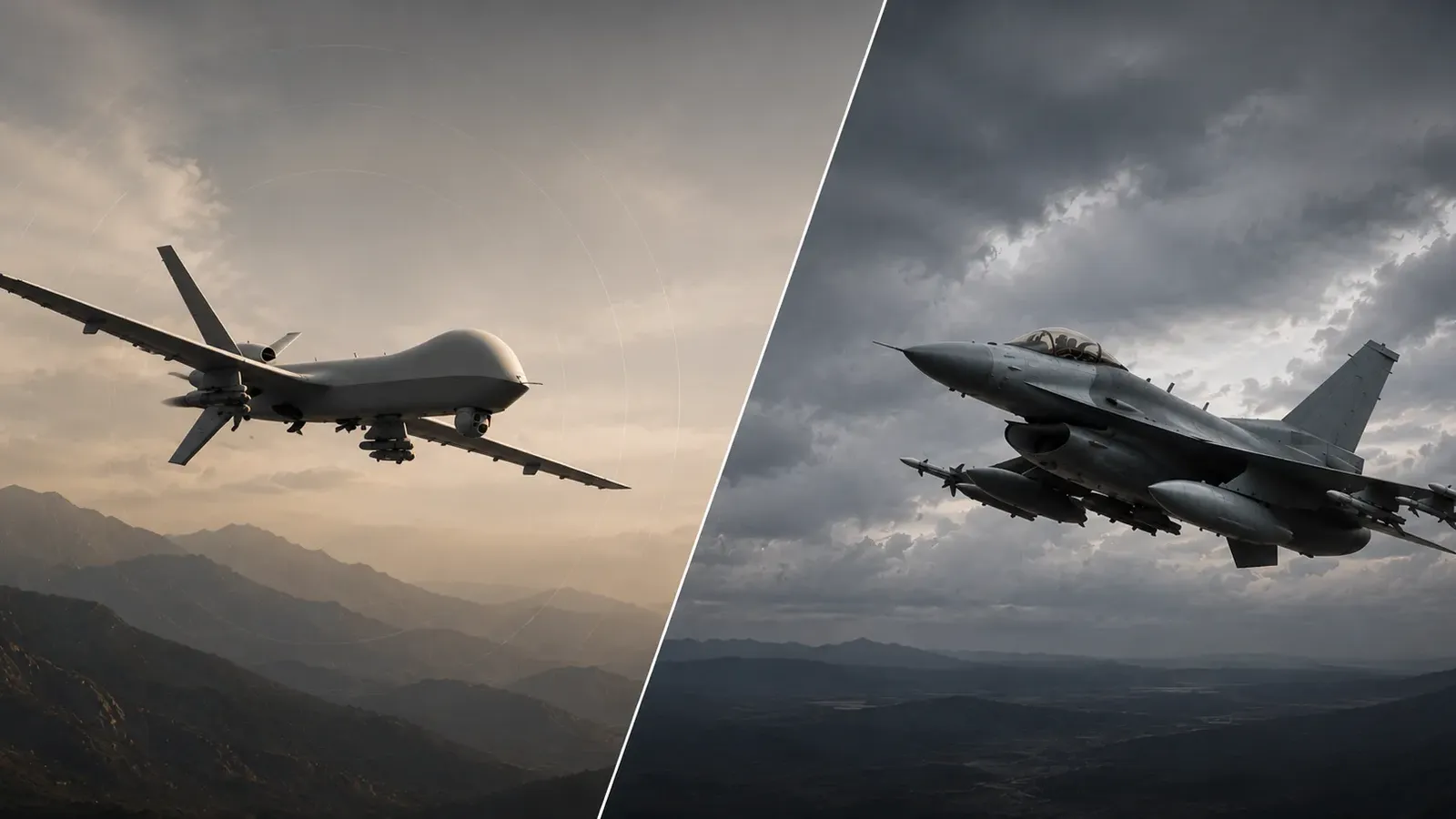
Drones vs traditional air power is no longer a binary debate inside South Block, and the role-mission-platform triad now organises Indian doctrine. CDS General Anil Chauhan ruled on 5 September 2025 in Gorakhpur that drones could not deliver Operation Sindoor's political objectives. IAF Chief Air Chief Marshal AP Singh told CAPSS on 15 May 2026 that unmanned systems are extensions of air power, not a separate domain. The FY26 DAC record confirms the doctrine through parallel procurement: 114 Rafale MRFA and 80 Ghatak stealth UCAV cleared in eight weeks.
Defining the question the chiefs have answered
The drones vs traditional air power debate inside South Block has been resolved at the highest service level. Two statements within eight months set the doctrinal line. The first came from CDS General Anil Chauhan in Gorakhpur on 5 September 2025. The second came from IAF Chief Air Chief Marshal AP Singh at the CAPSS-IMR Joint Seminar on 15 May 2026.
General Chauhan answered the why India used air power not drones Operation Sindoor question in his Gorakhpur address. He told the audience that drones and loitering munitions alone could not have delivered the political objectives of the operation. The CDS speech is the canonical Indian primary source on the doctrinal split (CDS General Anil Chauhan, Gorakhpur address, 5 September 2025). The 7 May 2025 strike package on the named targets used conventional air power.
The CDS framed the choice as a function of strategic effect and escalation control. Tactical capability was not the constraint. Political signalling was. A drone strike cannot carry the political weight that a manned air operation projects to adversaries, neutral observers, and the domestic audience at once.
AP Singh built on the Chauhan position eight months later. He described unmanned aerial systems as extensions of air power, not as a separate domain. He called the shift from concentrated to decentralised and autonomous operations a present reality (IAF Chief Air Chief Marshal AP Singh, CAPSS-IMR Joint Seminar, 15 May 2026). His "claws in the sky" formulation captured the offensive turn the IAF expects from unmanned platforms.
The IAF Chief did not place drones outside the air-power framework. He folded them inside it.
The CDS Anil Chauhan Operation Sindoor verdict and the AP Singh extensions of air power claws in the sky doctrine together define the Indian position. Drones extend. Manned aircraft anchor. The full Indian defence drone fleet and post-Sindoor doctrine sits inside this doctrinal frame.
Mapping the role-mission-platform triad in Indian doctrine
The role-mission-platform triad is the framework Indian doctrine uses to sequence the question. It begins with the role: the mission category an operation belongs to. It then defines the mission: the operational demand inside that role. It ends with the platform: the inventory class that meets the demand.
Competitors who skip straight to platform comparison lose the doctrine. That is why the unmanned aerial systems Indian doctrine question reads as a cost-arithmetic debate in foreign coverage. The Indian framing sequences the layers correctly.
The triad maps cleanly onto current Indian air-power structure. Five role categories matter:
Role | Mission demand | Platform class |
|---|---|---|
Strategic strike | Political signalling, deep penetration, escalation control | Manned fighters: Rafale, Su-30MKI, Tejas Mk-1A, AMCA |
Persistent ISR | Long-endurance surveillance and targeting | MALE and HALE: MQ-9B SkyGuardian, TAPAS, AS-HAPS |
Deep autonomous strike | Stealth penetration of contested airspace | Ghatak RPSA |
Manned-unmanned teaming | Risk absorption in high-threat missions | CATS Warrior loyal wingman, AMCA-linked UCAVs |
Attritable mass | Volume reconnaissance and saturation strike | Loitering munitions, swarms |
Under the triad, a fighter and a drone are not competing products. They occupy different positions in the operational architecture. A fighter squadron carries deterrence, escalation visibility, and the human judgement that strategic strike demands. A long-endurance unmanned platform carries persistence and time-on-station.
A stealth UCAV carries deep-strike survivability without putting pilots inside the threat envelope. The role mission platform triad Indian air power doctrine treats the dimensions as additive, not substitutive. It is why India invests in fighter fleets, stealth UCAVs, pseudo-satellites, MALE platforms, and loitering munitions inside one planning cycle. Each platform solves a different operational problem the role taxonomy defines.
Tracing what drones replace and what they cannot
The framework answers the practical question of do drones replace fighter jets India faces today. The answer is partial. Drones already replace manned aircraft in three mission categories. They do not replace the strategic-strike role that manned air power retains.
Persistent surveillance is the cleanest replacement. A remotely piloted aircraft can stay airborne for 35 to 40 hours at altitudes above 40,000 feet. It monitors borders, maritime approaches, logistics corridors, and theatre activity without exposing a pilot to risk (Ministry of Defence, 15 October 2024). Onboard autonomy handles navigation, sensor tasking, and route optimisation with reduced operator workload.
The mission profile suits unmanned platforms structurally. That structural fit explains why the IAF, the Indian Army, and the Indian Navy each take a share of the 31-platform MQ-9B contract.
Loitering strike is the second replacement. Loitering munitions combine reconnaissance and strike into one platform. They absorb single-use attrition that no manned aircraft would tolerate.
The Defence Acquisition Council approved a Loiter Munition System for Indian Army Artillery Regiments on 29 December 2025 (Ministry of Defence, 29 December 2025). The clearance sits inside a Rs 79,000 crore capital acquisition package. The detailed taxonomy lives in the post on kamikaze drones and loitering munitions in Indian service.
Route monitoring is the third replacement. Border and infrastructure patrolling once required helicopter sorties or fixed-wing reconnaissance. MALE-class drones now perform the same mission with a fraction of the airframe-hours-per-target cost. The economic side of this trade is mapped in the drone vs missile cost asymmetry breakdown.
The replacement stops where strategic signalling begins. Deep strategic strike has political consequences beyond target destruction. A drone can deliver a weapon. A fighter formation delivers a political signal that the adversary, the neutral observer, and the domestic constituency all read at once.
That asymmetry is the Indian doctrinal cut. Drones replace selected missions. They do not replace the function of air power.
Reading FY26 procurement as the proof of intent
Procurement decisions surface doctrine more reliably than speeches. The FY26 Defence Acquisition Council record reads as the doctrinal proof of the extension-not-replacement position. Four AoN clearances in eight months show India scaling both arms in parallel.
The 5 August 2025 DAC AoN approved tri-service Medium Altitude Long Endurance Remotely Piloted Aircraft. The clearance sat inside a Rs 67,000 crore capital acquisition package (Ministry of Defence, 5 August 2025). The MALE RPAs carry multiple payloads and operate at extended ranges. They add round-the-clock surveillance and combat capability across the three services.
The 29 December 2025 DAC AoN cleared two unmanned-side systems for the Indian Army (Ministry of Defence, 29 December 2025). The first is the Loiter Munition System for Artillery Regiments. The second is the Integrated Drone Detection and Interdiction System Mk-II.
The same meeting cleared low-level lightweight radars and long-range guided rocket ammunition for Pinaka. It also approved Astra Mk-II missiles and SPICE-1000 Long Range Guidance Kits for the Indian Air Force. The manned-strike side moved inside the same cycle as the unmanned-mass side.
The 12 February 2026 DAC AoN is the largest single proof point in the FY26 record. The Council approved capital acquisitions of approximately Rs 3.60 lakh crore for the three services. The Indian Air Force received Acceptance of Necessity for three categories at the same meeting (Ministry of Defence, 12 February 2026).
The first category covered Multi Role Fighter Aircraft (Rafale). The second covered Combat Missiles. The third covered the Air-Ship Based High Altitude Pseudo Satellite. The DAC AoN MRFA Rafale 114 February 2026 clearance covers the 114-aircraft programme that anchors the fighter side.
The 27 March 2026 DAC AoN closes the cycle. The Council granted AoN for the Remotely Piloted Strike Aircraft. The clearance formalised four squadrons of approximately 80 platforms drawn from the DRDO Ghatak programme (Ministry of Defence, 27 March 2026). The total DAC AoN value for calendar year 2025 alone reached Rs 3.84 lakh crore (Ministry of Defence, Year-End Review 2025, 31 December 2025).
If India intended to replace manned air power, the 12 February 2026 Rafale clearance would not make sense. If India intended to remain exclusively manned, the 27 March 2026 Ghatak clearance would not make sense. The record shows both moves in the same fiscal year.
Anchoring strategic strike in the fighter fleet
Strategic strike is the role manned air power keeps. The 12 February 2026 AoN for 114 Multi Role Fighter Aircraft (Rafale) sits at the centre of this anchor (Ministry of Defence, 12 February 2026). The Indian Air Force frames the procurement as raising air-dominance capability across the full conflict spectrum.
Strategic strike has four operational features that manned aircraft execute and unmanned platforms cannot match today. Speed and reach come first. A Rafale or Su-30MKI generates sortie cycles measured in hours. An unmanned platform might need days to transit and prosecute the same depth.
Payload comes second. A modern multi-role fighter carries weapons loads in the thousands of kilograms across air-to-air, air-to-ground, and stand-off categories. Decision authority comes third. A pilot in the cockpit makes situational calls that distributed autonomy cannot yet match in cluttered, contested airspace.
Visibility comes fourth. A manned strike formation is read as a deliberate political act in a way that a drone strike is not. The four features together define why the strategic-strike role remains a manned mission category.
Operation Sindoor on 7 May 2025 expressed all four features in one operation. The CDS framed the choice publicly. Drones and loitering munitions alone could not have delivered the political objectives (CDS General Anil Chauhan, Gorakhpur address, 5 September 2025). The operation needed credibility, depth, and an international signature that only manned air power could carry.
The strategic-strike anchor extends beyond the Rafale. The Tejas Mk-1A induction, the Tejas Mk-2 development programme, and the Advanced Medium Combat Aircraft (AMCA) sit inside the same role category. AMCA is the stealth platform around which the next generation of manned strategic strike will organise. Even the AMCA design assumes a manned cockpit at the centre of the architecture.
The fighter-fleet anchor keeps the rest of the doctrine coherent. Without a credible manned strike capability, the unmanned arms lose the political backstop that legitimises their tactical use.
Holding persistent ISR through unmanned long-endurance platforms
Persistent intelligence, surveillance, and reconnaissance is the role unmanned platforms now own outright. The Indian inventory builds the capability in three altitude bands: MALE, HALE, and HAPS. The detailed platform map lives in the MALE, HALE, and HAPS platform map.
The MQ-9B Predator India contract is the anchor at the HALE band. The Ministry of Defence signed the 31-platform contract on 15 October 2024 under the Foreign Military Sales route (Ministry of Defence, 15 October 2024). The procurement covers 15 SeaGuardian platforms for the Indian Navy and 8 SkyGuardian platforms each for the Indian Army and Indian Air Force.
The Acceptance of Necessity that authorised the deal came from the DAC on 15 June 2023. The estimated cost stood at 3,072 million USD (Press Information Bureau, 15 June 2023). The platform delivers 35 hours of endurance at altitudes above 40,000 feet. It carries precision-strike weapons inside the same airframe that performs the ISR mission.
The MALE band runs through tri-service procurement and indigenous development. The 5 August 2025 DAC AoN covered tri-service Medium Altitude Long Endurance Remotely Piloted Aircraft (Ministry of Defence, 5 August 2025). The indigenous side is documented in the TAPAS BH-201 indigenous MALE programme, the Aeronautical Development Establishment platform that targets the same band as imported systems.
The HAPS band is the AS-HAPS pseudo-satellite IAF capability that closed the 12 February 2026 package. The Air-Ship Based High Altitude Pseudo Satellite was cleared as a procurement category (Ministry of Defence, 12 February 2026). The clearance recognised stratospheric persistence as a permanent fixture of Indian air-power planning. A HAPS platform behaves more like atmospheric infrastructure than a sortied aircraft.
The three altitude bands together cover the persistent-ISR mission a fighter cannot meet without burning crew rest and airframe fatigue at unsustainable rates. The cost of persistence on a manned platform is what made the unmanned shift inevitable in this role.
Engineering deep-strike penetration with the Ghatak wedge
Deep autonomous strike in contested airspace is the role the Ghatak programme is built to fill. The 27 March 2026 DAC AoN delivered the four squadrons Ghatak stealth UCAV approved status (Ministry of Defence, 27 March 2026). The clearance formalised the platform's transition from technology demonstrator to operational asset. The Ghatak UCAV procurement covers approximately 80 platforms across the four squadrons.
The Ghatak design specifications make the role clear. The platform is a 13 to 15 tonne flying-wing. The airframe is carbon-composite with a low-observable radar cross section. The internal weapons bay carries precision-guided munitions (DRDO Aeronautical Development Establishment, Ghatak programme brief, March 2026).
The propulsion path runs through a derivative of the indigenous Kaveri turbofan. Operational ceiling sits near 30,000 feet. Combat radius runs to approximately 500 nautical miles.
The SWiFT technology demonstrator validated autonomous take-off, landing, and high-subsonic flight on 1 July 2022. The programme then moved into operational procurement.
Deep autonomous strike is not the same role as persistent ISR. A Ghatak does not sit at altitude collecting imagery. It penetrates contested airspace, suppresses or defeats enemy air defences, and strikes hardened targets without putting pilots inside the threat envelope. The platform is designed for missions where the air-defence picture is too dense for a manned fighter to survive without unsustainable losses.
The doctrinal advantage is asymmetric. A Ghatak loss is a materiel loss, not a casualty event. The political ceiling on operational use rises accordingly. The platform absorbs the risk that strategic-strike doctrine cannot impose on a piloted aircraft.
The Ghatak wedge also closes a gap that the imported MQ-9B does not address. The MQ-9B is a HALE ISR-strike platform, not a stealth UCAV. The two systems sit in different mission categories.
Inducting both inside the same FY26 cycle is the procurement signature of a force that has separated the roles cleanly. Broader coverage of the platform set sits inside Indian military drone platforms in service.
Building manned-unmanned teaming around CATS Warrior and AMCA
Manned-unmanned teaming is the role category that ties the manned anchor to the unmanned extensions. The Indian Air Force manned unmanned teaming concept connects a piloted mothership to one or more unmanned wingmen. The wingmen extend sensor coverage, absorb risk, and multiply the weapons load. The full doctrine sits in manned-unmanned teaming inside the IAF.
The Indian path to manned-unmanned teaming runs through Hindustan Aeronautics Limited's Combat Air Teaming System. The flagship platform is the CATS Warrior loyal wingman. It is a 2.2-tonne unmanned combat aerial vehicle designed to fly alongside manned fighters (Hindustan Aeronautics Limited, NDIC 2026 presentation, March 2026). The platform is engineered to team with the Tejas Mk-1A, Tejas Mk-2, Su-30MKI, and the AMCA stealth fighter.
First flight of the 2-tonne baseline prototype is targeted in the 2026 to 2027 window. Series production is planned to follow operational validation. The full HAL architecture is documented in HAL's Combat Air Teaming System.
The CATS Warrior carries the manned unmanned teaming Indian Air Force doctrine into operational reality. A pilot in the mothership acts as the mission commander. The Warrior carries weapons into the threat envelope and designates targets via secure datalink. It also executes electronic warfare tasks and absorbs the risk that a manned fighter would otherwise carry alone.
The AMCA programme is the destination platform for the doctrine. The fifth-generation stealth fighter is being designed from the outset as the command node of a manned-unmanned formation. The AMCA pilot will operate as the lead while CATS Warriors function as forward-operating receivers.
They will penetrate heavily defended airspace under data-linked control. The Ghatak UCAV adds a separate, more autonomous strike layer to the same formation when the mission demands deep penetration without a manned aircraft in the lead.
The teaming concept changes the cost-benefit calculus of air combat. Risk distributes across multiple airframes. Sensor coverage extends through the unmanned platforms.
Weapons load multiplies without adding a single pilot to the threat picture. The role is not replacement. It is the integrated combat formation the IAF Chief described on 15 May 2026 (IAF Chief Air Chief Marshal AP Singh, CAPSS-IMR Joint Seminar, 15 May 2026).
Calibrating attritable mass against the squadron deficit
The fifth role category is attritable mass. The Indian Air Force operates approximately 29 active fighter squadrons against a sanctioned strength of 42 (Observer Research Foundation, 9 December 2025). The India 42 squadron sanctioned strength deficit creates an operational gap that procurement cycles measured in decades cannot close on the manned side alone.
IAF squadron strength has been the structural problem of Indian air power for two decades. The retirement of the MiG-21 fleet widened the gap. The collapse of the Medium Multi-Role Combat Aircraft (MMRCA) tender meant the 100-plus modern fighters expected from that programme never arrived.
The 36-aircraft Rafale contract closed in 2016 added two squadrons, but the gap remained. The Tejas Mk-1A induction and the 12 February 2026 MRFA AoN are the slow path back toward sanctioned strength.
Attritable unmanned mass is the parallel path that does not require waiting for the manned floor to recover. Loitering munitions, swarm systems, and low-cost strike drones add operational volume. They do so without the airframe cost or training pipeline that a fighter squadron requires. The taxonomy sits in drone swarms and swarm intelligence.
The doctrinal use of attritable mass is the saturation of an adversary's air-defence picture. A loitering munition swarm imposes targeting costs that interceptor missiles cannot match in either inventory or unit cost. The mass arm forces the adversary to choose between interception inventory burn and acceptance of strike damage. The economics sit in the drone vs missile cost asymmetry breakdown.
The defensive side of the same equation is the counter-UAS layer. The 29 December 2025 DAC AoN cleared the Integrated Drone Detection and Interdiction System Mk-II for the Indian Army (Ministry of Defence, 29 December 2025). The full architecture is covered in anti-drone systems in India.
The squadron-deficit calibration is the pragmatic Indian response to a numerical shortfall the manned fleet cannot close inside the threat window. Attritable mass does not substitute for the manned anchor. It extends the operational envelope while the manned recovery runs in parallel.
Pointing air power forward into the next decade
The next decade of Indian air-power doctrine is mapped through three inflection points. The first Ghatak operational squadron will convert the 27 March 2026 AoN into a fielded deep-strike force. The induction will validate the four-squadron RPSA structure inside the IAF order of battle.
The AS-HAPS contract conversion is the second inflection point. The conversion will move the pseudo-satellite category from approved-in-principle to a delivered stratospheric capability. It will complete the three-band ISR architecture across MALE, HALE, and HAPS altitudes.
The third inflection point is the maturation of manned-unmanned teaming. The CATS Warrior first flight in the 2026 to 2027 window opens the validation phase for AMCA-linked formations and for Tejas-Mk-2-linked operational tests.
Series production of loyal wingmen will follow operational validation. Integration of Ghatak into combined formations completes the architecture. Together they formalise the doctrine the IAF Chief described on 15 May 2026 (IAF Chief Air Chief Marshal AP Singh, CAPSS-IMR Joint Seminar, 15 May 2026).
The manned arm stabilises in parallel. The 114-aircraft MRFA Rafale induction is the anchor procurement. The Tejas Mk-1A line, the Tejas Mk-2 first flight, and AMCA prototype work complete the manned arm.
Together they set the fighter floor at 42 to 50 squadrons across the next decade. The 12 February 2026 AoN is the procurement signal that the floor will not slip below sanctioned strength again (Ministry of Defence, 12 February 2026).
The Indian position on drones vs traditional air power will harden into the doctrinal default of the next decade. Drones extend. Manned aircraft anchor. The two arms scale together inside one procurement cycle and one command architecture.