The demand for FPV drone pilots in India reads best through a demand-supply-pathway triad spanning three pipelines: military, civilian commercial, and FPV-specific. The ARTRAC Investiture Ceremony in Shimla on 24 March 2026 reaffirmed more than 50,000 personnel trained inside the Indian Army (ARTRAC, 24 March 2026). The Press Information Bureau counted 39,890 DGCA-certified civilian remote pilots and 244 approved training organisations (Press Information Bureau, 17 February 2026). The gap to one lakh resolves only when those two stacks and the FPV-specific pathway are scored separately.
Tracing the lakh number's origin in policy
The lakh-pilot number, repeated in policy circles as the 100k drone pilot demand, traces to a single statement by the Ministry of Civil Aviation. At a NITI Aayog event in May 2022, then-Minister Jyotiraditya Scindia said India would need close to one lakh drone pilots ahead to meet commercial demand (Ministry of Civil Aviation, 10 May 2022). The figure reflected anticipated market absorption across agriculture, infrastructure inspection, logistics, surveying, and public services. It was an estimate of demand, not a recruitment target.
That estimate gained policy weight after the Drone (Amendment) Rules, 2022 abolished the traditional drone pilot licence on 11 February 2022. The Remote Pilot Certificate issued by a DGCA-authorised Remote Pilot Training Organisation became the only approved pathway (Ministry of Civil Aviation, 11 February 2022). The amendment aligned licensing with the Drone Rules, 2021 and reduced the regulatory barrier to certified operator entry.
Since 2022 the operator question has expanded beyond civilian aviation. AI-assisted target classification, computer vision, edge inference, and mission autonomy now demand operator skill sets that the standard DGCA syllabus does not measure. The same lakh number is read against three ecosystems rather than one. Treating it as a single workforce produces inaccurate conclusions about how many drone pilots India will need by 2030 and where the supply pipelines actually sit.
Mapping the army's drone-trained manpower target
The military pipeline measures operational capability, not civilian compliance. ARTRAC, the Army Training Command, has built the structure to scale drone proficiency into a universal soldier skill. The framework feeds India's drone-trained manpower target.
At the ARTRAC Investiture Ceremony in Shimla on 24 March 2026, Lt Gen Devendra Sharma confirmed that more than 50,000 personnel had completed drone operations training. The ceremony also named 15 establishments evolving as Centres of Expertise to absorb 33 niche technologies by 2030 (ARTRAC, 24 March 2026). The earlier 3 July 2025 investiture had set a harder target. All Indian Army soldiers are to receive drone training by 2027, backed by ₹390 crore over five years (ARTRAC, 3 July 2025).
The structure reaches every infantry battalion. Each one now fields an Ashni drone platoon equipped with surveillance drones and armed platforms for tactical strike (Indian Army Director General Infantry, 2025).
The Army has also raised about 15 Bhairav drone force battalions of roughly 250 soldiers each, with about 25 more planned. Bhairav formations sit between Para Special Forces and regular infantry and form the operational backbone of the Indian Army's FPV drone doctrine.
Military operator training diverges sharply from civilian Remote Pilot Certificate instruction. DGCA-approved Remote Pilot Training Organisations teach regulatory compliance, navigation, and airspace handling for commercial missions. Army operators train for contested environments across India's defence drone fleet that include electronic warfare, GPS denial, sensor fusion, and AI-assisted target classification under operational pressure that no civilian syllabus reproduces. The Army drone training programme 2027 therefore contributes Indian Army drone operators to the national stock, but they are not interchangeable with civilian Remote Pilot Certificate holders.
Counting today's certified remote pilot stock
The civilian pipeline measures certified operators authorised to conduct commercial drone operations under the Drone Rules, 2021. Direct regulation comes from the Directorate General of Civil Aviation and the network of authorised Remote Pilot Training Organisations across the country.
The Press Information Bureau's Drone Ecosystem brief of 17 February 2026 reported 39,890 DGCA-certified remote pilots and 244 approved Remote Pilot Training Organisations. The same brief counted more than 38,500 registered drones operating under the national framework (Press Information Bureau, 17 February 2026). These numbers reflect progress since the Drone Rules, 2021 simplified certification, registration, and operational approvals.
The DGCA Remote Pilot Certificate remains the mandatory qualification for commercial operations across applicable categories. Training covers aviation regulations, meteorology, navigation, flight safety, emergency procedures, maintenance practices, and supervised flying exercises.
The DGCA approved RPTO list (244 organisations in total) forms the only DGCA-recognised certification pipeline India operates today. The standard pathway is documented in how to fly a drone in India for first-time applicants and through the DGCA-published RPC renewal workflow for serving pilots.
The civilian curriculum prepares operators for commercial missions, not tactical FPV employment. Skills required to inspect transmission lines or survey agricultural land differ from those needed to fly manually piloted FPV aircraft in dynamic environments. Commercial certification establishes regulatory competence.
Tactical FPV proficiency requires additional simulator hours, manual flying precision, and specialised mission planning that fall outside today's standard syllabus. India's civilian certification system therefore supplies one part of the national operator requirement but cannot independently satisfy future demand for specialised FPV operators.
Drawing the FPV regulatory line beyond standard RPC
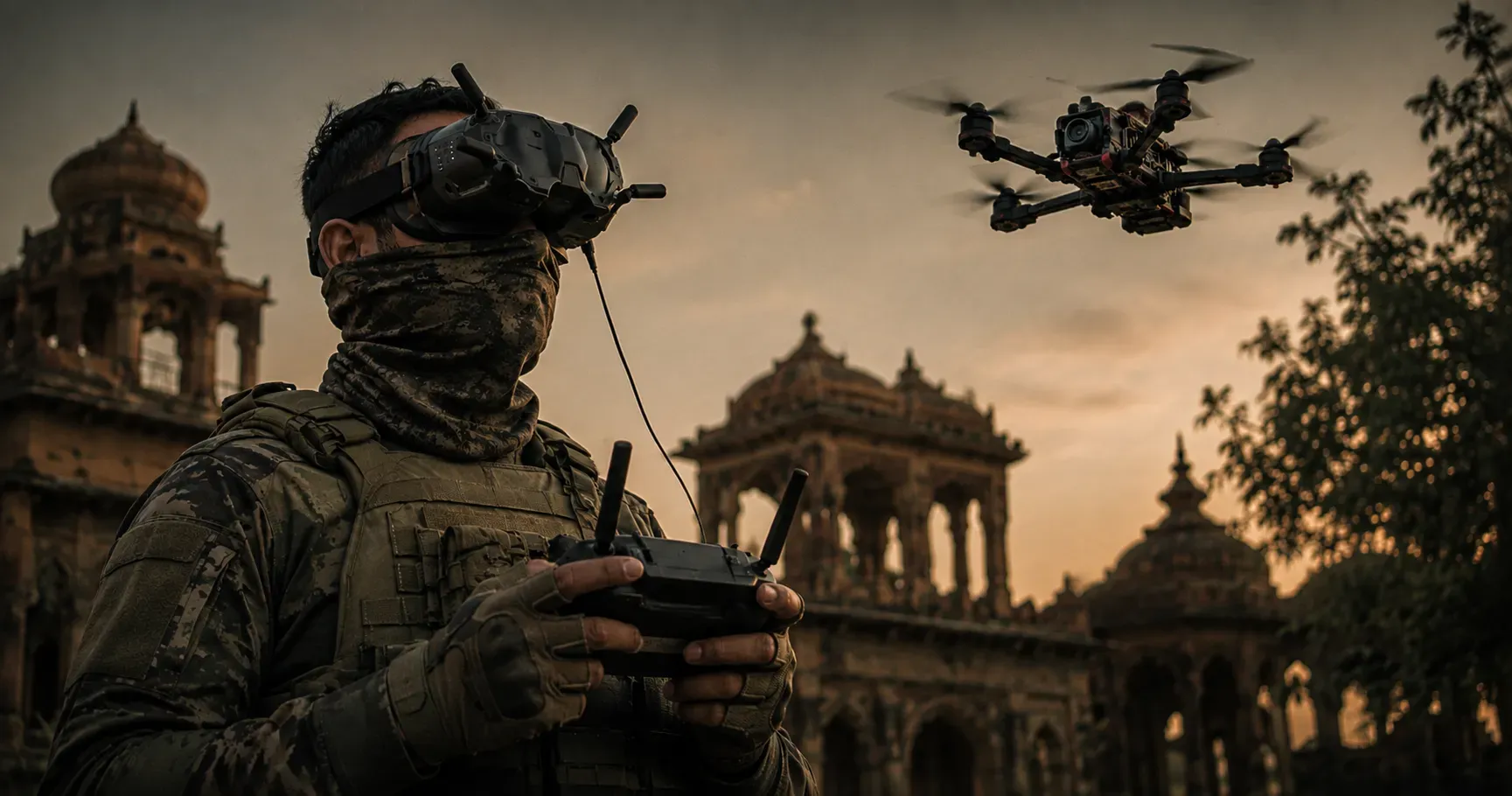
FPV drone pilot training in India sits inside the least defined of the three operator pipelines. Unlike the civilian Remote Pilot Certificate framework or the Indian Army's qualification system, India has no dedicated national certification for First Person View drone operators.
The Drone Rules, 2021 regulate unmanned aircraft by weight, registration, certification, and operational requirements rather than flight perspective (Directorate General of Civil Aviation, 25 August 2021). A sub-250 g Nano drone may qualify for regulatory exemptions in some situations. A Micro aircraft between 250 g and 2 kg requires compliance with applicable DGCA rules depending on intended use. None of these provisions create a separate FPV operator licence.
This distinction matters because FPV is a method of flying, not a separate aircraft category. An FPV drone can fall into Nano or Micro per its Maximum All-Up Weight (MAUW).
The legal requirements follow the DGCA drone category rather than the use of goggles. The same regulatory line that separates an FPV scout from a kamikaze-grade platform sits in weight, not perspective.
The gap becomes visible when civilian and tactical training are compared. A DGCA-approved Remote Pilot Training Organisation teaches aviation regulations, navigation, airspace management, and safe commercial operations. FPV operators require precision manual flying through immersive first-person video, simulator-based muscle memory, low-altitude terrain navigation, radio-frequency awareness, dynamic mission planning, and payload integration where authorised. The standard FPV pilot training India offers covers a subset of these competencies at best.
Military organisations build these skills through dedicated tactical training, repeated simulator sessions, and field exercises. Commercial FPV communities develop similar competencies through structured practice and competition. Neither pathway results in a nationally recognised FPV qualification. The difference between FPV operator and certified drone pilot is therefore not regulatory category but training depth on competencies the standard syllabus does not yet measure.
Charting three parallel pipelines feeding the demand
India's future drone workforce should be read as three parallel pipelines rather than one combined labour pool. Each pipeline serves a different operational purpose, follows a different training model, and produces operators with different competencies.
Pipeline | Primary objective | Training ecosystem | Current position |
|---|---|---|---|
Military operators | Tactical and defence operations | ARTRAC, military training establishments, Bhairav formations | 50,000+ personnel trained (ARTRAC, 24 March 2026) |
Civilian RPC pilots | Commercial UAS operations | DGCA-approved Remote Pilot Training Organisations | 39,890 certified pilots and 244 RPTOs (PIB, 17 February 2026) |
FPV specialist operators | High-skill tactical and commercial FPV operations | Fragmented institutional and private training | No dedicated national certification |
Each pipeline expands through different policy instruments. The military pathway depends on doctrine, force structure, and operational requirements articulated by ARTRAC. The civilian pathway expands through DGCA regulation, RPTO approvals, and commercial adoption. The FPV pathway develops through specialised training programmes, simulator instruction, and operational experience built on infrastructure like the drone simulator training framework.
The Government has also invested in capacity building beyond pilot certification. The Ministry of Electronics and Information Technology approved the SwaYaan UAS capacity building project in July 2022. As of April 2026, more than 32,000 beneficiaries had completed training against a long-term target of 42,560 participants (Digital India, 2 April 2026).
SwaYaan operates through 30 institutions including IIT Kanpur, which now offers an M.Tech in UAS Engineering. Parallel demand-side schemes like the Drone Shakti Mission push civilian adoption to absorb that workforce.
Viewed together, the three pipelines explain why the civilian RPC vs military drone operator distinction matters. The lakh figure cannot be hit through civilian pilot schools alone. Each ecosystem must scale to its own operational requirement while remaining tied to a coherent national drone strategy.
Costing the supply gap the system inherits
India's drone pilot shortage is not simply a question of producing more certificates. The drone pilot demand gap exists because the country is scaling three operator ecosystems at different speeds, each with distinct training requirements and operational objectives.
The military pipeline has accelerated. ARTRAC reported more than 50,000 personnel trained by March 2026 (ARTRAC, 24 March 2026). The Army continues to build Centres of Expertise for the 33 niche technologies it has identified for absorption by 2030. This indicates sustained investment in operational capability rather than one-time training.
The civilian pipeline has expanded steadily. Commercial drone adoption continues to outpace pilot production across agriculture, energy, infrastructure inspection, public safety, logistics, and industrial surveying. The supply numbers track upward, but the demand vectors track faster.
The largest uncertainty lies inside the FPV ecosystem. India has no national estimate for dedicated FPV operator demand because no official certification category distinguishes FPV specialists from conventional Remote Pilot Certificate holders. Workforce planning becomes difficult for policymakers, training institutions, defence organisations, and the wider drone manufacturing ecosystem when one of three pipelines has no countable supply.
AI-enabled navigation, computer vision, mission planning, and sensor fusion reduce operator workload but do not eliminate the need for trained personnel. As aircraft become more capable, operator responsibilities shift from basic flight control toward mission supervision, payload management, autonomous workflow validation, and decision support. The shortage therefore extends beyond pilot numbers. India must build a workforce capable of operating intelligent unmanned systems across civilian and defence applications.
Building a tactical certification India still lacks
India's next policy milestone is unlikely to be another pilot target. It is more likely to be the creation of a structured pathway for specialised FPV operator training.
The Remote Pilot Certificate establishes a strong regulatory foundation for commercial drone operations. Military organisations maintain their own operational qualification standards. Between these two systems sits an expanding group of operators whose work requires competencies that neither framework fully measures. A dedicated tactical certification India still lacks would close that middle ground.
The legal architecture is in place. The Bharatiya Vayuyan Adhiniyam 2024 supersedes the Aircraft Act 1934 and reshapes the legal foundation for civil aviation in India, including drone operations (Bharatiya Vayuyan Adhiniyam, 2024). Any FPV drone certification India introduces will sit on that foundation rather than the older statute. The framework therefore exists in principle, even though the operative rules for FPV operators have not yet been issued.
A dedicated FPV certification pathway could codify simulator proficiency, precision manual flight, low-altitude navigation, radio-frequency awareness, emergency recovery, mission planning, and AI-assisted flight operations. Standardised outcomes would give employers, government agencies, and procurement organisations clearer confidence in operator capability. The pathway would also support domestic manufacturing, software development, autonomy research, and workforce planning by setting a common benchmark across the ecosystem.
Advanced drone ecosystems already combine simulator-based learning with supervised field exercises before operational missions. India holds the institutional foundation through approved training organisations, academic programmes, defence establishments, and capacity-building initiatives such as SwaYaan.
Securing the next decade of operator readiness
The debate around one lakh drone pilots should shift from counting certificates to understanding capability. India's future operator workforce will not emerge from a single training system because the country no longer has a single operational requirement.
Government agencies should continue scaling DGCA-approved training capacity for commercial operations while developing specialised standards for tactical FPV instruction. Defence organisations will keep refining tactical operator programmes that reflect operational realities rather than civilian aviation requirements. Academic institutions and research programmes such as SwaYaan will remain central to producing engineers, autonomy specialists, and AI researchers who support the wider unmanned ecosystem.
For drone manufacturers, software developers, and system integrators, future competitive advantage will depend on the quality of operator training, simulator ecosystems, AI-assisted mission planning, and lifecycle support. Platform performance alone is no longer the decisive variable. For policymakers, the next milestone is no longer simply reaching one lakh operators. It is ensuring every pilot enters the workforce through a training pathway aligned with the missions they will perform.
The clearest actionable lever inside the next twelve months is a DGCA-issued FPV-specific certification pathway, which India does not yet operate. Building it would convert today's three-pipeline patchwork into a coherent national capability connecting military readiness, civilian regulation, and FPV specialisation.