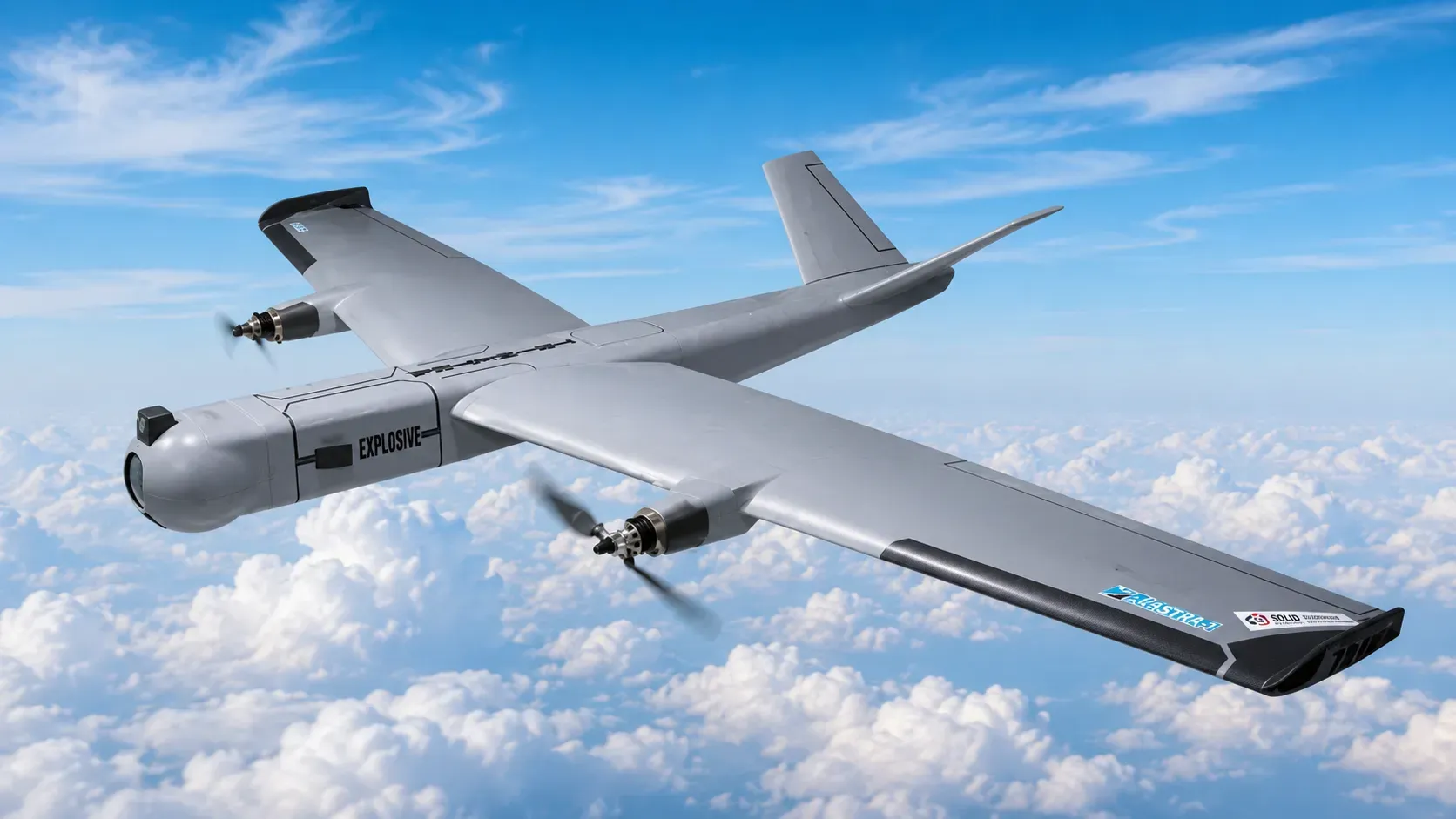
India's 100K-drone force takes shape through three connected layers. Doctrine creates demand under General Upendra Dwivedi's blueprint of 8,000 to 10,000 drones per corps. Policy sanctions scale inside the Defence Forces Vision 2047 released on 10 March 2026, which names Drone Force as a standing tri-service entity. Industrialisation funds delivery through the PLI scheme, a ₹2,000 crore post-Sindoor top-up, the ₹17,000 crore record procurement order, and the 40 per cent local-content target by FY28.
Decoding the 100,000-drone target inside the Army's order of battle
India 100K drone force calculations begin with force structure rather than procurement. The number is derived from how the Indian Army distributes unmanned systems across formations from battalion up to corps. It extends the wider defence drones in India build-out anchored in the post-Sindoor doctrine shift.
General Upendra Dwivedi's restructuring vision introduced the concept of deploying between 8,000 and 10,000 drones per corps. The goal is persistent surveillance, target acquisition, logistics support, electronic warfare support, and strike capability across the battlespace (Indian Army attribution via IDRW, 19 October 2025). With fourteen corps-level formations forming the backbone of the Army's operational structure, the arithmetic quickly approaches the 100,000-UAV threshold.
The requirement is not limited to First Person View systems. The force mix spans reconnaissance UAVs, loitering munitions, logistics platforms, swarm systems, counter-drone assets, and higher-end tactical platforms. Operation Sindoor accelerated the institutional acceptance of this model and exposed the value of distributed drone capability across formations (Tribune India, 23 April 2026).
The organisational foundation already exists. The Army has established Ashni drone platoons across infantry battalions as part of the "Eagle in the Arm" doctrine. The Indian Army FPV drone doctrine explainer covers the platoon-level table of organisation in depth. The platoons place dedicated drone operators inside combat units rather than holding drones at higher headquarters (Indian Army attribution via IANS, 5 May 2026).
This shift mirrors a broader transformation in Indian Army drone modernisation. Traditional force structures concentrated sensing and targeting capability at brigade or corps headquarters. Drone-centric structures distribute sensing down to platoon and company level, supported by AI-enabled computer vision and sensor-fusion workflows. The 100000 drones Indian Army target should therefore be read as a force-design decision before a procurement decision.
Tracing Defence Forces Vision 2047 to the Era of Transition
Defence Forces Vision 2047 provides the policy framework that transforms the drone expansion programme from a service-level initiative into a national defence objective. Released by Defence Minister Rajnath Singh on 10 March 2026, the document identifies Drone Force as one of five future tri-service entities (Ministry of Defence, 10 March 2026). Data Force and Cognitive Warfare Action Force structures sit alongside it. The designation matters because it elevates drones from equipment categories to institutional capability.
The Vision divides military transformation into three phases. The first phase, called the Era of Transition, runs until 2030. The second phase focuses on consolidation until 2040, while the final phase pursues military excellence and strategic leadership by 2047 (Ministry of Defence, 10 March 2026).
The Defence Forces Vision 2047 drone force entity differs from previous drone programmes because it treats unmanned capability as an organisational layer rather than a platform acquisition effort. Aircraft, sensors, communications networks, AI software, electronic warfare payloads, and operators become part of a single force construct.
The Headquarters Integrated Defence Staff is expected to play a coordinating role across services as the concept evolves into operational structures (Ministry of Defence, 10 March 2026). This creates a common framework for procurement, doctrine, training, and operational employment.
The Era of Transition Vision 2047 timeline also creates accountability. A target without a deadline remains aspirational. A target tied to a six-year transition window creates measurable milestones across procurement, training, doctrine, manufacturing, and deployment.
The significance of the document lies less in the headline announcement. The Drone Force concept now sits inside India's official defence transformation roadmap rather than at the edge of service-level wish lists.
Mapping Indian Army drone restructuring across the three services
The Indian Army drone restructuring effort represents the largest component of the expansion. The Army has already implemented structural reforms that place drone capability closer to frontline formations. More than 380 infantry battalions now include dedicated Ashni drone platoons staffed by approximately twenty-five personnel each. The trained operator base already approaches 9,500 personnel before specialist formations are counted (Indian Army attribution via Tribune India, 22 October 2025).
Alongside Ashni units, the Army is raising Bhairav Light Commando Battalions. The Army is also restructuring combat formations into Rudra Integrated Battle Groups to improve battlefield agility and technology integration (Tribune India, 26 July 2025). The structural logic mirrors the broader move toward manned-unmanned teaming across the force.
The scale becomes clearer when viewed across formations.
Formation Layer | Drone Integration Objective | Operational Effect |
|---|---|---|
Battalion | Ashni drone platoons | Organic surveillance and strike capability |
Brigade | Integrated drone coordination | Persistent tactical awareness |
Division | Multi-domain operations support | Sensor and shooter integration |
Corps | 8,000-10,000 UAV ecosystem | Battlespace dominance and resilience |
Tri-service | Drone Force framework | Joint operational capability |
The Indian Air Force Unmanned Force Plan complements this Army expansion. Air Force planning discussions have outlined a future inventory of 30 to 50 higher-end UAV platforms across Medium Altitude Long Endurance and High Altitude Long Endurance categories (IAF attribution via IDRW, 7 July 2025). The IAF roadmap intersects the combat air teaming system concept under development for manned-unmanned strike packages.
This distinction matters. The Army's 100,000-drone ambition focuses on mass and distribution. The Air Force's unmanned roadmap focuses on persistence, reach, and strategic effects. Together they form different layers of the same national capability architecture.
Funding the modernisation arc through PLI, iDEX and emergency procurement
Industrial scale requires financial scale. The credibility of India's 100K-drone force depends on whether funding mechanisms match doctrinal ambitions.
The first layer came through the Production Linked Incentive scheme for drones. The Government of India introduced the scheme in 2021 with dedicated incentives for drone and component manufacturing (Ministry of Civil Aviation, September 2021).
The second layer emerged after operational lessons accelerated procurement priorities. Defence officials subsequently proposed an approximately ₹2,000 crore incentive programme covering drone manufacturing, components, software, counter-drone systems, and services (Defence Secretary briefing reported by Deccan Herald, June 2025).
The third layer is direct acquisition. Reports indicate India is preparing a record ₹17,000 crore Indian military drone procurement programme focused on domestic industry participation and accelerated delivery schedules (Bharat Shakti, June 2026).
The procurement chain extends beyond drones themselves. The Defence Acquisition Council, working through the Defence Acquisition Procedure, approved capital acquisition proposals worth approximately ₹2.38 lakh crore, including remotely piloted strike aircraft (The Week, June 2026).
Innovation funding forms another pillar. Innovations for Defence Excellence, known as iDEX, and the ADITI challenge framework provide pathways for startups and technology firms. They build autonomy software, payload systems, navigation solutions, computer vision models, communications architectures, and counter-UAS technologies (PIB, 19 March 2026).
This structure differs from earlier defence procurement cycles. Previous acquisition programmes focused primarily on platforms. The present model funds platforms, software, components, autonomy stacks, and manufacturing ecosystems simultaneously.
Industrialising the India drone manufacturing hub backbone
Manufacturing scale remains the hardest part of the equation. Defence Minister Rajnath Singh called for India to become a global drone manufacturing hub during the National Defence Industries Conclave 2026 organised by the Department of Defence Production. The Minister linked that objective directly to indigenous capability development (PIB, 19 March 2026).
The challenge is not airframe production. The challenge lies in electronics, propulsion systems, communications equipment, sensors, navigation modules, batteries, payload integration, and software-defined architectures across India's drone manufacturing ecosystem.
The government's proposed incentive framework targets approximately 40 per cent local content drone components by FY28. The target creates a measurable industrial milestone before the end of the transition phase (Defence Secretary briefing reported by Deccan Herald, June 2025). It aligns with the broader Make in India drones policy stack.
Public-sector organisations including DRDO, HAL, BEL, and BDL remain part of this industrial chain. Their role extends beyond manufacturing into subsystem development, systems integration, testing infrastructure, and technology transfer programmes.
AI capability also sits inside the industrial challenge. Computer vision models, sensor-fusion software, route-planning systems, swarm coordination engines, and mission-autonomy frameworks must be developed, validated, and integrated at scale. Hardware alone does not create a Drone Force. Operational software creates the difference between an inventory of aircraft and a connected combat capability.
By 2030, the industrial question is no longer whether India can manufacture drones. The question is whether India can manufacture complete drone ecosystems.
Layering Mission Sudarshan Chakra and the multi-domain architecture
Mission Sudarshan Chakra represents the defensive side of the transformation. The Defence Forces Vision 2047 framework identifies layered air defence, integrated sensing, and multi-domain operations as core elements of future force design (Delhi Policy Group analysis of Vision 2047, 20 March 2026). The architecture sits alongside the Akashteer integrated air defence backbone feeding the Army Air Defence command-and-control fabric.
A large drone inventory creates opportunities but also creates management challenges. Thousands of airborne systems require command-and-control architectures capable of tracking platforms, identifying threats, allocating tasks, and distributing intelligence across formations linked through drone swarms and swarm intelligence workflows.
General Dwivedi has linked future warfare planning to multi-domain operations with a broader transition objective extending toward 2032 (Indian Army attribution via All India Radio, 11 November 2025). Multi-domain operations connect land, air, cyber, space, and electromagnetic activities into a single operational framework.
Mission Sudarshan Chakra fits into that architecture as a defensive layer. Drone Force expands sensing and reach while integrated air defence protects that capability. Data Force structures process the information feed, and cognitive warfare organisations manage influence and information environments.
This architecture also creates a natural role for AI. Edge inference handles onboard processing, sensor fusion combines data streams across systems, and agentic mission-management software allocates tasks across distributed assets. Human operators retain authorisation while software reduces cognitive burden and lifts operational tempo.
Reading the procurement curve through the transition phase
The Indian Army drone target 2030 should be evaluated against milestones rather than headlines. The runway parallels the wider effort of building a self-reliant drone industry across the defence ecosystem.
The first milestone is industrial. The domestic ecosystem must approach the FY28 local-content objective and demonstrate production depth across components, software, and subsystems (Defence Secretary briefing reported by Deccan Herald, June 2025).
The second milestone is innovation throughput. iDEX programmes, ADITI challenge cycles, and future defence innovation rounds must continue generating deployable technologies rather than laboratory demonstrations (PIB, 19 March 2026).
The third milestone is acquisition execution. Defence Acquisition Council approvals and procurement releases must convert allocated budgets into fielded capability within planned timelines (The Week, June 2026).
Viewed together, the arithmetic becomes straightforward. Corps-level demand drives the requirement, Defence Forces Vision 2047 provides the institutional framework, and procurement programmes fund delivery. Industrial policy supports manufacturing while AI and autonomy software lift operational effectiveness.
The result is that the 100,000-UAV target no longer sits at the edge of defence planning. It sits at the centre of India's transition-era military modernisation agenda.
The next indicator to watch is not another headline target. It is the pace at which procurement approvals, local-content milestones, and autonomy programmes convert policy into fielded capability across the Drone Force architecture.