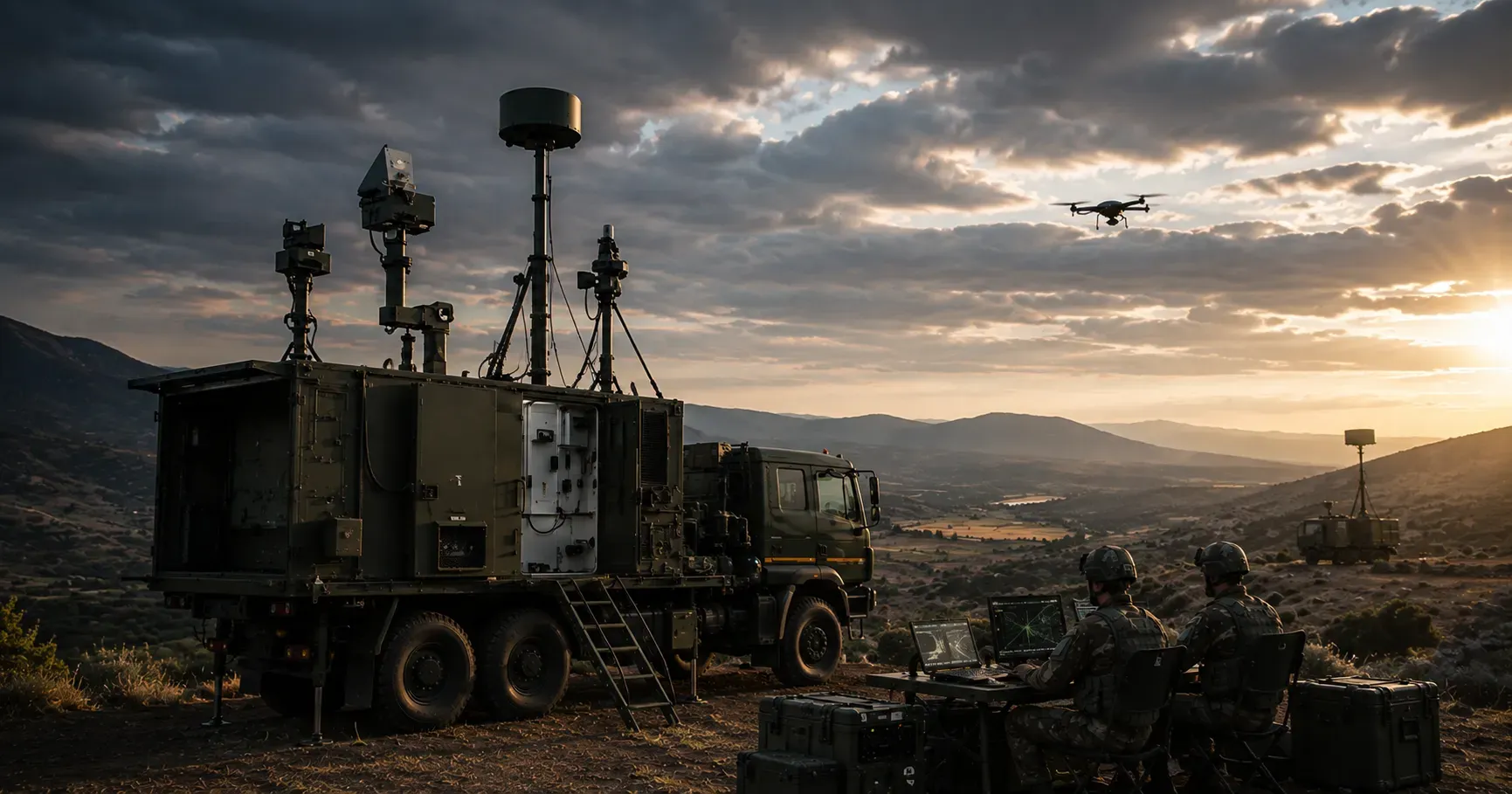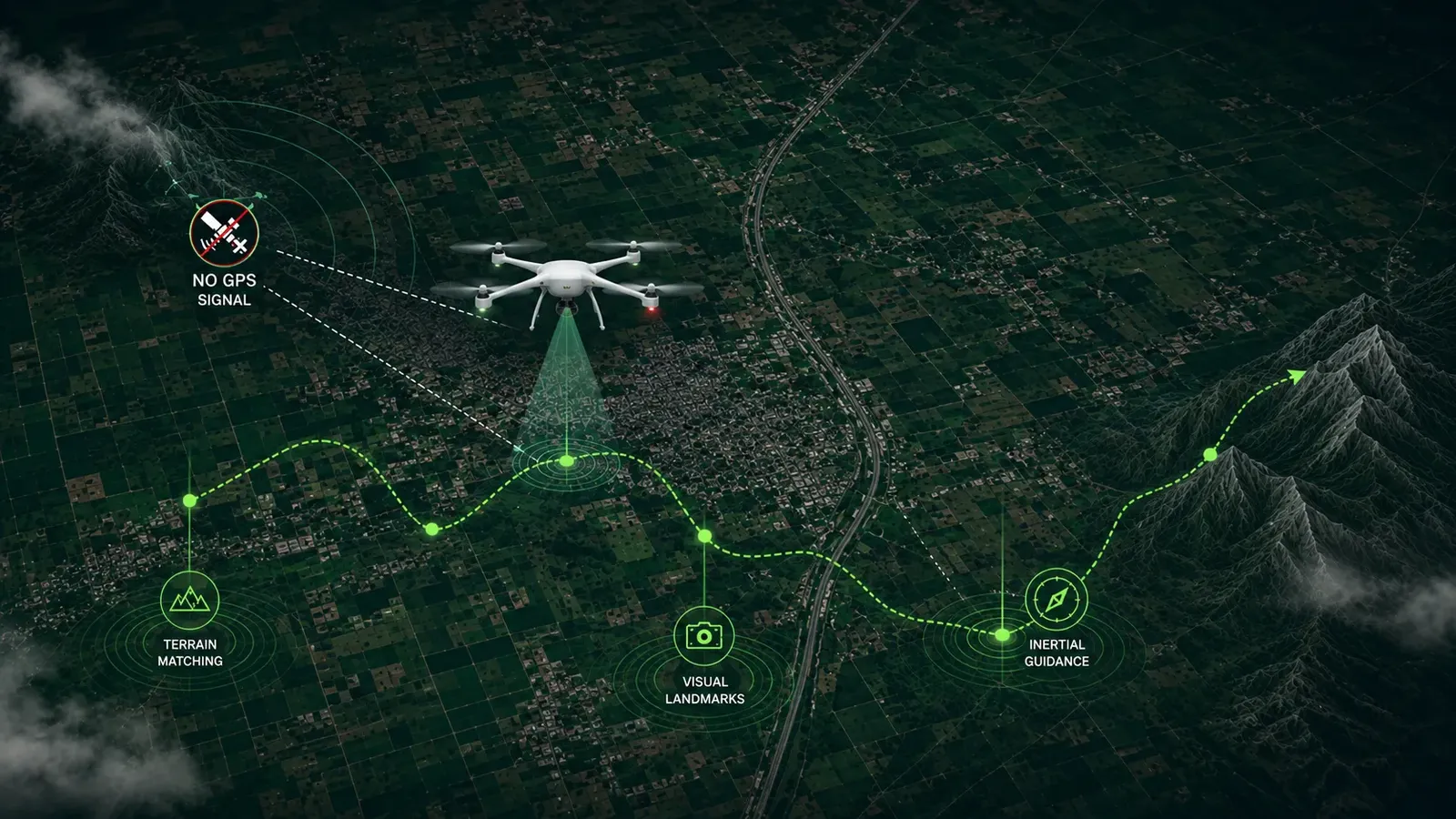
GPS-denied navigation is the engineering of a drone's ability to fix its position without satellite signals. The capability fuses inertial sensing, visual-inertial odometry, simultaneous localisation and mapping, terrain-relative methods, and indigenous receivers such as NavIC. The October 2025 Uttarakhand trials moved this sensor stack from research into the procurement bar (Press Information Bureau, 27 May 2025). The 18 June 2026 clearance of the ₹500 crore National Military Drone Technology Hub at IIT Kanpur extended that bar across upcoming UAV tenders (Department of Defence Production, 18 June 2026).
Understanding why satellite signals fail in contested airspace
Satellite navigation underwrites unmanned aviation by triangulating a position fix from signals broadcast by satellites in medium Earth orbit. The fix carries metre-level accuracy under permissive conditions and degrades sharply under electronic warfare.
A jamming source raises the noise floor on the receiver until the signal disappears. A spoofing source feeds the receiver a false signal that pulls the navigation solution off course. Either failure mode can blind a satellite-dependent drone within seconds, mirroring the GPS spoofing patterns documented across Indian operations.
Drone GPS jamming is no longer an exotic threat. The Indian Army recorded sustained jamming during the May 2025 Capacity Development Demonstrations at Babina, Pokhran, and Joshimath, conducted under simulated electronic warfare (Press Information Bureau, 27 May 2025). Operators flying in urban canyons, dense forest, indoor inspections, and mountainous terrain meet the same failure modes through signal multipath and reflection.
GPS-denied navigation is the answer the engineering community has built. The term describes a flight architecture that holds position and heading without continuous satellite input. The architecture fuses inertial sensing, visual landmarks, terrain matching, and indigenous regional positioning into one solution that the flight controller validates against itself.
Each sensor checks the others, so a single corrupted input cannot break the navigation chain. This is why drone navigation in jammed environments now reads as a procurement category, not a research topic. Operators researching counter-drone systems in Indian service and procurement officers writing jam-resistant specifications share the same engineering vocabulary.
Building the inertial backbone for GPS-denied flight
An inertial navigation system is the first layer of every GPS-denied architecture. It measures motion without relying on external radio signals. The system combines an inertial measurement unit, gyroscopes, and accelerometers to calculate a drone's position, speed, and orientation from its own movement. These sensors keep working when electronic warfare blocks satellite signals.
Every movement recorded by the IMU feeds a process called dead reckoning. Instead of asking a satellite where the aircraft is, the flight computer estimates the next position from acceleration and rotation data. This holds the drone in controlled flight through tunnels, dense forest, urban canyons, and jammed military environments. The principle is the same one how drones work end to end describes for everything from a quadcopter to a long-endurance UAV.
The limitation is cumulative drift. Small measurement errors grow over time because each estimate depends on the previous one. Even a high-grade inertial navigation system pulls away from the true track if no external reference corrects it. Short flights stay within tolerance; long-range reconnaissance and precision strike missions do not.
Defence-grade UAS therefore treat inertial navigation as the backbone of a sensor-fusion stack rather than a stand-alone answer. The flight computer fuses IMU data with camera frames, terrain references, and satellite signals whenever they return. The Observer Research Foundation has noted that future military UAVs require inertial navigation paired with spoof-resistant positioning to stay effective in contested environments (Observer Research Foundation, 29 December 2024). DRDO has named GPS-denied navigation as a key enabler for swarm work under the Technology Development Fund (DRDO, December 2025).
For procurement officers, an inertial navigation system is not a differentiator on the bidsheet. The differentiator is drift control and fusion quality after satellite signals disappear.
Mapping visual-inertial odometry and SLAM for autonomous drones
An inertial navigation system estimates movement, but it cannot eliminate drift by itself. Visual-inertial odometry provides that correction by fusing camera imagery with inertial data to fix the aircraft's position relative to its environment. The navigation computer picks out distinctive visual features and measures how they move between successive image frames.
Every camera frame becomes another navigation reference. Buildings, roads, rocks, vegetation, and terrain contours act as landmarks that refine the position estimate. Combined with IMU data, the result is far tighter than inertial sensing alone. This answers one operational question: how drones navigate without GPS when the satellite link disappears mid-mission.
Visual-inertial odometry does not replace inertial sensors. It corrects them. The inertial system supplies high-frequency motion data; cameras supply slower but more accurate environmental references.
Together they hold a stable position estimate even when satellites are jammed. The visual inertial odometry vs GPS comparison is therefore not a substitution; it is the complement that holds when GPS fails.
For longer missions, drones extend this through simultaneous localisation and mapping. Instead of tracking movement alone, SLAM builds a three-dimensional map of the environment while calculating the UAV's own position inside that map. The same computer vision pipelines on Indian drones that detect targets also anchor SLAM and visual-inertial odometry on the same hardware budget.
The Aeronautical Development Establishment has flown autonomous tests that combine onboard sensing with advanced navigation rather than external positioning (DRDO, 1 July 2022). The ISRO Robotics Challenge 2025 recognised autonomous aerial navigation systems built to operate without conventional GNSS (ISRO, 23 August 2025). SLAM for autonomous drones is no longer experimental; it is the principal method for holding navigation confidence after GPS denial, deployed across autonomous drones in Indian service.
Reading the ground through LiDAR and terrain-relative navigation
Inertial navigation and visual-inertial odometry depend on the drone measuring its own movement and identifying visual landmarks. Terrain-relative navigation adds a third layer by comparing the landscape beneath the aircraft with stored terrain data. The UAV fixes its position by matching hills, valleys, buildings, rivers, and other features against an onboard reference map.
The technique has been used in military aviation for decades because terrain does not disappear during electronic warfare. Mountains, road networks, ridgelines, coastlines, and built structures provide stable references even when satellite signals are jammed.
LiDAR strengthens terrain-relative navigation by measuring distance with laser pulses. Every pulse reflects from the ground and returns to the sensor, generating a three-dimensional map of the environment. Unlike cameras, LiDAR performs under changing lighting and measures terrain elevation, vegetation height, and obstacles accurately.
LiDAR terrain navigation drones are now appearing in inspection and survey tenders alongside defence programmes. The same sensor that powers aerial mapping solutions corrects inertial drift in a GPS-denied mission.
LiDAR also fills the gaps cameras leave. Visual sensors struggle in darkness, smoke, or featureless landscapes such as deserts or snow. LiDAR measures geometry rather than visible colour, so navigation algorithms keep positional awareness in conditions that defeat cameras.
The Aeronautical Development Establishment's Stealth Wing Flying Testbed demonstrated autonomous flight that fused onboard sensing with satellite-assisted navigation (DRDO, 1 July 2022). Future Indian military UAVs will combine inertial sensing, visual systems, LiDAR, and terrain-relative positioning into a single integrated navigation stack.
Layering NavIC and indigenous receivers for jam-resistant positioning
GPS-denied navigation does not mean satellite navigation disappears permanently. Resilient navigation systems use every trusted positioning source while reducing dependence on any single constellation. For Indian defence programmes, that strategy places NavIC alongside inertial, visual, and terrain-based methods rather than treating it as a like-for-like GPS replacement.
NavIC, formally the Indian Regional Navigation Satellite System, provides positioning across India and surrounding regions through satellites designed and operated by ISRO. The programme runs a Standard Positioning Service for civilian use and a Restricted Service for authorised government and defence users (ISRO, NavIC Programme Overview).
The second generation of the constellation broadened these capabilities. ISRO launched NVS-01 aboard the GSLV-F12 mission on 29 May 2023, introducing the L1 navigation signal for wider receiver compatibility (ISRO, 29 May 2023). NVS-02 followed on the GSLV-F15 mission on 29 January 2025, ISRO's 100th launch from Sriharikota (ISRO, 29 January 2025).
The upgrades reshape the NavIC vs GPS for Indian drones question. GPS is a global system; NavIC is optimised for India's regional operating environment. Defence platforms now integrate receivers that process multiple constellations alongside inertial and visual systems. If one signal becomes unreliable, the navigation computer keeps using the trusted inputs while checking their consistency through sensor fusion.
A NavIC drone receiver is therefore one piece of a layered architecture, not a standalone answer. The layered approach also blunts spoofing because conflicting inputs trigger weight reduction or outright rejection by the flight controller. Winning platforms combine regional satellite positioning with inertial sensing, visual-inertial odometry, SLAM, and terrain-relative navigation. The same architecture underpins jam-resistant drone design across the rest of the electronic warfare stack.
Tracing the procurement bar after the Uttarakhand trials
GPS-denied navigation moved from desirable feature to procurement requirement because trials exposed how vulnerable satellite-dependent systems become during electronic warfare. The Indian Army's 2025 evaluations asked whether unmanned aircraft could finish missions after losing reliable satellite navigation, not how they flew under ideal conditions. This shift drives how integrators design platforms and how procurement officers evaluate bids.
The transition began with the Capacity Development Demonstrations at Babina, Pokhran, and other operational ranges in May 2025 (Press Information Bureau, 27 May 2025). Evaluators measured how full UAS platforms held navigation, target tracking, and mission continuity while communication and positioning systems faced disruption from the detection and jamming layers counter-UAS grids field.
Attention sharpened during the October 2025 high-altitude Indian Army GPS-denied drone trials near Dehradun. Participating systems were tested in environments simulating GPS denial and signal degradation. Results showed that navigation resilience depended less on satellite receivers and more on onboard sensor-fusion quality (Raksha Anirveda, October 2025; Observer Research Foundation, 29 December 2024).
Trade press reporting documented an Indian Army communication to the Drone Federation of India in October 2025. The Army flagged GPS-denied capability as a key requirement for upcoming UAV tenders (IDRW, 15 October 2025). Satellite-only platforms no longer satisfy the operational environment, particularly for loitering munitions in Indian service where terminal-phase guidance cannot wait on a satellite signal.
The policy response carried into 2026. On 18 June 2026, the Department of Defence Production cleared the ₹500 crore National Military Drone Technology Hub at IIT Kanpur in principle (Department of Defence Production, 18 June 2026). The Army Design Bureau was named the single point of coordination between users, researchers, and industry. The Hub targets navigation resilience, autonomy, swarm technologies, and electronic warfare survivability.
The procurement implication is direct. Anti-jamming drone technology is no longer assessed as a standalone subsystem. Evaluation teams now examine whether the full navigation architecture supports the mission after satellite signals disappear, the bar the Operation Sindoor drone deployment record made unavoidable.
Sighting the next twelve months of Indian drone engineering
The next phase of Indian drone development will focus on navigation resilience rather than range or endurance alone. Future platforms will fuse inertial navigation, visual-inertial odometry, SLAM, terrain-relative methods, and indigenous positioning into tightly integrated sensor-fusion architectures. Success depends on how cleanly these technologies work together once satellite signals disappear.
This direction is already visible across government programmes. The Ministry of Defence has prioritised indigenous drone capability through the National Military Drone Technology Hub (Department of Defence Production, 18 June 2026). DRDO continues advancing autonomous flight and swarm work under multiple research initiatives (DRDO, December 2025). ISRO's expansion of the NavIC constellation adds a layer of resilient positioning that complements onboard sensing (ISRO, 29 January 2025).
Defence integrators will design aircraft around resilient navigation from the first stage. Procurement officers will evaluate field trials, sensor integration, and operational testing rather than laboratory specifications alone. Autonomous drone navigation will become the benchmark separating contested-airspace platforms from permissive-airspace platforms.
The same technologies will filter into inspections, mining, infrastructure surveys, indoor flight, and disaster response, where satellite visibility was already inconsistent. The pattern reaches beyond defence into drone-as-a-service operations and across Indian industry verticals where the same sensor stack pays back the investment.
The next round of field demonstrations, iDEX challenges, and Aero India showcases will turn GPS-denied navigation into the defining engineering benchmark separating contested-airspace platforms from permissive ones.
GPS-denied navigation will shape the next generation of Indian unmanned systems because operational advantage now depends on resilient sensor fusion rather than uninterrupted satellite access.