Jam-resistant drones are unmanned aircraft engineered to keep flying, navigating and reporting when an adversary contests the electromagnetic spectrum. After Operation Sindoor on 7-10 May 2025, the Chief of Defence Staff named indigenous UAV and counter-UAS hardening as a strategic priority (Press Information Bureau, 16 July 2025). This piece names the four-layer hardness stack covering position-navigation-timing, communications, compute, and autonomy. It maps each layer to the primary-source procurement signal that has reshaped India's drone roadmap.
Defining jam-resistant drones in contrast to anti-drone systems
Jam-resistant drones get confused with anti-drone systems despite solving opposite operational problems. Anti-drone systems detect, track, disrupt or neutralise hostile unmanned aircraft. Jam-resistant drones are friendly UAVs engineered to keep operating when exposed to enemy electronic warfare.
One side attacks the electromagnetic environment while the other survives within it. That distinction explains why anti-jamming drone technology searches in India surface counter-UAS equipment rather than survivable UAV design. A drone able to resist interference needs protection across navigation, communications, onboard processing and mission execution.
A jammer-resistant platform is therefore an architecture challenge rather than a single hardware feature. The question "how do drones resist jamming on the battlefield" cannot be answered with one component. Anti-jam antennas help with signal hygiene but cannot solve datalink disruption on their own.
Encrypted communications protect the link but do not replace navigation. Autonomous mission execution buys time but cannot compensate for compromised sensors. Survivability emerges when all four layers work together as one system. Counter-UAS coverage lives on the other side of this distinction.
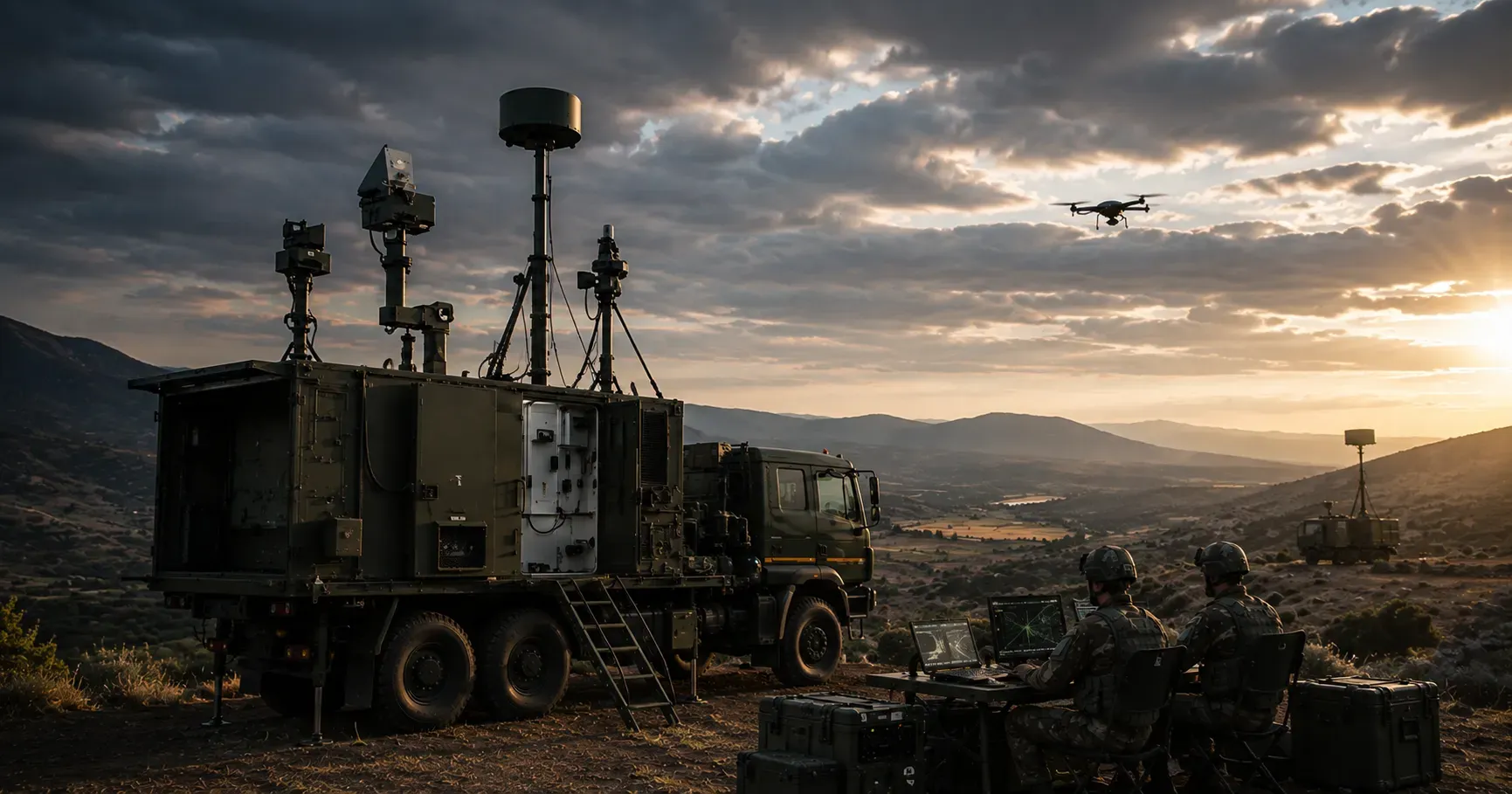
Readers tracking the offensive side can study counter-drone systems in India and the procurement footprint of anti-drone systems in India.
Reading Operation Sindoor as a battlefield reset moment
Operation Sindoor became a visible demonstration of how electronic warfare shapes modern military operations. Integrated air defence and counter-drone systems engaged aerial threats across Awantipura, Srinagar, Jammu, Pathankot, Amritsar, Adampur and other locations on the night of 7-8 May 2025 (Press Information Bureau, 14 May 2025). The defensive grid held, but the offensive lesson was about Indian UAVs that had to operate inside the same contested airspace.
That offensive lesson moved the discussion from observation to procurement direction. During a defence workshop focused on UAV and counter-UAS indigenisation, the Chief of Defence Staff named two takeaways. Operation Sindoor demonstrated the operational value of indigenous systems. Dependence on imported niche technologies remains a long-term vulnerability (Press Information Bureau, 16 July 2025).
The broader policy environment reinforced the same message. The Bharatiya Vayuyan Adhiniyam 2024 established the updated legislative framework for India's aviation ecosystem (Ministry of Civil Aviation, 2024). Defence Acquisition Council decisions through 2025 expanded investment in drone, counter-drone, surveillance and electronic warfare programmes (Press Information Bureau, December 2025).
Trade-press reporting documented setbacks during GPS-denied drone evaluations conducted after Sindoor (IDRW, 18 October 2025). Specific figures remain unconfirmed by government releases, but the reported results made the gap between permissive flight conditions and deliberate electronic attack visible across the procurement chain. That gap explains why EW-hardened UAV requirements now sit inside almost every Service requirement document.
For broader operational context, readers can study post-Sindoor defence drones in India and the Akashteer integrated air defence network that absorbed the night of 7-8 May.
Hardening position, navigation and timing for GNSS-denied flight
The first layer of the hardness stack addresses position, navigation and timing. Commercial drones rely on satellite navigation for position fixes and route management, and that dependency creates a vulnerability. GPS signals arrive at extremely low power levels, so an adversary can disrupt or spoof the navigation signal without destroying the aircraft.
GPS-denied drone navigation therefore requires overlapping systems instead of a single source. The first element is spoof-resistant GNSS architecture, covering anti-jam receivers and controlled reception pattern antenna technology, commonly referenced in defence procurement as the CRPA antenna drone solution. These systems reject interference before it enters the navigation chain through directional null-steering across the antenna array.
The second element is inertial navigation. An inertial navigation system drone GPS denied architecture uses accelerometers and gyroscopes to estimate movement when satellite signals disappear. Accuracy degrades over time, but the aircraft retains navigational awareness during critical mission phases.
The third element is visual inertial odometry drone technology. Cameras, inertial sensors and onboard processing combine to estimate position by comparing visual features across successive frames. The technique has become standard for low-altitude operations where GNSS multipath degrades position fixes. DRDO has explored this layer through Technology Development Fund projects supporting tight-formation autonomous flight in GPS-denied conditions.
The fourth element is NavIC integration. India's regional navigation constellation provides positioning through L1, L5 and S-band services, including restricted services for authorised military users (ISRO, 2024-2025). A NavIC drone military India architecture diversifies the positioning source available to the platform and reduces single-vendor dependency on foreign satellite networks.
The Observer Research Foundation has argued for resilient PNT architectures as the practical path for military drone survivability (Observer Research Foundation, 29 December 2024). The architecture combines GNSS, inertial systems and alternative navigation sources. The pattern across Indian procurement signals tracks the same thinking. For deeper technical context on the vision element, readers can study computer vision in drones.
Building communications resilience with spread spectrum, SATCOM and fibre links
Navigation alone does not keep a drone alive. A platform that knows where it is still needs a reliable way to talk to its controller. That requirement is where frequency hopping drone datalink architectures earn their place inside the procurement specification.
Frequency-hopping spread spectrum systems move communications across multiple channels according to a predefined sequence. A jammer targeting one frequency becomes less effective because the signal continuously shifts across the spectrum. The result is improved resistance against narrowband interference and harder traffic for an adversary to track.
Post-Sindoor trade-press reporting documented defence requirements that now reference frequency-hopping spread spectrum links, encrypted satellite communications and software-defined radio architectures with adaptive frequency agility (IDRW, 3 September 2025). Satellite communications add a second layer of resilience. Encrypted Ku-band and Ka-band links can carry telemetry beyond line of sight while reducing dependence on local terrestrial radio infrastructure. SATCOM is the only link option for medium and high-altitude platforms operating across border zones where ground stations cannot reach.
A third approach is fibre-connected unmanned systems. Interest in fibre optic FPV drone EW resistant architectures has expanded because a physical fibre tether cannot be disrupted through conventional radio-frequency jamming. The trade-off is range and manoeuvrability, but the survivability benefit is decisive in tactical reconnaissance and urban precision strike profiles.
Communications resilience is ultimately about preserving command authority. Without a trusted datalink, even a technically advanced platform becomes operationally constrained.
Shielding onboard compute and sensors from electromagnetic stress
Navigation and communications dominate the EW discussion, but electronic warfare does not stop at the antenna. Sensors, processors, power systems and mission computers must also withstand interference and electromagnetic stress to keep a jam-resistant drone in the fight.
Shielded electronics carry the first weight in the compute layer. Mission computers, flight controllers and sensor processing boards sit inside Faraday-style enclosures that attenuate inbound radio-frequency energy before it reaches integrated circuits. The shielding adds mass and thermal load, which forces a design trade-off integrators must close at the airframe level.
Hardened processors carry the second weight. Defence-grade compute boards rate themselves on electromagnetic compatibility margins rather than only clock speed. Redundant inertial measurement units run parallel state estimation in case one IMU saturates under field stress. Protected sensor pathways and shielded cable harnesses prevent coupled interference from corrupting the signals that reach the flight controller.
Power supplies sit inside the same envelope. Filtered DC rails, surge-tolerant battery management circuits and EMP-aware switching regulators keep the platform powered when the surrounding spectrum becomes hostile. These measures overlap closely with India's drone cybersecurity framework because EW vulnerabilities and cyber attack surfaces share the same physical pathways.
The compute layer is where engineering meets discipline. A platform with a hardened airframe but a vulnerable processor remains vulnerable, and the hardness stack works only when every layer carries its weight.
Layering autonomy and counter-countermeasures into the airframe
The final layer of the hardness stack is autonomy. When connectivity, navigation and sensor inputs all degrade together, the platform itself has to make the next decision. An autonomous drone EW architecture allows the aircraft to keep executing pre-authorised mission functions when external connectivity falls away.
Autonomy here is bounded rather than unrestricted. It does not imply free target engagement. It allows navigation continuity, route management, sensor operation and mission continuity under degraded communications conditions. Weapons release stays a human decision in every Indian Service doctrine published to date.
The Defence Acquisition Council's approval of the Collaborative Long Range Target Saturation/Destruction System, or CLRTS/D, marked institutional interest in autonomous operations inside dense electronic warfare environments. The programme is a swarm-oriented capability designed for contested operating conditions and long-range engagement (DAC AoN coverage, October 2025). The architecture references encrypted line-of-sight and beyond-line-of-sight links hardened against EW, with the swarm permitted to modify tactics on the move when central command authority becomes unreliable.
Electronic counter-countermeasures sit alongside autonomy at this layer. ECCM techniques include adaptive frequency selection, AI-assisted pattern recognition for hostile emitters and burst-mode communications. These techniques let the airframe respond to changing EW conditions in flight rather than fall back on a fixed default behaviour.
This is where broader AI capabilities matter. The architecture connects directly to drone swarms and swarm intelligence and to how autonomous drones think and act. The broader AI in drones stack classifies observations and supports mission execution when connectivity falls away.
Tracing procurement direction across DAC, iDEX and emergency routes
The engineering discussion matters because procurement signals across DAC, iDEX and emergency channels now reflect the same priorities. The Defence Acquisition Council approved proposals worth about ₹67,000 crore in August 2025, including remotely piloted aircraft requirements for the three Services (Press Information Bureau, 5 August 2025). Additional approvals worth about ₹79,000 crore followed in December 2025 and included Integrated Drone Detection and Interdiction System Mk-II for the Indian Army (Press Information Bureau, 29 December 2025).
The Ministry of Defence Year End Review documented emergency procurement activity across drone, counter-drone, surveillance and electronic warfare systems. The review noted an emergency procurement ceiling of ₹9,100 crore in revenue authority during 2025 and progress across dozens of capability development schemes (Press Information Bureau, December 2025). Twenty-nine schemes had been contracted at the time, with sixteen more closing by year-end.
The Indian Army drone EW hardening directive emerged from this procurement frame. Battlefield feedback from Operation Sindoor moved through three-tiered evaluation cycles. These cycles screened component supply chains, simulated heavy jamming from launch zones onward and assessed performance in high-altitude operational areas (IDRW, 3 September 2025). The directive flowed into emergency procurement orders for kamikaze, longer-range strike and reconnaissance platforms.
Innovation pathways tell a similar story. The iDEX challenge GPS-denied drone specifications and ADITI programme requirements explicitly reference GPS-independent navigation and electronic warfare payload capability. The shift in specification language is the upstream signal that procurement direction will sustain past the next defence budget cycle.
Together, DAC approvals, iDEX initiatives, emergency procurement authority and post-Sindoor capability reviews form one consistent picture. India is not only buying more drones. It is prioritising platforms able to operate when the surrounding electromagnetic environment becomes hostile, which connects directly to building a self-reliant drone industry.
What the next twelve months of jam-resistant work signal
The clock now running across India's defence procurement chain is the gap between trial outcomes and hardened-platform inductions. Twenty-nine emergency schemes were already contracted by late 2025, with the next batch closing inside the same cycle (Press Information Bureau, December 2025). The next DAC and iDEX rounds will pick up where this batch ends.
The next inflection point is the iDEX cycle that follows the post-Sindoor reset. Specifications will demand GPS-independent navigation as a default, encrypted datalinks with adaptive frequency agility and sensor architectures with quantifiable electromagnetic compatibility margins. The bar will sit where the September 2025 trials revealed the indigenous baseline cannot yet reach.
Every subsequent Request for Information will have to clear that bar. The next twelve months are about whether Indian integrators can converge the four hardness layers inside one platform. The target is a system that flies at expected mission ranges and durations rather than producing one layer per vendor. The procurement chain will reward systems integrators able to hold the whole stack at once.