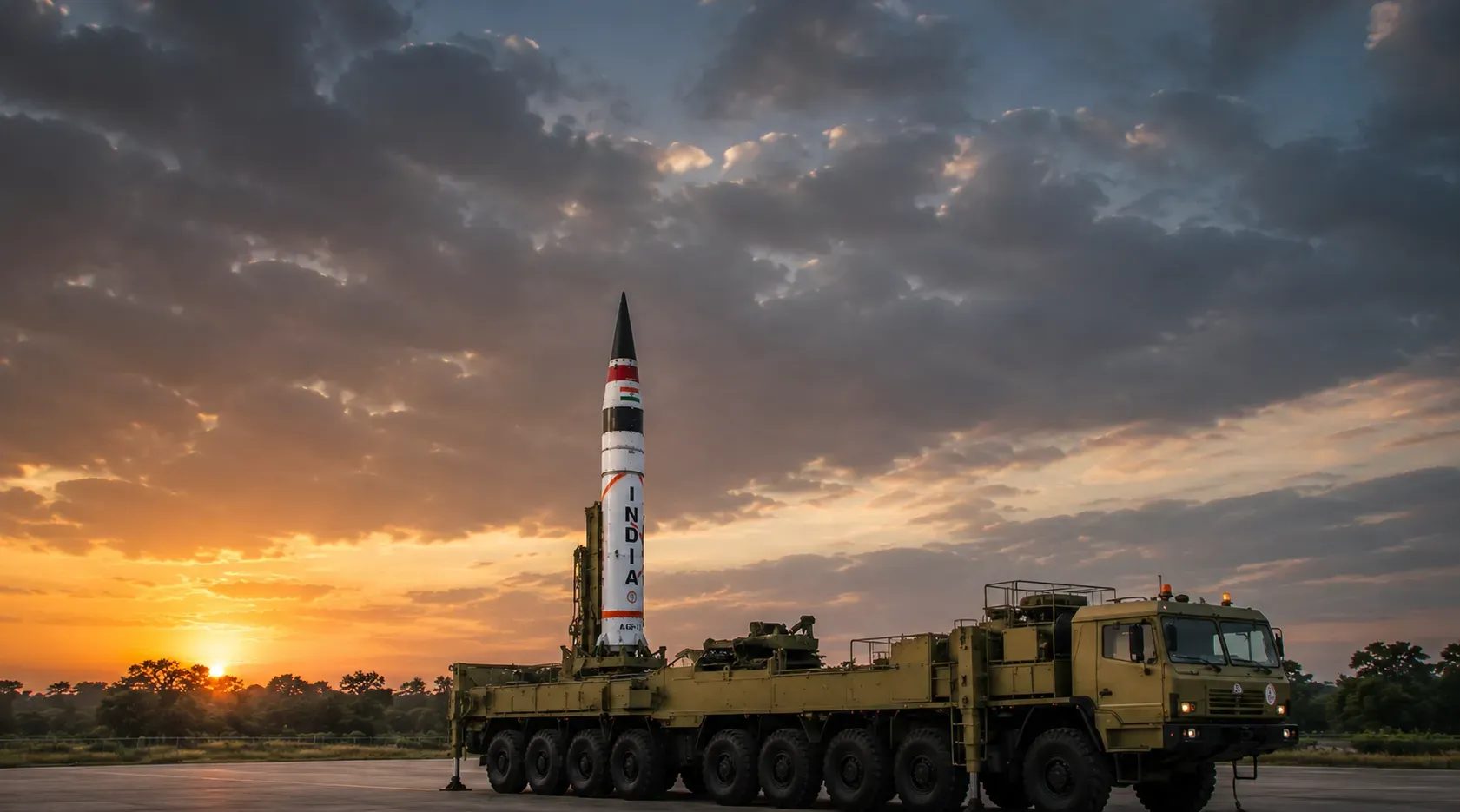
The Agni-5 missile sits at the top of India's land-based nuclear delivery ladder. This article reads the programme through a delivery, payload, and doctrine triad. On 8 May 2026, DRDO flight-tested the second publicly acknowledged MIRV Agni variant from Dr APJ Abdul Kalam Island (Press Information Bureau, 9 May 2026). That test followed Mission Divyastra by fourteen months, defining a two-test operationalisation window (Press Information Bureau, 11 March 2024, Release ID 2013549).
Tracing Agni-5's development from IGMDP to canister-launch
The Agni-5 missile represents the strategic end of India's Agni development path. The programme grew from the Integrated Guided Missile Development Programme. Agni-5 then followed a distinct trajectory centred on longer range, road mobility, canister launch, and strategic payload integration. DRDO's Advanced Systems Laboratory led the engineering work.
Agni-5 should not be read as an incremental extension of the earlier IGMDP sequence. Programmes such as DRDO's TAPAS BH-201 programme sit alongside it in the wider DRDO strategic-asset stack.
The public flight-test record gives the programme a granular timeline. The first Agni-5 flight took place on 19 April 2012. Canister-launched trials followed from 2015 onward, and Strategic Forces Command user trials were conducted in 2018 (Missile Defense Project, CSIS).
The 27 October 2021 trial demonstrated Agni-5 as a surface-to-surface ballistic missile launched from Dr APJ Abdul Kalam Island. The Ministry of Defence noted a three-stage solid engine and a range of up to 5,000 km (Press Information Bureau, 27 October 2021).
Mission Divyastra on 11 March 2024 demonstrated the first publicly acknowledged Agni-5 flight with a Multiple Independently Targetable Re-entry Vehicle configuration (Press Information Bureau, 11 March 2024, Release ID 2013549). The Ministry of Defence noted a woman Project Director and significant women contributions on the mission. On 20 August 2025, an Agni-5 Intermediate Range Ballistic Missile was test-fired from the Integrated Test Range at Chandipur under Strategic Forces Command (Press Information Bureau, 20 August 2025, Release ID 2158574).
That sequence gives the programme a useful timeline. The 27 October 2021 trial established the baseline system, Mission Divyastra introduced MIRV integration, and the 20 August 2025 trial placed the missile within a user-trial context. The 8 May 2026 flight then provided the second publicly acknowledged MIRV test. The cadence shows a programme moving through development, user validation, payload integration, and operationalisation.
Breaking down the three-stage solid-fuel propulsion stack
Agni-5 uses a three-stage solid-fuel propulsion architecture. The Ministry of Defence publicly described the missile as a three-stage solid-engine ballistic missile during the 27 October 2021 test announcement (Press Information Bureau, 27 October 2021).
A three-stage architecture divides powered flight into sequential propulsion phases. Each stage burns its solid propellant, contributes velocity during its assigned portion of flight, and separates after its propulsive work is complete. The upper stages then continue the trajectory toward the re-entry phase.
Solid propulsion matters for a strategic road-mobile missile because the propellant remains contained within the missile during storage and deployment. That architecture supports a missile held in a ready configuration without the launch sequence associated with liquid-fuel systems. Public open-source assessments place the launch mass at around 50,000 kg. Length is reported at 17.5 m, diameter at 2 m, and nuclear payload at around 1,100 kg (Missile Defense Project, CSIS).
The Agni-5 missile range is officially disclosed by the Ministry of Defence as up to 5,000 km (Press Information Bureau, 27 October 2021). Other public assessments place the system's potential range higher, creating a disclosure gap rather than a settled public specification. Business Standard reported an analyst estimate of 7,500 km and an external assessment of 8,000 km (Business Standard, 12 March 2024). The official Indian figure remains the appropriate baseline for a government-source-led description.
Weight reduction is the technical lever behind the higher analyst estimates. Business Standard reported a weight reduction of over 20 per cent, opening the possibility of striking targets beyond 7,000 km if authorised (Business Standard, 12 March 2024). Range figures should therefore be separated into three categories: official disclosure, analytical estimation, and external assessment.
The propulsion stack connects directly to the payload architecture. A ballistic missile must generate the velocity required for its flight path while carrying its re-entry system and payload through powered flight. For Agni-5, propulsion cannot be separated from the canister, guidance, re-entry, and MIRV systems. Operational value comes from combining solid propulsion, road mobility, canister launch, precision guidance, and strategic payload delivery within one system.
Reading the canister launcher and road-mobile deployment
The Agni-5 canister launcher changes the operational model of a strategic ballistic missile. Older systems required transporting an exposed missile to a launch position and preparing it through a lengthy sequence. The Agni-5 canister becomes part of the storage, transportation, and launch architecture.
The system is associated with the Transport-cum-Tilting Vehicle-5, or TCT-5, launcher configuration. The TCT-5 chassis has been reported as a seven-axle trailer paired with a three-axle prime mover, with a later variant on a Tatra chassis (Missile Defense Project, CSIS). Road mobility adds another layer to the delivery system. A mobile launcher can relocate between prepared positions, reducing the dependence on a single fixed launch facility.
Canisterisation also changes readiness. A sealed launch container protects the missile during movement and storage while providing the structural interface for launch. The launcher therefore becomes more than a transport vehicle; it forms part of the weapon's operational architecture.
The 20 August 2025 test is important in this context because the Ministry of Defence identified Strategic Forces Command in the test chain (Press Information Bureau, 20 August 2025, Release ID 2158574). The trial took place from the Integrated Test Range at Chandipur.
Strategic mobility, dispersion, and survivability are three distinct concepts that wider commentary can collapse into one. Mobility describes the vehicle's ability to move. Dispersion describes how the force is spread across the operating area. Survivability describes the probability that a specific launcher remains available to fire after an adversary's first strike.
A road-mobile system distributes signature across a larger operating area. Distributed operations require the force to hold the logistics, communications, security, route planning, and launch infrastructure needed for dispersed deployment. Mobility creates the conditions for survivability, and survivability depends on how effectively the entire force can conceal, move, communicate, protect, and sustain its launch assets.
Mapping guidance, avionics, and re-entry accuracy
Agni-5's guidance system is the digital layer connecting launch position, trajectory control, and re-entry performance. Public technical assessments identify a ring laser gyroscope inertial navigation system alongside a micro inertial navigation system (Missile Defense Project, CSIS). The two-source architecture interfaces with Indian and foreign satellite navigation constellations, and detailed operational parameters remain classified.
An inertial navigation system calculates movement from internal measurements rather than depending continuously on an external navigation signal. Ring laser gyroscopes provide angular-rate measurements that help the navigation system estimate the missile's orientation during flight. The two-source architecture builds redundancy into the navigation chain.
The guidance architecture has to operate across a ballistic flight profile. The missile moves through powered ascent, stage separation, mid-course flight, and terminal re-entry. Each phase creates different navigation and control requirements. Terminal velocities during re-entry have been reported at up to Mach 24 in open-source assessments.
Accuracy depends on the quality of onboard avionics and flight-control architecture. Guidance computers process sensor measurements, estimate the missile's state, and generate control commands. Those functions must remain stable through acceleration, vibration, thermal stress, and stage separation.
Re-entry creates another engineering boundary. The payload must survive the transition from spaceflight conditions into the atmosphere while maintaining the required trajectory. For a MIRV configuration, the post-boost vehicle must also manage the separation of individual re-entry vehicles. This makes MIRV integration more than a payload change; guidance, avionics, separation mechanisms, re-entry vehicles, and mission-planning architecture must operate as one system.
The public record does not disclose the complete Agni-5 guidance architecture or its operational accuracy figures. A source-led account should therefore distinguish confirmed architecture from classified performance. That boundary matters when describing a strategic missile whose operational specifications are not fully public.
Situating MIRV under Mission Divyastra and the second acknowledged flight
MIRV technology changes the payload architecture of a ballistic missile by allowing multiple re-entry vehicles to be carried within one missile system and directed toward separate target locations. Agni-5 entered this publicly acknowledged phase through Mission Divyastra on 11 March 2024 (Press Information Bureau, 11 March 2024, Release ID 2013549).
Mission Divyastra was the first publicly acknowledged Agni-5 flight with a MIRV configuration. The Ministry of Defence described the mission as a successful demonstration of the technology. Multiple telemetry and radar stations tracked the re-entry vehicles during the flight.
The next publicly acknowledged MIRV flight came on 8 May 2026. DRDO conducted the Advanced Agni missile test from Dr APJ Abdul Kalam Island, Odisha, and the Ministry of Defence announced the flight on 9 May 2026 (Press Information Bureau, 9 May 2026). The Agni-5 test 8 May 2026 payload targeted geographically separated impact points across the Indian Ocean region.
The fourteen-month interval between the two flights is the analytical signal. Kodainya defines the two-test operationalisation window as a house metric. Two or more publicly acknowledged MIRV flights within a twenty-four-month period signal movement from technology demonstration into force integration. A first flight can establish that an architecture works under test conditions; a second flight validates the architecture and supports the transition toward operational use.
The Agni-5 MIRV capability should not be reduced to a simple question of warhead count. Public sources do not provide a complete operational payload specification, and the exact Agni-5 warhead payload deployed operationally should not be inferred from test imagery or secondary reporting.
The strategic value of MIRV technology comes from payload distribution. One missile can carry multiple independently targeted re-entry vehicles, changing how a strategic force approaches target coverage and missile-defence penetration. That creates a different relationship between missile numbers and delivered effects.
The May 2026 test therefore belongs to a broader operationalisation story. Mission Divyastra established the first public MIRV demonstration. The 8 May 2026 flight established a second public test point. The 2025 Strategic Forces Command-linked trial provides an additional part of the user-validation timeline.
The defensible conclusion is narrower than the headlines suggest. Two publicly acknowledged MIRV tests within fourteen months have moved the system into an operational-induction window.
Locating Agni-5 inside the Strategic Forces Command chain
Strategic Forces Command provides the operational context for India's land-based nuclear delivery systems. The public Agni-5 test record shows the command appearing directly in the user-trial chain, connecting DRDO development with strategic force validation (Press Information Bureau, 20 August 2025, Release ID 2158574).
Strategic missile programmes move through six broadly observable lifecycle stages: development testing, user-associated trials, pre-induction validation, formal induction, deployment, and alert-readiness. DRDO owns the first two stages. Strategic Forces Command owns the last three. Pre-induction validation sits at the boundary.
Two publicly acknowledged MIRV flights in fourteen months define the operationalisation window. The analytical question shifts from whether MIRV works to how the technology becomes a fielded strategic capability. The 20 August 2025 test is useful because the Ministry of Defence explicitly identified the trial as taking place under Strategic Forces Command (Press Information Bureau, 20 August 2025, Release ID 2158574).
The subsequent May 2026 MIRV test adds a payload-specific layer to that timeline. The public record now contains separate evidence for the missile's ballistic delivery system, user-oriented testing, and MIRV configuration.
Public information cannot establish the exact readiness state of the Strategic Forces Command inventory. Operational deployment numbers, alert procedures, targeting arrangements, and command protocols remain outside the public record. The responsible analytical position is therefore to distinguish test evidence from force-structure claims.
Parsing the IRBM against ICBM classification debate
Agni-5 occupies a classification boundary that depends on the range figure and the classification framework being used. India's official description has referred to Agni-5 as an Intermediate Range Ballistic Missile. External assessments have placed its potential range above the conventional 5,500 km threshold used for ICBM classification.
The Ministry of Defence disclosed a range of up to 5,000 km in its 27 October 2021 release (Press Information Bureau, 27 October 2021). That ministry then described the 20 August 2025 trial as an Agni-5 Intermediate Range Ballistic Missile test (Press Information Bureau, 20 August 2025, Release ID 2158574). Business Standard reported an analyst estimate of 7,500 km and an external assessment of 8,000 km (Business Standard, 12 March 2024).
The classification gap is not only a technical dispute. India publicly declares Agni-5 as an IRBM at up to 5,000 km, while credible open-source assessments point to an ICBM-class range. The declared figure sets the ceiling for what the government is willing to publicly acknowledge, while the operational envelope may sit higher. That choice serves credible minimum deterrence without escalating the arms-control conversation.
The India ICBM programme question therefore needs careful wording. India has not publicly disclosed an Agni-5 range above the official 5,000 km figure in the cited government source. External assessments can be reported as assessments, but they should not replace the government's own disclosure.
The strategic significance does not depend entirely on the label. A canister-launched, road-mobile ballistic missile with a publicly demonstrated MIRV configuration occupies a high-value position in India's land-based nuclear deterrent architecture. The phrase ICBM-class deterrent captures both the external classification debate and the strategic role without asserting an undisclosed range as an official specification.
Placing the deterrent within India's No First Use doctrine
India's nuclear deterrence posture provides the doctrinal context for the Agni-5 missile. The weapon's strategic purpose cannot be understood only through range, launcher mobility, or payload architecture. Its role is tied to India's stated nuclear doctrine and the requirement for a credible retaliatory capability.
The No First Use doctrine places the emphasis on deterrence rather than first-use employment. A survivable delivery system supports that posture because deterrence depends on maintaining the ability to respond after an adversary's first strike.
Road mobility contributes to that survivability equation, canister launch contributes readiness and deployment flexibility, and MIRV technology contributes payload distribution. Agni-5 anchors the land leg of India's nuclear delivery architecture, which also includes sea-based and air-launched components under the wider triad. A layered defensive picture depends on interceptor and command systems such as the Akashteer air-defence backbone, which shape the survivability equation from the receiving end.
Doctrine remains a political and strategic decision. Technology changes the available options within that doctrine. This distinction becomes important as missile defences evolve. A single-warhead ballistic missile and a MIRV-capable ballistic missile impose different defensive planning problems.
MIRV can distribute re-entry vehicles across separate trajectories, while the defender must account for the missile, its post-boost vehicle, and the resulting re-entry sequence. The public record does not disclose India's operational targeting doctrine, launch authority procedures, or specific contingency plans. The defensible conclusion is that Agni-5 strengthens the technical foundation of a survivable land-based deterrent.
Reviewing the system alongside the wider Agni family
The Agni family represents a progression in range, propulsion, mobility, and strategic role. Public specifications vary by source. The table below uses the broad programme position described in government releases and established public assessments rather than presenting external estimates as official figures.
System | Public range position | Propulsion | Payload position | Programme status |
|---|---|---|---|---|
Agni-I | Shorter-range Agni variant | Solid fuel | Strategic payload delivery | Operational family member |
Agni-II | Medium-range Agni variant | Two-stage solid fuel | Strategic payload delivery | Operational family member |
Agni-III | Longer-range Agni variant | Two-stage solid fuel | Strategic payload delivery | Operational family member |
Agni-IV | Longer-range strategic variant | Two-stage solid fuel | Strategic payload delivery | Operational family member |
Agni-5 | Up to 5,000 km officially disclosed | Three-stage solid fuel | MIRV configuration publicly tested | Strategic user trials and MIRV development |
Agni-6 | Public range statements point beyond 10,000 km | Development architecture not fully public | Future strategic payload architecture | Development and future capability |
Each generation adds a different combination of mobility, launch architecture, guidance, propulsion, and strategic payload capability. Agni-5 differs from earlier Agni systems through its three-stage solid architecture, canister launch, road mobility, and publicly demonstrated MIRV configuration (Press Information Bureau, 27 October 2021). The generational question is whether Agni-5 is a next-generation break or a longer Agni-IV, and the delivery-payload-doctrine reading points to a break.
Similar comparative reads for cruise weapons include the BrahMos supersonic cruise missile. Tactical strike sits with loitering munitions India has inducted. Long-range unmanned strike falls within the wider set of long-range strike platforms.
The Agni-5 versus Agni-6 comparison requires greater caution. Public statements by DRDO leadership have indicated work toward a missile with a range exceeding 10,000 km. The complete Agni-6 architecture and operational specification are not publicly established in the cited sources. That makes Agni-5 the more concrete reference point today, with its flight-test history, launcher architecture, MIRV demonstrations, and Strategic Forces Command-linked trial documented through public sources.
Tracking the path to Agni-6 and long-range successors
Agni-6 represents the forward edge of India's strategic missile development programme. DRDO Chairman Dr Samir V Kamat has stated that DRDO can test a missile with a range exceeding 10,000 km subject to government approval (IDSA, 12 May 2026). That range would place the programme in a different category from the officially disclosed Agni-5 specification.
The transition should not be described as a simple replacement cycle. Strategic missile programmes operate through overlapping development, testing, induction, and sustainment phases. Agni-5 can therefore continue to occupy an operational role while successor technologies mature.
Future Agni-5 variants are also reported to be under study for bunker-busting payloads, extending the system's target set beyond area-strike missions (Gulf News, 21 August 2025). The next generation also raises questions about launcher architecture. India's wider Agni family is moving toward different mobility approaches, including rail-based launcher development associated with Agni-Prime (IISS Missile Dialogue Initiative, 4 February 2026).
Mobility is becoming a system-level design problem. A missile's survivability depends on more than its propulsion and range. It also depends on the launcher, transport network, communications, route planning, concealment, maintenance, and command infrastructure supporting the force.
AI and autonomy will intersect with that infrastructure rather than with nuclear release authority, and the broader trajectory is captured in AI in Indian defence modernisation. Edge inference can support equipment diagnostics and anomaly detection. These applications remain distinct from autonomous nuclear decision-making. The Agni-6 development window will therefore reveal how India assembles its next strategic architecture across range, mobility, survivability, payload integration, guidance, and deployment infrastructure.
Weighing what the twin MIRV tests signal for operational induction
The two publicly acknowledged MIRV tests establish the clearest recent signal in the Agni-5 programme. Mission Divyastra on 11 March 2024 demonstrated the first public MIRV configuration (Press Information Bureau, 11 March 2024, Release ID 2013549). The 8 May 2026 Advanced Agni flight provided a second public test within fourteen months (Press Information Bureau, 9 May 2026).
That cadence matters because strategic weapons move through validation stages. A single demonstration establishes a capability under one test condition. A second flight validates the architecture, tests repeatability, and supports the transition toward operational deployment. The public evidence still stops short of a formal induction announcement.
The next twelve months should therefore be tracked through three observable signals. Signal one is any further MIRV flight activity that would extend the two-test cadence into a three-test pattern. Signal two is additional Strategic Forces Command-linked user trials that echo the 20 August 2025 test. Signal three is a formal government statement or gazette notification confirming operational induction of the MIRV-configured Agni-5.
The payload and doctrine questions will remain important in parallel. Public sources do not establish a complete deployed warhead configuration. Claims about an exact Agni-5 warhead payload should be separated from the technology demonstrated during Mission Divyastra and the May 2026 flight.
MIRV changes the relationship between one missile and multiple re-entry vehicles, but the strategic meaning depends on India's nuclear command structure and No First Use posture. The delivery-payload-doctrine triad provides the clearest way to track that transition. Delivery determines survivability and readiness, payload determines the number and distribution of re-entry vehicles, and doctrine determines how the capability fits India's nuclear deterrence posture.
For defence integrators, the wider lesson is that strategic missile capability is a systems problem across propulsion, navigation, avionics, launch vehicles, communications, secure software, logistics, testing, and maintenance. That systems view also frames the cost asymmetry between drones and missiles and the industrial-base context of India's defence industry. Programmes such as the iDEX innovation scheme provide one procurement channel for the adjacent technology stack.
The Agni-5 programme has reached a more consequential phase than the launch of a single test suggests. The March 2024 and May 2026 MIRV flights provide a two-test operationalisation window, and the 2025 Strategic Forces Command-linked trial connects the development record to the user chain.
The next inflection point is whether that demonstrated MIRV architecture moves from repeated flight validation into a formally acknowledged operational capability. The Agni family advances toward its next long-range generation alongside that transition. Further programme-level reads live in the missiles category.