India's drone defence industry crossed a demand-signal threshold on 19 March 2026 at the National Defence Industries Conclave (Press Information Bureau, 19 March 2026). Defence Minister Rajnath Singh disclosed that 676 start-ups and MSMEs sit inside the iDEX ecosystem. Of these, 58 prototypes worth ₹3,853 crore have procurement clearance and 45 contracts worth ₹2,326 crore are signed. Read against the policy-procurement-platform triad, the figures show an industrial base scaling into a ₹38,424 crore FY 2025-26 export outcome (Press Information Bureau, 17 June 2026).
Reading the demand signal from recent conflicts
India's drone defence industry is no longer defined by technology demonstrations alone. It is measured by how quickly indigenous systems move from laboratories into operational units and sustained procurement programmes. The demand signal firmed after Operation Sindoor validated indigenous drones and counter-UAS technologies developed under India's defence modernisation programme (Press Information Bureau, 14 May 2025).
The Ministry of Defence later confirmed that indigenous systems strengthened operational readiness during the campaign (Press Information Bureau, 27 January 2026). Named performers included Defence Research and Development Organisation (DRDO) technology and the Akashteer air defence control system. For policymakers and procurement planners, the lesson landed straightforward. Indigenous capability reduces external dependence during periods of geopolitical uncertainty.
The lesson has reshaped defence acquisition priorities across the services. Procurement now focuses on integrated systems: aircraft, communication links, mission software, ground control stations, electronic warfare protection, autonomous navigation, and AI-enabled mission planning. Military capability now depends on the entire unmanned aircraft system rather than the aircraft alone.
Artificial intelligence changes how these systems operate. Computer vision enables automated target classification, and sensor fusion combines electro-optical, infrared, radar, and navigation inputs into a unified operating picture. Edge inference allows aircraft to process data onboard, and mission autonomy helps aircraft continue assigned tasks in communications-degraded environments while remaining under human command authority.
The policy response followed this operational validation. The National Defence Industries Conclave on 19 March 2026 placed component-level sovereignty at the centre of India's defence manufacturing agenda. Rajnath Singh named domestic production of engines, batteries, specialised electronics, moulds, and precision manufacturing as the next benchmark for industrial self-reliance.
The demand signal explains why the industry should not be analysed only through the lens of drone manufacturers. The sharper framework examines three interconnected drivers. Policy created the regulatory foundation, procurement created predictable demand, and public-sector platforms created industrial scale. Together, the three drivers explain how India built its indigenous drone defence industry.
Tracing the policy stack from Drone Rules to Adhiniyam
India's drone defence industry rests on a regulatory framework that simplified compliance while encouraging indigenous manufacturing. Before 2021, drone regulation depended on fragmented approvals and licensing requirements that limited commercial adoption and slowed industrial investment. The Drone Rules, 2021 replaced complex approval structures with a lighter framework focused on certification, digital permissions, and risk-based operations (Press Information Bureau, 10 February 2022).
The reforms extended beyond simplified licensing. The Ministry of Civil Aviation published the national Drone Airspace Map on 24 September 2021, defining green, yellow, and red zones for drone operations. The government notified the Production Linked Incentive (PLI) Scheme for drones a week later, allocating ₹120 crore for domestic manufacturing (Press Information Bureau, 10 February 2022).
The next policy milestone arrived with the Drone (Amendment) Rules, 2022. These amendments replaced the Remote Pilot Licence with the Remote Pilot Certificate issued through authorised Remote Pilot Training Organisations. The government also prohibited imports of fully built foreign drones while allowing imports of components, subsystems, and raw materials (Press Information Bureau, 8 December 2022).
The distinction encouraged assembly, manufacturing, and supply-chain development within India instead of dependence on imported finished platforms. The legal foundation expanded with the Bharatiya Vayuyan Adhiniyam, 2024, which replaced the Aircraft Act, 1934 as India's principal aviation legislation. While operational rules continue under the Drone Rules, the Adhiniyam provides the statutory framework supporting future drone regulation, certification, and airspace governance.
Policy reforms alone do not create industrial capability. Regulation reduces barriers to entry, but production requires investment, procurement, testing infrastructure, certification, and long-term demand. That is why India's policy framework should be understood as the first layer of a larger industrial strategy rather than its final objective.
The reform sequence also reshaped how state governments engaged the industry. Between 2022 and 2025, at least seven states notified state drone policies or aerospace and defence policies with drone components. The list includes Uttar Pradesh, Tamil Nadu, Karnataka, Telangana, Madhya Pradesh, Gujarat, and Maharashtra. State-level activity carried the central framework into industrial implementation.
Following PLI and Drone Shakti into the manufacturing ecosystem
The PLI Scheme and the Drone Shakti Mission converted regulatory reform into industrial capacity. Together, they shifted India's drone manufacturing ecosystem from policy intent to factory floors, component supply chains, testing infrastructure, and manufacturing clusters. Where the Drone Rules created an easier operating environment, these initiatives created economic incentives for companies to manufacture complete unmanned aircraft systems and core components inside India.
The Government of India notified the PLI Scheme for drones and drone components on 30 September 2021 with a financial outlay of ₹120 crore across three financial years. Unlike traditional subsidy programmes, the scheme rewards manufacturers based on value addition rather than production volume. Companies receive incentives linked to incremental sales of drones and eligible components manufactured domestically (Press Information Bureau, 10 February 2022).
The Ministry of Civil Aviation later shortlisted 23 drone and component manufacturers under the scheme, creating India's first coordinated production cohort (Press Information Bureau, 26 July 2022). The scheme's strategic purpose extends beyond direct incentives. It signals long-term policy stability, encouraging investment in production facilities, certification capability, research laboratories, and skilled engineering teams.
The Drone Shakti Mission complements the PLI Scheme from the demand side. Announced in the Union Budget 2022-23, the initiative encourages drone-as-a-service applications across agriculture, infrastructure inspection, logistics, disaster management, and surveying. Its industrial effect reaches the defence sector because manufacturers supplying commercial systems also develop production capacity, supplier networks, and avionics expertise applicable to defence platforms.
The dual-use approach mirrors how aerospace industries have matured globally. Composite manufacturing, embedded electronics, mission computers, secure communications, artificial intelligence, computer vision, and autonomous navigation technologies serve both civil and military customers. As production scales across commercial sectors, defence manufacturing benefits from stronger domestic suppliers and reduced component costs.
State-level manufacturing hubs anchor the ecosystem. Karnataka, Tamil Nadu, Maharashtra, Gujarat, Telangana, Uttar Pradesh, and Madhya Pradesh have established dedicated drone clusters, industrial parks, testing ranges, and innovation centres. The Uttar Pradesh Defence Industrial Corridor and the Tamil Nadu Defence Industrial Corridor attracted proposals worth roughly ₹70,000 crore, with approximately ₹10,000 crore already committed.
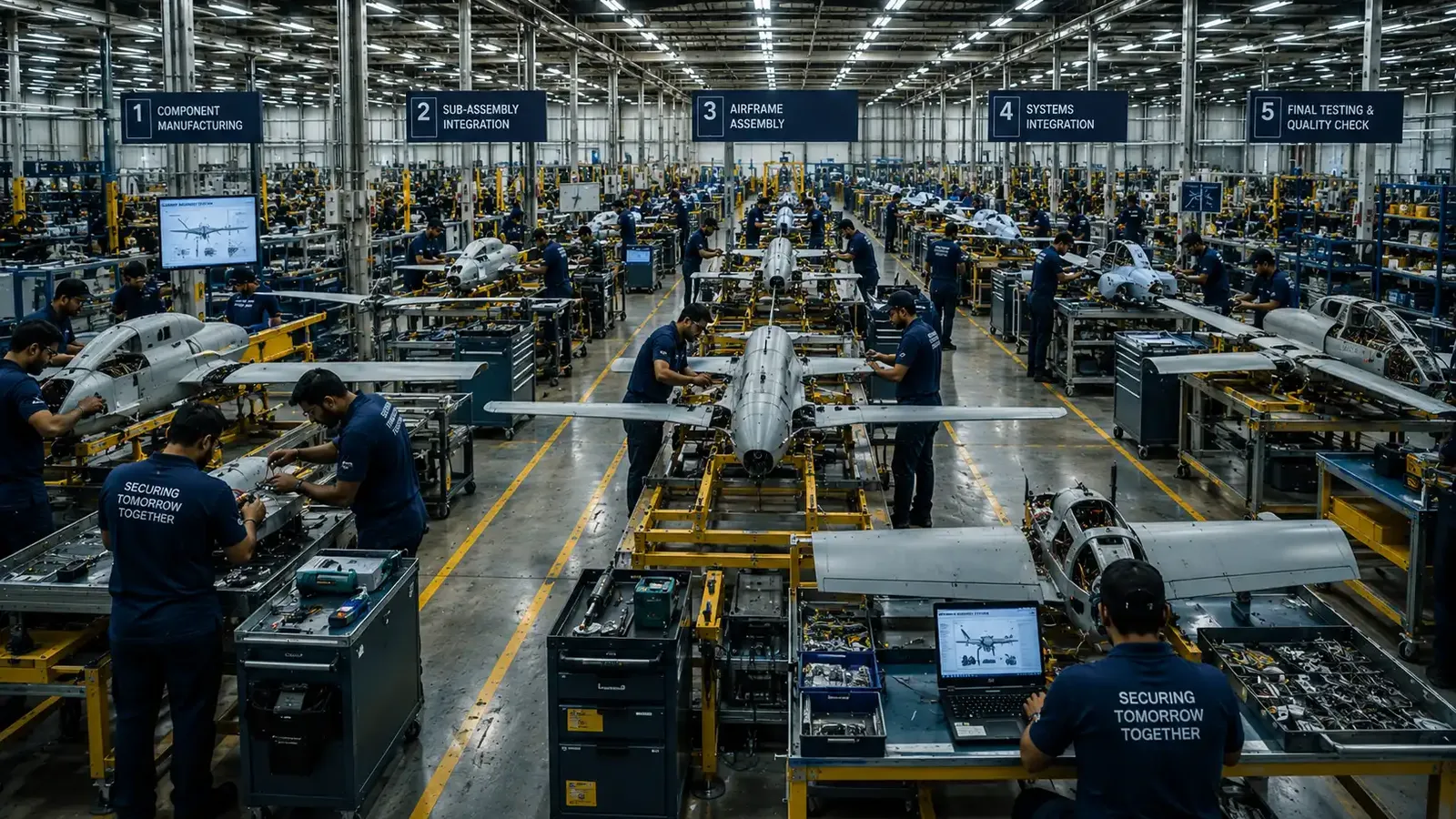
Machine vision now supports automated quality inspection during production. Digital twins allow engineers to simulate aircraft performance before physical testing begins. Predictive maintenance systems improve factory utilisation, and autonomous test benches generate large datasets for propulsion, endurance, vibration, and flight-control optimisation.
The result is an industrial ecosystem rather than a collection of independent drone companies. Manufacturing capability now includes composite fabrication, precision machining, embedded software development, secure communications, battery technology, electronics integration, mission software, and lifecycle support. That broader capability explains why the ecosystem has become a strategic national asset rather than a niche aerospace industry.
Mapping iDEX and ADITI as the innovation funnel
Innovation for Defence Excellence (iDEX) is the principal bridge between Indian innovation and defence procurement. Rather than funding research without defined operational outcomes, iDEX identifies capability gaps, supports prototype development, validates operational performance, and connects successful technologies directly to procurement agencies. That structure reduces the traditional gap between laboratory innovation and military acquisition.
The programme has expanded substantially since its launch. Speaking at the National Defence Industries Conclave on 19 March 2026, Rajnath Singh announced that the iDEX ecosystem now includes 676 start-ups, MSMEs, and technology partners. The programme has signed 548 contracts and cleared 58 prototypes worth approximately ₹3,853 crore for procurement. Of those, 45 procurement contracts have been finalised at around ₹2,326 crore (Press Information Bureau, 19 March 2026).
The 14th Defence India Start-up Challenge (DISC-14) and the fourth edition of Advanced Defence Innovation through iDEX (ADITI) launched at the same conclave. They together carry 107 problem statements for start-ups and MSMEs (Press Information Bureau, 19 March 2026). ADITI targets strategic technologies with greater technical maturity: autonomous systems, advanced propulsion, secure communications, and next-generation sensing.
The funnel differs from traditional defence procurement because it introduces competition earlier in the development cycle. Multiple companies can explore different technical solutions before the armed forces commit to large-scale acquisitions. Performance data gathered during prototype testing informs procurement decisions, reducing technical risk while encouraging engineering innovation.
AI capability now sits alongside airframe engineering as a procurement gate. Defence platforms require onboard computer vision, autonomous navigation, sensor fusion, route optimisation, and edge inference. Software-defined capability evolves on a shorter cycle than hardware, making innovation programmes essential for maintaining technological relevance.
MSMEs and technology companies specialising in individual subsystems matter as much as complete-aircraft manufacturers. Advanced batteries, propulsion systems, navigation software, embedded computing, cybersecurity, communication links, payload integration, and AI software all contribute to national capability. The innovation ecosystem extends well beyond aircraft manufacturers to the broader defence technology supply chain.
The Srijan Deep industry database, launched at NDIC 2026, formalised a searchable directory of defence-sector suppliers, capabilities, and product listings (Press Information Bureau, 19 March 2026). Together with iDEX, it closes the loop between innovation, discovery, and acquisition.
Sitting inside the emergency procurement pivot
Policy reforms and innovation programmes established industrial capability. Emergency procurement accelerated operational adoption. In response to changing battlefield requirements, the Ministry of Defence expanded emergency procurement mechanisms to shorten acquisition timelines for operationally essential technologies.
Traditional defence acquisition programmes can require three to five years from requirement definition to full-scale induction. Emergency procurement provides an alternative pathway for proven systems needed within compressed timelines. The mechanism enables the armed forces to respond quickly to operational requirements while maintaining technical evaluation and financial oversight.
For India's drone defence industry, the procurement shift has significant industrial implications. Manufacturers now have clearer demand signals, allowing them to expand production capacity, supplier networks, and long-term manufacturing infrastructure. Procurement certainty encourages companies to establish dedicated production lines instead of relying on prototype-scale manufacturing.
Emergency procurement complements the iDEX ecosystem. Successful prototypes validated through innovation programmes gain a faster route into operational service when immediate capability requirements emerge. Alongside the Emergency Procurement Tranches, the GeM portal for defence procurement carries standardised drone systems and services into operational units.
The government's broader objective extends beyond acquiring additional drones. Procurement emphasises complete unmanned aircraft systems: aircraft, mission software, secure communications, electronic warfare resilience, logistics, operator training, and maintenance infrastructure. The systems approach generates sustained demand across India's aerospace and electronics supply chain rather than benefiting aircraft manufacturers alone.
The interaction between policy, manufacturing, innovation, and procurement explains why India's drone defence industry has matured into a coordinated ecosystem. Regulation created the foundation, the PLI Scheme strengthened manufacturing, and Drone Shakti expanded demand. iDEX accelerated innovation while Emergency Procurement converted validated capability into operational deployment.
Placing the public-sector spine at the centre
India's drone defence industry depends on a public-sector industrial backbone that connects research, production, electronics, integration, and lifecycle support. Private innovation has expanded fast; even so, the industrial spine still runs through public bodies. The Defence Research and Development Organisation (DRDO), Hindustan Aeronautics Limited (HAL), Bharat Electronics Limited (BEL), and Bharat Dynamics Limited (BDL) underpin large-scale defence drones capability.
Each organisation performs a distinct function. DRDO develops technologies and validates concepts, and HAL transforms mature designs into production platforms and aerospace manufacturing programmes. BEL integrates avionics, communication systems, electronic warfare equipment, and radars; BDL supports weapon integration, production engineering, and lifecycle sustainment. Together, they form the industrial architecture supporting indigenous unmanned aircraft systems.
The public-sector network also enables collaboration with MSMEs, start-ups, and academic institutions. Rather than replacing private innovation, it provides certification expertise, specialised testing infrastructure, manufacturing experience, and long-term programme management that smaller organisations cannot maintain independently.
The contribution of Defence Public Sector Undertakings (DPSUs) extends beyond production. India's defence exports reached ₹38,424 crore during FY 2025-26. DPSUs accounted for approximately 54.84 per cent of the total (Ministry of Defence, 2 April 2026).
The DPSU share climbed from ₹8,389 crore in FY 2024-25 to ₹21,071 crore in FY 2025-26, a 151 per cent year-on-year jump. The shift shows that established production organisations remain the industrial engine even as private participation widens.
The platform spine strengthens technology transfer. Research programmes developed within DRDO laboratories move into industrial production through established manufacturing partners, and specialised suppliers contribute avionics, composites, propulsion, batteries, sensors, and software. The layered ecosystem reduces dependence on isolated development efforts and improves the consistency of defence manufacturing.
Component sovereignty now represents the next stage of industrial development. At the National Defence Industries Conclave, Rajnath Singh named domestic production of engines, batteries, specialised electronics, moulds, embedded software, and precision manufacturing as the next benchmark. Aircraft assembly alone cannot deliver strategic autonomy if high-value subsystems continue to depend on imported supply chains (Press Information Bureau, 19 March 2026).
Charting DRDO's flagship unmanned platform set
India's drone defence industry reflects more than a decade of sustained research across surveillance, target drones, tactical unmanned aircraft systems, high-endurance platforms, and future combat aircraft. DRDO has led much of this work through programmes designed for different operational roles rather than a single universal platform.
The portfolio spans multiple platform categories. Nishant and Rustom-1 covered tactical surveillance in earlier decades. Lakshya and Abhyas support weapons testing as expendable and reusable target drones.
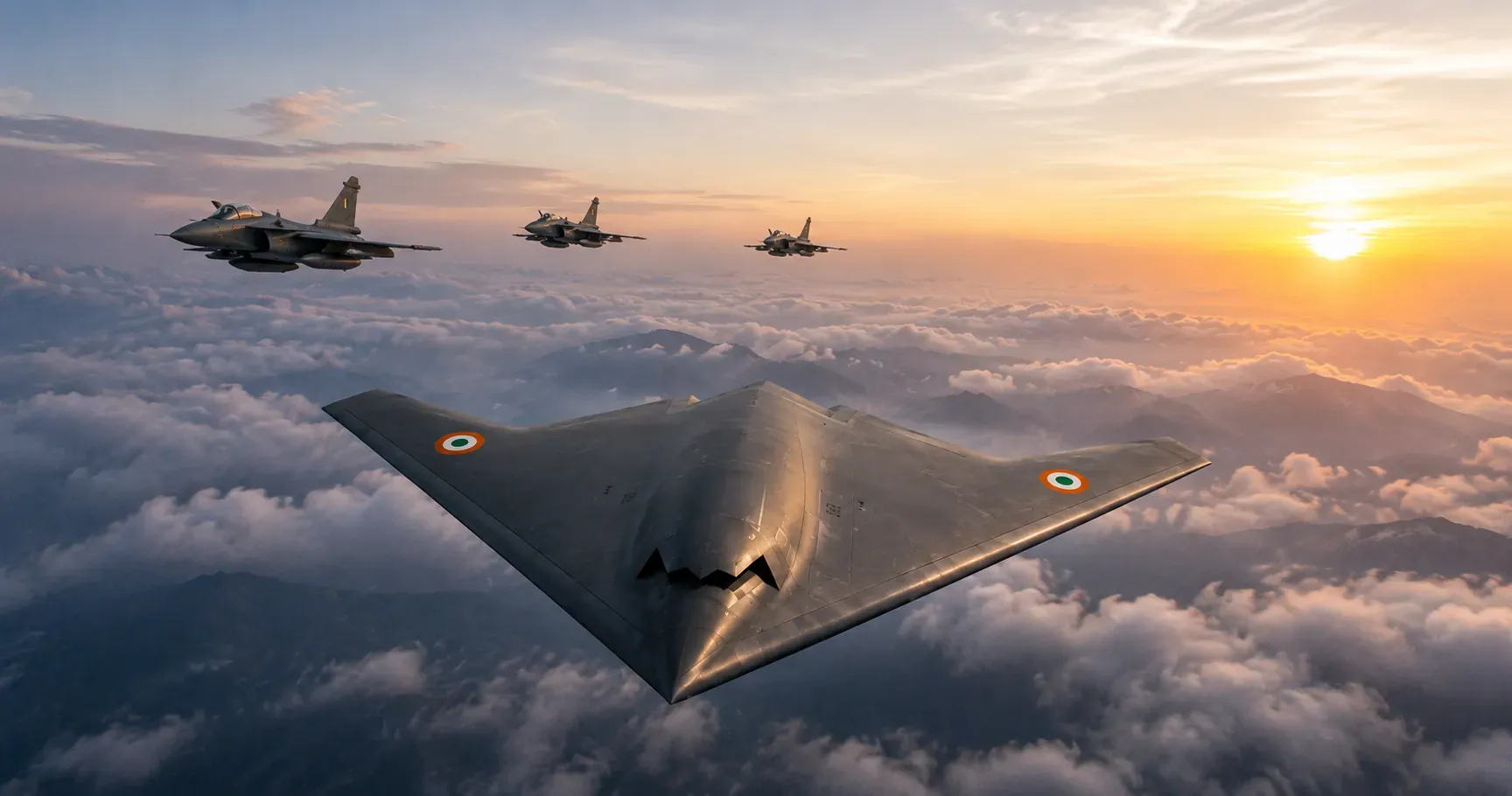
The MALE tier centres on TAPAS-BH-201 (formerly Rustom-II), which supports intelligence, surveillance, and reconnaissance missions requiring extended endurance. Archer-NG carries armed-MALE capability, and the Ghatak unmanned combat aerial vehicle is under development as a stealth strike platform. Each programme contributes knowledge in aerodynamics, flight controls, propulsion integration, autonomous navigation, and systems engineering.
HAL's Combat Air Teaming System extends this progression by exploring collaborative operations between crewed aircraft and unmanned systems. Rather than treating drones as independent platforms, the programme investigates distributed mission execution in which multiple systems share sensing, communications, and operational tasks. That reflects a broader shift toward manned-unmanned teaming supported by mission autonomy and secure data exchange.
Artificial intelligence plays an enabling role throughout these programmes. Computer vision assists target classification, sensor fusion combines multiple payload inputs into a single operational picture, and route-planning algorithms optimise flight paths. Edge inference allows onboard processing when communication links become constrained.
The value of these programmes extends beyond individual aircraft. Every successful research initiative contributes manufacturing techniques, software libraries, certification experience, supply-chain capability, and engineering talent. Industrial maturity accumulates across programmes rather than beginning from scratch with each platform.
For manufacturers, subsystem suppliers, and defence planners, that continuity reduces technical risk while expanding indigenous capability across propulsion, avionics, autonomous software, secure communications, and advanced materials. The accumulated knowledge is one of the least visible but highest-value assets within India's drone defence industry.
Anchoring output to the Bhairav operator force
Industrial capability becomes strategically meaningful only when operational forces absorb it at scale. India's drone defence industry has entered a phase in which manufacturing growth aligns with force expansion, operator training, logistics, maintenance, and doctrinal integration.
The Indian Army has raised the Bhairav Force, a class of drone-enabled light commando battalions built for hybrid, multi-domain operations (Indian Army briefings, January 2026). Roughly 15 Bhairav battalions have already been raised, with plans to expand to about 25. Each battalion carries about 200 to 250 specialised soldiers optimised for speed, reconnaissance, and drone-enabled strike.
Alongside the battalions, the Army has trained a pool of over 100,000 drone operators distributed across formations. Rudra Brigades, another newly established formation, combine infantry, mechanised units, armour, artillery, special forces, drones, and organic logistics into integrated combat groups. The service has also equipped its Artillery, Mechanised Infantry, and Armoured Corps with unmanned and surveillance systems.
The transition changes procurement priorities. Aircraft alone are no longer sufficient. Operational capability depends equally on mission planning software, encrypted communications, operator training, simulation environments, maintenance systems, spare parts, and secure command-and-control networks.
The shift increases demand for domestic manufacturing because lifecycle support extends well beyond initial procurement. Every deployed unmanned aircraft system requires software updates, component replacement, calibration, batteries, maintenance, repair facilities, and continuous operator qualification. Indigenous production shortens support chains and improves availability during sustained operations.
AI-enabled mission planning helps coordinate multiple aircraft, and computer vision improves reconnaissance workflows. Sensor fusion sharpens situational awareness, and automated route optimisation reduces workload during complex missions. Operational integration explains why the industry should be measured by deployed capability rather than production numbers alone.
Positioning defence exports as the outcome indicator
Production capacity, innovation programmes, and procurement pipelines all contribute to industrial development, but defence exports provide the clearest measurable outcome. Export performance shows whether domestic manufacturing has achieved the quality, scale, certification, and international competitiveness required to serve customers beyond India's own armed forces.
India's defence exports reached a record ₹38,424 crore during FY 2025-26 (Ministry of Defence, 2 April 2026). The figure marks a 62.66 per cent jump from ₹23,622 crore in FY 2024-25. Indigenous defence production climbed from ₹46,429 crore in FY 2014-15 to approximately ₹1.78 lakh crore in FY 2025-26 (Press Information Bureau, 17 June 2026).
The number of registered defence exporters grew by 13.3 per cent to 145. Indian defence products now reach buyers in over 80 countries under India's drone export framework and adjacent authorisation pipelines.
The figures matter because they measure industrial capability rather than policy ambition. Export success requires certified manufacturing systems, reliable supply chains, quality assurance, engineering support, documentation, lifecycle maintenance, and regulatory compliance. Buyer nations evaluate industrial reliability as closely as platform performance.
The Government of India has set a defence export target of ₹50,000 crore by FY 2028-29. Total defence production is targeted at ₹3 lakh crore over the same horizon (Press Information Bureau, 24 March 2026). Reaching those targets will depend on expanding indigenous capability across both complete platforms and high-value components.
Drone systems will contribute meaningfully to this trajectory because they combine aerospace engineering, electronics, software, artificial intelligence, advanced manufacturing, and dual-use technologies applicable across multiple industries. Every increase in domestic capability strengthens the wider aerospace manufacturing base. Exports therefore represent more than commercial success; they indicate whether the ecosystem has matured into an internationally competitive industrial base.
Naming the component sovereignty gap that persists
India's drone defence industry has established a strong policy framework, an expanding procurement pipeline, and a more capable manufacturing ecosystem. The next challenge lies deeper within the supply chain.
Component sovereignty has become the defining industrial objective for the coming decade. Airframes can be manufactured domestically. Dependence on imported propulsion, specialised batteries, semiconductors, navigation electronics, sensors, communication modules, precision bearings, composites, and embedded software still exposes manufacturers to supply-chain disruption and geopolitical uncertainty.
Closing the gaps requires investment beyond aircraft assembly. Indigenous engine development, advanced battery chemistry, secure communication hardware, and AI processors matter as much as the airframe. Electronic warfare components and high-precision manufacturing equipment will determine whether India controls the technologies defining a self-reliant drone industry at scale.
The same challenge extends to software. Mission autonomy, computer vision, edge inference, digital engineering, cyber resilience, and autonomous mission management determine operational performance alongside physical aircraft design. Nations that control these software layers also control future capability evolution.
The policy-procurement-platform framework therefore enters its next stage. Policy must encourage component localisation, procurement must reward domestic value addition, and public-sector platforms must continue supporting industrial scale while innovation programmes accelerate subsystem development. Those efforts together will determine whether India moves from assembly leadership to technology leadership.
The benchmark to watch now is whether FY 2026-27 defence exports keep climbing. Domestic production must simultaneously expand into engines, electronics, batteries, embedded software, and other strategic subsystems named as national priorities. That answer will define the next chapter of India's drone defence industry, and how it slots into the wider global capability map.