The Kharga kamikaze drone opens a formation-fabricated tier below every kamikaze platform the Indian Army has fielded. Exercise Kharga Shakti 2026 at Mahajan Field Firing Ranges showed how II Corps has folded indigenous drones into manoeuvre warfare (The Tribune, 16 February 2026). This analysis applies a cost-capability-doctrine framework to place Kharga on the Indian Army's expanding strike ladder. It then traces the Kharga Corps arc from the Rs 30,000 airframe toward the 100 km Kharga Chakra validated in December 2025.
Placing the platform within India's kamikaze drone taxonomy
The Kharga kamikaze drone is an indigenous one-way attack UAV developed inside the Indian Army's Kharga Corps for short-range precision strike missions. Unlike a reconnaissance drone that returns after surveillance, it carries an explosive warhead and destroys itself against the target. Indian Army channels unveiled Kharga on 5 December 2024 as a lightweight strike asset fabricated inside the formation (ADG PI Indian Army, 5 December 2024).
The platform sits inside a wider family of indigenous kamikaze drone programmes across the Indian Armed Forces. The category, sometimes called a suicide drone in India's popular defence coverage, sits functionally between disposable first-person-view strike drones and dedicated loitering munitions. For readers less familiar with the family, kamikaze drones in the Indian context span the whole ladder from disposable tactical UAVs to jet-powered stand-off platforms.
FPV strike drones give platoon commanders very short-range precision engagement, while loitering munitions deliver heavier payloads and longer reach for brigade objectives. Kharga occupies the middle rung, offering company and battalion commanders an indigenous option that fills the operational gap. That placement matters because doctrine written for the two end tiers cannot cover a formation-fabricated Rs 30,000 airframe designed for the mid-rung.
The name itself carries a signal. Kharga is the traditional edged weapon that gives II Corps, the Ambala-based strike formation, its emblem. The corps has folded its symbolic weapon into a formation-built strike UAV that any battalion can employ, tightening the link between symbol and capability.
Tracing the specifications the Indian Army has confirmed
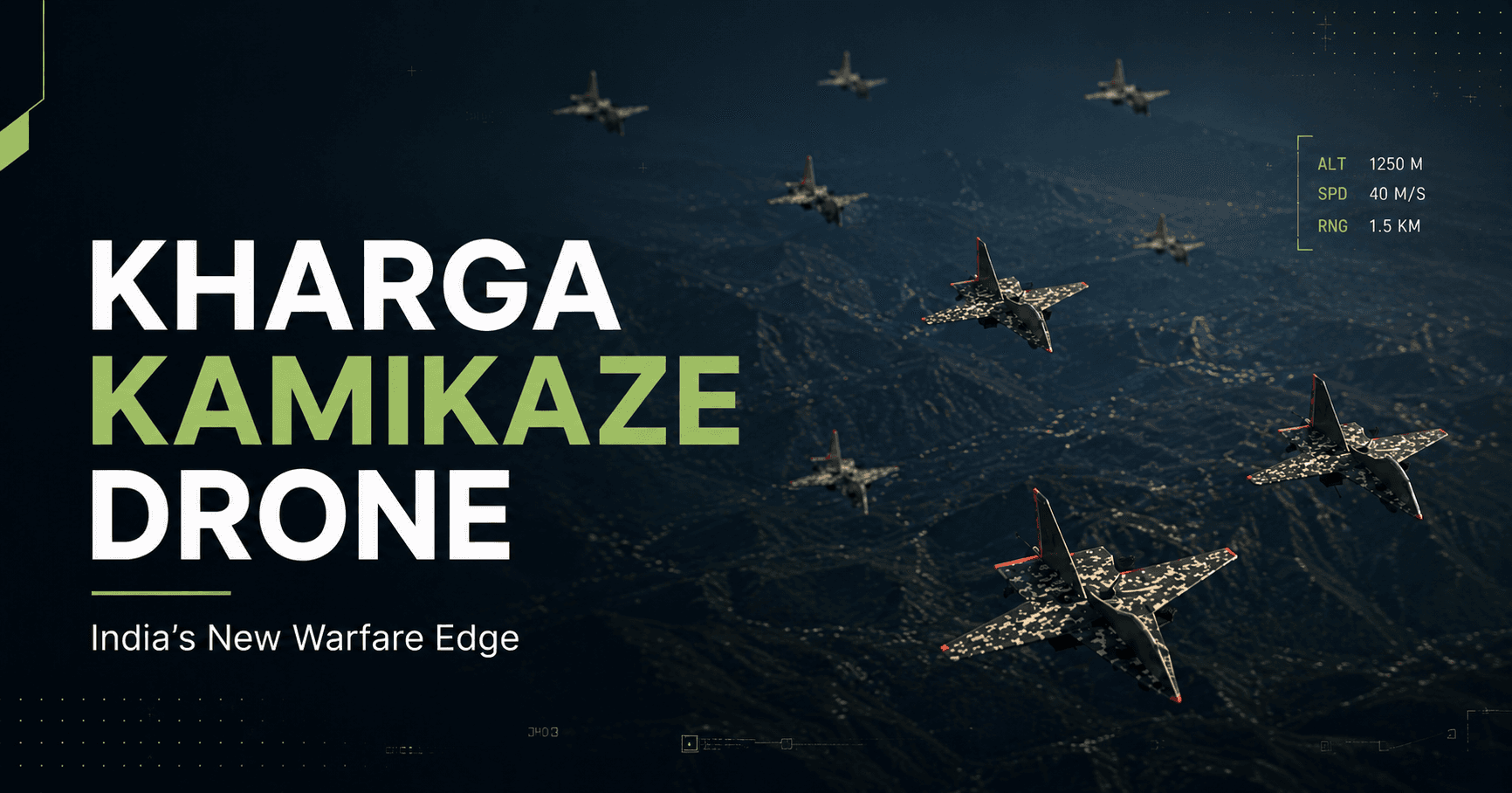
Indian Army public information channels released the Kharga drone specifications on 5 December 2024. The UAV flies at 40 metres per second and carries a 700-gram explosive warhead (ADG PI Indian Army, 5 December 2024). Its operational range is roughly 1.5 kilometres, and each unit costs approximately Rs 30,000.
Navigation runs on Global Positioning System guidance combined with onboard flight-control software. An integrated high-definition camera lets the operator verify target location before terminal engagement. The architecture keeps manufacturing complexity low enough for formation-level production while retaining tactical usefulness.
The short operational range should not be read as a limitation in isolation. Every military UAV is designed around a mission profile, and Kharga's profile is close tactical engagement rather than deep penetration. Longer-range platforms address brigade or corps-level operations across extended distances.
The Kharga drone specifications include resistance against jamming and electronic interference as a stated design objective (ADG PI Indian Army, 5 December 2024). Implementation details remain undisclosed, but counter-electronic warfare posture at the tactical tier leans on navigation redundancy and stable flight-control logic. The Army treated electromagnetic survivability as a design input rather than a bolt-on.
These specifications reveal a purpose, not just a data sheet. Kharga was never scoped to compete with long-range strike systems. Simple engineering, disciplined cost control, and mission-focused design gave the formation an indigenous strike capability cheap enough for routine operational employment.
Understanding how unit engineers built the airframe
The Kharga kamikaze drone shows that military innovation is moving into operational formations. A serving Indian Army officer led the fabrication inside the Ambala-based Kharga Corps, with military engineers supporting the build (ADG PI Indian Army, 5 December 2024). That model shortens the loop between operational need and deployable capability, sitting outside the standard laboratory-to-industry acquisition cycle.
Standard procurement delivers mature platforms after years of design, qualification, and production. Formation-level engineering runs a different clock. Soldiers identify a gap during training, engineers build a prototype, operators evaluate it under field conditions, and the design evolves through repeated testing.
The programme fits a wider pattern. Rising Star Drone Battle School produced over 100 FPV strike airframes by March 2025 with the Terminal Ballistics Research Laboratory in Chandigarh (Deccan Herald, 8 April 2025). The Rising Star FPV drone doctrine grew from the same unit-fabrication instinct that produced Kharga.
The Fleur-De-Lis Brigade, formally the 2nd Independent Armoured Brigade, ran a parallel FPV programme with the same lab. The formation inducted 100 kamikaze FPV drones at roughly Rs 1.4 lakh per unit (Deccan Herald, 8 April 2025). Together, these programmes point at a pattern: the fastest indigenous strike aviation is being built where the operational lessons live.
That pattern is only viable because India's drone manufacturing ecosystem can now supply components at the formation level. Airframes, motors, flight controllers, GPS modules, video links, and warhead casings are being sourced inside India, keeping Kharga's Rs 30,000 build genuinely reproducible.
Reading the cost signal against Nagastra and FPV rungs
The defining feature of the Kharga kamikaze drone is not its 40 metre-per-second speed or its 700-gram payload. It is the Rs 30,000 build cost, which places Kharga at the bottom rung of the Indian Army's expanding cost-capability ladder (IndiaTV, 5 December 2024). Viewed inside the wider strike inventory, that figure is a doctrinal signal.
The kharga drone cost breakdown reads clearly against the platforms sitting above it. Rising Star FPV airframes came in at roughly Rs 1.4 lakh per unit (Deccan Herald, 8 April 2025). Nagastra-1R loitering munitions were contracted near USD 41,000 per unit inside a USD 18.5 million, 450-unit order (Marknteladvisors, 2026). The Peacekeeper (Agniveg) turbojet system was delivered at emergency-procurement scale in June 2026 (Bharat Shakti, 11 June 2026).
Capability tier | Representative platform | Primary mission | Approximate cost | Formation employment |
|---|---|---|---|---|
Tactical expendable strike | Kharga | Short-range precision attack | Rs 30,000 per unit | Company and battalion |
Advanced FPV strike | Formation-built FPV airframes | Precision tactical engagement | Rs 1.4 lakh per unit | Battalion |
Loitering munition | Nagastra-1 family | Stand-off strike | USD ~41,000 per unit | Battalion and brigade |
Deep-strike one-way attack | Peacekeeper (Agniveg) | Long-range operational strike | Emergency-procurement tier | Corps |
Each rung buys a distinct capability. Bigger payloads need stronger airframes; longer range needs efficient propulsion; deeper reach needs sturdier communications and navigation. Understanding the cost asymmetry between drones and missiles helps explain why an indigenous low-cost kamikaze UAV like Kharga sits below every other rung on this ladder.
Kharga does not compete with those tiers. Tactical commanders need precision effects against nearby targets, and a Rs 30,000 airframe lets a formation employ dozens of strikes without touching bigger platforms. That kind of expendability changes what a company or battalion commander can plan for.
This ladder reflects a shift in strike procurement. Armed forces no longer wait for one platform to satisfy every requirement; complementary systems get fielded for specific mission profiles. For the fuller inventory of higher-rung platforms, the Indian Army's loitering munition inventory sits directly above Kharga on the ladder.
Assessing the electronic warfare posture
Electronic warfare is one of the defining pressures on drone operations today. A strike UAV that flies well in clean airspace can fail when satellite navigation, radio links, or telemetry are disrupted. Survivability against electronic attack is no longer reserved for strategic platforms; it is a design input at the tactical tier.
Indian Army statements at the Kharga drone unveiling described countermeasures against jamming and electronic interference (ADG PI Indian Army, 5 December 2024). Technical details remain undisclosed, but the announcement framed electronic resilience as a design objective rather than a bolt-on. For the underlying engineering, jam-resistant drone engineering covers the layered approach tactical UAVs take.
Kharga drone jamming resistance is not immunity. No tactical UAV can guarantee uninterrupted operation against every electronic warfare system. Instead, engineers layer navigation redundancy, stable flight-control logic, and communication resilience to keep the airframe flying when parts of the link degrade.
The Kharga programme's evolution reinforces this reading. In December 2025, the Indian Army validated the Kharga Chakra UAV. Reports placed its operational range near 100 kilometres and its EW resilience above the original Kharga airframe (Indian Masterminds, 20 December 2025). Electronic survivability, in other words, is being matured alongside the airframe, not as a separate line item.
Signature also matters. Small tactical strike UAVs carry compact airframes, lightweight structures, and small propulsion, all of which cut visual and radar signatures below what larger unmanned aircraft show. Kharga drone electronic warfare countermeasures therefore combine physical simplicity with software resilience, aiming for enough survival time to complete a short-range precision strike.
Mapping the doctrinal role between FPV and loitering munition
The Kharga kamikaze drone occupies a distinct doctrinal position because it bridges FPV strike drones and dedicated loitering munitions. The two ends of that spectrum solve different battlefield problems, not overlapping ones. Kharga fills the space between.
An FPV strike drone gives platoon operators very short-range precision engagement under continuous manual control. Those platforms are cheap, agile, and suited to immediate tactical work close to friendly forces. Usable range at that tier stops around a few hundred metres.
A dedicated Indian Army loitering munition solves a different problem. It stays airborne for longer, searches designated areas, and attacks targets across brigade or corps distances with heavier warheads and sturdier navigation. How kamikaze drones differ from FPV drones draws the boundary cleanly for a reader placing Kharga on the map.
Kharga vs nagastra loitering munition is a useful mental map for the mid-rung question. Kharga's 700-gram payload and 1.5-kilometre reach put it above a basic FPV airframe but well below a Nagastra-class platform (ADG PI Indian Army, 5 December 2024). Company and battalion commanders get an indigenous strike option that would otherwise sit unfilled.
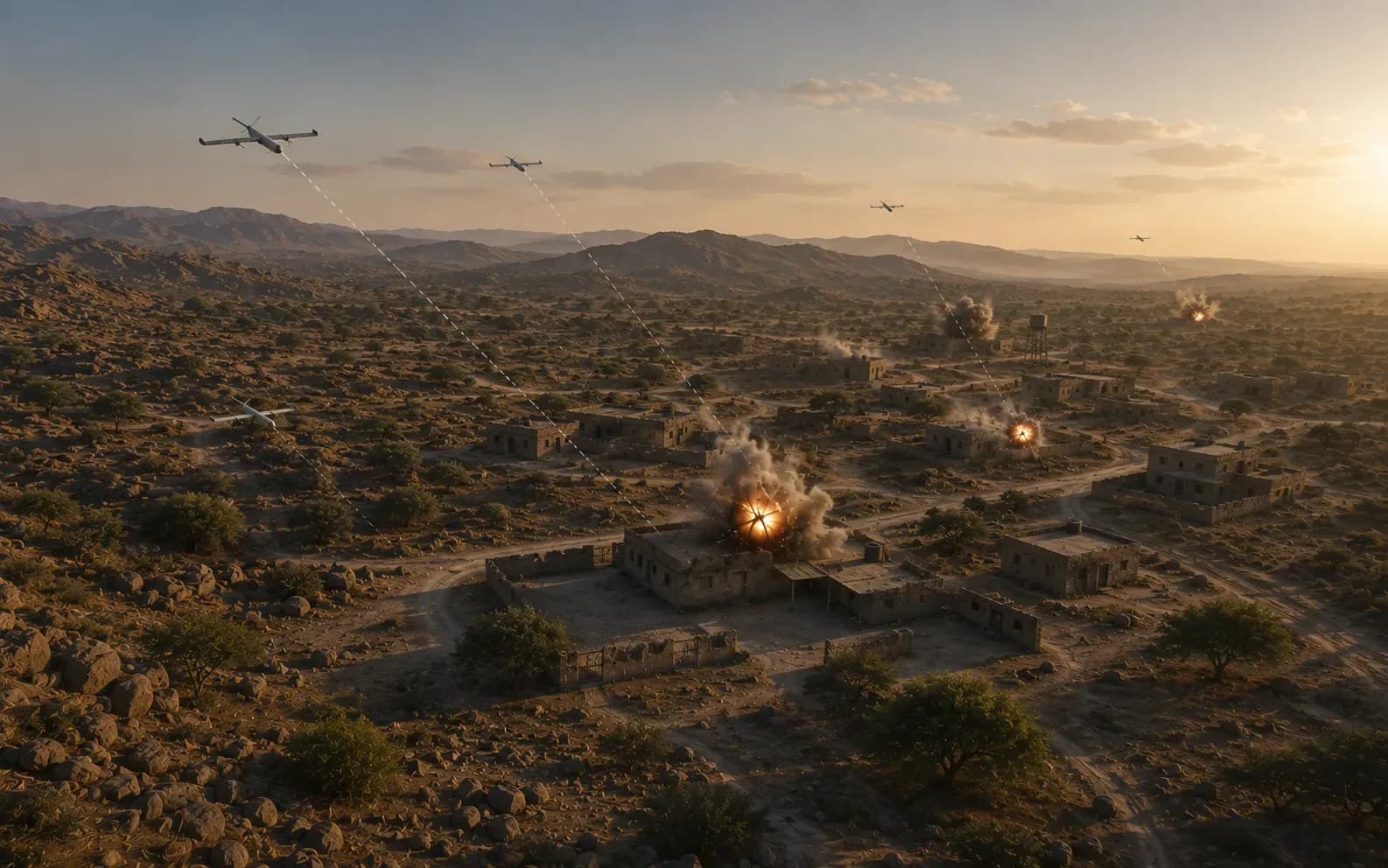
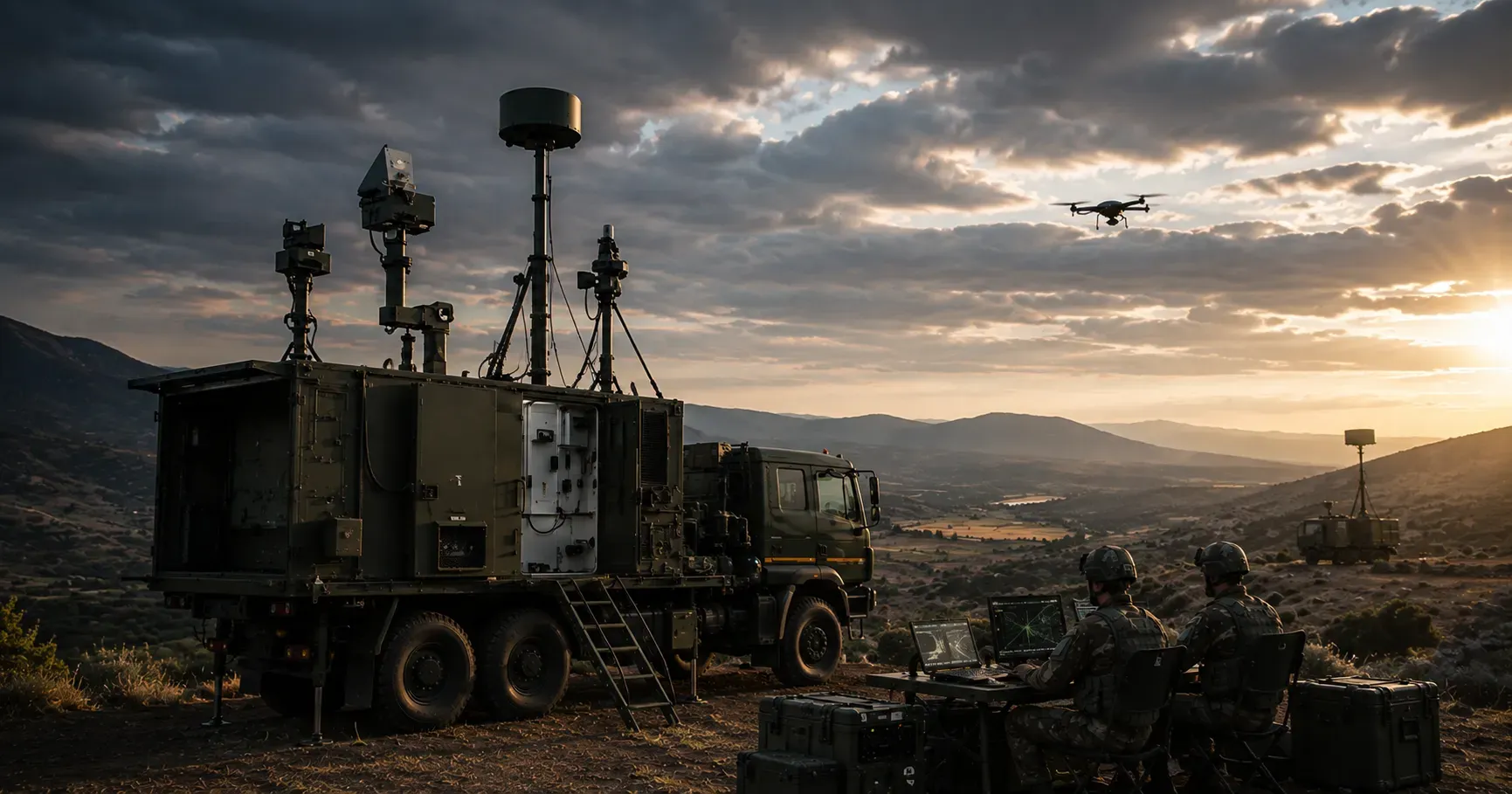
Operation Sindoor and the exercises that followed reinforced the case for graded strike options at every operational level. Kharga Shakti 2026 demonstrated integrated employment of drones, counter-drone systems, precision fires, and manoeuvre elements as one system (The Tribune, 20 February 2026). The record of drone employment during Operation Sindoor sits behind this doctrinal shift.
The doctrinal ladder runs across four layers. FPV drones handle last-mile precision; Kharga handles short-range one-way attack for company and battalion; loitering munitions extend reach across brigade sectors; long-range jet-powered platforms carry corps-level deep strike. Each layer buys something the others cannot supply cheaply.
Watching the Kharga Corps trajectory from Kharga to Kharga Chakra
The Kharga kamikaze drone should be read as the opening move of a broader capability programme, not a standalone platform. Since its unveiling on 5 December 2024, the Ambala-based II Corps under Lt Gen Rajesh Pushkar has folded indigenous drones into every major exercise. Formation-level innovation is now a structured roadmap.
The first milestone came during Exercise Kharga Shakti in November 2024. The two-day exercise pulled artillery, armour, infantry, aviation, loitering munitions, swarm drones, and logistics UAVs into one operational framework (PTI via The Week, 25 November 2024). Lt Gen Manoj Katiyar, GOC-in-C Western Command, reviewed the culmination at Mahajan Field Firing Ranges (The Tribune, 27 November 2024).
Western Command extended that pattern at Exercise Kharga Shakti 2026, held at the same ranges in February 2026. Commanders reviewed drone-centric tactics, integrated firepower, counter-UAS grids, and battlefield surveillance as one system (The Tribune, 16 February 2026). Kharga Corps Ambala drone development had shifted from folding drones into exercises to writing operational doctrine around them.
The next milestone appeared in December 2025 when the Indian Army validated the Kharga Chakra UAV. Reports placed its operational range at approximately 100 kilometres with stronger electronic warfare resilience than the original Kharga airframe (Indian Masterminds, 20 December 2025). The lineage sits alongside broader Army-level force builds like the Bhairav Drone Force induction, which added a dedicated formation for offensive drone employment during the same window.
The trajectory sits inside an Army-wide doctrine shift. General Upendra Dwivedi visited the Kharga Corps in Ambala in 2025 to review the same drone-centric posture (News Arena India, 5 November 2025). The Indian Army high-speed attack drone map now covers formation-fabricated tactical UAVs, standing loitering munitions, and jet-powered deep strike.
Defence drones in India now cover this graded ladder end to end. The open question is where the next rung lands, given the Army's push for long-range one-way attack drones at the top of the ladder (Raksha Anirveda, 14 July 2026).
The next twelve months will show whether Kharga stays alone at the bottom of the ladder or whether a mid-tier platform sits between it and Peacekeeper. Given the Kharga Corps trajectory, the next indigenous strike experiment will land inside a formation, not on a laboratory bench.