On 3 March 2026, the Defence Procurement Board recommended clearance for 60 DRDO Ghatak unmanned combat aerial vehicles at an estimated ₹39,000 crore (Business Standard defence source, 3 March 2026). The proposal now moves to the Defence Acquisition Council. This article uses a lineage, propulsion, and doctrine framework to explain the programme. The framework connects the SWiFT demonstrator, Kaveri Derivative Engine pathway, and manned-unmanned teaming role.
Tracing the AURA to Ghatak development lineage
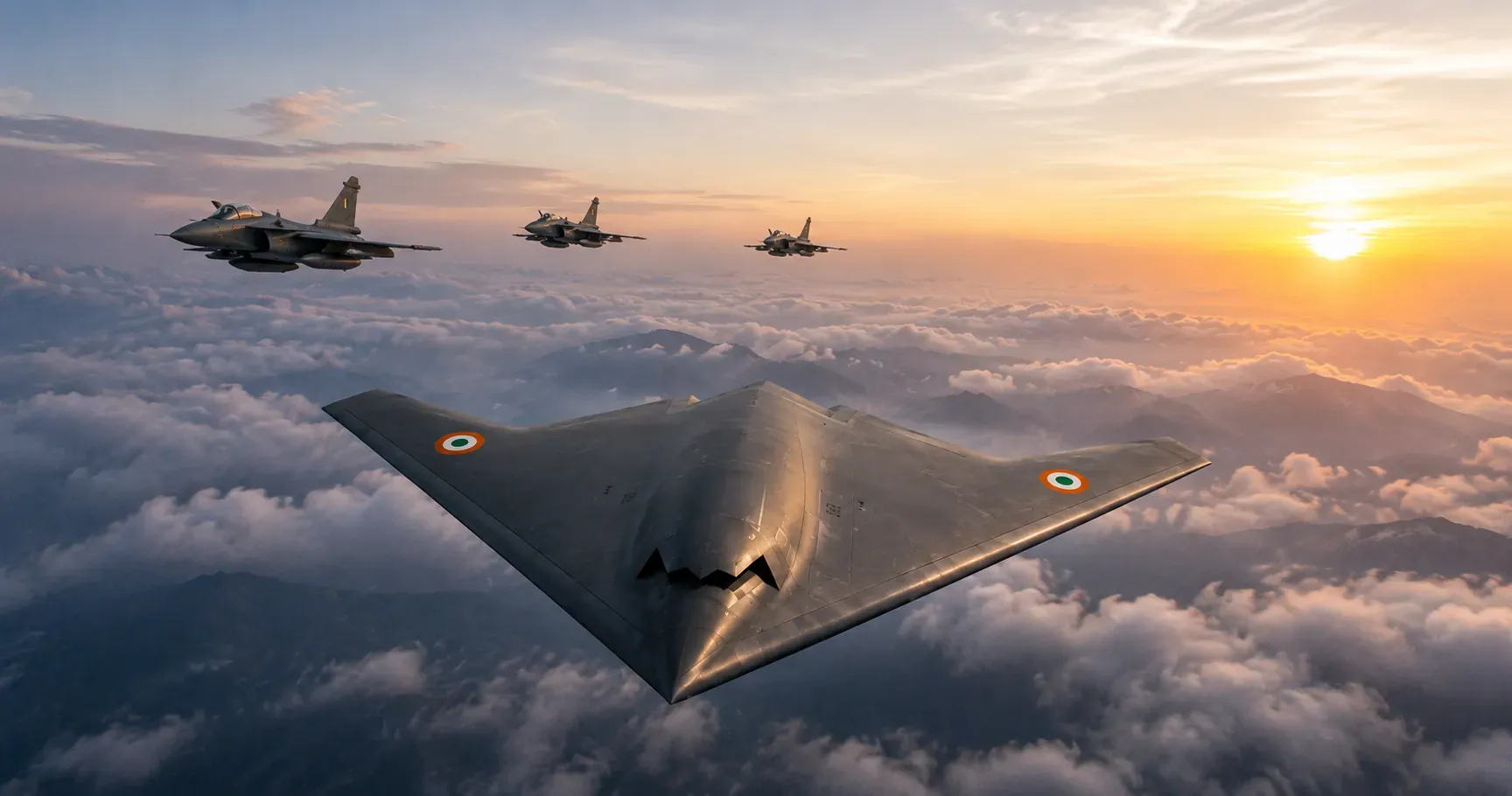
DRDO Ghatak is the planned Indian Air Force stealth UCAV that grew from a longer flying-wing technology programme. The programme lineage includes the Autonomous Unmanned Research Aircraft concept, AURA, followed by the Autonomous Flying Wing Technology Demonstrator and the planned Ghatak combat aircraft.
The AURA work established an early design path for an autonomous flying-wing aircraft. The Aeronautical Development Agency and DRDO pursued the concept before it evolved into technology demonstrators and flight-test articles. Sibling ADE efforts include the TAPAS BH-201 MALE UAV. The programme was earlier designated the Indian Unmanned Strike Air Vehicle (IUSAV); "Ghatak" translates from Sanskrit as "lethal".
This lineage matters because Ghatak is not a standalone aircraft project. The next major step came through the Autonomous Flying Wing Technology Demonstrator. DRDO's Aeronautical Development Establishment designed and developed the aircraft, while the programme used flight testing to mature aerodynamic, control, avionics, and autonomous-flight technologies (PIB, 15 December 2023).
The demonstrator also established a technology bridge between research and an operational UCAV. DRDO described the aircraft as an indigenous high-speed flying-wing UAV and identified the tailless configuration as a significant technology achievement (PIB, 15 December 2023).
This distinction separates the Ghatak UCAV from conventional Indian stealth UCAV development. A conventional aircraft can demonstrate flight without proving the control problems created by a tailless flying wing. Ghatak requires those technologies to work together with propulsion, mission systems, low observability, and autonomous operation.
The programme therefore represents an accumulated technology stack rather than a single airframe design. That stack includes flight controls, composite structures, navigation, avionics, propulsion integration, and mission autonomy. The programme dates below compress the AURA UCAV Ghatak project history into one view:
Year | Programme milestone | Primary source |
|---|---|---|
2009 | AURA autonomous unmanned research aircraft concept commissioned | DRDO institutional record |
2013 | AURA programme completed | ADA institutional record |
2016 | Stealth Wing Flying Testbed (SWiFT) sanctioned as scaled technology demonstrator | DRDO institutional record |
January 2021 | CVRDE delivers indigenous retractable landing gear for SWiFT | DRDO / CVRDE |
1 July 2022 | SWiFT maiden autonomous flight from Chitradurga ATR | PIB, 1 July 2022 |
15 December 2023 | Seventh SWiFT flight in tailless configuration | PIB, 15 December 2023 |
3 March 2026 | DPB recommends 60 Ghatak UCAVs at approximately ₹39,000 crore | Business Standard defence source, 3 March 2026 |
Testing the SWiFT flying-wing technology demonstrator
The SWiFT UAV demonstrator is the flight-test foundation for India's flying-wing UCAV effort. DRDO conducted its maiden flight from the Aeronautical Test Range at Chitradurga on 1 July 2022, with the aircraft operating in fully autonomous mode (PIB, 1 July 2022).
That first flight demonstrated autonomous take-off, waypoint navigation, and touchdown. DRDO also stated that the aircraft used an indigenous airframe, undercarriage, flight-control system, and avionics, with propulsion provided by a small turbofan engine (PIB, 1 July 2022).
The flight campaign then expanded across developmental configurations. By December 2023, DRDO had completed seven flight trials using two internally manufactured prototypes (PIB, 15 December 2023).
The seventh flight demonstrated the autonomous flying wing technology demonstrator in its tailless configuration. DRDO reported that the aircraft used onboard sensor fusion with GPS Aided GEO Augmented Navigation, or GAGAN, receivers to improve navigation accuracy and integrity (PIB, 15 December 2023).
The landing demonstration was also important. DRDO reported autonomous landing without ground radar infrastructure or a pilot, using surveyed runway coordinates and demonstrating resilience relevant to GPS-denied navigation (PIB, 15 December 2023).
The aircraft used a complex arrowhead wing planform and lightweight carbon-prepreg composite material developed domestically. The composite structure also incorporated fibre interrogators for structural health monitoring (PIB, 15 December 2023). The Combat Vehicles Research and Development Establishment (CVRDE) delivered the indigenous retractable landing gear designed to fit the demonstrator's limited internal bay (DRDO, January 2021). Defence Minister Rajnath Singh complimented DRDO, the Armed Forces, and industry for the flight trial and said indigenous defence technologies further strengthen the Armed Forces (PIB, 15 December 2023).
For Ghatak, this flight history establishes more than airframe stability. It gives India a working base for autonomous control of a tailless aircraft. The next challenge is integrating that base into a larger combat aircraft with mission systems and internal weapons carriage.
Engineering low-observability into the airframe
A flying wing UCAV reduces the need for conventional fuselage and tail surfaces, creating a planform suited to low-observability engineering. Ghatak is therefore designed around the relationship between aerodynamic efficiency, radar signature management, propulsion integration, and internal weapon carriage.
DRDO has described Ghatak as an autonomous jet-powered stealth UCAV for the Indian Air Force. The organisation has also identified the flying-wing configuration, turbofan propulsion, and internal weapons bay as elements of the aircraft concept (DRDO, March 2023).
The flying-wing architecture removes conventional vertical and horizontal tail surfaces, placing Ghatak within the same design lineage as leading global military drone programmes. That geometry can reduce exposed scattering features while placing greater demands on flight-control software.
The SWiFT programme addressed part of that problem through autonomous flight-control development, real-time simulation, hardware-in-loop simulation, and avionics integration (PIB, 15 December 2023).
The airframe also needs to accommodate weapons internally. Internal carriage supports the low-observable design objective by keeping external stores away from the airflow and reducing radar-reflective surfaces. Deep-penetration missions also assume a jam-resistant drone architecture able to hold navigation and data links inside contested electromagnetic environments.
The Ghatak stealth drone therefore integrates airframe, autonomy, and weapons into one design. SWiFT testing has demonstrated autonomous flight functions; full combat autonomy for an operational UCAV remains a separate development milestone.
Powering the platform with the Kaveri Derivative Engine
The Kaveri Derivative Engine is the propulsion pathway being developed for India's unmanned combat aircraft programmes. The engine derives from the Kaveri family developed by the Gas Turbine Research Establishment and removes the afterburner for an application centred on unmanned aircraft.
DRDO Chairman Dr Samir V Kamat stated in 2025 that the derivative version was expected to produce about 49 kN of thrust. He also said the engine was undergoing high-altitude testing before flight-test-bed evaluation and certification (DRDO, August 2025).
A DRDO publication reported that the dry Kaveri derivative produced approximately 49 to 51 kN in its cited configuration. The publication identified this Kaveri Derivative Engine thrust class as suitable for UAV applications such as Ghatak (DRDO, December 2024). The three Kaveri variants that frame the propulsion pathway sit side by side below:
Variant | Configuration | Thrust class | Intended platform | Status |
|---|---|---|---|---|
GTX-35VS Kaveri | Afterburning | Approximately 85 kN wet | LCA Tejas (delinked 2008) | Delinked |
Kaveri Derivative Engine (KDE) | Dry, non-afterburning | Approximately 46 to 49 kN dry | Ghatak UCAV | In flight-test-bed evaluation |
Kaveri 2.0 (planned) | Afterburning next-generation | Approximately 95 to 98 kN class | Future combat platforms | Under design |
The Kaveri Derivative Engine's flight-test-bed evaluation on a Russian Il-76 introduces a single-point external dependency during a critical certification window. GTRE's twin-cell test facility at Rajanukunte near Bengaluru is intended to close that gap.
The propulsion pathway is strategically important because engine integration determines more than thrust. The engine affects aircraft mass, thermal management, fuel consumption, intake geometry, exhaust treatment, and mission endurance.
For a stealth UCAV, the intake and exhaust interfaces also matter to low-observability engineering. The propulsion system must fit the airframe without creating unacceptable aerodynamic or thermal signatures.
The Kaveri Derivative Engine therefore has two roles in the Ghatak programme, one of which extends the propulsion lineage that also underwrites the AMCA fifth-generation fighter programme. It provides a domestic propulsion option for an unmanned combat aircraft while advancing India's ability to certify and integrate indigenous gas-turbine technology.
The certification path remains a programme gate. Ghatak's airframe technology can mature through flight testing, but operational induction requires propulsion reliability and flight certification to reach the required standard.
Building the industrial base under the DcPP model
The Ghatak programme is moving from technology demonstration toward an industrial development structure. The proposed Development cum Production Partner, or DcPP, model is intended to connect prototype development with a future production pathway.
The programme's March 2026 procurement signal involved 60 Ghatak UCAVs at an estimated ₹39,000 crore, according to defence reporting attributed to a government defence source (Business Standard defence source, 3 March 2026). The proposal still requires Defence Acquisition Council approval before it becomes an approved acquisition.
The proposed acquisition scale changes the industrial question. A technology demonstrator can rely on limited prototype production, while a combat fleet requires repeatable manufacturing, quality assurance, supply-chain depth, maintenance infrastructure, and configuration control.
ADE anchors the development effort inside the wider defence drones in India landscape. Other DRDO establishments contribute specialised technologies across avionics, propulsion, structures, flight controls, and aircraft systems. The four laboratories carrying the Indian Air Force UCAV programme forward map like this:
Laboratory | Role in the Ghatak programme |
|---|---|
Aeronautical Development Establishment (ADE) | Airframe design, systems integration, flight testing |
Aeronautical Development Agency (ADA) | Design work on the full UCAV configuration |
Gas Turbine Research Establishment (GTRE) | Kaveri Derivative Engine development and certification |
Combat Vehicles Research and Development Establishment (CVRDE) | Indigenous retractable landing gear |
The industrial base will need to support the transition from flight-test prototypes to production aircraft. That includes composite manufacturing, precision structures, propulsion integration, mission computers, and software verification. Under the DcPP structure, private-sector partners will co-develop the six flight-test prototypes required before serial production begins.
The DcPP structure creates a pathway for private-sector participation without transferring the core technology-development role away from DRDO. That distinction matters for India's UCAV ecosystem. The objective is not only to produce one stealth aircraft. It is to create an industrial process capable of manufacturing, maintaining, upgrading, and iterating autonomous combat aircraft.
Positioning the drone as a manned-unmanned teaming asset
Ghatak fits into India's wider shift toward manned-unmanned teaming, where crewed fighters and autonomous aircraft operate as a coordinated force. The Indian Air Force's Vision 2047 roadmap places unmanned systems inside a broader combat-air architecture, with the combat air teaming system forming the closest doctrinal parallel. Chief of the Air Staff Air Chief Marshal AP Singh has confirmed IAF backing for the UCAV programme within that roadmap (Business Standard, November 2025).
The operational value of Ghatak lies in its ability to extend the reach of a crewed aircraft without placing a pilot inside every aircraft. A stealth UCAV can carry sensors, electronic systems, or weapons while a crewed platform remains outside the highest-risk portion of the mission.
This creates a different role from both a conventional surveillance UAV and the Indian loitering munitions programme. Ghatak is intended as a deep strike unmanned combat aerial vehicle, with low observability, autonomous flight, and internal weapons carriage forming its mission architecture (DRDO, March 2023).
Manned-unmanned teaming India changes how mission software is applied. The aircraft needs mission autonomy, route planning, sensor fusion, target classification, and communications management rather than a simple remote-piloting interface.
The human operator remains central to mission authority. Autonomous functions execute approved mission tasks, while command architecture defines what the aircraft may perform without continuous per-step control.
Data links, mission computers, navigation, and autonomous behaviours must operate as one integrated system. Ghatak therefore becomes a test case for a broader combat-air doctrine that treats stealth, propulsion, weapons integration, and human-machine coordination as one platform-level design problem.
Mapping the procurement route toward Air Force induction
The procurement pathway now represents the next major programme gate. The Defence Procurement Board recommended moving the proposal for 60 Ghatak UCAVs, now designated as the Remotely Piloted Strike Aircraft (RPSA), forward in March 2026. Final approval rests with the Defence Acquisition Council (Business Standard defence source, 3 March 2026).
The reported proposal also places Ghatak inside a longer induction timeline. DRDO Chairman Dr Samir V Kamat has been reported as placing the aircraft in the 13-tonne class. He also discussed an estimated seven to eight-year induction period (Business Standard defence source, May 2026).
Those figures should be treated as programme statements rather than completed procurement facts. Ghatak drone procurement still depends on approval, prototype development, flight testing, certification, industrialisation, and acceptance.
The immediate technical milestones are therefore clear. The Kaveri Derivative Engine must progress through flight testing and certification, while the airframe must move from technology-demonstrator evidence toward a full-scale combat aircraft.
The industrial milestone follows those steps. Under the DcPP model, partner selection and prototype production will determine how quickly the programme converts design maturity into repeatable manufacturing.
The strategic milestone is doctrinal. Ghatak's value will depend on how the Indian Air Force integrates autonomous aircraft into strike packages, sensor networks, electronic warfare operations, and manned-unmanned teams.
For operators and defence integrators, the next eighteen months carry three signals worth tracking. These are Defence Acquisition Council clearance, propulsion flight certification, and the industrial partner selection process.
Ghatak has moved beyond the question of whether India can fly a tailless autonomous aircraft. The platform now enters a benchmark class comparable to the HAL Tejas Mk1A in mass and mission profile. That transition demands a certified, producible, and operational combat system.
The next inflection point is the convergence of DAC approval, Kaveri Derivative Engine certification, and the first full-scale Ghatak airframe. That convergence will define whether India's flying-wing UCAV becomes an operational force element.