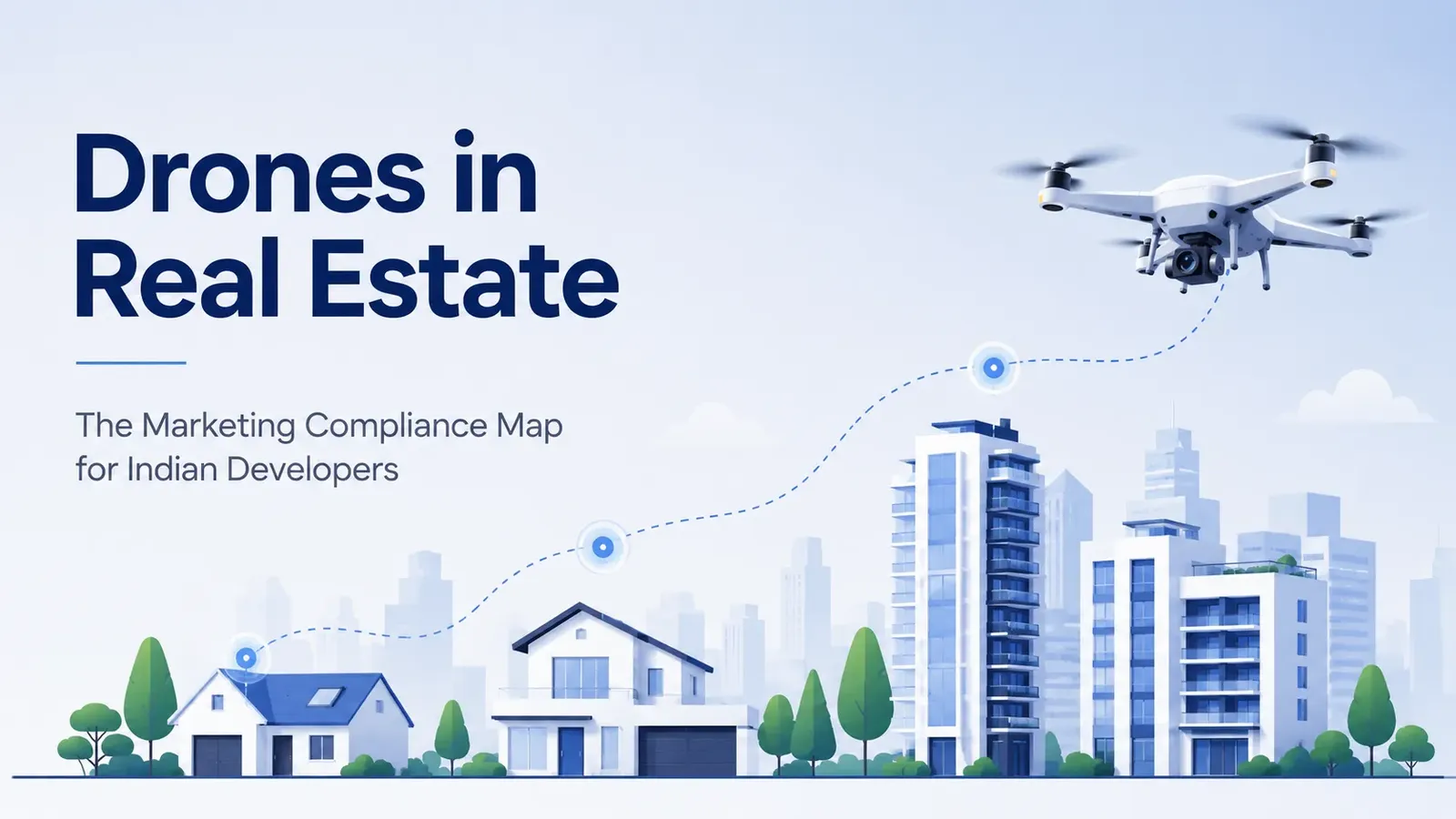
Drones in real estate now sit inside a three-stack compliance environment that links the operator, the mission, and the marketing layer. MeitY notified the Digital Personal Data Protection Rules on 13 November 2025, with full compliance by 13 May 2027. That privacy layer sits on top of the Drone Rules 2021, the RERA Act 2016, and the Bharatiya Vayuyan Adhiniyam 2024. Every developer, broker, and marketing agency now has to clear that stack before publishing aerial footage.
Mainstreaming aerial photography in Indian real estate listings
Drones in real estate now anchor the visual layer of how India's property market reaches consumers. The Indian real estate market crossed USD 532 billion in 2025 and continues to scale across tier-1 and tier-2 cities (IMARC, 2025). Real estate drone photography documents project scale, connectivity, surrounding infrastructure, green spaces, and construction progress in a single asset that static photography cannot match.
The compliance environment caught up with that mainstreaming. The Drone Rules 2021 were notified by the Ministry of Civil Aviation on 25 August 2021 and brought UAS operations under a structured framework (Ministry of Civil Aviation, 25 August 2021). The Bharatiya Vayuyan Adhiniyam 2024 replaced the Aircraft Act 1934 and consolidated India's aviation statute. Drones fall under its definition of aircraft, anchoring the operator base for any property-sector flight.
A third layer landed on the system in late 2025. MeitY notified the Digital Personal Data Protection Rules on 13 November 2025, creating a structured framework for processing identifiable personal data (MeitY, 13 November 2025). Drone footage of housing projects routinely captures neighbouring buildings, vehicles, and identifiable individuals. That makes the DPDP framework directly relevant to aerial photography for property marketing.
Mapping the camera's role across acquisition, planning, and sale
Drone use across real estate workflows splits cleanly into three phases. Acquisition teams use aerial surveys to verify land boundaries, neighbouring features, and approach roads before a deal closes. Planning teams use orthomosaic outputs and contour data to brief architects, civil engineers, and master-planning consultants tracking construction progress across milestones.
Sales teams deploy drones for marketing assets, hoardings, OOH campaigns, social-media reels, and online listing collateral. A single shoot can produce both a 4K cinematic asset for the launch campaign and a vertical-format clip for the Reels and Shorts editorial cycle. Property videography drone work has become a standard line item in real estate marketing budgets. Drone marketing for builders is now treated as a planning function rather than a post-production task.
The cost of drone photography for property in India varies by city, project scale, deliverable format, and zone permission complexity. A standalone luxury villa shoot may close at a few tens of thousands of rupees. A high-rise tower complex in a yellow-zone city can run into multi-lakh budgets across pre-launch, mid-construction, and possession phases. Each shoot loops back to the operator stack and the mission stack before any frame reaches the cutting room.
Setting up the operator base on eGCA, QCI, and insurance
The operator stack is where every property-sector drone programme starts. Aircraft, pilot, type certification, and insurance must all be in place before a single rotor turns over a project site. The eGCA-DigitalSky platform split in July 2025 reorganised where each piece is filed (DGCA Public Notice, July 2025).
Aircraft registration and operator-side workflows moved into eGCA, while airspace management and flight permissions stayed on DigitalSky. Every aircraft above the nano category needs a Unique Identification Number issued through eGCA. Type certification under the QCI Certification Scheme for Unmanned Aircraft Systems confirms airworthiness, build standards, and software conformance before a platform can fly commercially.
The pilot side runs through the Remote Pilot Certificate framework. Training is delivered by DGCA-authorised Remote Pilot Training Organisations, and the certificate is issued through eGCA. Pilot logbooks and currency requirements continue under the same framework throughout the year.
Third-party insurance under the IRDAI master circulars completes the operator stack. The policy must cover bodily injury, third-party property damage, and incidental media liability arising from aerial photography. It is the first document developers review when vetting any operator pitching drone permission for housing project shoots.
Working DigitalSky for yellow zone clearance and NPNT
The mission stack governs every individual flight. India's drone airspace map divides controlled airspace into green, yellow, and red zones. Premium markets sit inside yellow-zone airspace across Mumbai's BKC and Lower Parel, Bengaluru's Whitefield and Sarjapur, and Hyderabad's HITEC City. Pune's Kharadi corridor, Gurugram's Golf Course Road, and the Dwarka Expressway in Delhi-NCR run on the same yellow-zone overlap.
The yellow zone clearance mechanism splits into two rings around an operational aerodrome. The inner ring runs 5 to 8 kilometres from the aerodrome reference point and needs both air traffic control and DGCA approval. The outer ring runs 8 to 12 kilometres and needs ATC coordination and local police intimation. Both rings cap altitude at 60 metres above ground level (DGCA Operational Guidance, 2021 onwards).
Yellow zone permission for real estate shoots closes inside a 24 to 72 hour window once the file is clean. Non-Permission No Takeoff baked into the Drone Rules 2021 means the aircraft itself will refuse to lift unless the permission artefact loads onto its NPNT module. That hardware-software handshake separates a compliant commercial drone shoot from a hobby flight. NPNT also creates a tamper-evident flight log that DGCA inspectors and state police can request post-flight.
Protecting third-party privacy under Rule 38 and the DPDP Act
Rule 38 of the Drone Rules 2021 instructs operators to capture imagery only after ensuring the privacy of third parties (Ministry of Civil Aviation, 25 August 2021). That obligation predates the DPDP Act 2023 but takes structural force from the DPDP Rules 2025 notified on 13 November 2025. Compliance is phased, with full enforcement reaching its final window by 13 May 2027 (MeitY, 13 November 2025).
A typical drone shoot at a residential project sweeps across neighbouring balconies, parked vehicles, identifiable persons, and recognisable architectural detail on adjacent buildings. Once that footage enters editing, approval, and distribution stages, the developer becomes a data fiduciary under the DPDP framework. That fiduciary status applies to any identifiable personal data processed downstream. Drone shoot privacy compliance for neighbouring properties is now a checklist item, not an editorial preference.
The practical privacy checklist runs through three steps before the rotor spins. The operator confirms the flight path will not sweep restricted public-sector facilities, residential balconies in direct line, or any site where consent has not been documented. The footage is then reviewed for incidental personal data capture and processed for blurring before any commercial use. A purpose-limitation note, retention window, and processing log accompany the final asset, so the developer's DPDP fiduciary trail holds up under a Data Protection Board notice.
Aligning marketing footage with RERA Sections 11(2) and 12
RERA compliance is the second leg of the marketing layer. Section 3 of the Real Estate (Regulation and Development) Act 2016 prohibits any advertising of a project before its registration with the state real estate regulatory authority (Real Estate Regulation and Development Act, 2016). Drone footage is advertising material, which means aerial assets cannot run on any platform before the project carries a valid RERA registration number.
Section 11(2) requires every project advertisement to display the RERA registration number issued by the state authority. State circulars have re-emphasised this obligation across the country, including UP RERA's advertising circular dated 24 February 2020 and Haryana RERA's clarification dated 9 March 2021. Marketing teams running drone-led campaigns must overlay the RERA registration number on drone footage at the title-card, end-card, and watermark levels.
Section 12 establishes liability for misleading advertisements that induce a buyer to invest or commit to a project. Aerial perspectives compress distance, soften setbacks, and can create misleading impressions of project amenities, road connectivity, surrounding infrastructure, or completion status. RERA drone compliance therefore extends into the edit suite, the colour-grading session, and the storyboard approval chain. State authorities have imposed compounding fines and ad-pull directions on developers running drone-led campaigns without registration disclosures, signalling that enforcement reaches the marketing chain end-to-end.
Choosing between an in-house team and drone-as-a-service
The in-house drone team vs drone-as-a-service for builders decision turns on shoot frequency, geographic footprint, and the developer's tolerance for compliance overhead. An in-house team makes sense for developers running multiple active projects with recurring content cycles. Registration, RPC, IRDAI insurance, and DigitalSky workflows fold into normal business operations, and the team gains scheduling flexibility across launches and milestone shoots.
A drone-as-a-service model shifts aviation compliance to the provider. The provider holds the UIN, the RPC-certified pilots, the type-certified aircraft, and the third-party insurance under the IRDAI master circulars. The developer pays for the deliverable and avoids the overhead of running a flight department.
Aviation compliance can be outsourced, but advertising and privacy compliance cannot. The developer publishing the footage still carries RERA Section 11(2) and Section 12 exposure. The DPDP fiduciary status applies regardless of who flew the aircraft.
Tracking the Civil Drone Bill's impact on property developers
The Civil Drone Bill 2025 entered public consultation in September 2025 and signals the next inflection point for the property sector. The Bill consolidates UAS regulation into a single statutory instrument. It folds the Drone Rules 2021 framework into primary legislation rather than subordinate rules under the Bharatiya Vayuyan Adhiniyam 2024. The shift from rules to statute hardens enforcement and adds legislative permanence to compliance obligations.
For developers, the Bill matters across three axes. Penalties for non-compliance rise materially under the statute compared with the current rules framework. DPDP Act drone photography enters the same enforcement perimeter, and DPDP Rules 2025 implications for drone marketing footage flow through the same compliance chain. Statutory clarity also tightens enforcement around the Drone Airspace Map, including the yellow-zone permissions that govern premium project sites in Indian metros.
Developers asking how to use drones for real estate marketing in India should treat the operator-mission-marketing stack as a single workflow. Privacy assessments, airspace reviews, permission timelines, and advertising compliance checks belong in the same brief as the storyboard, the colour grade, and the publish schedule. The Indian property sector that builds these processes into its marketing operations before the Bill is enacted will compound a regulatory advantage that survives every refresh cycle.