The D-4 anti-drone system runs on a detect-deter-destroy chain built by four DRDO laboratories and produced by Bharat Electronics Limited. On 16 July 2025, Chief of Defence Staff General Anil Chauhan said Operation Sindoor demonstrated the value of indigenous counter-UAS (Press Information Bureau, 16 July 2025). He called for an integrated counter-UAS grid where the D-4 now sits. This article maps the architecture, the laboratory consortium, the Mark-family ladder, the procurement trail, the SAKSHAM integration, and the export pipeline.
Unpacking the D-4 system architecture and sensor stack
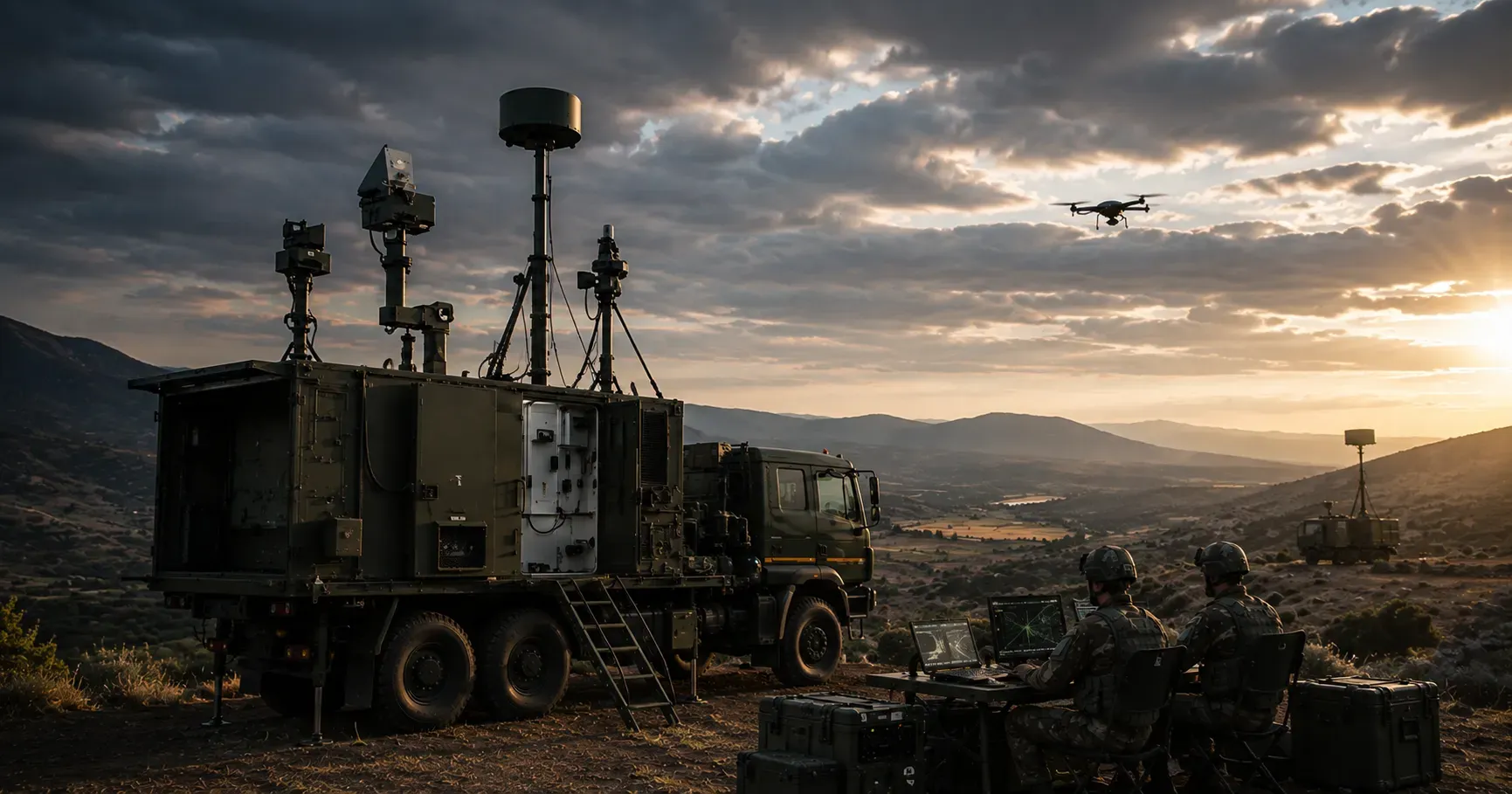
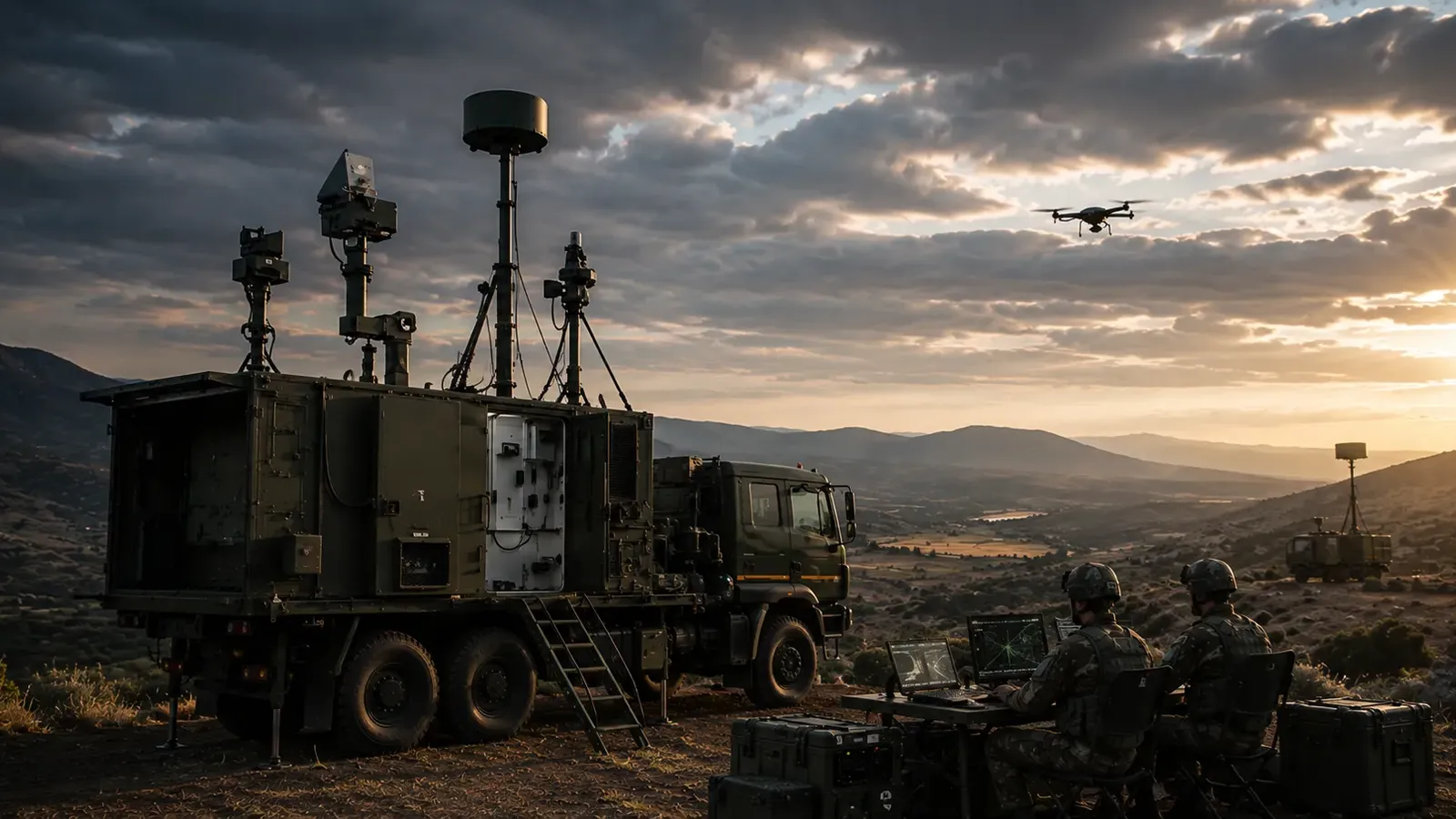
The D-4 anti-drone system is a layered counter-UAS platform built to detect, track, identify, and neutralise small unmanned aircraft before they reach protected airspace. Bharat Electronics Limited describes the platform as a real-time search, detection, tracking, and neutralisation system (Bharat Electronics Limited, accessed June 2026). It combines radar, radio-frequency detection, electro-optical sensors, infrared sensors, and both soft-kill and hard-kill effectors.
The architecture follows the logic of modern integrated air-defence networks. Detection does not rely on a single sensor. Radar identifies low-altitude targets, radio-frequency sensors detect drone-control signals, and electro-optical payloads provide visual confirmation before engagement. The sensor fusion approach reduces false alarms and improves target classification across the threat envelope.
The D-4 anti-drone system features include automatic tracking, operator display through a common graphical interface, thermal imaging support, and multiple engagement options. The platform handles the nano, micro, and small UAV classes defined under the Drone Rules, 2021 (Ministry of Civil Aviation, 25 August 2021). Detection coverage scales with sensor altitude, terrain masking, and atmospheric conditions, with open-source DRDO references placing micro-drone detection at the 3 to 4 kilometre envelope.
Capability | Function | Primary subsystem |
|---|---|---|
Detection | Finds aerial targets | Radar and RF sensors |
Identification | Confirms target type | EO/IR payloads |
Soft kill | Disrupts flight control | RF jamming and spoofing |
Hard kill | Physically neutralises target | Directed-energy system |
Command and control | Coordinates engagement | Integrated operator console |
The result is a counter-drone system India can deploy across military installations, strategic facilities, and high-value events without depending on imported architectures. Command and control runs through an integrated operator console that fuses tracks from each sensor into a single picture, and presents engagement options for soft-kill or hard-kill response.
Mapping the detect, deter, destroy engagement chain
Drone Detect Deter Destroy is more than a slogan. It is the operational framework that shapes how the D-4 engages airborne threats from first contact to final neutralisation. The framework organises every layer of capability inside anti-drone systems in India.
The first stage is detection. Radar and RF sensors scan the airspace and identify potential drone activity. Operators ask how D-4 system detects drones. The answer is a combination of low-RCS radar tracking, radio-frequency signal analysis, and electro-optical confirmation working as one engagement chain (Press Information Bureau, 31 August 2021).
The second stage is deterrence through soft-kill jamming. Once a drone is classified, the system can disrupt command links, navigation signals, or communication channels. Soft-kill techniques are preferred because they neutralise the threat without creating debris or secondary hazards, which makes them suitable around civilian infrastructure and military facilities alike.
The third stage is destruction. When jamming fails or the target remains hostile, directed-energy weapons provide a hard-kill option. With D-4 system soft kill hard kill explained simply: soft kill disrupts the drone's ability to operate, and hard kill physically disables the aircraft.
This layered approach differs from traditional point-defence systems. A missile interceptor destroys the target directly, while the D-4 attempts electronic disruption first and escalates only when required. The sequence lowers engagement costs and conserves defensive resources, a pattern that drives the wider cost asymmetry between drones and missiles.
AI-enabled tracking and target classification now anchor this engagement chain. Computer vision helps classify objects, sensor fusion improves confidence levels, and automated cueing shortens the time between detection and engagement. Human operators remain responsible for engagement decisions, but the system reduces cognitive burden during high-tempo operations against drone-swarm threats.
Tracing the four-laboratory DRDO consortium
The D-4 programme is a four-laboratory collaboration across the Defence Research and Development Organisation. Each laboratory owns a specific layer of the engagement chain, and the structure shapes everything downstream.
The LRDE DLRL CHESS IRDE D-4 relationship explains why the platform matured into a complete system rather than a standalone sensor. The Electronics and Radar Development Establishment (LRDE), Bengaluru, developed the radar layer responsible for target detection and tracking. The Defence Electronics Research Laboratory (DLRL), Hyderabad, developed radio-frequency detection and jamming capabilities (Press Information Bureau, 31 August 2021).
The Centre for High Energy Systems and Sciences (CHESS), Hyderabad, developed the directed-energy element used for hard-kill engagements. The Instruments Research and Development Establishment (IRDE), Dehradun, contributed electro-optical and infrared payloads that provide target identification and tracking support.
DRDO laboratory | Core responsibility |
|---|---|
LRDE | Radar detection and tracking |
DLRL | RF detection and jamming |
CHESS | Directed-energy systems |
IRDE | EO/IR sensing and tracking |
The DRDO anti-drone system grew out of this deliberate four-laboratory split. Detection, identification, jamming, and hard-kill functions evolved together rather than being stitched together after development.
The model also supports technology transfer. DRDO transferred the system to Bharat Electronics Limited and additional industry partners, creating a production pathway that aligns with Aatmanirbhar Bharat objectives across India's defence drone fleet.
Long-term sustainment runs through the same network of laboratories and PSUs. Each subsystem can be upgraded without rebuilding the platform, and that modularity now informs the next-generation programmes in the same family.
Understanding the IDD&IS Mark family power ladder
The Integrated Drone Detection and Interdiction System, or IDD&IS, is a family of counter-UAS platforms rather than a single configuration. The D-4 represents the first operational rung on a broader directed-energy roadmap that climbs into the megawatt class.
The IDD&IS counter-UAS family started with the Mark-1 configuration built around a 2 kW laser system. Later variants expanded power levels and engagement ranges through successive technology upgrades, charted in DRDO programme documents and MP-IDSA analysis (MP-IDSA Commentary, 29 August 2025).
Variant | Power class | Status |
|---|---|---|
Mark-1 | 2 kW | Operational foundation |
Mark-II | 10 kW | Transitioning toward production |
Mark-IIA | 30 kW | Publicly trialled |
Mark-III | 50 kW | Under development |
Surya | 300 kW | Classified programme |
Public-domain reporting places the Mark-IIA at 30 kW after a vehicle-mounted trial conducted at Kurnool in April 2025. The Mark-III at 50 kW remains under development, while the classified Surya programme targets the 300 kW class. Each rung extends engagement range, improves dwell-time efficiency, and tightens the gap between detection and neutralisation.
The IDD&IS Mark 1 Mark 2 difference is not merely laser output. Higher-power variants expand engagement envelopes, improve effectiveness against hardened targets, and reduce dwell time requirements.
Laser hard kill drone systems attract attention because the cost per engagement remains substantially lower than kinetic interceptors. As drone swarms increase in density, directed-energy weapons become more valuable because they engage multiple targets without consuming traditional ammunition.
The Mark family therefore represents a progression from point defence toward broader airspace denial capability. Each step up the ladder increases operational flexibility while preserving the same detect-deter-destroy framework. Upgrades cascade across army, navy, and air force variants without breaking interoperability.
Reading the BEL contract trail from naval induction
The D-4 moved from prototype to operational capability through a structured procurement pathway. The key milestone came on 31 August 2021. The Indian Navy signed a contract with Bharat Electronics Limited for the Naval Anti Drone System (Press Information Bureau, 31 August 2021). It joined a wider line of advanced military drone systems entering Indian service.
The Ministry of Defence described the platform as the first indigenously developed anti-drone system inducted into the Indian Armed Forces. The same release confirmed earlier deployments during Republic Day celebrations and Independence Day security operations, where the system protected sensitive airspace (Press Information Bureau, 31 August 2021).
The BEL counter-UAS programme draws production support from facilities in Bengaluru, Hyderabad, Pune, and Machilipatnam. This distributed manufacturing base supports sustainment, ToT to additional industry partners, and future scaling requirements.
Questions about DRDO BEL anti-drone system price do not have a publicly disclosed answer because contract values are not fully broken down by configuration or customer. Procurement decisions are shaped by sensor packages, effector mix, deployment model, and service-specific operational requirements.
The broader significance lies in indigenous content. Public DRDO statements have placed local content close to 80 per cent, while dozens of Indian suppliers contribute to the production ecosystem. That industrial footprint aligns with Defence Acquisition Procedure objectives and supports adjacent roles such as counter-battery spotting in field formations.
Anchoring D-4 inside the SAKSHAM tactical grid
The SAKSHAM counter-UAS grid transforms the D-4 from a standalone engagement platform into part of a larger operational network. Chief of Defence Staff General Anil Chauhan's July 2025 call for an integrated counter-UAS architecture established the doctrinal direction. The objective was a layered grid combining radars, sensors, jammers, and directed-energy weapons into a unified operational picture (Press Information Bureau, 16 July 2025).
The D-4 system Operation Sindoor performance entered that discussion directly. Indigenous counter-UAS systems demonstrated operational relevance during the conflict period described by the Ministry of Defence (Press Information Bureau, 14 May 2025).
The Indian Army later approved the SAKSHAM Counter-UAS Grid under Fast Track Procurement, with Bharat Electronics Limited positioned as a key implementation partner (The Tribune, September 2025). The grid sits alongside the Akashteer air defence control system and addresses the kamikaze drone threat at lower altitudes.
MP-IDSA analysis described the logic clearly: distributed sensors and effectors become more effective when connected through a common command-and-control architecture (MP-IDSA Commentary, 29 August 2025). The D-4 therefore functions as the engagement edge of a wider defensive grid rather than an isolated system.
AI enters at the operational layer. Multi-sensor networks generate large volumes of data, and AI-assisted target classification, route prediction, sensor prioritisation, and threat correlation help operators manage that information load. The result is a faster engagement cycle and a more coherent air picture across formations.
Sizing export interest and friendly-foreign-force inquiries
The D-4 has already moved beyond Indian service into the friendly-foreign-force showcase circuit. The Ministry of Defence has confirmed the system was demonstrated to friendly foreign forces (Press Information Bureau, 31 August 2021). The platform now sits in India's export catalogue, signalling intent to compete in the global counter-UAS market.
BEL counter-UAS export buyers have started surfacing in open-source reporting. The Democratic Republic of Congo expressed interest in the D-4 family during 2025, and Taiwan reportedly submitted a procurement inquiry shortly after Operation Sindoor. Neither signal has translated into a confirmed contract, but the inquiry pipeline shows where the platform stands in the global counter-UAS market.
The export story matters because it validates the four-laboratory architecture against external scrutiny. Foreign buyers evaluate platforms on engagement performance, modularity, and supportability. A platform that performed during Operation Sindoor and traces its lineage to DRDO laboratories rather than imported subsystems clears the bar sovereign buyers care about.
BEL's production ramp matters here. The Bengaluru, Hyderabad, Pune, and Machilipatnam facilities together support both domestic field formations and any future export order book. The supply-chain footprint also derisks foreign-buyer sustainment, because every critical subsystem can be repaired and upgraded inside India.
The export pipeline therefore sits where indigenous capability, doctrinal demand, and sovereign-buyer interest intersect. Each fresh inquiry reinforces the case for continued scaling across the IDD&IS Mark family. Procurement officers worldwide are watching how India operationalises its counter-UAS portfolio under the Aatmanirbhar Bharat framework.
The next inflection point sits at full-rate production of the SAKSHAM grid and field deployment of the IDD&IS Mark-III class. Procurement officers and air-defence planners should expect counter-UAS spend to consolidate behind BEL-anchored grid-integrated platforms over the next acquisition cycle.