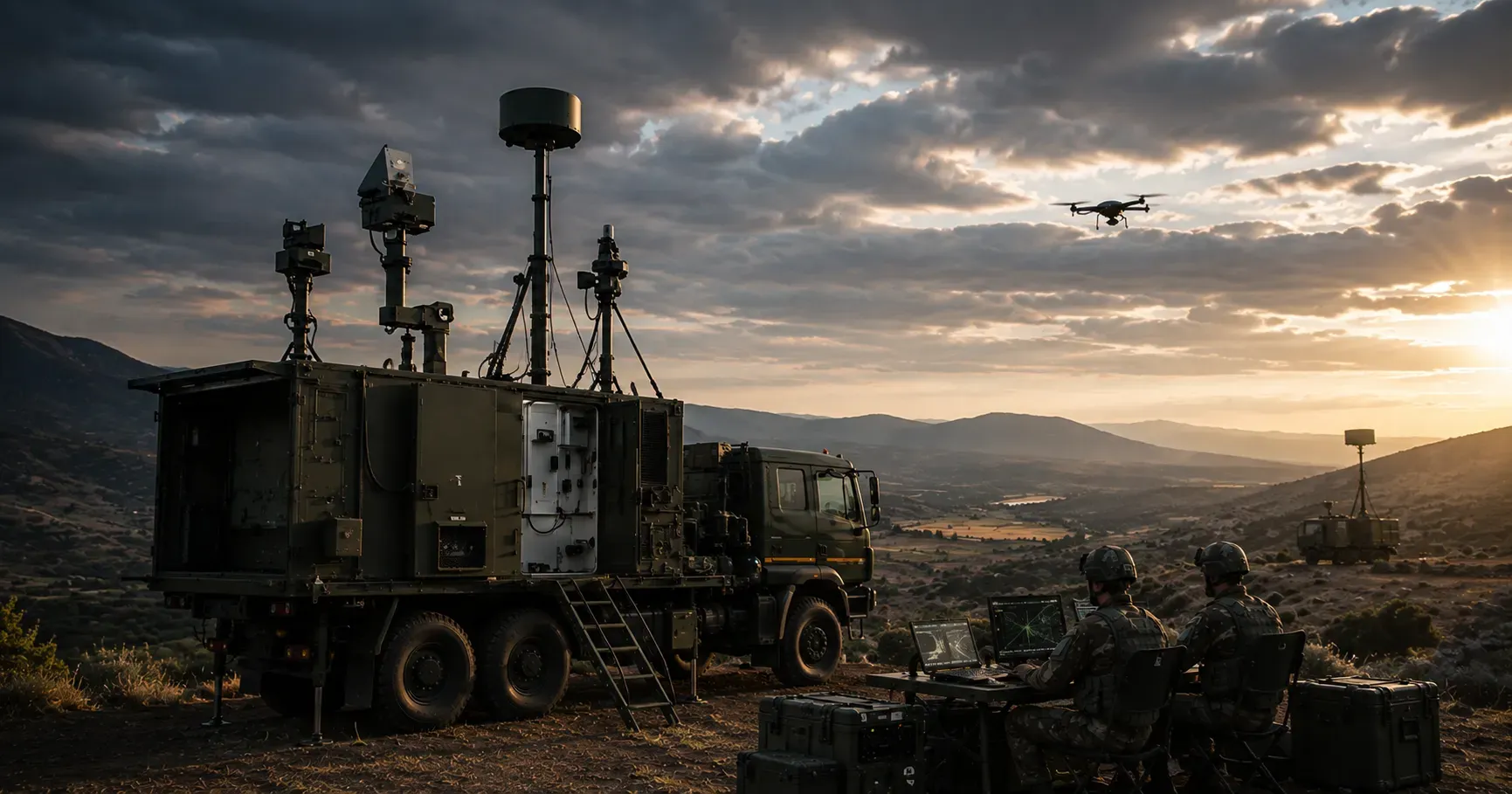
The Bhargavastra counter-drone system is India's first guided micro-missile platform built for the cost curve of modern drone warfare. Its sensor stack identifies swarm threats beyond six kilometres and fires up to 64 munitions in a single salvo. The full stack links to the Akashteer air defence grid and clears the detect-decide-defeat loop in under sixteen seconds. The Indian Army issued Project Sanction Orders in early June 2026, clearing the path to induction by late 2026.
Why the cost curve drives air defence doctrine
India's air defence formations spent the night of 7 to 8 May 2025 absorbing the first non-contact air-attack wave of the post-Drone Rules era. The Integrated Counter-UAS Grid and the Air Defence umbrella neutralised the threat without damage to vital assets (Ministry of Defence, 30 December 2025). The episode reframed Indian counter-UAS doctrine around one arithmetic problem: defeating low-cost drones without firing a million-rupee interceptor at each one.
The Bhargavastra counter-drone system is the first Indian platform purpose-built for that arithmetic. The Indian Army issued Project Sanction Orders for the Bhargavastra Counter-Unmanned Aerial System in early June 2026 (Indian Defence Research Wing, 11 June 2026). The order followed dual interceptor trials of both unguided and guided modes, and the platform now moves from technology demonstrator to induction pipeline. Final evaluations are scheduled to conclude by late 2026.
The cost arithmetic is not abstract. The MP-IDSA primer notes that the May 2025 engagements involved hundreds of hostile drones intercepted by a layered grid (IDSA, 29 August 2025). That grid included the Akashteer Integrated Air Defence Control System and mobile vehicle-mounted counter-UAS platforms.
Using surface-to-air missiles costing crores of rupees against drones costing a few lakh is workable for a single night and unsustainable for a sustained campaign. The drone-versus-missile cost asymmetry is now the operating constraint on Indian air defence design.
Bhargavastra closes the cost mismatch with a 2.5 kg salvo munition fired in groups of up to 64. The Akashteer grid identifies the drone swarm before the salvo launches.
Unpacking Bhargavastra's two-layer rocket and micro-missile interceptor stack
The Bhargavastra kinetic stack is built in two layers, each priced and engineered for a different threat profile. The first layer fires unguided micro-rockets with a 20-metre lethal radius, designed to defeat dense drone swarms at engagement ranges up to 2.5 kilometres (IDSA, 29 August 2025). The second layer fires precision-guided micro-missiles in a hit-to-kill mode against high-value individual targets, including loitering munitions and electronic-warfare drones operating without external command links.
Each munition weighs 2.5 kg and runs on a solid-propellant rocket motor. Guidance on the second-layer interceptor uses an imaging infrared seeker and a charge-coupled-device sensor, supporting lock-on-after-launch homing against manoeuvring targets. The system fires up to 64 munitions in a single salvo from a canisterised launcher mounted on a 7.5-ton 4x4 all-terrain platform. Naval mounts are on the development roadmap.
The two-layer split reflects an operational reality observed in the May 2025 air defence engagements. Hostile drone waves arrived in mixed compositions: dense reconnaissance and decoy swarms alongside fewer high-value loitering munitions carrying explosive payloads (Ministry of Defence, 30 December 2025). A single-layer hard-kill response either wastes precision interceptors on cheap decoys or fails to defeat the high-value attacker. The two-layer Bhargavastra response routes each threat class to its matched interceptor.
The salvo arithmetic is the wedge. A 64-munition salvo against a 30-drone swarm leaves redundant interceptors for re-engagement. The unit cost of each unguided rocket is calibrated for parity with the cost of the drones it defeats. The IDSA primer frames this category of cost-matched kinetic interceptor as the layer that anchors a sustainable counter-UAS doctrine over a long campaign window (IDSA, 29 August 2025).
Mapping the sensor chain and sixteen-second decision loop
Detection precedes engagement. The Bhargavastra sensor stack runs a layered detection chain that identifies aerial threats well before a salvo launches. Radar provides the primary cue at ranges between six and ten kilometres for medium-sized targets, with a working five-kilometre band against low-radar-cross-section drones below 0.01 square metres (IDSA, 29 August 2025). Electro-optical and infrared sensors confirm the identification at shorter ranges, picking up low-RCS targets that the radar cannot lock cleanly.
The decision loop sits inside a Command, Control, Communications, Computers and Intelligence (C4I) layer mounted on the same platform vehicle. Once a threat is classified, the fire-control logic selects the engagement layer: unguided micro-rocket for swarm-density targets, guided micro-missile for evasive high-value targets. The full detect-to-defeat cycle clears in under sixteen seconds from target recognition to interception.
That sixteen-second figure carries doctrinal weight. CDS General Anil Chauhan called for an integrated counter-UAS architecture that closes the engagement loop at machine speed against autonomous drones operating without external communication links (Press Information Bureau, 28 February 2025). A sixteen-second loop is fast enough to engage a fixed-wing loitering munition during its terminal run-in.
The system stays automated rather than autonomous. The platform identifies, classifies and engages on rules of engagement set by the operator. Target authorisation remains with the human commander inside the Akashteer chain.
The architecture leaves room for a soft-kill bolt-on layer. Jamming and spoofing modules can slot in for missions where kinetic engagement is constrained by geography or rules of engagement.
Linking the system to Akashteer's network-centric command backbone
Bhargavastra does not engage in isolation. The system slots into the Akashteer Air Defence Control and Reporting System, the Indian Army's air defence command backbone. Akashteer in turn links into the Indian Air Force's Integrated Air Command and Control System (IACCS). Akashteer assigns targets to the weapon closest to the threat, and Bhargavastra functions as one of the low-cost interceptor classes inside the assignment table.
Akashteer's performance during the May 2025 air defence engagements is documented in Ministry of Defence communications and Bharat Electronics statements. The system tracked hostile aerial activity across six nodes on the western front and assigned engagements to the weapon best matched to each target's altitude, speed and signature (Ministry of Defence, 30 December 2025). Bhargavastra was not yet inducted during those engagements. The platform's June 2026 Project Sanction Order opens its slot inside the Akashteer assignment grid.
The integration logic matters because counter-UAS doctrine is moving away from standalone systems. The MP-IDSA primer notes that effective C-UAS deployment requires sensors, links, electronic warfare and interceptors operating as one cycle under pressure (IDSA, 29 August 2025). A standalone Bhargavastra unit without the Akashteer track picture would either fire blind or wait for a local radar. Integration into Akashteer gives Bhargavastra the corps-level air picture and lets the system fire on the assignment Akashteer pushes down.
The naval variant on the development roadmap will require an equivalent link into the Indian Navy's combat management network. The Corps of Army Air Defence is the user formation for the land variant.
Tracing the trial timeline from Gopalpur to induction
The Bhargavastra trial chain runs through the Seaward Firing Range at Gopalpur in Odisha. The platform was unveiled in 2024 and saw its maiden firing trials on 12 and 13 January 2025.
The first trial engaged a stationary virtual target at a 2.5 kilometre range and 400-metre altitude. The second engaged a moving electronic target. Both engagements cleared their designated launch parameters under controlled conditions.
The first public salvo demonstration ran on 13 May 2025 at the same range. Senior officers from the Corps of Army Air Defence observed the firing. The Bhargavastra developer conducted three trials in the presence of those officers: two single-rocket launches and one salvo of two rockets within two seconds. All four rockets performed to the designated launch parameters.
The truck-mounted full operational system was unveiled in June 2025. The launcher and the C4I cabin sit integrated on a 7.5-ton 4x4 light-truck chassis built for high-mobility deployment. The chassis supports operations from desert plains to high-altitude regions above 5,000 metres above sea level.
The platform's deployment envelope therefore covers desert plains, the forward western front and the high-altitude northern front in one configuration. The coverage map places Bhargavastra alongside India's existing defence drone landscape.
Interceptor trials continued through 2025 and into 2026. Both the unguided micro-rocket and the guided micro-missile cleared interceptor-against-target trials. Those trial results were the direct basis for the Indian Army's Project Sanction Order issued in early June 2026 (Indian Defence Research Wing, 11 June 2026).
The PSO clears the platform for the final trial phase, scheduled to conclude by late 2026. Large-scale orders will follow against an Indian Army user requirement formally communicated through the Acceptance of Necessity chain.
Positioning the platform in India's layered counter-UAS grid
Bhargavastra is one layer of a five-layer Indian counter-UAS architecture taking shape under the post-2025 lessons. The other layers are visible in current induction. The Akashteer Air Defence Control and Reporting System is the command backbone.
The SAKSHAM counter-UAS grid, inducted from October 2025, handles AI-powered detection and tracking. The D4 anti-drone system, jointly developed by DRDO and Bharat Electronics, runs combined soft-kill and hard-kill engagement. DRDO directed-energy weapons add a laser-based hard-kill layer with engagement ranges up to two kilometres.
Each layer addresses a different threat class. SAKSHAM handles low-altitude detection and tracking under 3,000 metres above ground level. D4 covers point-defence with combined radar, RF and laser interception.
Bhargavastra fills the kinetic salvo layer against medium-altitude swarm threats out to 2.5 kilometres. DRDO directed-energy weapons handle precision short-range hard-kill at machine speed, and Akashteer assigns targets across all of them. The full architecture is the subject of Kodainya's counter-drone systems pillar, with anti-drone systems in India covered as the broader category.
The Indian Army validated this layered concept during Exercise Vayu Samanvay in September 2025 at the Naraingarh Field Firing Ranges near Ambala. Formations from Western Command and South-Western Command ran offensive and defensive drone manoeuvres incorporating lessons from the May 2025 engagements (Indian Army, 29 September 2025). The exercise tested how multiple counter-UAS layers cooperate under live tactical conditions, including assignment logic and weapon-target pairing.
Raksha Mantri Rajnath Singh framed the broader policy at the National Defence Industries Conclave 2026 in March (Press Information Bureau, 19 March 2026). He stated that self-reliance in drones and counter-drones must reach the component level rather than the product level alone. Bhargavastra's all-Indian sensor and munition stack fits that policy direction.
The platform's sensor radar, EO/IR module, C4I cabin and propulsion are designed and produced within India. The programme reads as a worked example of building a self-reliant drone industry under the Make in India and Atmanirbhar Bharat policy stack.
What this means for procurement and field integrators
The Project Sanction Order is the procurement gate that converts trial performance into production demand. Once final evaluations conclude by late 2026, the Indian Army will move to scale orders against its formally communicated user requirement. The platform manufacturer will scale serial production in parallel.
The Indian Air Force has signalled interest in the platform for forward airbase protection. The naval variant remains on the development roadmap for shipborne and harbour-defence applications.
Three operational signals are worth tracking over the next twelve months. First, watch for the Acceptance of Necessity value attached to the Bhargavastra programme once the user requirement is booked through the Defence Acquisition Council. AoN tranches in the post-Sindoor window have averaged in the thousands of crores for indigenous platforms (Ministry of Defence, 30 December 2025).
Second, watch for the soft-kill bolt-on layer; jamming and spoofing modules unlock missions where kinetic engagement is constrained. Third, watch for the high-altitude deployment cycle on the northern front, where the platform's above-5,000-metre envelope was a specific design requirement.
For procurement officers and defence integrators, the platform's open architecture means that radar, EO/IR sensor and effector choices can be tuned to mission profile. For policy researchers, the suo moto industrial-funding model that built Bhargavastra without a formal Army Request for Proposal is the procurement-side wedge worth studying.
The cost curve is the brief, and Bhargavastra is the first Indian answer at scale.