The drone arms race is a five-tier industrial architecture that runs on procurement volume rather than platform demonstrations. Three anchors inside seven weeks confirmed the shift.
SIPRI refreshed its Arms Transfers Database on 9 March 2026. The Defence Acquisition Council then cleared 60 Ghatak strike aircraft on 27 March 2026. Six weeks later the Pentagon requested $54.6 billion for autonomous warfare on 21 April 2026. This pillar maps every tier and places India inside the rising indigenous position.
Framing the drone arms race as an industrial map
The drone arms race is best understood as an industrial capability map rather than a competition between individual aircraft. Countries no longer compete by introducing a single advanced drone. They compete by building research ecosystems, propulsion technology, artificial intelligence software, and defence production capacity that sustain military demand over decades.
Three primary-source events inside seven weeks in 2026 anchor the industrial shift. SIPRI updated its Arms Transfers Database on 9 March 2026 (Stockholm International Peace Research Institute, 9 March 2026). The Defence Acquisition Council cleared 60 Ghatak strike aircraft at approximately ₹39,000 crore on 27 March 2026 (Ministry of Defence, 27 March 2026). The Pentagon then requested $54.6 billion for the Defense Autonomous Warfare Group on 21 April 2026 (US Department of Defense, 21 April 2026).
Platform comparisons rarely explain long-term military advantage. A stealth combat drone can dominate headlines for weeks. Its strategic value depends on whether the producing nation can manufacture hundreds of aircraft, replace battlefield losses, and update software across the fleet.
The five-tier drone capability map separates countries according to industrial maturity rather than media visibility.
Tier | Capability | Characteristics | Representative countries |
|---|---|---|---|
Tier 1 | Originators | Long-term investment across the entire drone ecosystem | United States, Israel |
Tier 2 | Industrial-scale producers | Large manufacturing capacity with global exports | China, Turkey |
Tier 3 | Niche exporters | Strong capability in selected mission categories | Iran, Russia |
Tier 4 | Rising indigenous players | Expanding domestic research, procurement and manufacturing | India, South Korea, Brazil |
Tier 5 | Procurers | Depend primarily on imports and licensed production | Majority of drone-operating nations |
Unlike traditional fighter aircraft, unmanned systems benefit from rapid software iteration. Mission-planning algorithms, computer vision, and swarm coordination receive continuous updates without redesigning the airframe. That innovation cycle runs in months rather than decades.
SIPRI drone data shows military UAV exports remain concentrated among a handful of producers (Stockholm International Peace Research Institute, 9 March 2026). Manufacturing ecosystems therefore matter more than isolated programmes. Global drone capability now correlates with propulsion depth, avionics engineering, and sovereign supply chains. Our companion pillar on global military drone platforms compares operational aircraft across tier positions.
Tracing the originators tier and its combat-tested lineage
The originators tier consists of countries that pioneered military unmanned aviation across multiple mission categories. These nations developed reconnaissance drones, armed remotely piloted aircraft, and long-endurance surveillance platforms decades before other countries established domestic drone industries.
The United States remains the largest originator among top drone producing countries. Its capability extends from satellite communications and advanced propulsion to artificial intelligence, secure networking, and autonomous mission software. Rather than focusing on a single aircraft family, the United States built an industrial architecture spanning surveillance drones, strike aircraft, maritime systems, and loyal wingman platforms.
That architecture entered another phase on 21 April 2026. The Pentagon requested $54.6 billion for the Defense Autonomous Warfare Group inside a total $70 billion FY27 drone and counter-drone allocation (US Department of Defense, 21 April 2026).
Anduril Industries, the leading autonomy contractor, secured a $20 billion, ten-year US Army enterprise deal on 13 March 2026 (US Army procurement announcement, 13 March 2026). The company then reached a $61 billion valuation with $2.2 billion in 2025 revenue (Anduril Industries Series H, 13 May 2026). The Arsenal-1 facility in Ohio, at approximately five million square feet, anchors the industrial-scale weapons production the Pentagon expects from the private tier.
Israel represents the second major originator through its operational unmanned aviation history. Israeli research institutions and defence organisations demonstrated how persistent surveillance and battlefield reconnaissance could reshape military operations. Those capabilities then expanded into export markets across three continents.
What separates Tier 1 from every other tier is not technology alone. It is the ability to sustain innovation through government laboratories, universities, semiconductor industries, propulsion manufacturers, and software companies working inside the same ecosystem. Manufacturing an airframe represents only one layer of capability. Developing secure processors, resilient data links, and software-defined mission systems requires industrial investment spanning multiple decades.
Defence procurement agencies now evaluate complete unmanned ecosystems rather than individual aircraft specifications. Industrial resilience, software update cycles, and production scalability influence acquisition decisions alongside endurance and payload.
Mapping the manufacturing-scale producers and the volume leaders
Manufacturing-scale producers transform research capability into export capacity. Their competitive advantage sits in producing drones at volume and maintaining supply pipelines that serve dozens of international customers. This tier shows how industrial efficiency shapes geopolitical influence as much as technological breakthroughs.
China combines electronics manufacturing, battery production, composite materials, precision machining, and high-volume assembly within a single industrial ecosystem. That depth allows Chinese producers to serve domestic military requirements and international export demand at the same time. China drone exports served thirteen buyer countries between 2008 and 2018, with the UAE, Saudi Arabia, and Egypt accounting for the largest tickets (CSIS ChinaPower Project, 2019).
Turkey followed a different path. Instead of competing across every drone category, the country concentrated on operational experience and export-focused manufacturing. The CNAS Drone Proliferation Dataset shows Turkey overtook China as the largest supplier of exported military drones during 2021 (CNAS, 9 September 2024). The Nagorno-Karabakh conflict of 2020 served as the operational proof point that unlocked buyer trust across four continents.
Baykar illustrates the scale that model reached. The Turkish manufacturer recorded $2.2 billion in exports across 37 buyer countries during 2025, with 88 per cent of revenue derived from exports (Baykar / SAHA 2026, 11 May 2026). Its Bayraktar TB2 and Akinci platforms carry the volume, while the jet-powered Kizilelma unmanned combat aircraft entered Turkish Air Force induction in 2026. Turkey drone exports and China drone exports now anchor the second tier of the global map.
SIPRI confirms the concentration. The United States, Israel, China, and Turkey collectively hold over 90 per cent of the global military UAV export market (Stockholm International Peace Research Institute, 9 March 2026). Four suppliers therefore shape the pricing, policy, and doctrine of every buyer country.
The Missile Technology Control Regime shaped this concentration for two decades. US self-imposed adherence limited armed-drone exports beyond NATO members, opening space for China and Turkey to enter with fewer restrictions (CNAS, 9 September 2024). India joined the MTCR in 2016. That accession unlocks future export pathways for domestic manufacturers.
Manufacturing-scale leadership rests on five reinforcing foundations. Production capacity determines whether manufacturers can fulfil large procurement contracts without disrupting domestic military requirements. Secure supply chains reduce dependence on imported electronics and propulsion.
Software engineering carries continuous improvements through mission-planning updates and electronic-warfare adaptation. Operator training and maintenance infrastructure allow exported platforms to remain operational throughout their service lives. Government policy provides export financing, industrial incentives, and long-term procurement commitments that push manufacturers to expand facilities.
Charting the niche exporter model and conflict-driven specialisation
The niche exporter tier consists of countries that dominate specific categories of unmanned systems rather than the entire drone ecosystem. These nations may not possess the industrial depth of Tier 1 or the manufacturing scale of Tier 2. They have built operational expertise around selected mission profiles that shape drone proliferation across regional conflicts.
Loitering munitions, tactical reconnaissance platforms, and one-way attack systems form the core of this segment. These platforms have shown that affordability and rapid production can shape battlefield outcomes alongside advanced technology.
The CNAS Drone Proliferation Dataset shows how drone exports have diversified beyond traditional aerospace powers. While four suppliers dominate the global military UAV market, specialised exporters expand their influence by supplying mission-specific platforms tailored for surveillance and precision strike (CNAS, 9 September 2024).
Iran represents the clearest example of this model. Its Shahed loitering munition family shows how a country can become internationally recognised within one operational category. That happens without possessing the complete industrial architecture of Tier 1 or Tier 2. The emphasis remains on scalable production of expendable strike systems.
Russia occupies a similar position for different reasons. Its unmanned systems portfolio evolved around military requirements rather than export-led manufacturing. Although the country possesses significant aerospace capability, sanctions and supply-chain disruption limit its position within the global drone export market.
What distinguishes Tier 3 is operational specialisation rather than industrial diversity. Manufacturers optimise one family of aircraft, one production model, or one tactical role instead of chasing the entire unmanned spectrum. Defence ministries worldwide now recognise that every mission does not require an expensive high-end platform.
Placing India inside the rising indigenous tier
India occupies the rising indigenous tier because its drone ecosystem is transitioning from technology development towards sustained industrial production. The country still imports selected high-end capabilities. The centre of gravity has shifted decisively towards indigenous design, domestic manufacturing, defence procurement, and sovereign technology development.
This transition became visible during March 2026. On 27 March 2026 the DAC approved procurement of 60 Ghatak strike aircraft valued at approximately ₹39,000 crore (Ministry of Defence, 27 March 2026). The DAC clearance Ghatak decision signals that indigenous unmanned combat systems have entered India's long-term defence procurement roadmap. The Defence Procurement Board recommendations released on 3 March 2026 strengthened that direction (Ministry of Defence, 3 March 2026).
Scale followed almost immediately. The Ministry of Defence earmarked ₹1.39 lakh crore, approximately $16.7 billion, for procurement from domestic industries on 1 February 2026 (Ministry of Defence, 1 February 2026). The framework covers 411 positive-indigenisation-list products across the Atmanirbhar Bharat mandate.
By March 2026 the Indian armed forces managed over 140 UAV platforms across nine categories, up from fewer than twelve in 2020 (Indian Army doctrinal note, March 2026). The India drone programme therefore expanded eleven-fold across six years.
India's capability map differs from both Tier 1 and Tier 2 countries. The objective is not immediate export dominance. The priority is building sovereign capability across the complete unmanned technology stack. That stack spans propulsion, flight-control computers, composite structures, secure communication links, and payload integration.
The October 2024 contract for 31 MQ-9B Sky and Sea Guardian HALE aircraft remains part of this strategy (Ministry of Defence, 15 October 2024). MQ-9B Sea Guardian India acquisitions strengthen operational capability while indigenous programmes mature across medium-altitude and combat categories.
Imported platforms address immediate operational requirements. Indigenous programmes establish industrial capacity that remains under national control for decades. India's defence drone landscape examines how these military UAV programmes fit inside the modernisation effort.
Anchoring the DRDO programme quartet across the altitude ladder
India's indigenous capability rests upon four complementary programme families rather than one flagship aircraft. Together they cover surveillance, stealth combat, collaborative operations, and loitering strike missions across multiple altitude bands. This portfolio explains why India is progressing towards Tier 3 capability rather than isolated technology demonstrations.
The first pillar is TAPAS BH-201, developed by the Aeronautical Development Establishment under the Defence Research and Development Organisation. TAPAS evolved from the earlier Rustom programme into a Medium Altitude Long Endurance platform designed for persistent intelligence, surveillance, and reconnaissance missions. The Ministry of Defence extended the follow-on procurement process into late May 2026 (DRDO, 22 May 2026). Full TAPAS BH-201 lineage coverage sits inside the sibling deep-dive.
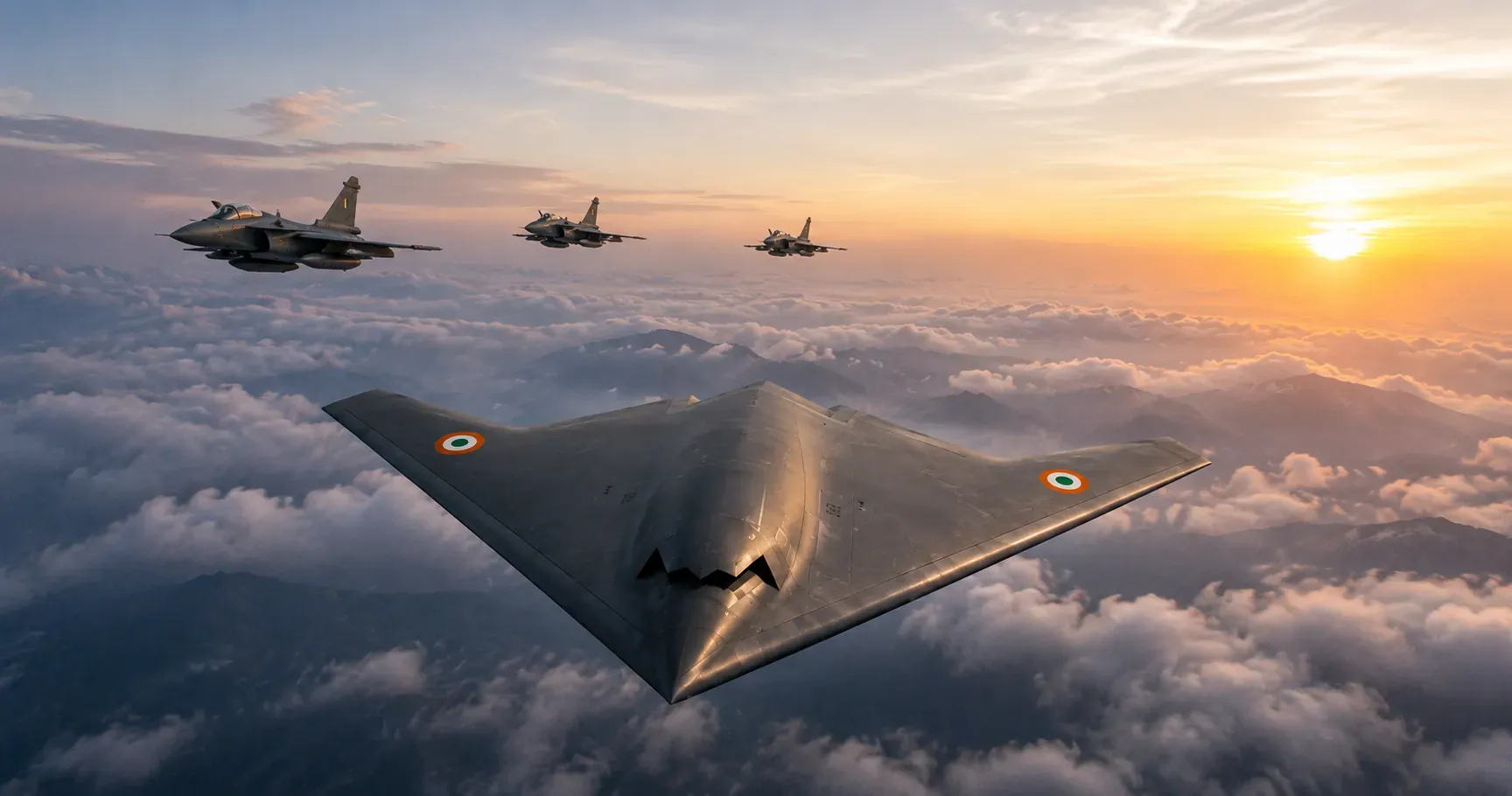
The second pillar is the Ghatak unmanned combat aerial vehicle programme. Its technological foundation originated from the Stealth Wing Flying Testbed, which validated India's flying-wing configuration during flight trials on 1 July 2022 (DRDO, 1 July 2022). The DAC approval demonstrates that stealth combat aircraft are moving from research into structured procurement. The India indigenous drone programme now spans jet-powered UCAVs on the same doctrinal timeline as the US Collaborative Combat Aircraft effort.
The third pillar is the Combat Air Teaming System. Unlike traditional unmanned aircraft, this programme explores collaborative operations between crewed aircraft and autonomous unmanned platforms. Mission autonomy, distributed sensing, cooperative electronic warfare, and networked targeting define the operational philosophy of this family. The Combat Air Teaming System family carries the full mission architecture.
The fourth pillar comprises the Kharga loitering munition family. These systems expand India's indigenous strike capability by providing expendable precision engagement options that complement larger surveillance and combat platforms. Loitering munitions give commanders additional operational flexibility across tactical missions. The Kharga kamikaze family lays out the doctrinal fit.
Together, these four programmes establish a layered indigenous architecture.
Programme | Primary mission | Lead organisation | Capability focus |
|---|---|---|---|
TAPAS BH-201 | Medium-altitude surveillance | DRDO, ADE | Persistent ISR |
Ghatak UCAV | Stealth combat operations | DRDO | Low-observable strike capability |
Combat Air Teaming System | Collaborative air operations | DRDO | Human-machine teaming |
Kharga | Loitering munition | DRDO | Precision tactical strike |
These programmes share common enabling technologies. Secure communications, autonomous navigation, sensor fusion, edge computing, flight-control software, and advanced composite manufacturing contribute across multiple aircraft families. Developing these shared technologies reduces long-term development costs. For altitude-band detail, readers can also study the DRDO altitude ladder from MALE to HAPS.
Building the Indian production base through PLI and DPP routes
Industrial capability cannot exist without production capacity. Research organisations develop technology. Factories, suppliers, certification agencies, and manufacturing ecosystems convert prototypes into operational capability. This is where India's Production Linked Incentive scheme and Defence Procurement Procedure become strategically important.
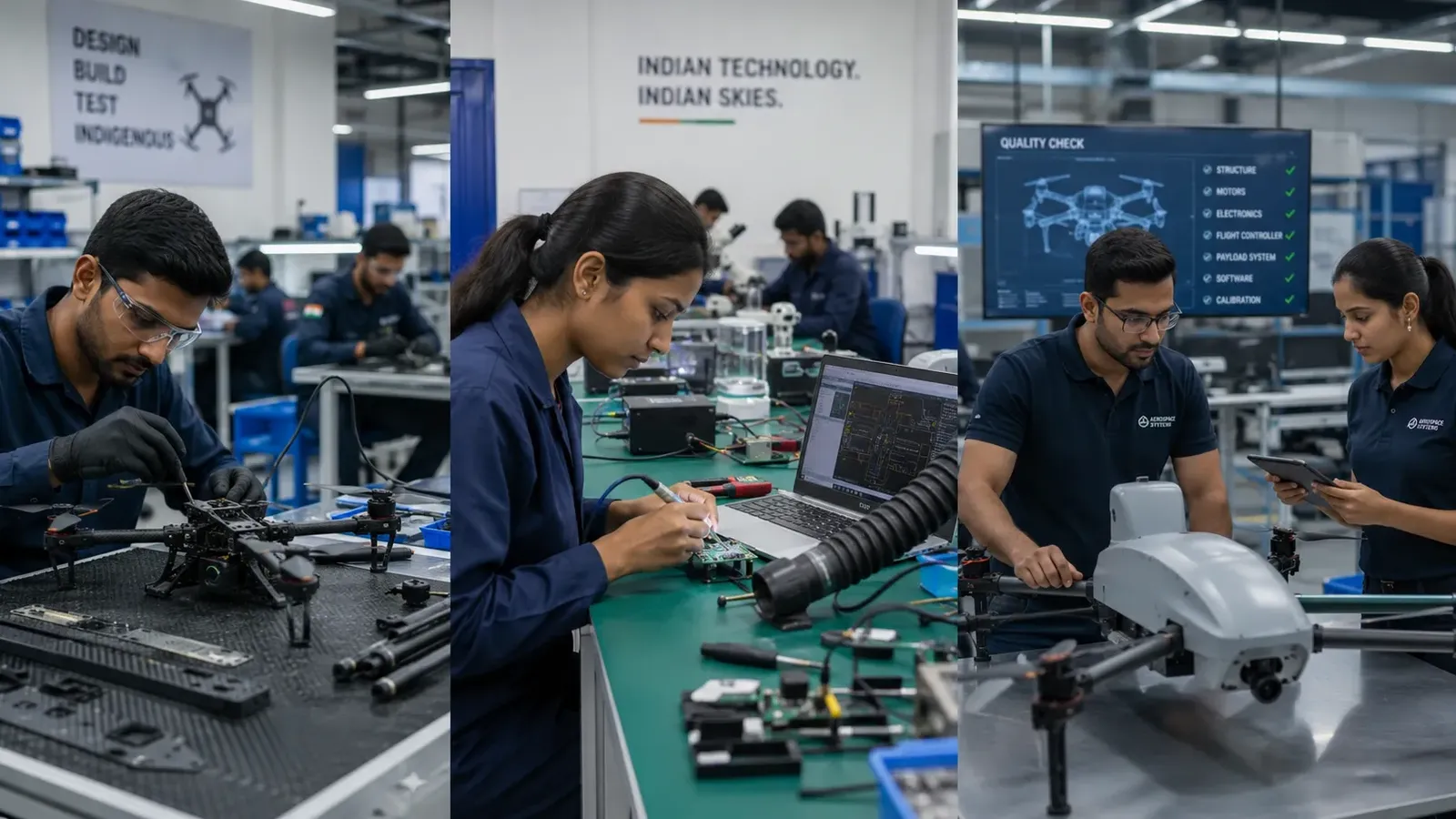
The Ministry of Defence treats unmanned systems as an industrial sector rather than a collection of isolated procurement projects. Domestic manufacturing reduces external supply dependence while expanding national capability across propulsion, avionics, composites, batteries, electronics, software, and systems integration. The PLI scheme for drones encourages investment across the production chain rather than concentrating on final aircraft assembly. Manufacturers receive incentives to establish indigenous capacity in high-value components that historically depended upon imports.
The Defence Procurement Procedure complements this objective by encouraging indigenous development under structured acquisition pathways such as Make-I and Make-II. These frameworks reduce procurement risk for domestic developers while providing predictable demand through government acquisition programmes.
The iDEX platform accelerates the ecosystem below the DPSU tier. As of early 2026, iDEX had run 500 problem statements, signed 400 contracts, and enrolled 676 startups and MSMEs into the defence-innovation ecosystem (Ministry of Defence iDEX challenge log, 14 January 2026). The ADITI 2.0 scheme extends grants up to ₹25 crore for deep-tech critical technologies. This funnel supplies component and subsystem innovation the aircraft-integrator tier depends upon.
The interaction between PLI, DPP, and iDEX creates an industrial flywheel. Government procurement generates demand, domestic production expands manufacturing capability, supply chains mature, and engineering talent accumulates. Component localisation improves in step, and export opportunities become commercially viable over time.
Indigenous component manufacturers now anchor the layer below aircraft assembly. NWESTA, a Made-in-India precision-propeller manufacturer, engineers carbon-fibre and composite blades at ISO 1940 G2.5 balance grade for defence, agri, FPV, and surveying UAV platforms. That component-tier depth is what a sovereign drone industry requires. Every domestically manufactured propeller, motor, ESC, and sensor reduces external dependence at the sub-system layer.
Digital manufacturing, predictive quality control, and model-based engineering shorten production cycles while improving reliability. Autonomous software developed for military aircraft also creates opportunities across civil aerospace, robotics, and logistics. India's drone manufacturing ecosystem covers the production-base geography.
Costing the asymmetry between attritable drones and legacy air power
The economics of the drone arms race are reshaping military procurement as much as advances in propulsion or artificial intelligence. Armed forces no longer evaluate platforms solely by speed, payload, or endurance. Procurement planners now compare operational effect against acquisition cost, replacement cost, and battlefield survivability.
Traditional air power depends upon a limited number of expensive crewed platforms that require years of development, specialised maintenance, and extensive pilot training. Attritable unmanned systems follow a different philosophy. They are designed to accomplish specific missions while remaining affordable enough to manufacture in large numbers.
Ukraine gave the drone cost asymmetry its clearest numerical anchor. A $400 first-person-view drone operating at 30 per cent hit rate reaches an expected cost near $1,300 per armoured-vehicle kill against a $4.5 million legacy tank (Congressional Research Service, 2026). Ukrainian forces produced an estimated 50,000 FPV drones per month during late 2025. The kill ratio inverts the traditional cost curve of armoured warfare.
This asymmetry has altered defence planning worldwide. A mission that once required a sophisticated crewed aircraft can now be distributed across multiple unmanned systems. Reconnaissance, electronic warfare, communications relay, and precision strike run across separate platforms in the same sortie.
The US budget response tracks the same logic. The FY26 National Defense Authorization Act carried a first-ever standalone $13.4 billion autonomy-and-AI budget line (US Department of Defense, 26 June 2025). The FY27 request extended this to $54.6 billion for DAWG and $70 billion across all drone and counter-drone lines.
The economics favour layered force structures rather than platform-centric inventories. High-end stealth aircraft, long-endurance surveillance systems, loitering munitions, and tactical reconnaissance platforms complement one another rather than competing for the same role. Readers can study the drone versus missile cost asymmetry for the deeper analysis.
Reading the export ambition and the Global South opportunity
Export capability represents the final stage of a mature drone ecosystem. Countries that master research, manufacturing, procurement, and sustainment then seek international markets to increase production scale and strengthen strategic partnerships. The drone export market has become an extension of industrial policy rather than a commercial opportunity alone.
India is approaching this stage through a combination of indigenous technology development, defence procurement reforms, and manufacturing incentives. India's strategy is based on building sovereign capability before pursuing large-scale international sales.
The Ministry of Defence has identified indigenous defence manufacturing as a national priority. At the National Defence Industries Conclave on 19 March 2026, the Defence Minister called for India to emerge as a global hub for indigenous drone manufacturing (Press Information Bureau, 19 March 2026).
The Global South represents the sharpest opportunity. Turkey captured this market first by exporting the TB2 to countries that could not afford US high-end platforms. Baykar's 37 buyer countries span Africa, Central Asia, and Southeast Asia. India can compete for the same buyer set with lower unit prices, transparent procurement processes, and industrial-partnership terms that include local production.
India's export opportunity differs from that of traditional suppliers. Buyer countries seek reliable unmanned systems supported by long-term maintenance, software updates, operator training, and technology transfer rather than simple equipment sales. This creates room for complete capability packages that include manufacturing cooperation, lifecycle support, and technical training.
Artificial intelligence becomes a competitive differentiator in the same market. Computer vision, mission autonomy, swarm coordination, and secure data links influence procurement decisions as much as endurance or payload. India's drone export framework covers the export controls, international partnerships, and licensing mechanisms that will support the Global South push.
Positioning the country for the next inflection
The next phase of the global drone arms race will not be determined by a single aircraft, one procurement announcement, or one technological breakthrough. It will be determined by which countries can integrate artificial intelligence, autonomous mission systems, resilient manufacturing, secure supply chains, and defence procurement into one sustainable industrial ecosystem.
India has already crossed the threshold from technology demonstration to structured capability development. Four indigenous moves point in the same direction: the Ghatak approval, the TAPAS follow-on, the CATS development, and the Kharga expansion. Together they indicate a broadening portfolio. Each programme contributes to a different operational requirement while strengthening common technologies across propulsion, flight control, autonomy, and communications.
Supply chain localisation will be the next visible milestone. Engines, composite materials, secure processors, navigation systems, flight-control computers, batteries, sensors, and communication equipment represent strategic technologies that determine industrial independence. Every domestically manufactured subsystem reduces external dependence while improving production resilience.
The next twelve to eighteen months will therefore matter less because of individual prototypes and more because of procurement execution. Two milestones frame the window. The resolution of the TAPAS follow-on tender inside its late-May 2026 review sits first (Ministry of Defence, March 2026). The Bhairav Drone Force induction and the first billion-dollar export ticket cleared under the drone export framework sit second.
The global capability map remains dynamic and tier positions are not permanent rankings. They shift through procurement decisions, industrial investment, research output, manufacturing scale, and export performance. The case for a self-reliant Indian drone industry tracks the domestic side of that shift.
For India, the challenge is no longer proving technological competence. The challenge is sustaining industrial momentum until indigenous research, defence manufacturing, artificial intelligence, and export capability reinforce one another as a single strategic ecosystem. That transition will define India's position in the next phase of global unmanned aviation. Enduring advantage will belong to the country that can design, manufacture, update, deploy, and export complete autonomous defence ecosystems at scale.