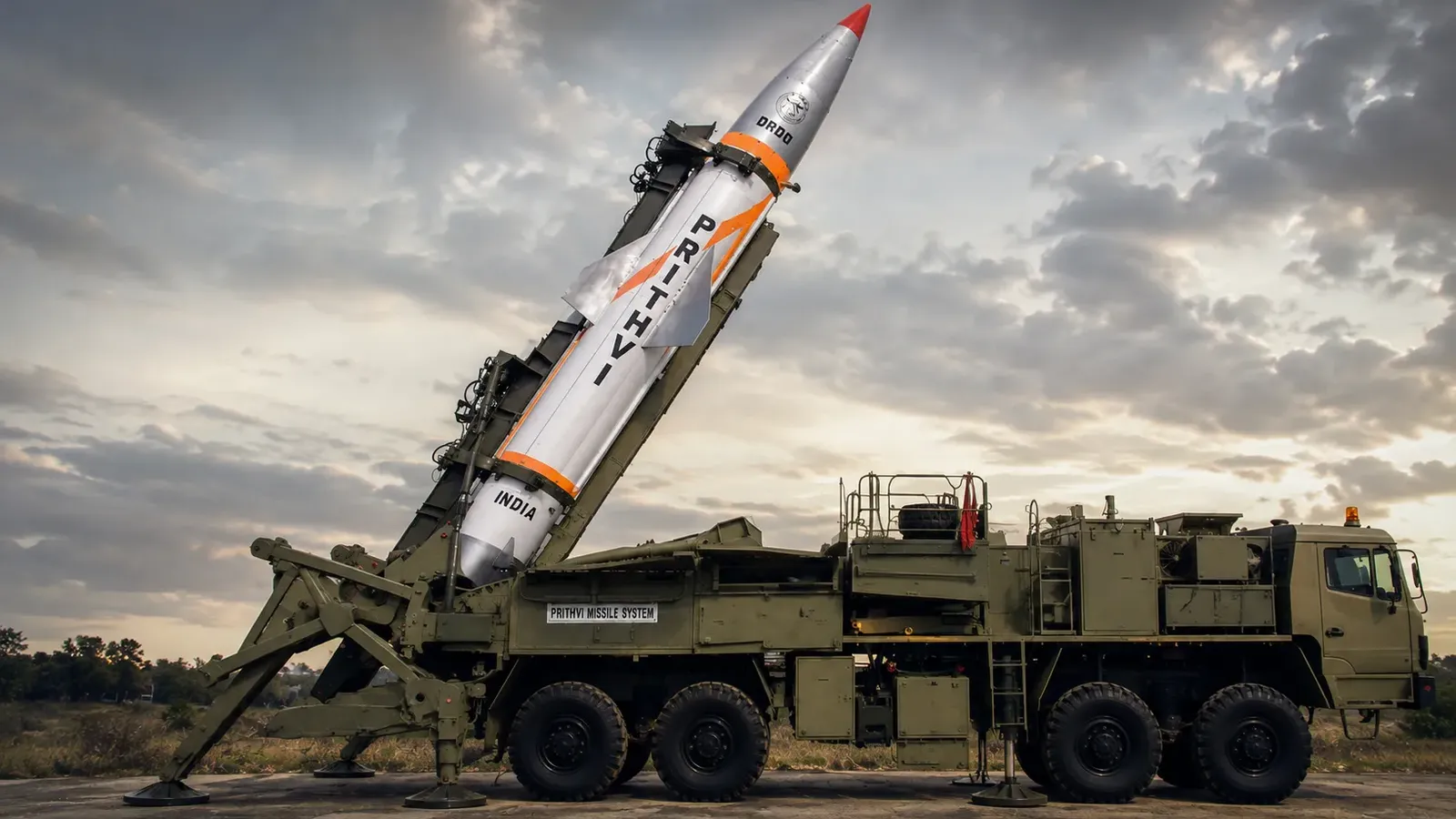
The Prithvi missile family represents the first operational branch of India's indigenous ballistic-missile programme, launched in 1983 under IGMDP. This analysis reads the family through three lenses: lineage, doctrine, and transition. The news anchor is the 17 July 2025 Prithvi-II and Agni-I launch from ITR Chandipur, conducted under Strategic Forces Command (Press Information Bureau, 17 July 2025, Release ID 2145662). It confirmed that Prithvi-II remains an active strategic system inside India's SRBM stock.
Tracing the Prithvi missile to the IGMDP
The Prithvi missile emerged from the Integrated Guided Missile Development Programme, or IGMDP, sanctioned by the Union Cabinet in 1983 under the leadership of Dr APJ Abdul Kalam. Kalam moved from the SLV-3 launch vehicle programme at ISRO to the Defence Research and Development Laboratory in Hyderabad. He took over as DRDL Director to conceive and lead the programme (Press Information Bureau, 13 August 2012).
IGMDP was structured around five missile efforts: Prithvi, Agni, Trishul, Akash and Nag. Prithvi became the programme's surface-to-surface ballistic-missile branch. Government records identify the family with 150 km, 250 km and 350 km range classes for the Army, Air Force and Navy respectively (Press Information Bureau, 27 February 2008).
DRDL Hyderabad, the lead agency, was renamed the Dr APJ Abdul Kalam Missile Complex by Defence Minister Manohar Parrikar on 15 October 2015 (Ministry of Defence, 15 October 2015). India acceded to the Missile Technology Control Regime on 27 June 2016 (Ministry of External Affairs, 27 June 2016). The MTCR accession reframed the export-control context in which the original Prithvi programme had once been a point of friction with supplier states.
The programme established an indigenous chain across propulsion, guidance, mobile launchers, telemetry and production. That industrial base later supported India's wider missile stock and the parallel unmanned work seen in the TAPAS-BH-201 and Rustom-II programme.
The Union government's 2012 parliamentary response recorded that the Prithvi series had been inducted into service (Press Information Bureau, 13 August 2012). The programme was formally declared complete on 8 January 2008 after achieving its principal development objectives. The Prithvi story therefore starts with IGMDP and extends into India's current strategic-force structure.
Mapping the three Prithvi missile variants
The Prithvi missile variants were configured around different service requirements, producing three principal branches: Prithvi-I, Prithvi-II and the naval Prithvi-III, better known as Dhanush. Later Prithvi-II training releases consistently cite a 350 km strike range (Press Information Bureau, 12 August 2013).
Variant | Primary service role | Range class | Propulsion and configuration |
|---|---|---|---|
Prithvi-I | Indian Army surface-to-surface missile | 150 km | Single-stage liquid propulsion |
Prithvi-II | Strategic Forces Command ballistic missile | 350 km in later training releases | Single-stage liquid propulsion |
Prithvi-III / Dhanush | Indian Navy ship-launched variant | 350 km class | Two-stage configuration |
Prithvi-I was first test-fired on 25 February 1988 from the Sriharikota SHAR Centre and inducted with the Indian Army in 1994. Its development established the road-mobile launcher and surface-to-surface operating concept that defined the early Prithvi architecture.
Prithvi-II became the strategic variant associated with Strategic Forces Command, with induction recorded in 2003. Repeated user-training launches from Chandipur followed (Press Information Bureau, 12 August 2013). The Prithvi-III branch produced Dhanush for naval deployment, first tested from INS Subhadra, a Sukanya-class patrol vessel, in 2000.
Bharat Dynamics Limited, a Ministry of Defence DPSU under the Department of Defence Production, became the industrial producer of the Prithvi series. That DRDO-BDL linkage built the model later applied to India's wider ballistic and cruise-missile stock. The BrahMos missile supersonic cruise system inherited the same integration pattern.
The distinction matters because the Prithvi missile range cannot be treated as one fixed specification. The family holds three service-specific platforms built from one indigenous programme.
Reading the propulsion and guidance architecture
The Prithvi missile architecture combines liquid propulsion with an inertial guidance and manoeuvring system designed for controlled ballistic flight. Prithvi-II uses a mobile Transporter Erector Launcher, allowing it to be moved and launched from a road-mobile platform (Press Information Bureau, 12 August 2013).
Guidance is a defining part of the system. Government test records describe Prithvi-II as using an indigenous high-accuracy navigation and manoeuvring system. The manoeuvring trajectory is designed to defeat anti-ballistic missile intercept attempts (Press Information Bureau, 12 August 2013).
A 2011 Ministry of Defence release reported a Prithvi-II flight test to a 350 km range. The missile reached its predefined target with accuracy better than 10 metres during that test (Press Information Bureau, 9 June 2011). That circular error probable places Prithvi-II at the high-precision end of first-generation SRBMs anywhere in the world.
As a 350 km-class short-range ballistic missile, Prithvi-II reaches supersonic velocities during its ballistic flight profile. DRDO has not publicly disclosed a specific peak velocity figure for the operational configuration.
The liquid-fuel architecture separates Prithvi from the solid-fuel systems that later assumed a larger role in India's tactical inventory. Liquid propulsion enabled the original Prithvi family, but its operational model involves a longer preparation chain than a canisterised solid-fuel missile. That readiness gap partly explains the drone versus missile cost asymmetry shaping India's newer strike architectures.
Range alone does not define a missile's operational utility. Propellant, launcher, guidance, storage and command all matter. Prithvi set the Indian baseline against which every later SRBM has been measured.
Building the induction path into service
The Prithvi missile moved from development into operational use through a sequence of testing, user trials and service induction. Prithvi-I entered Army service during the 1990s. Prithvi-II became associated with Strategic Forces Command after its 2003 induction (Press Information Bureau, 12 August 2013).
The induction process continued after formal entry into service through recurring training launches. These launches tested more than the missile itself. They exercised launch crews, command procedures, tracking systems and navigation performance, along with the wider chain required to conduct an operational launch.
The Strategic Forces Command conducted repeated Prithvi-II training launches from Chandipur. A 2013 Ministry of Defence release recorded a training exercise in which a missile was selected from SFC-held production stock. The launch validated targeting and technical parameters (Press Information Bureau, 7 October 2013).
That distinction remains relevant for India's short range ballistic missile architecture. Readiness depends on the complete kill chain: launch preparation, command authority, navigation, telemetry, tracking and post-launch assessment.
Prithvi's induction also established an Indian production pathway for strategic missiles. Bharat Dynamics Limited became associated with production of the Prithvi series, linking DRDO development work with industrial manufacturing capacity across Hyderabad and adjacent defence-industrial nodes.
Positioning Prithvi inside India's deterrence ladder
Prithvi-II occupies a specific position within India's strategic missile structure through its association with Strategic Forces Command. The SFC is responsible for India's strategic nuclear forces, making Prithvi-II different from a conventional battlefield missile developed solely for tactical employment.
The distinction between strategic role and missile range is important. A short-range ballistic missile can still form part of a strategic deterrence architecture when its assigned role, payload and command arrangements place it within that architecture.
The Prithvi-II missile has repeatedly been described by the Ministry of Defence as a nuclear-capable surface-to-surface system. Its 2003 induction into Strategic Forces Command established its place within India's strategic force structure (Press Information Bureau, 12 August 2013). India's strategic posture is governed by its stated doctrine of credible minimum deterrence and no first use.
Prithvi-II has to be understood through its assigned command structure rather than through range alone. The SFC has continued training launches of Prithvi-II alongside other ballistic-missile systems, creating a layered force in which different missile families occupy different range bands and roles.
The layered force also connects with defensive architecture on the same battlefield. India's Akashteer air-defence command network and the AI battle management in India work stack sit on the defensive side of the same doctrinal geometry. Prithvi occupies the offensive side.
The Prithvi missile developed by DRDO therefore represents more than the first indigenous SRBM. It became one component of a command-and-control structure that connects missile engineering with national strategic policy under a codified doctrine.
Transitioning from liquid-fuel Prithvi to solid-fuel successors
The Prithvi lineage is now best understood as a transition rather than a single static missile programme. Prithvi-II remains associated with Strategic Forces Command, while solid-fuel systems such as Prahaar and Pralay address parts of the tactical ballistic-missile mission space.
The transition changes the engineering model. Solid-fuel propulsion supports faster launch preparation and simplifies long-term operational handling compared with liquid-fuel systems. Canisterisation adds another layer by integrating storage, transport and launch functions into a protected launcher architecture.
Prahaar was first test-fired in 2011 as a 150 km-range solid-fuel road-mobile tactical ballistic missile. DRDO leadership publicly described Prahaar as the intended replacement for the tactical Prithvi-I in 2013. Pralay entered flight testing on 22 December 2021 with a 150 to 500 km range band (Ministry of Defence, 22 December 2021). The Defence Acquisition Council subsequently cleared an order for approximately 120 Pralay missiles for the Indian armed forces.
The generational picture across India's SRBM stock now looks like this:
Generation | Era | Representative platforms | Propulsion | Launcher | Doctrinal role |
|---|---|---|---|---|---|
First | 1988 to early 2000s | Prithvi-I, Prithvi-II, Prithvi-III / Dhanush | Liquid, single or two-stage | TEL, ship-launched | SFC nuclear-capable strike |
Second | 2011 onwards | Prahaar | Solid, single-stage | Road-mobile | Tactical conventional |
Third | 2021 onwards | Pralay | Solid, canisterised, quasi-ballistic | Road-mobile canister | Conventional battlefield strike |
Pralay also changes the doctrinal separation between strategic and conventional ballistic missiles. The system is designed around a conventional strike role, while Prithvi-II remains associated with the strategic force structure. This creates a cleaner division between nuclear-delivery and conventional-strike SRBM stock.
This does not make Prithvi obsolete. It shows how India's missile architecture moved from liquid-fuel development into solid-fuel canisterised systems. Adjacent programmes like the Bhargavastra counter-drone system and the Indian loitering-munitions programme draw on the same accumulated engineering base.
[ALT TEXT: Comparative schematic showing the Prithvi liquid-fuel design against Prahaar and Pralay solid-fuel canisterised designs across launcher, propulsion and readiness parameters.]
The transition also carries an industrial lesson. The capability developed through IGMDP now exists across propulsion, guidance, launch systems, testing and production, absorbed into India's drone and defence industrial base. Later programmes inherit that accumulated engineering base rather than starting from the original Prithvi design.
Situating the ITR Chandipur SFC validation
The 17 July 2025 launch is the clearest recent primary-source marker for the continuing Prithvi-II lineage. The Ministry of Defence reported successful test-firing of Prithvi-II and Agni-I from ITR Chandipur, Odisha, under the aegis of Strategic Forces Command (Press Information Bureau, 17 July 2025, Release ID 2145662).
The ministry stated that the launches validated all operational and technical parameters. That wording matters because the event was conducted under SFC rather than as a developmental flight-test campaign. The launches followed the same Operation Sindoor drone employment cycle by less than eight weeks. They frame the validation inside a wider post-Sindoor readiness posture across India's strategic and air-defence systems.
The launch also fits the established pattern of user-training activity associated with Prithvi-II. Earlier SFC launches from Chandipur demonstrated the system's role in maintaining operational readiness through recurring training cycles (Press Information Bureau, 12 August 2013).
For defence readers, the important signal is not another range figure, but the fact that Prithvi-II remained part of an active SFC validation cycle in July 2025. The system is not archival. It is an inducted, operationally exercised platform inside an active strategic force structure.
That signal has direct implications for how the Prithvi-II stock will coexist with Pralay through the next acquisition cycle. It also shapes how MoD sequences training launches across liquid-fuel and solid-fuel families sitting inside overlapping doctrinal roles.
Projecting the SRBM stock into the next acquisition cycle
The Prithvi missile should be treated as a living lineage with three distinct layers: indigenous missile development, strategic force employment, and transition to solid-fuel systems. That framing is more useful than a specification-only table because it explains why the family still appears in contemporary defence activity.
For procurement and defence-industry readers, the transition from Prithvi to solid-fuel successors shows where Indian missile engineering has moved. Road mobility, solid propulsion, canisterisation, digital guidance and integrated command systems now shape the next generation of missile designs.
The missile itself is not an AI system. Its relevance lies in the wider kill chain, where sensor data, navigation, mission planning, telemetry and command networks now depend on digital processing across the loop. The wider frame of AI in Indian defence modernisation and defence drones in India sits alongside this SRBM stock.
For defence-technology firms, the deeper lesson is systems integration. Prithvi connected propulsion, guidance, launch vehicles, range instrumentation and industrial production into one indigenous programme. That integration model remains the template as India builds strategic and conventional systems.
The next inflection point is the pace of Prithvi-II retention alongside Pralay induction under the Defence Acquisition Council clearance. That balance will define how India's short-range ballistic-missile architecture evolves through the next acquisition cycle. It will also test how far the IGMDP industrial base can carry India's next-generation strike systems.